Smart Electricity Meters Market Size & Growth Forecast 2027–2036, By Segments (Phase, End-use), Regional Demand Trends (North America, Asia Pacific, Europe), Key Country Insights (U.S., Japan, South Korea, Germany, France, Italy), and Competitive Landscape
Market Size and Growth Outlook
Smart Electricity Meters Market size was more than USD 16.3 billion in 2026 and is set to grow at a 7.22% CAGR between 2027 and 2036, reaching USD 32.73 billion by 2036. The industry revenue for 2027 is estimated at USD 17.29 billion.
Get more details on this report
Request Free Sample ReportSmart Electricity Meters Market Intelligence Snapshot
Regional Market Dynamics
- Asia Pacific accounted for 46.64% of the market in 2026, supported by large-scale utility deployments, grid modernization, and growing demand for accurate metering, remote monitoring, and efficient electricity management.
- North America is expected to grow at an 8.59% CAGR as utilities replace legacy meters, invest in advanced grid systems, and expand capabilities for outage detection, time-based pricing, and consumption monitoring.
Segment Momentum
- Single-phase meters held an 86.45% share in 2026 because they serve the extensive base of residential and small-user connections targeted in large-scale utility modernization programs.
- Commercial adoption is rising fastest as businesses require more accurate energy monitoring, detailed consumption tracking, and stronger energy management across higher-load operating environments.
Market Expansion Drivers
- Aging grid infrastructure modernization driving large-scale smart meter deployment programs globally.
- Regulatory mandates and utility policies accelerating advanced metering infrastructure installations.
- Integration of IoT and AI analytics improving energy monitoring and consumption optimization.
Leading Market Participants
- Major companies in the smart electricity meters market include Landis+Gyr Group AG (Switzerland), Itron, Inc. (United States), Siemens AG (Germany), Schneider Electric SE (France), ABB Ltd. (Switzerland), General Electric Company (United States), Holley Technology Ltd. (China), Iskraemeco, d.d. (Slovenia), Honeywell International Inc. (United States), Sensus USA Inc. (United States).
Global Market Forecast Snapshot
Market Outlook
- 2026 Market Size: USD 16.3 billion
- 2027 Estimated Market Size: USD 17.29 billion.
- Projected Market Size: USD 32.73 billion by 2036
- Growth Forecast: 7.22% CAGR (2027-2036)
Regional and Segment Outlook
- Leading Regional Market: Asia Pacific
- High-Growth Regional Hub: North America
- Core Revenue Segment: Single-Phase (Phase) | Residential (End-use)
- Emerging Opportunity Segment: Three-Phase (Phase) | Commercial (End-use)
Market Growth Drivers and Industry Trends
Aging grid infrastructure modernization driving large-scale smart meter deployment programs globally
Modernization of aging electricity infrastructure is encouraging utilities to upgrade conventional metering systems, and the smart electricity meters market will benefit as deployment programs become an important component of broader grid improvement initiatives. Smart meters provide utilities with more advanced measurement capabilities and support improved visibility across electricity networks, making their integration relevant to infrastructure modernization and evolving utility operational requirements.
Regulatory mandates and utility policies accelerating advanced metering infrastructure installations
Regulatory requirements and utility-led policies are encouraging faster adoption of advanced metering infrastructure, creating stronger deployment momentum in the smart electricity meters market. Utilities are increasingly incorporating smart metering into infrastructure programs where policy objectives and operational priorities support more sophisticated electricity measurement. This regulatory and institutional focus can accelerate replacement of conventional meters with digitally enabled systems.
Integration of IoT and AI analytics improving energy monitoring and consumption optimization
IoT connectivity and AI-based analytics are increasing the functional value of smart metering by enabling more detailed monitoring and analysis of electricity consumption, strengthening the smart electricity meters market. Utilities can use connected meter data to gain greater visibility into usage patterns, while analytical capabilities support more informed approaches to consumption management and energy optimization across electricity networks.
| Growth Driver | Impact on CAGR | Regulatory Influence | Geographic Relevance | Adoption Rate | Impact Timeline |
|---|---|---|---|---|---|
| Rising smart grid modernization & energy efficiency | 2.90% | Short term (≤ 2 yrs) | Asia Pacific, Europe (spillover: North America) | High | Fast |
| Government mandates for smart metering deployment | 2.60% | Medium term (2–5 yrs) | North America, Asia Pacific (spillover: Europe) | High | Moderate |
| Integration with IoT & energy analytics platforms | 2.10% | Long term (5+ yrs) | Europe, North America (spillover: Asia Pacific) | Medium | Slow |
| Aging grid infrastructure modernization driving large-scale smart meter deployment programs globally | 2.50% | High | Asia Pacific, Europe, North America | High | Near Term |
| Regulatory mandates and utility policies accelerating advanced metering infrastructure installations | 2.20% | High | Europe, North America | High | Near Term |
| Integration of IoT and AI analytics improving energy monitoring and consumption optimization | 1.70% | Moderate | Asia Pacific, North America | Emerging | Mid Term |
Explore Growth Opportunities
Request Free Sample ReportRegional Demand Dynamics
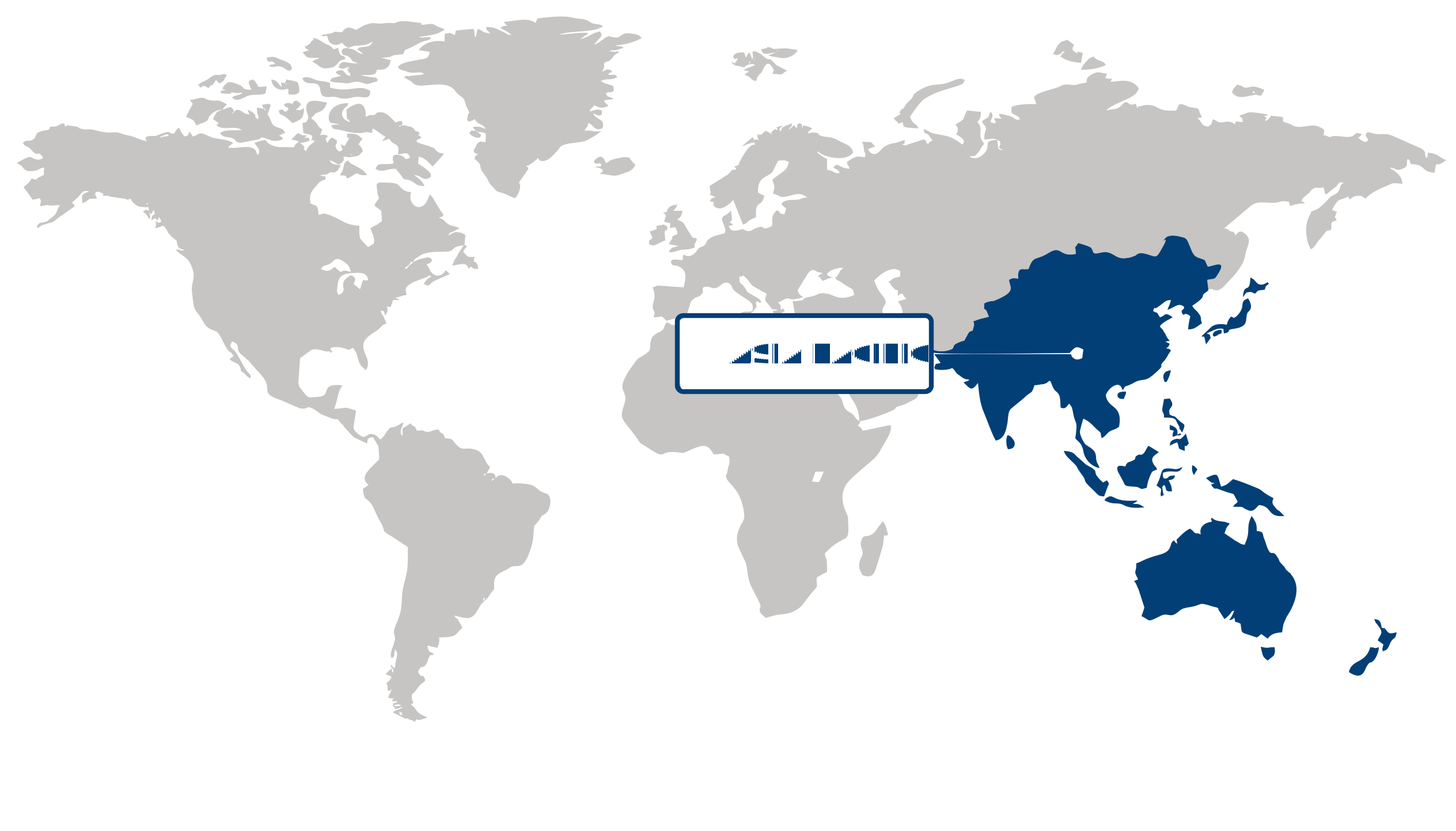
Asia Pacific (Largest Region)
The smart electricity meters market was led by Asia Pacific, which accounted for 46.64% of the market in 2026. Regional dominance is supported by rapid urbanization, expanding electricity networks, and large-scale efforts to modernize power distribution infrastructure. Utilities are increasingly adopting advanced metering to improve consumption monitoring, support automated billing, reduce non-technical losses, and strengthen grid management. Growing integration of renewable energy and distributed power resources is also increasing the need for more responsive electricity networks, encouraging investment in digital metering infrastructure across the region.
North America (Fastest-Growing Region)
North America represents the fastest-growing region as utilities accelerate grid modernization and deploy digital technologies to improve network visibility and customer engagement. Smart meters enable more accurate consumption tracking, demand management, outage detection, and integration of distributed energy resources, making them increasingly important to modern electricity systems. The expansion of renewable generation, growing interest in energy efficiency, and investments in resilient and digitally connected grids are creating favorable conditions for continued adoption.
| Parameter | North America | Asia Pacific | Europe | Latin America | MEA |
|---|---|---|---|---|---|
| Innovation Hub i Scale Nascent Developing Advanced | |||||
| Cost-Sensitive Region i Scale Low Medium High | |||||
| Regulatory Environment i Scale Restrictive Neutral Supportive | |||||
| Demand Drivers i Scale Weak Moderate Strong | |||||
| Development Stage i Scale Emerging Developing Developed | |||||
| Adoption Rate i Scale Low Medium High | |||||
| New Entrants / Startups i Scale Sparse Moderate Dense | |||||
| Macro Indicators i Scale Weak Stable Strong |
Key Country Insights
Germany 🇩🇪
Energy Transition SupportGermany is expanding smart electricity meter deployment to improve energy efficiency and accommodate decentralized renewable generation. Utilities are emphasizing secure communication systems and standardized metering platforms that strengthen grid management and regulatory compliance.
France 🇫🇷
Consumer Energy ManagementFrance is strengthening smart electricity meter utilization to improve electricity distribution efficiency and customer energy awareness. Energy providers are expanding digital metering capabilities that enable remote services, consumption analytics, and better integration of renewable electricity.
Italy 🇮🇹
Distribution Network ModernizationItaly continues upgrading electricity distribution networks with smart metering technologies that improve billing accuracy and operational visibility. Italian utilities are enhancing digital infrastructure to support flexible energy management and faster service response.
Japan 🇯🇵
Smart Utility IntegrationJapan continues integrating smart electricity meters into advanced utility networks to improve energy optimization and disaster resilience. Japanese utilities are investing in data-driven metering platforms that enhance operational planning and customer energy management services.
South Korea 🇰🇷
Intelligent Grid DeploymentSouth Korea is accelerating smart electricity meter adoption as part of broader smart grid and digital infrastructure initiatives. Utilities are deploying connected metering systems that support dynamic energy management, remote monitoring, and efficient network operations.
United States 🇺🇸
Grid Digitalization FocusThe U.S. smart electricity meters market is advancing through utility modernization programs that improve grid visibility and demand response capabilities. Utilities are prioritizing interoperable metering infrastructure that supports outage management, distributed energy integration, and real-time consumption monitoring.
Segment Leadership and Growth Trends
Smart Electricity Meters Market Share (%), by Phase, 2026
Go beyond the chart, access full insights & data tables
Request Free Sample ReportPhase Segment Analysis: Single-Phase (Largest Segment) vs Three-Phase (Fastest-Growing Segment)
The single-phase segment dominated the smart electricity meters market in 2026, accounting for the largest share due to its extensive use across residential electricity connections and smaller power-consuming applications. The widespread deployment of smart metering in households is supported by utilities' efforts to improve consumption monitoring, automate meter reading, strengthen billing accuracy, and enable more efficient electricity management. Growing consumer awareness of energy usage also reinforces demand for connected single-phase metering solutions.
Three-phase smart electricity meters are advancing at the fastest pace as commercial facilities, industrial users, and other higher-load applications increasingly require more sophisticated electricity monitoring. These meters support accurate measurement across multiple phases and enable utilities and customers to obtain better visibility into power consumption and system performance. The expansion of commercial and industrial electrification, alongside broader grid modernization initiatives, is creating favorable conditions for increased adoption of three-phase smart metering.
End-use Segment Analysis: Residential (Largest Segment) vs Commercial (Fastest-Growing Segment)
Residential applications led the smart electricity meters market in 2026, reflecting the extensive deployment of smart meters across households as utilities modernize distribution networks and transition toward more automated energy management. Smart meters provide consumers and utility providers with improved visibility into electricity consumption, supporting accurate billing, remote monitoring, and demand-management initiatives. The increasing focus on energy conservation and digital utility services further strengthens residential adoption.
Commercial applications are the fastest-growing end-use segment as businesses increasingly seek detailed electricity monitoring and improved control over energy consumption. Smart metering enables commercial facilities to identify consumption patterns, manage operational energy use, and support efficiency initiatives while providing utilities with more responsive demand information. The broader adoption of digital energy-management practices across commercial establishments is consequently accelerating the integration of smart electricity meters.
| Segment | Sub-Segment | Largest Segment | Fastest Growing |
|---|---|---|---|
| Phase | Single-Phase, Three-Phase | Single-Phase | Three-Phase |
| End-use | Residential, Commercial, Industrial | Residential | Commercial |
Unlock insights tailored to your business with our bespoke market research solutions.
Click to get your customized report now.
Competitive Landscape and Market Positioning
Top players in the smart electricity meters market:
1. Landis+Gyr Group AG (Switzerland)
2. Itron Inc. (United States)
3. Siemens AG (Germany)
4. Schneider Electric SE (France)
5. ABB Ltd. (Switzerland)
6. General Electric Company (United States)
7. Holley Technology Ltd. (China)
8. Iskraemeco d.d. (Slovenia)
9. Honeywell International Inc. (United States)
10. Sensus USA Inc. (United States)
In the smart electricity meters market, digital grid transformation is accelerating deployment of connected metering systems. Real-time energy monitoring is improving consumption transparency and utility efficiency. The smart electricity meters market is also influenced by evolving regulatory frameworks promoting smart infrastructure adoption. Advanced metering solutions are enhancing grid responsiveness and data accuracy.
| Company | Market Share | Company Revenue | Revenue CAGR (%) | Product Portfolio | Geographic Presence | Innovation / R&D Focus | Strategic Developments |
|---|---|---|---|---|---|---|---|
| Landis+Gyr Group AG (Switzerland) | |||||||
| Itron Inc. (United States) | |||||||
| Siemens AG (Germany) | |||||||
| Schneider Electric SE (France) | |||||||
| ABB Ltd. (Switzerland) | |||||||
| General Electric Company (United States) | |||||||
| Holley Technology Ltd. (China) | |||||||
| Iskraemeco d.d. (Slovenia) | |||||||
| Honeywell International Inc. (United States) | |||||||
| Sensus USA Inc. (United States). |
Industry Development/News
| Company Name | Date | Key Development |
|---|---|---|
| Wirepas | Dec-25 | Wirepas and Polaris Smart Metering announced an expansion of their strategic partnership, targeting the deployment of 5 million additional smart electricity meters. This initiative focuses on scaling national grid connectivity through advanced mesh networking, directly supporting utility efforts to modernize infrastructure and improve real-time energy management capabilities across India. |
| Polaris Smart Metering | Nov-25 | Polaris Smart Metering initiated a major rollout targeting 10 million smart electricity meters in India. This project is central to the national Revamped Distribution Sector Scheme (RDSS), aimed at minimizing financial leakage from power theft, enhancing grid reliability, and enabling demand-side management to support the integration of renewable energy sources. |
| Kahramaa | Jul-25 | Qatar’s Kahramaa reported the successful installation of over 988,000 smart electricity and water meters. This milestone in the national smart metering project facilitates automated billing and remote monitoring, significantly improving operational efficiency and supporting Qatar’s long-term environmental sustainability and utility modernization goals under the Qatar National Vision 2030 framework. |
| Itron Inc | Feb-23 | Itron Inc expanded its strategic collaboration with Smart Energy Water (SEW) to integrate cloud-based consumer engagement solutions with its Distributed Intelligence (DI) platform. By leveraging high-resolution metering data, the partnership empowers utilities to provide customers with actionable energy usage insights, facilitating improved demand response and greater participation in energy efficiency programs. |
Customize Your Report
Explore examples of how this report can be tailored to different research needs, including custom segments, additional topics or chapters, and related reports. Click a section of the wheel or its numbered marker to explore the available options.
Smart Electricity Meters Market — Custom Segments
| Segment | Sub-Segment |
|---|---|
| Communication Technology | Cellular, RF Mesh, Power Line Communication, Wi-Fi |
| Ownership Model | Utility-Owned, Consumer-Owned, Third-Party-Owned |
| Utility Type | Electric Utilities, Municipal Utilities, Cooperative Utilities, Private Utilities |
Smart Electricity Meters Market — Custom TOC
| Custom Chapter | Custom Details |
|---|---|
| Utility Deployment and Grid Modernization Strategies |
|
| Advanced Metering Infrastructure Ecosystem |
|
| Smart Meter Data Security and Privacy Framework |
|
Need a different cut of the data?
Request Custom ResearchWhat is the market size of smart electricity meters?
How is the smart electricity meters industry expected to grow over the next 10 years?
How is grid modernization influencing large-scale deployment of smart electricity meters?
How are IoT integration and AI analytics changing utility demand for smart electricity meters?
Why are single-phase smart electricity meters the largest market segment?
Why is the commercial end-use segment growing the fastest?
Why is Asia Pacific the leading market for smart electricity meters?
What is fueling smart electricity meter market growth in North America?
Which organizations are considered leaders in the smart electricity meters landscape?
Our Clients
"The information presented in the report was genuinely insightful. The data was clear and easy to understand, which made it much easier to interpret the findings."
Amara Raja Group
"The responsiveness and professionalism exhibited by the team were exemplary. They were readily available to address queries, provide clarifications, and offer additional insights."
ONGC
"The reports offered a comprehensive analysis of various segments within the market. The detailed insights into market trends, and regulatory landscapes were excellent."
TotalEnergies
Our Research Team & Methodology
Every Fundamental Business Insights report is built by a dedicated vertical research team, validated through a structured primary-and-secondary methodology, and reviewed for accuracy before it reaches you.
Research Team Overview
Prepared by the Energy & Power Research Team
Delivery
Published
Demand
Available
Support
Trust & Compliance
Research Intelligence
Research Workflow & Quality Assurance
Data Collection
Verified information gathered through primary and secondary research.
Data Triangulation
Cross-validation using multiple independent data sources.
Forecast Modelling
Market estimates developed using historical trends and analytical models.
Analyst Validation
Findings reviewed by domain experts for accuracy and consistency.
Editorial & Quality Review
Final editorial, quality, and compliance checks before publication.
Final Publication
Released after successful completion of the internal review process.
Report Coverage
📊 Market Assessment
- Market Size & Forecast
- Market Segmentation
- Regional Analysis
- Growth Drivers & Challenges
- Market Dynamics
🏢 Competitive Intelligence
- Competitive Landscape
- Company Profiles
- Competitive Benchmarking
- Mergers & Acquisitions
- Market Share Analysis or Key Company Strategies
🔍 Strategic Analysis
- Value Chain Analysis
- Porter's Five Forces
- PESTLE Analysis
- Pricing Trends
- Supply-Demand Analysis
🚀 Future Outlook
- Technology Landscape
- Regulatory Landscape
- Investment & Funding Landscape
- Emerging Opportunities
- Future Market Outlook
Have a question about this report or need a custom scope?
Request Customization