Semiconductor Chemicals Market Size & Growth Forecast 2027–2036, By Segments (End-use, Type), Regional Demand Trends (North America, Asia Pacific, Europe), Key Country Insights (U.S., Japan, South Korea, Germany, France, Italy), and Competitive Landscape
Market Size and Growth Outlook
Semiconductor Chemicals Market size was estimated at USD 17.4 billion in 2026 and is projected to grow at a 11.4% CAGR from 2027 to 2036, surpassing USD 51.22 billion by 2036. The industry revenue for 2027 is assessed at USD 19.07 billion.
Get more details on this report
Request Free Sample ReportSemiconductor Chemicals Market Intelligence Snapshot
Regional Market Dynamics
- Asia Pacific accounted for 60.14% of the market in 2026, supported by concentrated semiconductor fabrication capacity, high wafer production volumes, and closely integrated chemical supply networks.
- North America is projected to grow at a 13.22% CAGR as investments in semiconductor manufacturing and advanced process technologies increase demand for high-purity process chemicals.
Segment Momentum
- Integrated circuits held a 76.29% market share in 2026 because fabrication repeatedly consumes high-purity chemicals across cleaning, etching, deposition, and wafer finishing, sustaining strong demand.
- High-performance polymers are expanding fastest because advanced semiconductor manufacturing increasingly requires materials with superior thermal stability, chemical resistance, and precision for complex device structures and tighter process tolerances.
Market Expansion Drivers
- Rapid semiconductor fabrication expansion driven by AI, EV, and high-performance computing demand surge.
- Semiconductor manufacturing reshoring and localized supply chain development boosting chemical consumption.
- Advanced node scaling and EUV lithography increasing ultra-high purity chemical requirements in fabs.
Leading Market Participants
- Top players in the semiconductor chemicals market include BASF SE (Germany), FUJIFILM Corporation (Japan), Honeywell International Inc. (United States), Linde plc (United Kingdom), Entegris, Inc. (United States), Solvay S.A. (Belgium), Eastman Chemical Company (United States), SK Inc. (South Korea), Avantor, Inc. (United States), Tokyo Ohka Kogyo Co., Ltd. (Japan).
Global Market Forecast Snapshot
Market Outlook
- 2026 Market Size: USD 17.4 billion
- 2027 Estimated Market Size: USD 19.07 billion.
- Projected Market Size: USD 51.22 billion by 2036
- Growth Forecast: 11.4% CAGR (2027-2036)
Regional and Segment Outlook
- Leading Regional Market: Asia Pacific
- High-Growth Regional Hub: North America
- Core Revenue Segment: Integrated Circuits (End-use) | Acid & Base Chemicals (Type)
- Emerging Opportunity Segment: Optoelectronics (End-use) | High-performance Polymers (Type)
Market Growth Drivers and Industry Trends
Rapid semiconductor fabrication expansion driven by AI, EV, and high-performance computing demand surge
Strong demand for AI systems, electric vehicles, and high-performance computing is encouraging semiconductor manufacturers to expand fabrication capacity, directly increasing the consumption of specialized process materials in the semiconductor chemicals market. Modern chip production requires a broad range of chemicals for wafer cleaning, etching, deposition, lithography, doping, and other fabrication stages, making chemical consumption closely connected with manufacturing activity. As semiconductor architectures become more complex and processing requirements intensify, fabrication facilities require consistent supplies of materials capable of supporting precise and repeatable processes. Expansion across application areas such as advanced computing and automotive electronics is therefore creating additional requirements throughout the semiconductor manufacturing ecosystem.
Semiconductor manufacturing reshoring and localized supply chain development boosting chemical consumption
The movement toward geographically diversified semiconductor production is strengthening local manufacturing ecosystems and will drive the semiconductor chemicals market by creating demand for dependable regional supplies of critical fabrication materials. New and expanded fabs require supporting chemical infrastructure, including storage, purification, distribution, and handling capabilities, to maintain continuous production. Localized sourcing can also help manufacturers reduce exposure to international logistics disruptions and improve supply continuity for materials that are essential to wafer processing. As more semiconductor production capacity is established closer to key end-use and technology markets, chemical suppliers gain opportunities to develop regional distribution and production networks aligned with fab requirements.
Advanced node scaling and EUV lithography increasing ultra-high purity chemical requirements in fabs
The progression toward smaller semiconductor process nodes is raising the importance of extremely controlled manufacturing environments, supporting demand in the semiconductor chemicals market for ultra-high-purity materials. Advanced fabrication processes have increasingly narrow tolerances, meaning trace levels of impurities in process chemicals can interfere with wafer quality, yield, and device performance. EUV lithography and other advanced manufacturing techniques consequently require chemicals with stringent purity and consistency characteristics across processes such as wafer preparation, patterning, cleaning, and etching. Greater process complexity also increases the need for tightly controlled chemical formulation and delivery systems within fabrication facilities to maintain stable production conditions.
| Growth Driver | Impact on CAGR | Regulatory Influence | Geographic Relevance | Adoption Rate | Impact Timeline |
|---|---|---|---|---|---|
| Rapid semiconductor fabrication expansion driven by AI, EV, and high-performance computing demand surge | 2.10% | High | Asia Pacific, North America | High | Near Term |
| Semiconductor manufacturing reshoring and localized supply chain development boosting chemical consumption | 1.80% | Moderate | North America, Europe | High | Mid Term |
| Advanced node scaling and EUV lithography increasing ultra-high purity chemical requirements in fabs | 1.60% | High | Asia Pacific | Emerging | Long Term |
Unlock insights tailored to your business with our bespoke market research solutions.
Click to get your customized report now.
Regional Demand Dynamics
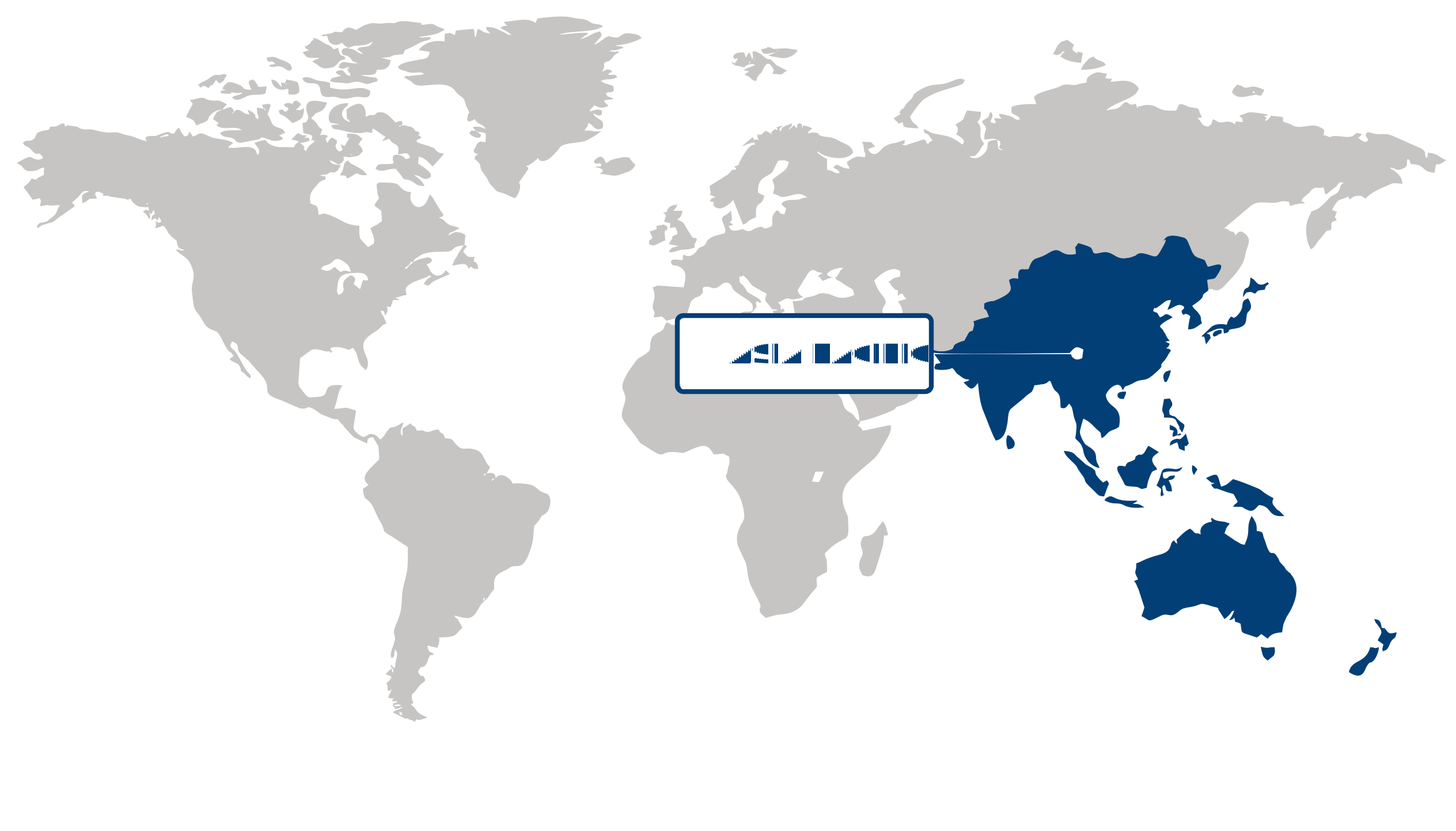
Asia Pacific (Largest Region)
Asia Pacific dominated the semiconductor chemicals market with a 60.14% share in 2026, underpinned by the region's highly concentrated semiconductor manufacturing ecosystem and extensive fabrication capacity. The production of advanced chips requires a broad range of specialized chemicals for processes including wafer cleaning, etching, deposition, lithography, and surface treatment, creating sustained demand throughout the semiconductor manufacturing chain. Strong investments in fabrication facilities, packaging capabilities, and supporting industrial infrastructure continue to reinforce the region's position. The presence of established electronics manufacturing clusters also provides an integrated customer base for chemical suppliers, while increasing requirements for process precision and contamination control are encouraging the adoption of increasingly specialized and high-purity materials.
North America (Fastest-Growing Region)
North America is positioned as the fastest-growing regional market as semiconductor manufacturing capacity expands and governments and industry stakeholders place greater emphasis on strengthening domestic chip supply chains. New fabrication and advanced manufacturing initiatives are increasing requirements for high-purity process chemicals and specialized materials used throughout semiconductor production. The region's strong research and development capabilities are also supporting innovation in advanced materials, process chemistry, and manufacturing techniques. Greater focus on supply-chain resilience is encouraging localized sourcing and investment across the semiconductor ecosystem, creating additional opportunities for chemical producers and infrastructure providers. At the same time, demand for increasingly sophisticated chips in computing, artificial intelligence, communications, and other technology applications is supporting broader expansion of semiconductor-related chemical consumption.
| Parameter | North America | Asia Pacific | Europe | Latin America | MEA |
|---|---|---|---|---|---|
| Innovation Hub i Scale Nascent Developing Advanced | |||||
| Cost-Sensitive Region i Scale Low Medium High | |||||
| Regulatory Environment i Scale Restrictive Neutral Supportive | |||||
| Demand Drivers i Scale Weak Moderate Strong | |||||
| Development Stage i Scale Emerging Developing Developed | |||||
| Adoption Rate i Scale Low Medium High | |||||
| New Entrants / Startups i Scale Sparse Moderate Dense | |||||
| Macro Indicators i Scale Weak Stable Strong |
Key Country Insights
Germany 🇩🇪
Precision Manufacturing SupportGermany relies on semiconductor chemicals for specialty chip production serving automotive and industrial electronics. German facilities emphasize consistent material quality, process stability, and close collaboration between chemical suppliers and semiconductor manufacturers.
France 🇫🇷
Specialty Materials CollaborationFrance supports semiconductor chemical demand through research-driven electronics manufacturing and specialty material development. French companies increasingly seek high-performance process chemicals that enhance manufacturing precision and align with European semiconductor initiatives.
Italy 🇮🇹
Electronics Supply IntegrationItaly utilizes semiconductor chemicals across specialty electronics manufacturing and semiconductor-related supply chains. Italian manufacturers emphasize reliable sourcing, regulatory compliance, and chemical formulations that support precision production environments.
Japan 🇯🇵
High-Purity Chemical ExpertiseJapan maintains strong demand for semiconductor chemicals through its established specialty materials ecosystem. Japanese producers focus on developing ultra-pure formulations that enable reliable wafer processing and advanced semiconductor manufacturing requirements.
South Korea 🇰🇷
Memory Production AlignmentSouth Korea's semiconductor chemicals market is closely linked with high-volume memory manufacturing and advanced fabrication facilities. South Korean buyers prioritize dependable chemical supply, contamination control, and materials tailored for increasingly sophisticated production processes.
United States 🇺🇸
Advanced Process MaterialsThe U.S. semiconductor chemicals market benefits from expanding domestic chip manufacturing and advanced fabrication investments. U.S. manufacturers prioritize ultra-high-purity chemicals that support complex process nodes, yield improvement, and supply chain resilience.
Segment Leadership and Growth Trends
Semiconductor Chemicals Market Share (%), by End-use, 2026
Go beyond the chart, access full insights & data tables
Request Free Sample ReportEnd-use Segment Analysis: Integrated Circuits (Largest Segment) vs Optoelectronics (Fastest-Growing Segment)
Integrated circuits segment dominated the semiconductor chemicals market with a 76.29% share in 2026, reflecting the extensive consumption of specialized chemicals throughout semiconductor fabrication processes. The segment benefits from sustained demand for advanced integrated circuits across computing, consumer electronics, automotive systems, telecommunications, and industrial applications. As chip manufacturing becomes increasingly sophisticated, semiconductor producers require high-purity acids, bases, solvents, cleaning agents, and other process chemicals to support wafer preparation, etching, deposition, and surface treatment. Continued semiconductor miniaturization and the growing complexity of chip architectures further reinforce chemical consumption within integrated circuit manufacturing.
Optoelectronics is emerging as the fastest-growing end-use segment, supported by expanding demand for components that enable optical communication, sensing, imaging, and high-speed data transmission. The broader shift toward fiber-based connectivity, advanced sensing technologies, autonomous systems, and data-intensive applications is increasing the need for specialized semiconductor materials and processing solutions. Rising adoption of optoelectronic devices across telecommunications, automotive, healthcare, and industrial electronics is also encouraging manufacturers to enhance production capabilities, creating additional opportunities for semiconductor chemical suppliers serving this evolving application area.
Type Segment Analysis: Acid & Base Chemicals (Largest Segment) vs High-performance Polymers (Fastest-Growing Segment)
Acid & base chemicals accounted for the largest share of the semiconductor chemicals market, representing 41.23% in 2026, owing to their essential role in core semiconductor manufacturing and wafer-processing operations. These chemicals are widely used for cleaning, etching, surface preparation, and other critical fabrication stages where stringent purity and process consistency are required. The expansion of semiconductor production and increasing emphasis on manufacturing precision continue to support demand for high-quality chemical inputs. Growing process complexity also makes contamination control and chemical performance increasingly important, reinforcing the established position of acid and base formulations within semiconductor fabrication.
High-performance polymers represent the fastest-growing type segment as semiconductor manufacturers increasingly require advanced materials capable of meeting demanding thermal, chemical, and mechanical performance requirements. Their use is being supported by the development of smaller, more complex, and higher-performance semiconductor components, where conventional materials may face limitations under increasingly demanding processing conditions. The expansion of advanced packaging, miniaturized electronics, and next-generation semiconductor applications is encouraging greater adoption of specialized polymer materials, creating stronger growth opportunities for suppliers with solutions tailored to sophisticated fabrication and packaging requirements.
| Segment | Sub-Segment | Largest Segment | Fastest Growing |
|---|---|---|---|
| End-use | Integrated Circuits, Discrete Semiconductor, Optoelectronics, Sensors | Integrated Circuits | Optoelectronics |
| Type | High-performance Polymers, Acid & Base Chemicals, Adhesives, Solvents, Others | Acid & Base Chemicals | High-performance Polymers |
Competitive Landscape and Market Positioning
Major players in the semiconductor chemicals market:
1. BASF SE (Germany)
2. FUJIFILM Corporation (Japan)
3. Honeywell International Inc. (United States)
4. Linde plc (United Kingdom)
5. Entegris Inc. (United States)
6. Solvay S.A. (Belgium)
7. Eastman Chemical Company (United States)
8. SK Inc. (South Korea)
9. Avantor Inc. (United States)
10. Tokyo Ohka Kogyo Co. Ltd. (Japan)
The semiconductor chemicals market is evolving due to increasing chip manufacturing complexity. High-purity chemical formulations are improving fabrication quality. Continuous innovation is supporting advanced node production. The semiconductor chemicals market is critical to next-generation electronics manufacturing.
| Company | Market Share | Company Revenue | Revenue CAGR (%) | Product Portfolio | Geographic Presence | Innovation / R&D Focus | Strategic Developments |
|---|---|---|---|---|---|---|---|
| BASF SE (Germany) | |||||||
| FUJIFILM Corporation (Japan) | |||||||
| Honeywell International Inc. (United States) | |||||||
| Linde plc (United Kingdom) | |||||||
| Entegris Inc. (United States) | |||||||
| Solvay S.A. (Belgium) | |||||||
| Eastman Chemical Company (United States) | |||||||
| SK Inc. (South Korea) | |||||||
| Avantor Inc. (United States) | |||||||
| Tokyo Ohka Kogyo Co. Ltd. (Japan). |
Industry Development/News
| Company Name | Date | Key Development |
|---|---|---|
| FUJIFILM | Nov-25 | FUJIFILM completed a new development and evaluation facility at its Shizuoka factory to accelerate the innovation of advanced semiconductor materials. The site focuses on the R&D of next-generation photoresists and specialized process chemicals, strengthening the company's ability to support the rigorous material requirements of advanced chip fabrication technologies. |
| BASF | Oct-25 | BASF is constructing an electronic-grade ammonium hydroxide plant in Ludwigshafen, Germany, to bolster supply chain resilience for European semiconductor manufacturers. This investment provides critical chemical inputs for wafer cleaning and etching processes, directly supporting the increasing demand for high-purity materials in regional advanced chip production. |
| Shinkong Synthetic Fibers | May-25 | Shinkong Synthetic Fibers is expanding into the semiconductor chemical sector by adding production lines for electronic-grade hydrogen peroxide. Leveraging its expertise in heat-resistant materials, the company aims to integrate into AI-linked supply chains, marking a strategic pivot toward high-value advanced materials to mitigate risks associated with raw material volatility. |
| Tokuyama Corporation | May-25 | Tokuyama Corporation, via a joint initiative with Formosa, is constructing a second high-purity isopropyl alcohol (IPA) facility in Taiwan. This capacity expansion is designed to meet the intensifying demand for ultra-high-purity solvents required in advanced electronic manufacturing processes, solidifying the company's competitive standing in the regional semiconductor chemical ecosystem. |
| Lotte Chemical | Apr-25 | Lotte Chemical is executing a portfolio restructuring to reduce its reliance on basic chemicals, aiming to shift more than 60% of its business toward specialty and advanced materials. This strategic transition prioritizes high-value semiconductor-related chemicals as a primary growth driver to enhance operational resilience and capitalize on technology-driven market trends. |
| LCY Chemical | Apr-25 | LCY Chemical is accelerating its transition into electronic materials, achieving a 26% CAGR in its advanced semiconductor segment. Following a supplier award from TSMC, the company is scaling its portfolio and chemical recycling capabilities to support next-generation semiconductor, AI, and display applications, enhancing its role as a key player in the advanced materials supply chain. |
| Tata Electronics | Apr-25 | Tata Electronics is negotiating a potentially exclusive long-term supply agreement with Merck for specialty semiconductor chemicals. The collaboration aims to secure a stable pipeline of critical materials for its Dholera fabrication facility, which is essential for scaling domestic production and strengthening the broader semiconductor manufacturing ecosystem in India. |
| Evonik Industries | Mar-25 | Evonik Industries has commenced production of high-purity colloidal silica at its Michigan facility to increase semiconductor materials output. This expansion targets the growing need for ultra-pure inputs in advanced wafer manufacturing, reinforcing the company’s ability to provide high-value, critical chemicals for chip fabrication processes in North America. |
| Mitsubishi Gas Chemical Company | Mar-25 | Mitsubishi Gas Chemical is expanding its Texas production footprint through MGC Pure Chemicals America to boost capacity for ultra-pure semiconductor chemicals. The investment addresses rising North American demand for high-performance process materials, enabling the company to better support the specialized chemical needs of advanced semiconductor fabrication facilities. |
| Tokyo Ohka Kogyo | Mar-25 | Tokyo Ohka Kogyo (TOK) is scaling production of its advanced photoresist portfolio, including EUV and ArF products, in response to surging AI-driven demand. The company is strategically positioned to capture increased market share as high-performance computing and AI chip requirements necessitate more sophisticated chemical solutions for semiconductor patterning and fabrication. |
Customize Your Report
Explore examples of how this report can be tailored to different research needs, including custom segments, additional topics or chapters, and related reports. Click a section of the wheel or its numbered marker to explore the available options.
Semiconductor Chemicals Market — Custom Segments
| Segment | Sub-Segment |
|---|---|
| Semiconductor Manufacturing Process | Wafer Cleaning, Etching, Deposition, Lithography, Planarization |
| Wafer Size | 150 mm Wafers, 200 mm Wafers, 300 mm Wafers |
| Semiconductor Node Technology | Mature Nodes, Advanced Nodes, Leading-Edge Nodes |
Semiconductor Chemicals Market — Custom TOC
| Custom Chapter | Custom Details |
|---|---|
| Semiconductor Fab Capacity and Chemical Demand Mapping |
|
| Geopolitical Supply Chain Risk Assessment |
|
| Localization and Domestic Sourcing Opportunities |
|
Need a different cut of the data?
Request Custom ResearchHow much revenue does the semiconductor chemicals market generate?
What are the growth projections for the semiconductor chemicals industry?
How is rapid expansion in semiconductor fabrication capacity affecting chemical consumption across production workflows?
How are advanced node scaling and EUV lithography influencing chemical purity requirements in semiconductor manufacturing?
Why do integrated circuits account for the largest share of the semiconductor chemicals market?
What is driving the rapid growth of high-performance polymers in the semiconductor chemicals market?
Why does Asia Pacific lead the semiconductor chemicals market?
What is driving the semiconductor chemicals market in North America?
What are the prominent companies operating in the semiconductor chemicals landscape?
Our Clients
"Working with FBI has been a good experience. The market report provided a holistic view, covering everything from emerging trends to potential risks."
Semtech Corporation
"The experience was highly positive. The team showcased remarkable flexibility in adapting to our specific needs and delivered report that perfectly aligned with all our requirements."
TSMC
"What really stood out to me was how clearly and promptly the Fundamental Business Insights team communicated throughout. It made the collaboration feel effortless."
NXP Semiconductors
Our Research Team & Methodology
Every Fundamental Business Insights report is built by a dedicated vertical research team, validated through a structured primary-and-secondary methodology, and reviewed for accuracy before it reaches you.
Research Team Overview
Prepared by the Electronics & Semiconductors Research Team
Delivery
Published
Demand
Available
Support
Trust & Compliance
Research Domains
10 coverage areasResearch Intelligence
| Source | Reference |
|---|---|
| Semiconductor Industry Association (SIA) | www.semiconductors.org |
| SEMI | www.semi.org |
| JEDEC Solid State Technology Association | www.jedec.org |
| IEEE | www.ieee.org |
| IPC – Association Connecting Electronics Industries | www.ipc.org |
| International Electrotechnical Commission (IEC) | www.iec.ch |
| International Organization for Standardization (ISO) | www.iso.org |
| U.S. Bureau of Industry and Security (BIS) | www.bis.gov |
| U.S. Patent and Trademark Office (USPTO) | www.uspto.gov |
| European Patent Office (EPO) | www.epo.org |
| Taiwan Semiconductor Industry Association (TSIA) | www.tsia.org.tw |
| World Semiconductor Trade Statistics (WSTS) | www.wsts.org |
| International Energy Agency (IEA) | www.iea.org |
| GSMA | www.gsma.com |
| 3GPP | www.3gpp.org |
| ITU (International Telecommunication Union) | www.itu.int |
| Omdia (public insights) | omdia.tech.informa.com |
| Display Supply Chain Consultants (DSCC) | www.displaysupplychain.com |
| U.S. Department of Energy (DOE) | www.energy.gov |
| NIST (National Institute of Standards and Technology) | www.nist.gov |
Research Workflow & Quality Assurance
Data Collection
Verified information gathered through primary and secondary research.
Data Triangulation
Cross-validation using multiple independent data sources.
Forecast Modelling
Market estimates developed using historical trends and analytical models.
Analyst Validation
Findings reviewed by domain experts for accuracy and consistency.
Editorial & Quality Review
Final editorial, quality, and compliance checks before publication.
Final Publication
Released after successful completion of the internal review process.
Report Coverage
📊 Market Assessment
- Market Size & Forecast
- Market Segmentation
- Regional Analysis
- Growth Drivers & Challenges
- Market Dynamics
🏢 Competitive Intelligence
- Competitive Landscape
- Company Profiles
- Competitive Benchmarking
- Mergers & Acquisitions
- Market Share Analysis or Key Company Strategies
🔍 Strategic Analysis
- Value Chain Analysis
- Porter's Five Forces
- PESTLE Analysis
- Pricing Trends
- Supply-Demand Analysis
🚀 Future Outlook
- Technology Landscape
- Regulatory Landscape
- Investment & Funding Landscape
- Emerging Opportunities
- Future Market Outlook
Have a question about this report or need a custom scope?
Request Customization