Sea Salt Market Size & Growth Forecast 2027–2036, By Segments (Distribution Channel, Product, Application), Regional Demand Trends (North America, Asia Pacific, Europe), Key Country Insights (U.S., Japan, South Korea, Germany, France, Italy), and Competitive Landscape
Market Size and Growth Outlook
Sea Salt Market size was around USD 20.41 billion in 2026 and is slated to grow at a 2.97% CAGR from 2027 to 2036, crossing USD 27.35 billion by 2036. The industry revenue for 2027 is estimated at USD 20.98 billion.
Get more details on this report
Request Free Sample ReportSea Salt Market Intelligence Snapshot
Regional Market Dynamics
- Asia Pacific led the sea salt market in 2026 and is forecast to grow at a 3.76% CAGR, supported by favorable salt-harvesting conditions, strong production capacity, and steady food processing and household demand.
- Asia Pacific remains the fastest-growing region as established processing and distribution networks efficiently meet rising consumption, enabling consistent product availability and scalable market expansion across end-use applications.
Segment Momentum
- Indirect Sales lead the market through extensive supermarket, wholesaler, and specialty retail networks that provide broad product availability and steady purchasing volumes across consumer and commercial buyers.
- Flake Sea Salt is the fastest-growing product segment as consumers increasingly seek premium culinary products that enhance texture, presentation, and finishing applications.
Market Expansion Drivers
- Expanding food processing industry increasing demand for natural seasoning and preservative ingredients.
- Rising consumer preference for mineral-rich natural salt alternatives supporting premium sea salt adoption.
- Growing use of sea salt in cosmetics and water treatment expanding industrial application scope.
Leading Market Participants
- Prominent players in the sea salt market include INFOSA (Spain), Morton Salt, Inc. (USA), Cargill Incorporated (USA), K+S Aktiengesellschaft (Germany), Salins Group (France), Cheetham Salt Limited (Australia), Tata Consumer Products Limited (India), Qinghai Salt Lake Industry Co., Ltd. (China), San Francisco Salt Company (USA).
Global Market Forecast Snapshot
Market Outlook
- 2026 Market Size: USD 20.41 billion
- 2027 Estimated Market Size: USD 20.98 billion.
- Projected Market Size: USD 27.35 billion by 2036
- Growth Forecast: 2.97% CAGR (2027-2036)
Regional and Segment Outlook
- Leading Regional Market: Asia Pacific
- High-Growth Regional Hub: Asia Pacific
- Core Revenue Segment: Indirect Sales (Distribution Channel) | Fine Sea Salt (Product) | Food (Application)
- Emerging Opportunity Segment: Direct Sales (Distribution Channel) | Flake Sea Salt (Product) | Cosmetics (Application)
Market Growth Drivers and Industry Trends
Expanding food processing industry increasing demand for natural seasoning and preservative ingredients
The continued expansion of processed and packaged food production is supporting the sea salt market by increasing demand for seasoning and preservation ingredients across diverse food applications. Sea salt is used to enhance flavor while also contributing to preservation processes in products such as snacks, sauces, bakery items, processed meats, and prepared foods. Food manufacturers are also incorporating different salt textures and formats to meet product formulation and sensory requirements, creating opportunities across both conventional and specialty food categories. As food processing expands and manufacturers seek ingredients that perform multiple functional roles within formulations, the use of sea salt is becoming more widespread across commercial food production.
Rising consumer preference for mineral-rich natural salt alternatives supporting premium sea salt adoption
Changing consumer attitudes toward natural and minimally processed ingredients are supporting greater interest in premium salt varieties. The sea salt market is benefiting from consumers who perceive naturally derived salt alternatives as more authentic and desirable than conventional refined options, particularly in premium food and culinary applications. Differences in texture, taste, origin, and mineral composition can further distinguish sea salt products, allowing producers to position them toward consumers seeking specialty ingredients and elevated cooking experiences. This preference is also encouraging retailers and food brands to broaden their offerings of naturally sourced salt products, including varieties designed for finishing, gourmet preparation, and specialty food formulations.
Growing use of sea salt in cosmetics and water treatment expanding industrial application scope
Beyond food applications, expanding utilization in personal care and industrial processes is broadening the demand base for sea salt. The sea salt market is gaining additional applications in cosmetics and personal care products where salt can be incorporated into exfoliating formulations, bath products, and other body-care preparations. Its use in water treatment also creates opportunities for applications requiring salt as an input for treatment and purification processes. Increasing diversification across these non-food industries reduces reliance on culinary demand alone and enables suppliers to serve a wider range of manufacturers requiring naturally sourced salt for formulation and processing purposes.
| Growth Driver | Impact on CAGR | Regulatory Influence | Geographic Relevance | Adoption Rate | Impact Timeline |
|---|---|---|---|---|---|
| Rising demand for natural sea salt in food applications | 1.10% | Short term (≤ 2 yrs) | North America, Europe | Low | Fast |
| Expansion of food processing and seasoning industry | 1.10% | Medium term (2–5 yrs) | North America, Asia Pacific | Low | Moderate |
| Growth of culinary tourism and specialty salt markets | 1.10% | Long term (5+ yrs) | Asia Pacific, Europe | Low | Slow |
| Expanding food processing industry increasing demand for natural seasoning and preservative ingredients | 1.60% | Moderate | North America, Asia Pacific | High | Near Term |
| Rising consumer preference for mineral-rich natural salt alternatives supporting premium sea salt adoption | 1.40% | Low | Europe, North America | Medium | Mid Term |
| Growing use of sea salt in cosmetics and water treatment expanding industrial application scope | 1.10% | Moderate | Asia Pacific, Latin America | Emerging | Long Term |
Unlock insights tailored to your business with our bespoke market research solutions.
Click to get your customized report now.
Regional Demand Dynamics
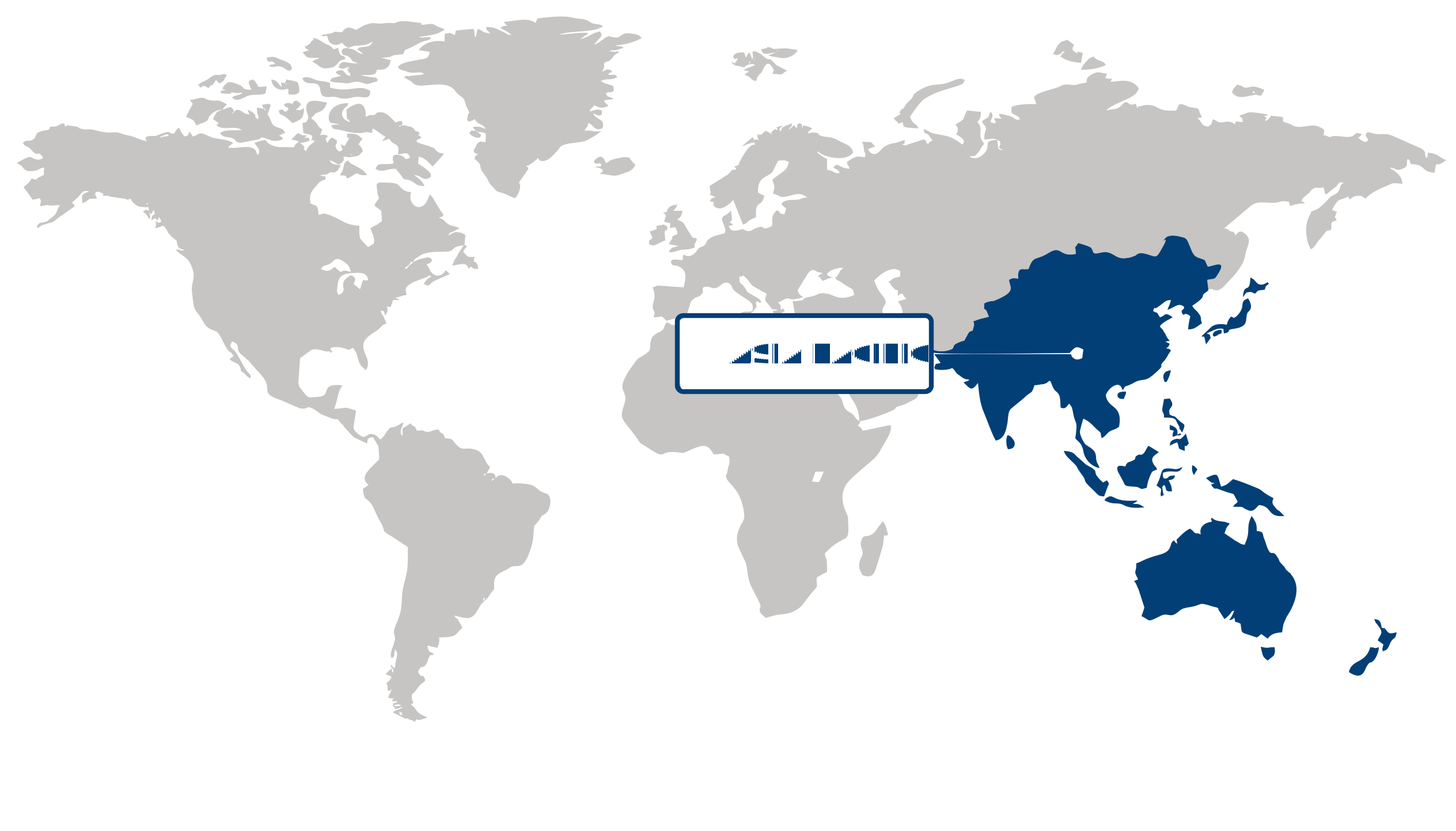
Asia Pacific (Largest & Fastest-Growing Region)
Asia Pacific led the sea salt market in 2026 and represented the fastest-growing regional market, supported by abundant coastal resources, established salt production activities, and strong demand from food processing and industrial applications. The region's extensive coastline and favorable conditions for solar salt production provide an important raw-material base, while expanding food manufacturing industries continue to drive consumption. Growing consumer interest in naturally sourced ingredients is also supporting demand for sea salt in packaged foods, culinary products, and specialty applications. At the same time, increasing urbanization and changing dietary preferences are strengthening demand for processed and convenience foods that use salt as an ingredient. Investments in food processing, improvements in distribution infrastructure, and expanding domestic consumption are reinforcing the region's leading position and creating favorable conditions for continued market expansion.
| Parameter | North America | Asia Pacific | Europe | Latin America | MEA |
|---|---|---|---|---|---|
| Innovation Hub i Scale Nascent Developing Advanced | |||||
| Cost-Sensitive Region i Scale Low Medium High | |||||
| Regulatory Environment i Scale Restrictive Neutral Supportive | |||||
| Demand Drivers i Scale Weak Moderate Strong | |||||
| Development Stage i Scale Emerging Developing Developed | |||||
| Adoption Rate i Scale Low Medium High | |||||
| New Entrants / Startups i Scale Sparse Moderate Dense | |||||
| Macro Indicators i Scale Weak Stable Strong |
Key Country Insights
Germany 🇩🇪
Industrial Processing FocusGermany integrates sea salt across food processing, water treatment, and chemical applications, supporting stable commercial demand. German manufacturers prioritize consistent quality specifications and reliable sourcing to serve industrial customers with diverse processing requirements.
France 🇫🇷
Gourmet Ingredient BaseFrance maintains strong demand for premium sea salt in gourmet food production and hospitality applications. French producers emphasize regional product identity, artisanal harvesting practices, and premium positioning to support specialty retail and export opportunities.
Italy 🇮🇹
Traditional Processing SupportItaly uses sea salt extensively across food preservation, cheese production, and specialty meat processing. Italian manufacturers continue balancing traditional production methods with modern packaging and quality standards to serve domestic and international food markets.
Japan 🇯🇵
Specialty Culinary DemandJapan values high-quality sea salt for traditional cuisine, premium food products, and artisanal manufacturing. Japanese producers continue refining production techniques and product differentiation to meet demand for distinctive taste profiles and premium food applications.
South Korea 🇰🇷
Functional Food IntegrationSouth Korea incorporates sea salt into fermented foods, processed foods, and health-oriented consumer products. Domestic manufacturers focus on value-added formulations and quality assurance while supporting demand from both household and commercial food production.
United States 🇺🇸
Premium Food ApplicationsThe U.S. sea salt market emphasizes premium culinary products, clean-label ingredients, and specialty food manufacturing. Food processors and retail brands in the U.S. continue expanding flavored and natural sea salt offerings to address consumer demand for minimally processed ingredients.
Segment Leadership and Growth Trends
Sea Salt Market Share (%), by Distribution Channel, 2026
Go beyond the chart, access full insights & data tables
Request Free Sample ReportDistribution Channel Segment Analysis: Indirect Sales (Largest Segment) vs Direct Sales (Fastest-Growing Segment)
Indirect sales represented the largest distribution channel in the sea salt market in 2026, supported by the broad reach of wholesalers, distributors, retailers, and other intermediaries serving diverse consumer and commercial markets. These channels allow sea salt producers to access geographically dispersed customers while benefiting from established logistics and retail networks. Indirect distribution is particularly important for reaching supermarkets, food processors, restaurants, and other end users that depend on consistent product availability. The convenience of established supply relationships and the ability to efficiently manage product movement across multiple markets continue to underpin the channel's leading position.
Direct sales are expanding at the fastest rate as producers increasingly seek closer relationships with customers and greater control over product positioning, pricing, and distribution. Direct channels can provide opportunities to communicate product attributes more effectively, particularly for specialty and premium sea salt offerings where origin, processing methods, texture, and perceived quality influence purchasing decisions. Digital commerce and direct-to-consumer platforms are also making it easier for producers to reach niche customer groups without relying entirely on intermediaries. This shift toward more personalized purchasing experiences and stronger producer-consumer engagement is supporting the expansion of direct sales.
Product Segment Analysis: Fine Sea Salt (Largest Segment) vs Flake Sea Salt (Fastest-Growing Segment)
Fine sea salt held the largest position in the sea salt market in 2026, driven by its versatility across household cooking, food processing, seasoning, and commercial food preparation. Its small and consistent grain size allows for convenient measurement, even distribution, and rapid incorporation into a wide range of recipes and formulations. These characteristics make fine sea salt suitable for everyday culinary use as well as processed food applications. Its broad functionality and familiarity among consumers and food manufacturers continue to support sustained demand.
Flake sea salt is witnessing the fastest growth as consumers and food professionals increasingly seek distinctive textures and premium finishing ingredients. Its delicate structure and ability to provide a noticeable surface texture make it attractive for garnishing prepared foods and enhancing the sensory experience of dishes. Rising interest in specialty culinary products, artisanal food preparation, and premium presentation is supporting broader awareness of flake sea salt. Its positioning as a finishing ingredient rather than solely a basic seasoning also creates opportunities for value-oriented product differentiation across retail and foodservice applications.
| Segment | Sub-Segment | Largest Segment | Fastest Growing |
|---|---|---|---|
| Distribution Channel | Direct Sales, Indirect Sales | Indirect Sales | Direct Sales |
| Product | Coarse Sea Salt, Fine Sea Salt, Flake Sea Salt, Others | Fine Sea Salt | Flake Sea Salt |
| Application | Food, Cosmetics, Animal Feed, Others | Food | Cosmetics |
Competitive Landscape and Market Positioning
Leading companies in the sea salt market:
1. INFOSA (Spain)
2. Morton Salt Inc. (USA)
3. Cargill Incorporated (USA)
4. K+S Aktiengesellschaft (Germany)
5. Salins Group (France)
6. Cheetham Salt Limited (Australia)
7. Tata Consumer Products Limited (India)
8. Qinghai Salt Lake Industry Co. Ltd. (China)
9. San Francisco Salt Company (USA)
In the sea salt market, growing consumer preference for natural and premium food ingredients is driving product diversification. Continuous introduction of specialty and flavored variants is expanding application areas. Collaborative sourcing and production initiatives are enhancing supply consistency, while differentiation is increasingly based on purity, texture, and origin-based branding.
| Company | Market Share | Company Revenue | Revenue CAGR (%) | Product Portfolio | Geographic Presence | Innovation / R&D Focus | Strategic Developments |
|---|---|---|---|---|---|---|---|
| INFOSA (Spain) | |||||||
| Morton Salt Inc. (USA) | |||||||
| Cargill Incorporated (USA) | |||||||
| K+S Aktiengesellschaft (Germany) | |||||||
| Salins Group (France) | |||||||
| Cheetham Salt Limited (Australia) | |||||||
| Tata Consumer Products Limited (India) | |||||||
| Qinghai Salt Lake Industry Co. Ltd. (China) | |||||||
| San Francisco Salt Company (USA). |
Industry Development/News
| Company Name | Date | Key Development |
|---|---|---|
| SweetWater | May-26 | SweetWater Brewing Company launched “Livin’ Salty,” a 5% ABV salt-and-lime seasonal lager, in collaboration with lifestyle brand Salt Life. This product extension demonstrates the application of sea salt-based flavoring in the craft beverage sector to drive consumer engagement and capitalize on lifestyle-oriented market trends, utilizing retail and on-premise distribution channels to reach outdoor-focused demographics. |
| Saltwell Group | Apr-26 | Saltwell Group opened a new, state-of-the-art production facility in Santiago, Chile, to scale the manufacturing of its reduced-sodium salt. This strategic investment increases global supply capacity and leverages proximity to raw material sources and key trading ports, enabling the company to better meet the food industry's growing demand for sodium-reduction reformulation solutions. |
| True Salt | May-24 | True Salt expanded its Southern California operations to significantly increase production capacity and enhance regional import capabilities. This infrastructure investment was designed to secure a more resilient supply chain and ensure distribution reliability for high-volume foodservice and food manufacturing clients requiring consistent, premium-quality sea salt inputs in an increasingly competitive market. |
| Exportadora de Sal (ESSA) | Feb-24 | The Mexican government completed the full nationalization of Exportadora de Sal (ESSA) by acquiring the remaining 49% stake held by Mitsubishi Corporation for 1.5 billion pesos. This move consolidates state control over the world’s largest sea salt production facility, signaling a major shift in the industrial ownership structure and operational governance of a key global salt supply asset. |
Customize Your Report
Explore examples of how this report can be tailored to different research needs, including custom segments, additional topics or chapters, and related reports. Click a section of the wheel or its numbered marker to explore the available options.
Sea Salt Market — Custom Segments
| Segment | Sub-Segment |
|---|---|
| Production Method | Solar Evaporation, Mechanical Evaporation, Vacuum Evaporation |
| Purity & Grade | Industrial Grade, Food Grade, Pharmaceutical Grade |
| Packaging Format | Bulk Bags & Sacks, Drums & Containers, Retail Packs |
Sea Salt Market — Custom TOC
| Custom Chapter | Custom Details |
|---|---|
| Premiumization and Consumer Preference Assessment |
|
| Supply Chain and Origin Traceability Assessment |
|
| Specialty Salt Application Expansion Strategy |
|
Need a different cut of the data?
Request Custom ResearchWhat is the market size of sea salt?
What is the expected industry size of sea salt by 2036?
How is the expansion of the food processing industry influencing procurement strategies in the sea salt market?
Why is flake sea salt gaining stronger traction compared to fine sea salt in premium applications?
Why do indirect sales dominate the sea salt market?
Which product segment is growing the fastest in the sea salt market?
Why does Asia Pacific lead the sea salt market?
How is Asia Pacific supporting future growth in the sea salt market?
Which organizations are considered leaders in the sea salt landscape?
Our Clients
"The report provided a thorough look at market trends, technological advancements, and the competitive landscape. The depth of insights was really valuable."
ITC Limited
"We would highly recommend Fundamental Business Insights & Consulting to anyone looking for reliable, detailed, and comprehensive market research in the Food industry."
Tyson Foods
"The clarity and presentation of the information were commendable. The report was delivered timely, which made the overall experience smooth and convenient."
Mondelēz International
Our Research Team & Methodology
Every Fundamental Business Insights report is built by a dedicated vertical research team, validated through a structured primary-and-secondary methodology, and reviewed for accuracy before it reaches you.
Research Team Overview
Prepared by the Food & Beverage Research Team
Delivery
Published
Demand
Available
Support
Trust & Compliance
Research Domains
10 coverage areasResearch Intelligence
| Source | Reference |
|---|---|
| Food and Agriculture Organization (FAO) | www.fao.org |
| World Health Organization (WHO) | www.who.int |
| U.S. Food & Drug Administration (FDA) | www.fda.gov |
| European Food Safety Authority (EFSA) | www.efsa.europa.eu |
| U.S. Department of Agriculture (USDA) | www.usda.gov |
| Codex Alimentarius Commission | www.fao.org/fao-who-codexalimentarius |
| International Organization for Standardization (ISO) | www.iso.org |
| AOAC INTERNATIONAL | www.aoac.org |
| Institute of Food Technologists (IFT) | www.ift.org |
| International Dairy Foods Association (IDFA) | www.idfa.org |
| International Sweeteners Association (ISA) | www.sweeteners.org |
| International Probiotics Association (IPA) | internationalprobiotics.org |
| Good Food Institute (GFI) | gfi.org |
| American Feed Industry Association (AFIA) | www.afia.org |
| International Feed Industry Federation (IFIF) | ifif.org |
| Specialty Food Association (SFA) | www.specialtyfood.com |
| Brewers Association | www.brewersassociation.org |
| International Bottled Water Association (IBWA) | bottledwater.org |
| International Alliance for Dietary/Food Supplement Associations (IADSA) | www.iadsa.org |
| OECD Agriculture & Food | www.oecd.org/agriculture |
Research Workflow & Quality Assurance
Data Collection
Verified information gathered through primary and secondary research.
Data Triangulation
Cross-validation using multiple independent data sources.
Forecast Modelling
Market estimates developed using historical trends and analytical models.
Analyst Validation
Findings reviewed by domain experts for accuracy and consistency.
Editorial & Quality Review
Final editorial, quality, and compliance checks before publication.
Final Publication
Released after successful completion of the internal review process.
Report Coverage
📊 Market Assessment
- Market Size & Forecast
- Market Segmentation
- Regional Analysis
- Growth Drivers & Challenges
- Market Dynamics
🏢 Competitive Intelligence
- Competitive Landscape
- Company Profiles
- Competitive Benchmarking
- Mergers & Acquisitions
- Market Share Analysis or Key Company Strategies
🔍 Strategic Analysis
- Value Chain Analysis
- Porter's Five Forces
- PESTLE Analysis
- Pricing Trends
- Supply-Demand Analysis
🚀 Future Outlook
- Technology Landscape
- Regulatory Landscape
- Investment & Funding Landscape
- Emerging Opportunities
- Future Market Outlook
Have a question about this report or need a custom scope?
Request Customization