Salmon Fish Market Size & Growth Forecast 2027–2036, By Segments (Species), Regional Demand Trends (North America, Asia Pacific, Europe), Key Country Insights (U.S., Japan, South Korea, Germany, France, Italy), and Competitive Landscape
Market Size and Growth Outlook
Salmon Fish Market size stood at USD 21.1 billion in 2026 and is predicted to grow at a 8.08% CAGR from 2027 to 2036, reaching USD 45.89 billion by 2036. The industry revenue for 2027 is estimated at USD 22.53 billion.
Get more details on this report
Request Free Sample ReportSalmon Fish Market Intelligence Snapshot
Regional Market Dynamics
- Europe accounted for 51.62% of the market in 2026, supported by integrated cold-chain logistics, established production, and strong retail and foodservice distribution networks.
- Asia Pacific is projected to grow at a 9.61% CAGR as urban consumption rises, modern retail expands, and imported salmon becomes more widely available through retail and dining channels.
Segment Momentum
- Atlantic/Aquaculture leads due to stable year-round supply, controlled production cycles, and reliable distribution, making it the preferred choice for retail, foodservice, and processing buyers.
- Pacific salmon is growing fastest due to rising consumer preference for wild-origin differentiation and alternative sourcing, offering distinct value in retail and premium foodservice channels.
Market Expansion Drivers
- Rising demand for ready-to-eat and convenient processed seafood meal solutions.
- E-commerce and direct-to-consumer seafood channels expanding global salmon distribution networks.
- Sustainable aquaculture certification and eco-friendly packaging boosting premium salmon demand.
Leading Market Participants
- Key players in the salmon fish market include Mowi ASA (Norway), SalMar ASA (Norway), Cermaq Group AS (Norway), Lerøy Seafood Group ASA (Norway), Bakkafrost P/F (Faroe Islands), Atlantic Sapphire ASA (Norway), Nordlaks Produkter AS (Norway), Sea Delight Group (United States), BluGlacier LLC (United States), Ideal Foods Ltd. (United Kingdom).
Global Market Forecast Snapshot
Market Outlook
- 2026 Market Size: USD 21.1 billion
- 2027 Estimated Market Size: USD 22.53 billion.
- Projected Market Size: USD 45.89 billion by 2036
- Growth Forecast: 8.08% CAGR (2027-2036)
Regional and Segment Outlook
- Leading Regional Market: Europe
- High-Growth Regional Hub: Asia Pacific
- Core Revenue Segment: Atlantic/Aquaculture (Species)
- Emerging Opportunity Segment: Pacific (Species)
Market Growth Drivers and Industry Trends
Rising demand for ready-to-eat and convenient processed seafood meal solutions
Changing lifestyles and growing preference for convenient meal formats are strengthening demand for processed seafood products that require minimal preparation. The salmon fish market is benefiting from increasing consumer interest in ready-to-eat meals, prepared fillets, smoked products, canned formats, and other convenient offerings that combine nutritional value with ease of consumption. Salmon's versatility allows processors and food manufacturers to incorporate it into a broad range of meal solutions suited to busy households, foodservice applications, and on-the-go consumption. Improvements in processing, portioning, preservation, and packaging are also helping maintain product quality while extending usability, making salmon more accessible across modern retail and prepared-food channels.
E-commerce and direct-to-consumer seafood channels expanding global salmon distribution networks
The expansion of online grocery platforms and direct-to-consumer purchasing is creating additional routes for seafood suppliers to reach consumers beyond conventional retail outlets. Through digital commerce, the salmon fish market can connect producers and distributors with geographically dispersed customers while offering greater convenience and product visibility. Online ordering also supports the sale of fresh, frozen, smoked, and specialty salmon products through delivery models designed to preserve quality during transportation. Direct-to-consumer channels can provide suppliers with greater control over product presentation and customer engagement, while subscription and recurring-order models can encourage repeat purchases. Broader digital distribution is consequently helping seafood businesses access new consumer segments and markets without relying exclusively on physical retail networks.
Sustainable aquaculture certification and eco-friendly packaging boosting premium salmon demand
Growing consumer attention to responsible sourcing and environmental impacts is increasing the importance of sustainability credentials across seafood purchasing decisions. Within the salmon fish market, recognized aquaculture certifications can provide buyers with greater transparency regarding farming practices, resource management, traceability, and environmental stewardship, strengthening confidence in responsibly produced seafood. At the same time, the adoption of recyclable, reduced-material, or otherwise eco-conscious packaging can appeal to consumers seeking products that align with environmental preferences. These attributes can support premium positioning for salmon products, particularly among retailers, foodservice operators, and consumers who place greater emphasis on responsible sourcing alongside taste, quality, and nutritional characteristics.
| Growth Driver | Impact on CAGR | Regulatory Influence | Geographic Relevance | Adoption Rate | Impact Timeline |
|---|---|---|---|---|---|
| Rising demand for ready-to-eat and convenient processed seafood meal solutions | 2.00% | Low | Europe, North America, Asia Pacific | High | Near Term |
| E-commerce and direct-to-consumer seafood channels expanding global salmon distribution networks | 1.60% | Low | North America, Europe | High | Near Term |
| Sustainable aquaculture certification and eco-friendly packaging boosting premium salmon demand | 1.30% | Moderate | Europe, Asia Pacific | Medium | Mid Term |
Unlock insights tailored to your business with our bespoke market research solutions.
Click to get your customized report now.
Regional Demand Dynamics
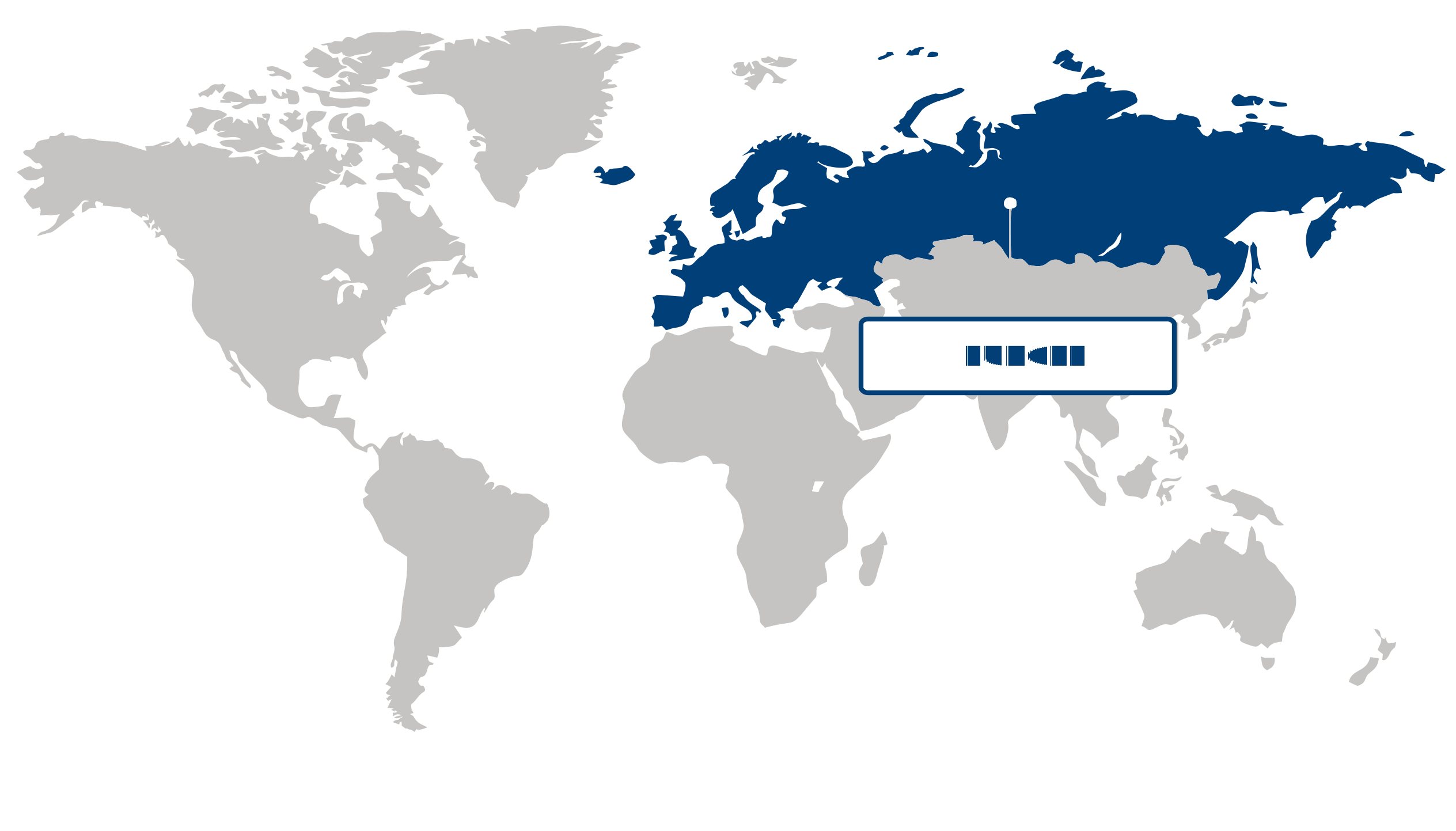
Europe (Largest Region)
Europe dominated the salmon fish market with a 51.62% share in 2026, supported by established seafood consumption patterns, sophisticated cold-chain infrastructure, and strong demand for nutritious and convenient protein sources. Salmon benefits from its positioning as a premium seafood product with broad applications across fresh, frozen, smoked, and processed food categories. Retail and foodservice channels across the region provide extensive access to salmon products, while consumer interest in healthy diets and high-quality protein continues to reinforce demand. Strong seafood processing capabilities, developed distribution networks, and growing attention to responsible sourcing and traceability are also shaping purchasing decisions and supporting the region's established market position.
Asia Pacific (Fastest-Growing Region)
Asia Pacific represents the fastest-growing region for the salmon fish market, fueled by rising disposable incomes, urbanization, and expanding consumer interest in premium seafood. Changing dietary preferences and increasing exposure to international cuisines are encouraging demand for salmon across restaurants, modern retail, and food delivery channels. Growth in cold-chain logistics and organized food distribution is improving product availability in urban centers, while rising health awareness is strengthening interest in seafood as a source of high-quality protein and beneficial nutrients. Expanding foodservice industries and greater availability of imported and locally distributed salmon products are further supporting consumption across diverse regional markets.
| Parameter | North America | Asia Pacific | Europe | Latin America | MEA |
|---|---|---|---|---|---|
| Innovation Hub i Scale Nascent Developing Advanced | |||||
| Cost-Sensitive Region i Scale Low Medium High | |||||
| Regulatory Environment i Scale Restrictive Neutral Supportive | |||||
| Demand Drivers i Scale Weak Moderate Strong | |||||
| Development Stage i Scale Emerging Developing Developed | |||||
| Adoption Rate i Scale Low Medium High | |||||
| New Entrants / Startups i Scale Sparse Moderate Dense | |||||
| Macro Indicators i Scale Weak Stable Strong |
Key Country Insights
Germany 🇩🇪
Sustainable Seafood FocusGermany emphasizes responsibly sourced salmon supported by retailer sustainability commitments and transparent labeling. The country's salmon fish market increasingly favors premium processed offerings and traceable supply partnerships that align with consumer purchasing preferences.
France 🇫🇷
Culinary Premium SegmentFrance supports demand for premium salmon across retail and hospitality sectors with attention to product quality and responsible sourcing. The salmon fish market increasingly includes smoked and value-added offerings tailored to changing consumer preferences.
Italy 🇮🇹
Foodservice Supply ChannelItaly's salmon fish market benefits from expanding use in restaurants, hospitality, and modern retail formats. Importers focus on maintaining product freshness, efficient logistics, and differentiated processed products to meet evolving consumption patterns.
Japan 🇯🇵
Premium Consumption CultureJapan's salmon fish market is driven by demand for high-quality products used in sushi, sashimi, and ready-to-eat meals. Japanese buyers place strong emphasis on freshness, product consistency, and dependable international supply relationships.
South Korea 🇰🇷
Convenience Seafood DemandSouth Korea continues to expand consumption of salmon through retail, home meal replacement products, and restaurant channels. The salmon fish market benefits from growing interest in chilled imports, premium packaging, and reliable cold-chain distribution.
United States 🇺🇸
Retail Demand HubThe U.S. salmon fish market is shaped by strong retail and foodservice demand for fresh, frozen, and value-added products. Buyers increasingly prioritize certified sourcing, consistent quality, and diversified import channels to strengthen supply resilience.
Segment Leadership and Growth Trends
Salmon Fish Market Share (%), by Species, 2026
Go beyond the chart, access full insights & data tables
Request Free Sample ReportSpecies Segment Analysis: Atlantic/Aquaculture (Largest Segment) vs Pacific (Fastest-Growing Segment)
The Atlantic/Aquaculture segment held the largest share of the salmon fish market in 2026, supported by the established scale of farmed salmon production and its consistent availability across global seafood supply chains. Aquaculture enables controlled production, predictable supply, and standardized product quality, helping meet demand from retail, foodservice, and processed seafood applications. The growing preference for salmon as a nutrient-rich protein source, combined with the reliability of farmed production, continues to reinforce the segment's leading position.
The pacific segment is emerging as the fastest-growing species category, supported by consumer interest in diverse salmon varieties and increasing demand for premium and differentiated seafood offerings. Its appeal is strengthened by the distinct flavor, quality characteristics, and culinary applications associated with pacific salmon. Expanding seafood consumption, greater product differentiation, and continued development of distribution channels are creating favorable conditions for stronger adoption of pacific salmon.
| Segment | Sub-Segment | Largest Segment | Fastest Growing |
|---|---|---|---|
| Species | Atlantic/Aquaculture, Pacific | Atlantic/Aquaculture | Pacific |
Competitive Landscape and Market Positioning
Top players in the salmon fish market:
1. Mowi ASA (Norway)
2. SalMar ASA (Norway)
3. Cermaq Group AS (Norway)
4. Lerøy Seafood Group ASA (Norway)
5. Bakkafrost P/F (Faroe Islands)
6. Atlantic Sapphire ASA (Norway)
7. Nordlaks Produkter AS (Norway)
8. Sea Delight Group (United States)
9. BluGlacier LLC (United States)
10. Ideal Foods Ltd. (United Kingdom)
Within the salmon fish market, competitive dynamics are increasingly influenced by efforts to stabilize supply chains and improve resource traceability across production and distribution networks. Sustainability considerations are no longer peripheral but central to operational strategies, particularly as environmental pressures and consumer awareness reshape purchasing behavior. Companies are also investing in ecosystem-level coordination, linking aquaculture practices with monitoring systems that improve yield predictability and reduce waste. These shifts collectively reflect how the salmon fish market is evolving toward a more controlled, efficiency-oriented structure aligned with long-term resource balance.
| Company | Market Share | Company Revenue | Revenue CAGR (%) | Product Portfolio | Geographic Presence | Innovation / R&D Focus | Strategic Developments |
|---|---|---|---|---|---|---|---|
| Mowi ASA (Norway) | |||||||
| SalMar ASA (Norway) | |||||||
| Cermaq Group AS (Norway) | |||||||
| Lerøy Seafood Group ASA (Norway) | |||||||
| Bakkafrost P/F (Faroe Islands) | |||||||
| Atlantic Sapphire ASA (Norway) | |||||||
| Nordlaks Produkter AS (Norway) | |||||||
| Sea Delight Group (United States) | |||||||
| BluGlacier LLC (United States) | |||||||
| Ideal Foods Ltd. (United Kingdom). |
Industry Development/News
| Company Name | Date | Key Development |
|---|---|---|
| WellFish Tech | Jun-26 | WellFish Tech established strategic partnerships with Andfjord Salmon and Bue Salmon to integrate biotechnology solutions into land-based salmon farming. The initiative focuses on deploying advanced analytics for fish health monitoring and operational efficiency, marking a strategic adoption of specialized tech platforms to optimize production outcomes in controlled-environment aquaculture systems. |
| Nordlaks | Nov-25 | Nordlaks reached a critical milestone in its infrastructure expansion by transporting a 6,000-tonne salmon containment tank to Norway. This development represents a material increase in high-capacity farming capabilities, illustrating the company’s commitment to deploying next-generation aquaculture infrastructure designed to enhance production scalability and operational resilience in large-scale salmon farming. |
| Gigante Salmon | Sep-25 | Gigante Salmon advanced its production facility into the final phase of development. This expansion is a strategic effort to scale aquaculture capacity through modern, land-based infrastructure, reflecting the company’s intent to strengthen its competitive position and increase total salmon output via advanced, controlled-environment farming systems. |
| China (Su Hai No. 1 project) | May-25 | China advanced the development of the Su Hai No. 1, a dedicated offshore salmon-farming vessel designed to scale industrial production capacity. The project signifies a shift toward mobile, ship-based aquaculture infrastructure, aimed at expanding domestic supply capabilities and reducing dependence on traditional coastal farming systems through technological innovation. |
| Nordlaks | Nov-24 | Nordlaks continued construction on its 'Hydra' semi-closed containment aquaculture project. This initiative represents a strategic investment in next-generation farming technology, focusing on improved environmental control and fish welfare. The project highlights a broader industry shift toward utilizing advanced containment systems to mitigate operational risks and enhance sustainability in commercial salmon production. |
| SalMar ASA | May-22 | SalMar ASA finalized the acquisition of Norway Royal Salmon, resulting in the formation of the second-largest Atlantic salmon farming entity globally. This consolidation significantly enhances the company's production capacity, strengthens its competitive positioning within the industry, and provides substantial operational synergies designed to increase long-term shareholder dividend capacity. |
| Bakkafrost | Jan-22 | Bakkafrost acquired a 90% stake in Munkebo Seafood A/S, a Denmark-based canned fish producer. This strategic move expands Bakkafrost’s value-added product portfolio and enhances its ability to capture greater margins by improving the processing and commercialization of salmon by-products, representing a deliberate effort to diversify its revenue streams within the salmon value chain. |
| Ideal Foods Ltd | Jun-20 | Ideal Foods Ltd entered a supply agreement with Mowi ASA to increase its stock availability by 5,000 tons annually. This partnership serves as a strategic effort to enhance distribution reach and meet rising global demand for Atlantic salmon, demonstrating the impact of supply chain collaborations on regional product availability and market responsiveness. |
| Cermaq | Dec-19 | Cermaq initiated a partnership with Labeyrie to implement blockchain technology for supply chain traceability. Additionally, the company collaborated with IBM Food Trust to leverage cloud-based blockchain solutions. These developments represent a strategic digital transformation effort to enhance transparency and quality assurance across the salmon value chain. |
Customize Your Report
Explore examples of how this report can be tailored to different research needs, including custom segments, additional topics or chapters, and related reports. Click a section of the wheel or its numbered marker to explore the available options.
Salmon Fish Market — Custom Segments
| Segment | Sub-Segment |
|---|---|
| Product Form | Fresh, Frozen, Canned, Smoked, Other Processed |
| Application | Foodservice, Retail Food, Food Processing |
| Sales Channel | Supermarkets & Hypermarkets, Specialty Seafood Stores, Online Retail, Foodservice Distribution |
Salmon Fish Market — Custom TOC
| Custom Chapter | Custom Details |
|---|---|
| Aquaculture Expansion and Production Capacity Outlook |
|
| Sustainable Seafood Certification and Sourcing Landscape |
|
| Value-Added Salmon Product Opportunity Assessment |
|
Need a different cut of the data?
Request Custom ResearchWhat is the market size of salmon fish?
How will the salmon fish industry grow in terms of size and CAGR by 2036?
How are convenience-focused consumption trends influencing growth in the Salmon Fish Market?
Why are sustainability initiatives becoming commercially important in the Salmon Fish Market?
Why does Atlantic/Aquaculture dominate the salmon fish market?
What is driving faster growth in Pacific salmon demand?
Why does Europe lead the salmon fish market?
What is fueling salmon market growth in Asia Pacific?
Which organizations are considered leaders in the salmon fish landscape?
Our Clients
"The report provided a thorough look at market trends, technological advancements, and the competitive landscape. The depth of insights was really valuable."
ITC Limited
"We would highly recommend Fundamental Business Insights & Consulting to anyone looking for reliable, detailed, and comprehensive market research in the Food industry."
Tyson Foods
"The clarity and presentation of the information were commendable. The report was delivered timely, which made the overall experience smooth and convenient."
Mondelēz International
Our Research Team & Methodology
Every Fundamental Business Insights report is built by a dedicated vertical research team, validated through a structured primary-and-secondary methodology, and reviewed for accuracy before it reaches you.
Research Team Overview
Prepared by the Food & Beverage Research Team
Delivery
Published
Demand
Available
Support
Trust & Compliance
Research Domains
10 coverage areasResearch Intelligence
| Source | Reference |
|---|---|
| Food and Agriculture Organization (FAO) | www.fao.org |
| World Health Organization (WHO) | www.who.int |
| U.S. Food & Drug Administration (FDA) | www.fda.gov |
| European Food Safety Authority (EFSA) | www.efsa.europa.eu |
| U.S. Department of Agriculture (USDA) | www.usda.gov |
| Codex Alimentarius Commission | www.fao.org/fao-who-codexalimentarius |
| International Organization for Standardization (ISO) | www.iso.org |
| AOAC INTERNATIONAL | www.aoac.org |
| Institute of Food Technologists (IFT) | www.ift.org |
| International Dairy Foods Association (IDFA) | www.idfa.org |
| International Sweeteners Association (ISA) | www.sweeteners.org |
| International Probiotics Association (IPA) | internationalprobiotics.org |
| Good Food Institute (GFI) | gfi.org |
| American Feed Industry Association (AFIA) | www.afia.org |
| International Feed Industry Federation (IFIF) | ifif.org |
| Specialty Food Association (SFA) | www.specialtyfood.com |
| Brewers Association | www.brewersassociation.org |
| International Bottled Water Association (IBWA) | bottledwater.org |
| International Alliance for Dietary/Food Supplement Associations (IADSA) | www.iadsa.org |
| OECD Agriculture & Food | www.oecd.org/agriculture |
Research Workflow & Quality Assurance
Data Collection
Verified information gathered through primary and secondary research.
Data Triangulation
Cross-validation using multiple independent data sources.
Forecast Modelling
Market estimates developed using historical trends and analytical models.
Analyst Validation
Findings reviewed by domain experts for accuracy and consistency.
Editorial & Quality Review
Final editorial, quality, and compliance checks before publication.
Final Publication
Released after successful completion of the internal review process.
Report Coverage
📊 Market Assessment
- Market Size & Forecast
- Market Segmentation
- Regional Analysis
- Growth Drivers & Challenges
- Market Dynamics
🏢 Competitive Intelligence
- Competitive Landscape
- Company Profiles
- Competitive Benchmarking
- Mergers & Acquisitions
- Market Share Analysis or Key Company Strategies
🔍 Strategic Analysis
- Value Chain Analysis
- Porter's Five Forces
- PESTLE Analysis
- Pricing Trends
- Supply-Demand Analysis
🚀 Future Outlook
- Technology Landscape
- Regulatory Landscape
- Investment & Funding Landscape
- Emerging Opportunities
- Future Market Outlook
Have a question about this report or need a custom scope?
Request Customization