Ruminant Methane Reduction Market Size & Growth Forecast 2027–2036, By Segments (Product, Animal Type), Regional Demand Trends (North America, Asia Pacific, Europe), Key Country Insights (U.S., Japan, South Korea, Germany, France, Italy), and Competitive Landscape
Market Size and Growth Outlook
Ruminant Methane Reduction Market size was valued at USD 3.4 billion in 2026 and is anticipated to grow at a 7.98% CAGR from 2027 to 2036, exceeding USD 7.33 billion by 2036. The industry revenue for 2027 is assessed at USD 3.63 billion.
Get more details on this report
Request Free Sample ReportRuminant Methane Reduction Market Intelligence Snapshot
Regional Market Dynamics
- Europe leads due to strong policy focus on livestock emissions, established dairy and beef systems, and integration of methane reduction into farm practices and procurement standards.
- Asia Pacific grows at 7.23% CAGR, driven by large livestock populations, demand for efficiency gains, and adoption of feed-based methane solutions within modernizing herd management systems.
Segment Momentum
- Feed Additives captured 85.5% of the market in 2026 because they integrate easily into existing feeding systems, enabling practical methane reduction without requiring significant operational changes on farms.
- Goats are growing fastest as methane reduction practices expand beyond cattle into more diversified livestock operations, creating greater opportunities to adopt mitigation products across less-penetrated production systems.
Market Expansion Drivers
- Rising climate regulations accelerating adoption of methane-reducing livestock feed additives.
- Expanding investment in biotech-driven methane mitigation platforms improving commercialization scalability.
- Increasing carbon reduction commitments by dairy producers driving low-emission farming technology deployment.
Leading Market Participants
- Leading players in the ruminant methane reduction market include DSM-Firmenich AG (Switzerland), Elanco Animal Health Incorporated (United States), Cargill, Incorporated (United States), Alltech, Inc. (United States), Fonterra Co-operative Group Limited (New Zealand), FutureFeed Pty Ltd (Australia), CH4 Global, Inc. (United States), Blue Ocean Barns, Inc. (United States), Symbrosia, Inc. (United States), Rumin8 Ltd (Australia).
Global Market Forecast Snapshot
Market Outlook
- 2026 Market Size: USD 3.4 billion
- 2027 Estimated Market Size: USD 3.63 billion.
- Projected Market Size: USD 7.33 billion by 2036
- Growth Forecast: 7.98% CAGR (2027-2036)
Regional and Segment Outlook
- Leading Regional Market: Europe
- High-Growth Regional Hub: Asia Pacific
- Core Revenue Segment: Feed Additives (Product) | Cattle (Animal Type)
- Emerging Opportunity Segment: Feed Additives (Product) | Goats (Animal Type)
Market Growth Drivers and Industry Trends
Rising climate regulations accelerating adoption of methane-reducing livestock feed additives
Stronger climate policies and growing regulatory attention to agricultural emissions are accelerating interest in mitigation solutions, supporting the ruminant methane reduction market as livestock producers face increasing pressure to lower methane emissions. Feed additives represent a practical intervention because they can be incorporated directly into existing feeding practices to influence methane formation during rumen digestion without requiring fundamental changes to livestock production systems. Regulatory developments and emissions-reduction frameworks can encourage producers to evaluate additives that suppress methane-generating processes while maintaining animal productivity and feed management practices. As environmental requirements become more closely integrated into agricultural operations, demand for scientifically validated feed-based mitigation approaches is increasing among producers seeking workable pathways for emissions management.
Expanding investment in biotech-driven methane mitigation platforms improving commercialization scalability
Investment in biotechnology is strengthening the development pipeline for solutions that target methane generation in ruminants, creating opportunities for the ruminant methane reduction market to expand beyond conventional mitigation approaches. Biotech-driven platforms can support the development of specialized feed additives, microbial interventions, enzymes, and other biological solutions designed to modify rumen fermentation and reduce methane production. Increased investment can accelerate research, testing, formulation development, and production capabilities, helping promising technologies progress toward broader commercial use. Improvements in formulation stability, delivery methods, compatibility with feeding systems, and production scalability are particularly important for translating laboratory advances into solutions that can be integrated into livestock operations.
Increasing carbon reduction commitments by dairy producers driving low-emission farming technology deployment
Dairy producers are increasingly incorporating emissions reduction into broader sustainability strategies, creating demand for practical technologies that can lower the carbon intensity of livestock production and strengthen the ruminant methane reduction market. Methane from enteric fermentation is a significant area of focus because reducing these emissions can complement improvements in feed efficiency, manure management, and overall farm resource use. Producers responding to sustainability expectations may adopt methane-reducing feed technologies as part of farm-level emissions management programs, particularly where these solutions can be integrated into existing feeding routines. Greater emphasis on low-emission production also encourages producers to evaluate technologies based on their compatibility with herd management, animal performance, feed availability, and operational requirements.
| Growth Driver | Impact on CAGR | Regulatory Influence | Geographic Relevance | Adoption Rate | Impact Timeline |
|---|---|---|---|---|---|
| Rising climate regulations accelerating adoption of methane-reducing livestock feed additives | 2.00% | High | North America, Europe | High | Near Term |
| Expanding investment in biotech-driven methane mitigation platforms improving commercialization scalability | 1.80% | Moderate | North America, Asia Pacific | High | Mid Term |
| Increasing carbon reduction commitments by dairy producers driving low-emission farming technology deployment | 1.40% | Moderate | Europe, Asia Pacific | Emerging | Long Term |
Unlock insights tailored to your business with our bespoke market research solutions.
Click to get your customized report now.
Regional Demand Dynamics
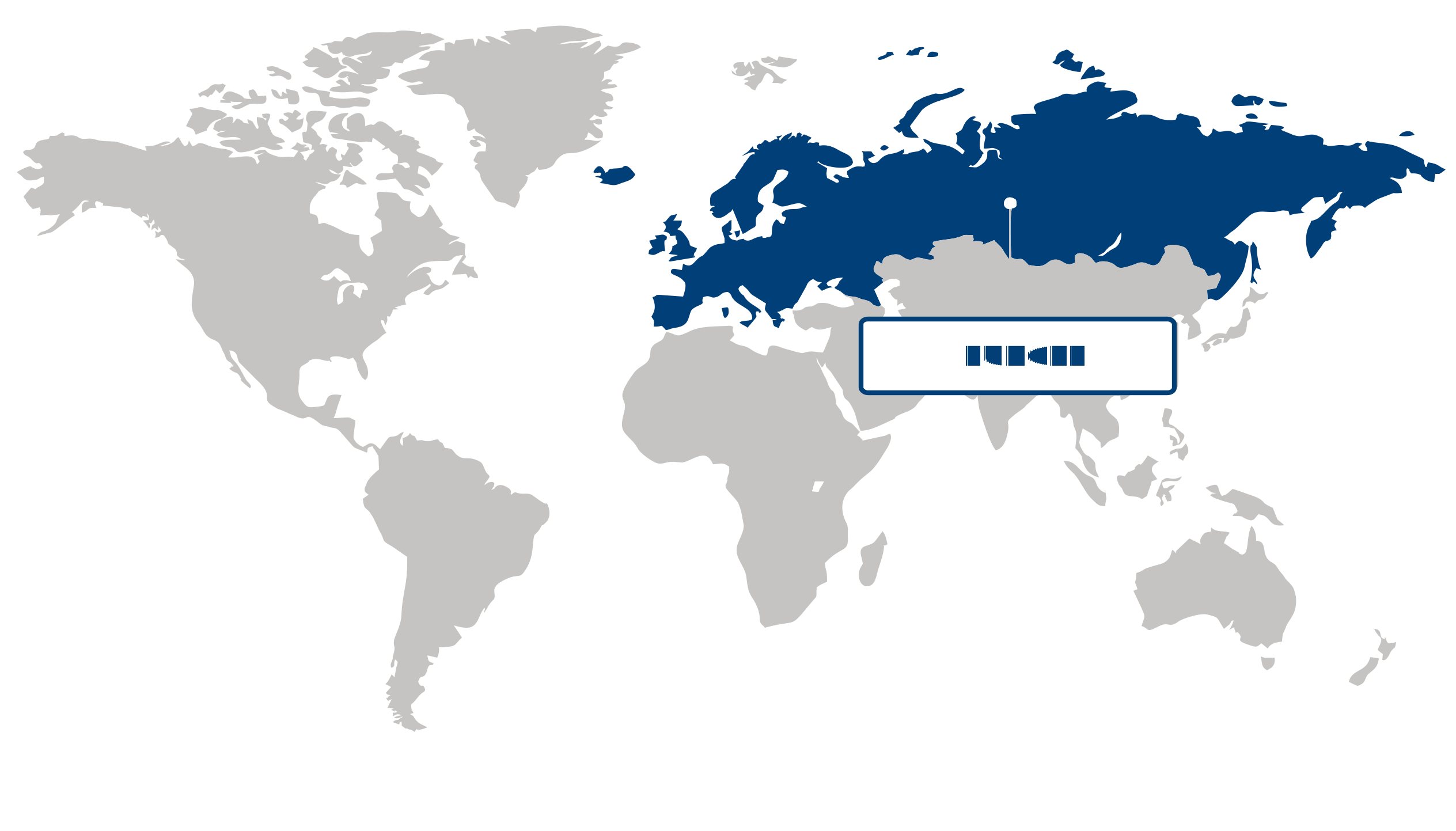
Europe (Largest Region)
Europe led the ruminant methane reduction market, holding the largest share in 2026, supported by strong climate policy priorities, established sustainable agriculture initiatives, and growing pressure to reduce greenhouse gas emissions from livestock production. Research and adoption of feed additives, dietary interventions, herd-management practices, and other methane-reduction approaches are being encouraged by the region's emphasis on lower-emission farming systems. Strong agricultural research capabilities and increasing interest in measurable environmental performance are further creating favorable conditions for the development and deployment of methane-reduction solutions.
Asia Pacific (Fastest-Growing Region)
Asia Pacific is experiencing the fastest growth as governments, livestock producers, and agricultural stakeholders increasingly focus on improving production efficiency while addressing the environmental impact of expanding ruminant farming. Growing demand for meat and dairy products is creating greater attention to sustainable livestock management, encouraging interest in technologies and feed-based approaches that can reduce methane emissions without compromising productivity. Improvements in agricultural infrastructure, expanding research activity, and increasing awareness of climate-smart farming are strengthening the region's adoption potential.
| Parameter | North America | Asia Pacific | Europe | Latin America | MEA |
|---|---|---|---|---|---|
| Innovation Hub i Scale Nascent Developing Advanced | |||||
| Cost-Sensitive Region i Scale Low Medium High | |||||
| Regulatory Environment i Scale Restrictive Neutral Supportive | |||||
| Demand Drivers i Scale Weak Moderate Strong | |||||
| Development Stage i Scale Emerging Developing Developed | |||||
| Adoption Rate i Scale Low Medium High | |||||
| New Entrants / Startups i Scale Sparse Moderate Dense | |||||
| Macro Indicators i Scale Weak Stable Strong |
Key Country Insights
Germany 🇩🇪
Sustainable Livestock PracticesGermany prioritizes methane reduction strategies that align with sustainable livestock management and scientifically validated feeding practices. Market participants in Germany are integrating nutritional innovations with farm efficiency measures to support practical emissions management within commercial operations.
France 🇫🇷
Dairy Emissions FocusFrance directs considerable attention toward methane reduction strategies within its established dairy sector through nutritional and herd management improvements. Organizations in France are supporting practical implementation of feed-based solutions that align with evolving environmental priorities and farm productivity goals.
Italy 🇮🇹
Farm Nutrition OptimizationItaly is strengthening methane reduction efforts through improved animal nutrition and efficient herd management practices. Feed suppliers and livestock producers in Italy are adopting targeted nutritional approaches that balance operational performance with environmental considerations across dairy and beef farming.
Japan 🇯🇵
Efficiency-Focused NutritionJapan emphasizes advanced feed formulations and research-driven nutritional solutions for methane reduction in ruminants. Companies in Japan are collaborating across the livestock value chain to improve feed efficiency while incorporating technologies suited to intensive production systems.
South Korea 🇰🇷
Technology-Enabled Feed SolutionsSouth Korea is expanding interest in methane reduction through innovative feed technologies and data-supported livestock management. Industry stakeholders in South Korea are encouraging practical adoption of nutritional interventions that complement productivity improvements and evolving sustainability objectives.
United States 🇺🇸
Feed Innovation AdoptionThe U.S. ruminant methane reduction market is advancing through feed additives, precision livestock technologies, and commercial sustainability initiatives. Producers in the U.S. are evaluating practical solutions that improve operational efficiency while supporting environmental performance across dairy and beef production systems.
Segment Leadership and Growth Trends
Ruminant Methane Reduction Market Share (%), by Product, 2026
Go beyond the chart, access full insights & data tables
Request Free Sample ReportProduct Segment Analysis: Feed Additives (Largest & Fastest-Growing Segment)
The feed additives segment dominated the ruminant methane reduction market, accounting for an 85.5% share in 2026. The segment’s strong position is driven by increasing focus on reducing livestock emissions while maintaining animal productivity. Feed additives provide an effective approach to improving feed efficiency and supporting methane reduction strategies within livestock operations. Growing emphasis on sustainable agriculture and environmentally responsible farming practices continues to strengthen demand for these solutions.
The same feed additives segment is also experiencing the fastest growth due to increasing adoption of sustainable livestock management practices and rising awareness of emission reduction technologies. Expanding efforts to address environmental impacts from animal farming are encouraging greater utilization of methane-reducing feed solutions across livestock production systems.
Animal Type Segment Analysis: Cattle (Largest Segment) vs Goats (Fastest-Growing Segment)
The cattle segment accounted for a 76.08% share in 2026, making it the largest animal type segment in the ruminant methane reduction market. The segment’s dominance is supported by the significant contribution of cattle farming to livestock-related methane emissions and the increasing focus on improving sustainability within cattle production. Adoption of methane reduction solutions in cattle operations is being supported by environmental initiatives and improved livestock management practices.
The goats segment is growing rapidly as awareness of sustainable practices expands across different livestock categories. Increasing efforts to improve environmental performance in diversified animal farming systems are encouraging adoption of methane reduction solutions among goat producers. The growing focus on reducing emissions across various ruminant species is supporting segment expansion.
| Segment | Sub-Segment | Largest Segment | Fastest Growing |
|---|---|---|---|
| Product | Feed Additives, Vaccines, Others | Feed Additives | Feed Additives |
| Animal Type | Cattle, Sheep, Goats, Others | Cattle | Goats |
Competitive Landscape and Market Positioning
Key companies in the ruminant methane reduction market:
1. DSM-Firmenich AG (Switzerland)
2. Elanco Animal Health Incorporated (United States)
3. Cargill Incorporated (United States)
4. Alltech Inc. (United States)
5. Fonterra Co-operative Group Limited (New Zealand)
6. FutureFeed Pty Ltd (Australia)
7. CH4 Global Inc. (United States)
8. Blue Ocean Barns Inc. (United States)
9. Symbrosia Inc. (United States)
10. Rumin8 Ltd (Australia)
The ruminant methane reduction market is gaining momentum as agricultural stakeholders prioritize sustainable livestock management and emission reduction strategies. Research initiatives focused on feed additives, biological solutions, and methane-monitoring technologies are accelerating innovation across the sector. Collaborative programs involving agriculture, biotechnology, and environmental organizations are also supporting broader commercialization of emission mitigation solutions.
| Company | Market Share | Company Revenue | Revenue CAGR (%) | Product Portfolio | Geographic Presence | Innovation / R&D Focus | Strategic Developments |
|---|---|---|---|---|---|---|---|
| DSM-Firmenich AG (Switzerland) | |||||||
| Elanco Animal Health Incorporated (United States) | |||||||
| Cargill Incorporated (United States) | |||||||
| Alltech Inc. (United States) | |||||||
| Fonterra Co-operative Group Limited (New Zealand) | |||||||
| FutureFeed Pty Ltd (Australia) | |||||||
| CH4 Global Inc. (United States) | |||||||
| Blue Ocean Barns Inc. (United States) | |||||||
| Symbrosia Inc. (United States) | |||||||
| Rumin8 Ltd (Australia). |
Industry Development/News
| Company Name | Date | Key Development |
|---|---|---|
| Orffa | Sep-25 | In September 2025, Orffa and Sea Forest established an exclusive long-term distribution partnership for the SEAFEED range of Asparagopsis-derived methane reduction supplements across the European Union and selected global markets. The agreement enables commercialization across dairy, beef, sheep, and goat production systems, leveraging Orffa’s established distribution infrastructure to accelerate market penetration of enteric methane abatement solutions. |
| Rumin8 | Jun-25 | In June 2025, Rumin8 reported trial results showing up to 95% methane reduction in cattle using its oil-based formulation, with no adverse impacts on animal health or feed intake. The results, consistent with earlier independent studies, support advancement of its methane-reducing livestock supplement toward commercial deployment in ruminant production systems. |
| Rumin8 | Oct-24 | In October 2024, Rumin8 received feed ingredient approval from Brazil’s Ministry of Agriculture for its methane-reducing livestock supplement based on tribromomethane (TBM). The approval supports commercialization in Brazil’s large cattle market and builds on prior trials demonstrating significant methane reduction and productivity improvements in cattle. |
| DSM-Firmenich | May-24 | In May 2024, DSM-Firmenich received FDA approval in the United States for Bovaer, a methane-reducing feed additive for livestock. The regulatory clearance enables commercialization of the product as a verified enteric methane mitigation solution within the U.S. animal feed market. |
| Symbrosia | Mar-24 | In March 2024, Symbrosia initiated a commercial dairy partnership in the United States to conduct trials of its red seaweed-based methane-reducing feed additive. The collaboration represents a step toward commercialization of enteric methane mitigation solutions within real-world dairy production systems. |
| Cargill | Feb-24 | In February 2024, Cargill partnered with Verra to develop a methodology for measuring and verifying methane reductions from livestock feed interventions. The initiative is designed to support carbon market access by improving emissions quantification frameworks across the livestock value chain. |
| DSM-Firmenich | Feb-24 | In February 2024, DSM-Firmenich partnered with Donau Soja to advance sustainability measurement in the animal protein value chain using its Sustell platform. The collaboration focuses on improving transparency and emissions accounting for feed ingredients, supporting broader methane and greenhouse gas reduction initiatives in livestock production systems. |
Customize Your Report
Explore examples of how this report can be tailored to different research needs, including custom segments, additional topics or chapters, and related reports. Click a section of the wheel or its numbered marker to explore the available options.
Ruminant Methane Reduction Market — Custom Segments
| Segment | Sub-Segment |
|---|---|
| Farm Size | Small Farms, Medium Farms, Large & Commercial Farms |
| Production System | Intensive Production Systems, Semi-Intensive Production Systems, Extensive Production Systems |
| Buyer Type | Individual Farmers & Ranchers, Commercial Livestock Producers, Dairy & Meat Production Companies |
Ruminant Methane Reduction Market — Custom TOC
| Custom Chapter | Custom Details |
|---|---|
| Livestock Emissions Policy and Incentive Landscape |
|
| Feed Additive Adoption and Producer Economics Study |
|
| Carbon Credit Monetization Potential Assessment |
|
Need a different cut of the data?
Request Custom ResearchWhat is the current revenue of the ruminant methane reduction market?
How is the ruminant methane reduction industry size expected to evolve during the forecast period?
Why are methane-reducing feed additives gaining strategic importance in the ruminant methane reduction market?
How are commercialization investments accelerating growth in the ruminant methane reduction market?
Why are Feed Additives the leading product in the ruminant methane reduction market?
Why are goats the fastest-growing animal type in the ruminant methane reduction market?
Why is Europe the leading region in ruminant methane reduction?
How is Asia Pacific driving growth in methane reduction solutions?
Which companies are driving growth in the ruminant methane reduction landscape?
Our Clients
"The information presented in the report was genuinely insightful. The data was clear and easy to understand, which made it much easier to interpret the findings."
Amara Raja Group
"The responsiveness and professionalism exhibited by the team were exemplary. They were readily available to address queries, provide clarifications, and offer additional insights."
ONGC
"The reports offered a comprehensive analysis of various segments within the market. The detailed insights into market trends, and regulatory landscapes were excellent."
TotalEnergies
Our Research Team & Methodology
Every Fundamental Business Insights report is built by a dedicated vertical research team, validated through a structured primary-and-secondary methodology, and reviewed for accuracy before it reaches you.
Research Team Overview
Prepared by the Energy & Power Research Team
Delivery
Published
Demand
Available
Support
Trust & Compliance
Research Domains
10 coverage areasResearch Intelligence
| Source | Reference |
|---|---|
| International Energy Agency (IEA) | www.iea.org |
| U.S. Energy Information Administration (EIA) | www.eia.gov |
| International Renewable Energy Agency (IRENA) | www.irena.org |
| International Electrotechnical Commission (IEC) | www.iec.ch |
| International Organization for Standardization (ISO) | www.iso.org |
| IEEE | www.ieee.org |
| CIGRE (International Council on Large Electric Systems) | www.cigre.org |
| World Energy Council (WEC) | www.worldenergy.org |
| U.S. Department of Energy (DOE) | www.energy.gov |
| International Atomic Energy Agency (IAEA) | www.iaea.org |
| American Petroleum Institute (API) | www.api.org |
| Society of Petroleum Engineers (SPE) | www.spe.org |
| Hydrogen Council | hydrogencouncil.com |
| Battery Council International (BCI) | batterycouncil.org |
| Global Wind Energy Council (GWEC) | gwec.net |
| SolarPower Europe | www.solarpowereurope.org |
| World Bioenergy Association (WBA) | worldbioenergy.org |
| International Hydropower Association (IHA) | www.hydropower.org |
| Edison Electric Institute (EEI) | www.eei.org |
| National Renewable Energy Laboratory (NREL) | www.nrel.gov |
Research Workflow & Quality Assurance
Data Collection
Verified information gathered through primary and secondary research.
Data Triangulation
Cross-validation using multiple independent data sources.
Forecast Modelling
Market estimates developed using historical trends and analytical models.
Analyst Validation
Findings reviewed by domain experts for accuracy and consistency.
Editorial & Quality Review
Final editorial, quality, and compliance checks before publication.
Final Publication
Released after successful completion of the internal review process.
Report Coverage
📊 Market Assessment
- Market Size & Forecast
- Market Segmentation
- Regional Analysis
- Growth Drivers & Challenges
- Market Dynamics
🏢 Competitive Intelligence
- Competitive Landscape
- Company Profiles
- Competitive Benchmarking
- Mergers & Acquisitions
- Market Share Analysis or Key Company Strategies
🔍 Strategic Analysis
- Value Chain Analysis
- Porter's Five Forces
- PESTLE Analysis
- Pricing Trends
- Supply-Demand Analysis
🚀 Future Outlook
- Technology Landscape
- Regulatory Landscape
- Investment & Funding Landscape
- Emerging Opportunities
- Future Market Outlook
Have a question about this report or need a custom scope?
Request Customization