Rubber Tired Gantry Crane Market Size & Growth Forecast 2027–2036, By Segments (Type, Power Supply), Regional Demand Trends (North America, Asia Pacific, Europe), Key Country Insights (U.S., Japan, South Korea, Germany, France, Italy), and Competitive Landscape
Market Size and Growth Outlook
Rubber Tired Gantry Crane Market size was estimated at USD 1.56 billion in 2026 and is projected to grow at a 5.23% CAGR from 2027 to 2036, surpassing USD 2.6 billion by 2036. The industry revenue for 2027 is assessed at USD 1.63 billion.
Get more details on this report
Request Free Sample ReportRubber Tired Gantry Crane Market Intelligence Snapshot
Regional Market Dynamics
- Asia Pacific leads with a 42.40% share due to dense port activity, terminal expansions, and strong reliance on efficient container handling infrastructure.
- Europe is growing at 6.33% CAGR, driven by port modernization, equipment upgrades, and efficiency-focused investments across established container terminals.
Segment Momentum
- The 16 Wheel segment held a 60.24% share in 2026 due to its suitability for heavy container handling, operational stability, and continuous use in high-throughput port environments.
- Electric is the fastest-growing power supply segment as port operators increasingly prioritize lower-emission equipment, energy efficiency, and long-term operating cost considerations in fleet investments.
Market Expansion Drivers
- Rising global container traffic increasing investments in advanced port handling infrastructure.
- Government-supported port modernization projects accelerating deployment of automated RTG crane systems.
- Increasing adoption of wireless and automation technologies improving crane operational efficiency and throughput.
Leading Market Participants
- Top players in the rubber tired gantry crane market include Konecranes Plc (Finland), Kalmar (Finland), Liebherr Group (Germany), SANY Group (China), Shanghai Zhenhua Heavy Industries Co., Ltd. (China), Mi-Jack Products (United States), Anupam Industries Limited (India), ElectroMech Material Handling Systems (India), Terex Corporation (United States), Doosan Corporation (South Korea).
Global Market Forecast Snapshot
Market Outlook
- 2026 Market Size: USD 1.56 billion
- 2027 Estimated Market Size: USD 1.63 billion.
- Projected Market Size: USD 2.6 billion by 2036
- Growth Forecast: 5.23% CAGR (2027-2036)
Regional and Segment Outlook
- Leading Regional Market: Asia Pacific
- High-Growth Regional Hub: Europe
- Core Revenue Segment: 16 Wheel (Type) | Diesel (Power Supply)
- Emerging Opportunity Segment: 8 Wheel (Type) | Electric (Power Supply)
Market Growth Drivers and Industry Trends
Rising global container traffic increasing investments in advanced port handling infrastructure
Higher container movement across international trade routes is supporting the rubber tired gantry crane market by increasing the need for efficient yard handling and container stacking capacity. Ports and intermodal terminals require flexible equipment to move containers between storage areas and transportation connections while maintaining smooth cargo flows. RTG cranes provide mobility across container yards and can support different terminal layouts, making them particularly relevant as operators expand or upgrade handling capacity in response to increasing cargo volumes and the need for more efficient terminal operations.
Government-supported port modernization projects accelerating deployment of automated RTG crane systems
Public investment in port infrastructure is strengthening the rubber tired gantry crane market as modernization programs encourage terminals to upgrade handling equipment and adopt more efficient operating systems. Government-backed projects can support improvements in cargo terminals, yard layouts, equipment fleets, and digital infrastructure, creating opportunities for advanced RTG deployments. Automation capabilities can also help ports address operational consistency, safety, and labor utilization requirements, while modernization programs provide a structured pathway for terminals to replace aging equipment with systems capable of integration into increasingly digitalized port environments.
Increasing adoption of wireless and automation technologies improving crane operational efficiency and throughput
Integration of wireless communication, remote control, sensors, and automated operating systems is transforming the rubber tired gantry crane market by enabling more coordinated and data-driven container handling. Connected crane systems can facilitate real-time monitoring of equipment status, positioning, and operating conditions, while automation can improve movement accuracy and reduce unnecessary handling delays. These technologies also support centralized supervision and predictive maintenance approaches, allowing terminal operators to optimize equipment utilization and coordinate yard activities more effectively.
| Growth Driver | Impact on CAGR | Regulatory Influence | Geographic Relevance | Adoption Rate | Impact Timeline |
|---|---|---|---|---|---|
| Rising global container traffic increasing investments in advanced port handling infrastructure | 2.00% | Moderate | Asia Pacific, Latin America | High | Near Term |
| Government-supported port modernization projects accelerating deployment of automated RTG crane systems | 1.70% | High | Middle East, Asia Pacific | High | Mid Term |
| Increasing adoption of wireless and automation technologies improving crane operational efficiency and throughput | 1.40% | Moderate | Europe, North America | Medium | Mid Term |
Unlock insights tailored to your business with our bespoke market research solutions.
Click to get your customized report now.
Regional Demand Dynamics
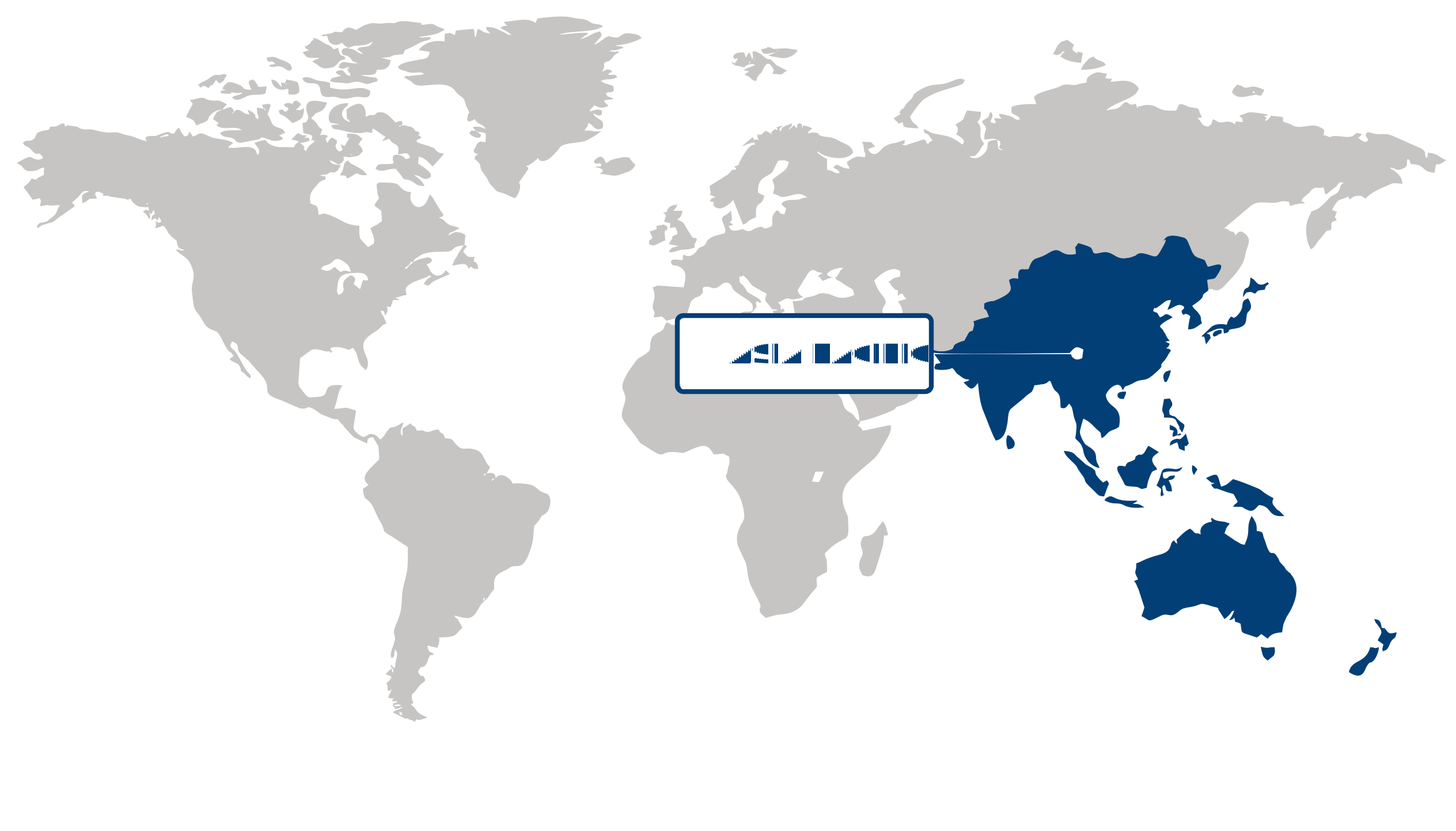
Asia Pacific (Largest Region)
Asia Pacific accounted for the largest share of the rubber tired gantry crane market, reaching 42.40% in 2026, owing to extensive port infrastructure, expanding container handling capacity, and sustained investment in logistics and trade-related facilities. The region's prominent role in global manufacturing and merchandise trade generates significant demand for efficient container movement and yard management solutions. Modernization of seaports and inland logistics facilities is further encouraging the deployment of automated and electrically powered crane systems that can improve operational efficiency while supporting emissions-reduction objectives. Continued expansion of transportation infrastructure and increasing focus on port productivity provide a strong foundation for the region's leading position.
Europe (Fastest-Growing Region)
Europe is the fastest-growing region, supported by ongoing port modernization, decarbonization initiatives, and increasing emphasis on efficient cargo-handling infrastructure. European logistics operators and port authorities are increasingly focused on reducing equipment emissions, improving energy efficiency, and upgrading aging handling systems, creating favorable conditions for advanced rubber tired gantry crane technologies. The transition toward cleaner terminal operations is also encouraging investment in electric and hybrid equipment, while the region's well-developed trade infrastructure supports demand for sophisticated yard-management solutions. These operational and environmental priorities are contributing to stronger adoption opportunities across European ports and logistics hubs.
| Parameter | North America | Asia Pacific | Europe | Latin America | MEA |
|---|---|---|---|---|---|
| Innovation Hub i Scale Nascent Developing Advanced | |||||
| Cost-Sensitive Region i Scale Low Medium High | |||||
| Regulatory Environment i Scale Restrictive Neutral Supportive | |||||
| Demand Drivers i Scale Weak Moderate Strong | |||||
| Development Stage i Scale Emerging Developing Developed | |||||
| Adoption Rate i Scale Low Medium High | |||||
| New Entrants / Startups i Scale Sparse Moderate Dense | |||||
| Macro Indicators i Scale Weak Stable Strong |
Key Country Insights
Germany 🇩🇪
Smart Terminal SolutionsGermany integrates rubber tired gantry cranes with intelligent logistics systems to improve terminal productivity and equipment utilization. Demand reflects continued investment in automated cargo handling and energy-efficient port infrastructure.
France 🇫🇷
Sustainable Port EquipmentFrance promotes rubber tired gantry cranes equipped with low-emission power systems and digital control technologies to support modern port operations. Infrastructure upgrades continue emphasizing operational flexibility and environmental performance.
Italy 🇮🇹
Terminal Modernization ProgramsItaly expands investments in rubber tired gantry cranes as ports modernize cargo handling infrastructure to improve logistics efficiency. Equipment selection increasingly reflects the need for flexible operations and reduced maintenance requirements.
Japan 🇯🇵
Precision Handling SystemsJapan prioritizes reliable rubber tired gantry crane solutions that support efficient container movement within highly organized port operations. Equipment suppliers focus on automation features and predictive maintenance capabilities that reduce operational disruptions.
South Korea 🇰🇷
Container Logistics EfficiencySouth Korea advances rubber tired gantry crane deployment as ports enhance container throughput and digital logistics capabilities. Operators increasingly favor equipment designed for efficient energy use and seamless integration with automated terminal systems.
United States 🇺🇸
Port Automation InvestmentThe U.S. continues modernizing container terminals through rubber tired gantry crane upgrades that improve operational efficiency and equipment reliability. Port operators increasingly adopt digital monitoring and automation technologies to optimize cargo handling performance.
Segment Leadership and Growth Trends
Rubber Tired Gantry Crane Market Share (%), by Type, 2026
Go beyond the chart, access full insights & data tables
Request Free Sample ReportType Segment Analysis: 16 Wheel (Largest Segment) vs 8 Wheel (Fastest-Growing Segment)
The 16 wheel segment dominated the rubber tired gantry crane market with a 60.24% share in 2026, supported by its suitability for demanding container handling operations requiring high lifting stability, load distribution, and operational reliability. These cranes are particularly valuable in large-scale container yards where frequent movement of heavy loads requires robust equipment capable of maintaining productivity across intensive handling cycles. Growing containerized trade and continued modernization of port and terminal infrastructure are reinforcing demand for higher-capacity configurations.
The 8 wheel segment is expected to register the fastest growth as terminal operators increasingly seek maneuverable and operationally efficient crane configurations for facilities where space utilization and equipment flexibility are important. Their relatively streamlined wheel arrangement can support movement within container yards while accommodating evolving terminal layouts. Increasing automation initiatives, modernization of smaller and medium-sized terminals, and demand for flexible cargo-handling equipment are supporting greater interest in 8 wheel rubber tired gantry cranes.
Power Supply Segment Analysis: Diesel (Largest Segment) vs Electric (Fastest-Growing Segment)
Diesel-powered rubber tired gantry cranes held the largest share of the rubber tired gantry crane market at 58.38% in 2026, reflecting their established use in container terminals where equipment requires independent mobility and dependable power availability. Diesel systems can support intensive crane operations without relying on fixed electrical infrastructure, making them suitable for yards with demanding operating schedules or layouts that require frequent equipment movement. Their established technology base and compatibility with existing terminal operations continue to sustain adoption.
Electric power supply is emerging as the fastest-growing segment as terminal operators place greater emphasis on reducing emissions, improving energy efficiency, and supporting cleaner cargo-handling operations. Electrification can also help lower dependence on conventional fuel during routine crane movements while supporting the broader transition toward environmentally responsible port infrastructure. Increasing sustainability objectives, investment in terminal modernization, and growing availability of charging and electrical infrastructure are encouraging the adoption of electric rubber tired gantry cranes.
| Segment | Sub-Segment | Largest Segment | Fastest Growing |
|---|---|---|---|
| Type | 8 Wheel, 16 Wheel | 16 Wheel | 8 Wheel |
| Power Supply | Diesel, Electric, Hybrid | Diesel | Electric |
Competitive Landscape and Market Positioning
Major players in the rubber tired gantry crane market:
1. Konecranes Plc (Finland)
2. Kalmar (Finland)
3. Liebherr Group (Germany)
4. SANY Group (China)
5. Shanghai Zhenhua Heavy Industries Co. Ltd. (China)
6. Mi-Jack Products (United States)
7. Anupam Industries Limited (India)
8. ElectroMech Material Handling Systems (India)
9. Terex Corporation (United States)
10. Doosan Corporation (South Korea)
Competitive activity in the rubber tired gantry crane market is increasingly centered on automation and digital integration within cargo handling operations. Manufacturers are focusing on intelligent crane systems equipped with remote monitoring, IoT-enabled controls, and energy-efficient operations to improve terminal productivity. Investments in advanced operational technologies are also supporting modernization across logistics and port infrastructure applications.
| Company | Market Share | Company Revenue | Revenue CAGR (%) | Product Portfolio | Geographic Presence | Innovation / R&D Focus | Strategic Developments |
|---|---|---|---|---|---|---|---|
| Konecranes Plc (Finland) | |||||||
| Kalmar (Finland) | |||||||
| Liebherr Group (Germany) | |||||||
| SANY Group (China) | |||||||
| Shanghai Zhenhua Heavy Industries Co. Ltd. (China) | |||||||
| Mi-Jack Products (United States) | |||||||
| Anupam Industries Limited (India) | |||||||
| ElectroMech Material Handling Systems (India) | |||||||
| Terex Corporation (United States) | |||||||
| Doosan Corporation (South Korea). |
Industry Development/News
| Company Name | Date | Key Development |
|---|---|---|
| DP World | May-25 | DP World initiated field testing of a hydrogen-powered rubber tired gantry crane at the Port of Vancouver. This development marks a material step in evaluating hydrogen fuel cell technology for heavy-duty container terminal equipment, aiming to reduce operational emissions and establish a scalable decarbonization model for global terminal networks. |
| DP World | Mar-24 | DP World committed US$50 million to expand container terminal operations at the Port of Santos. This capital investment is strategically designed to enhance overall terminal capacity and infrastructure, directly supporting increased cargo volume and the subsequent requirement for advanced container-handling equipment, including modern rubber tired gantry cranes to optimize yard performance. |
| Kobe-Osaka International Port | Feb-24 | Kobe-Osaka International Port launched a demonstration project featuring the world’s first rubber tired gantry crane retrofitted with a hydrogen engine. Located at the Hanshin Port Container Terminal, this project provides critical data on alternative-energy integration for cargo-handling equipment, advancing the industry's transition toward sustainable, decarbonized terminal operations. |
| Mi-Jack | Jun-23 | Mi-Jack introduced semi-autonomous functionality for its Travelift RTG cranes, enabling multi-machine operation without onboard personnel. By integrating auto-spreader technology, the system eliminates manual rigging requirements. This innovation significantly enhances operational efficiency and safety in industrial handling environments, representing a shift toward autonomous infrastructure in material handling and port logistics. |
| Kuenz | Sep-22 | Kuenz secured a contract to supply 20 sideloaded stacking automated cranes for the T3 terminal at Baltic Hub. Finalized in September 2022, this partnership with PSA underscores the trend toward terminal automation and capacity expansion in strategic European port locations, leveraging integration with ABB systems to enhance operational throughput. |
| PACECO CORP | Jan-22 | PACECO CORP was contracted by ITS to supply five RTG Transtainer cranes and five 65-ton capacity Ship to Shore Portainer cranes for a terminal modernization project in Long Beach. This investment facilitates the handling of ultra-large container vessels up to 24,000 TEUs, significantly upgrading terminal throughput capacity and operational infrastructure. |
Customize Your Report
Explore examples of how this report can be tailored to different research needs, including custom segments, additional topics or chapters, and related reports. Click a section of the wheel or its numbered marker to explore the available options.
Rubber Tired Gantry Crane Market — Custom Segments
| Segment | Sub-Segment |
|---|---|
| Lifting Capacity | Up to 40 Tons, 40–60 Tons, Above 60 Tons |
| Automation Level | Manual & Operator-Controlled, Semi-Automated, Fully Automated |
| Ownership Model | Direct Ownership, Equipment Leasing, Rental & Contract-Based Operation |
Rubber Tired Gantry Crane Market — Custom TOC
| Custom Chapter | Custom Details |
|---|---|
| Port Automation Investment Outlook |
|
| Container Terminal Modernization Pipeline |
|
| Aftermarket Service and Lifecycle Revenue Analysis |
|
Need a different cut of the data?
Request Custom ResearchHow much is the rubber tired gantry crane market worth?
What is the expected industry size of rubber tired gantry crane by 2036?
How is port modernization reshaping purchasing priorities in the rubber tired gantry crane market?
Which technology trends are driving operational upgrades in the rubber tired gantry crane market?
Why is the 16 Wheel segment the largest type category in the rubber tired gantry crane market?
Which power supply segment is growing fastest in the rubber tired gantry crane market?
Why does Asia Pacific hold the largest share of the rubber tired gantry crane market?
What is driving Europe’s growth in this market?
What are the key competitors in the rubber tired gantry crane landscape?
Our Clients
"The team at Fundamental Business Insights & Consulting demonstrated a commitment to excellence, not only in the quality of the report but also in their client-centric approach."
FANUC
"The level of detail in the market segmentation provided were particularly noteworthy. The detailed country-level insights were also very helpful."
B&R Industrial Automation GmbH
"The consultant took the time to understand our specific business objectives, ensuring that the reports were tailored to address our unique challenges and opportunities."
KUKA SE & Co. KGaA
Our Research Team & Methodology
Every Fundamental Business Insights report is built by a dedicated vertical research team, validated through a structured primary-and-secondary methodology, and reviewed for accuracy before it reaches you.
Research Team Overview
Prepared by the Industrial Automation & Equipment Research Team
Delivery
Published
Demand
Available
Support
Trust & Compliance
Research Domains
10 coverage areasResearch Intelligence
| Source | Reference |
|---|---|
| International Society of Automation (ISA) | www.isa.org |
| International Organization for Standardization (ISO) | www.iso.org |
| National Institute of Standards and Technology (NIST) | www.nist.gov |
| IEEE | www.ieee.org |
| VDMA (German Mechanical Engineering Industry Association) | www.vdma.org |
| Association for Advancing Automation (A3) | www.automate.org |
| International Federation of Robotics (IFR) | ifr.org |
| ASME (American Society of Mechanical Engineers) | www.asme.org |
| ASHRAE | www.ashrae.org |
| American Society of Heating, Refrigerating and Air-Conditioning Engineers (ASHRAE) | www.ashrae.org |
| Material Handling Industry (MHI) | www.mhi.org |
| OSHA (Occupational Safety and Health Administration) | www.osha.gov |
| National Fire Protection Association (NFPA) | www.nfpa.org |
| ASTM International | www.astm.org |
| International Electrotechnical Commission (IEC) | www.iec.ch |
| Open Process Automation Forum (The Open Group) | www.opengroup.org/open-process-automation-forum |
| AGMA (American Gear Manufacturers Association) | www.agma.org |
| Association of Equipment Manufacturers (AEM) | www.aem.org |
| Food and Agriculture Organization (FAO) | www.fao.org |
| International Labour Organization (ILO) | www.ilo.org |
Research Workflow & Quality Assurance
Data Collection
Verified information gathered through primary and secondary research.
Data Triangulation
Cross-validation using multiple independent data sources.
Forecast Modelling
Market estimates developed using historical trends and analytical models.
Analyst Validation
Findings reviewed by domain experts for accuracy and consistency.
Editorial & Quality Review
Final editorial, quality, and compliance checks before publication.
Final Publication
Released after successful completion of the internal review process.
Report Coverage
📊 Market Assessment
- Market Size & Forecast
- Market Segmentation
- Regional Analysis
- Growth Drivers & Challenges
- Market Dynamics
🏢 Competitive Intelligence
- Competitive Landscape
- Company Profiles
- Competitive Benchmarking
- Mergers & Acquisitions
- Market Share Analysis or Key Company Strategies
🔍 Strategic Analysis
- Value Chain Analysis
- Porter's Five Forces
- PESTLE Analysis
- Pricing Trends
- Supply-Demand Analysis
🚀 Future Outlook
- Technology Landscape
- Regulatory Landscape
- Investment & Funding Landscape
- Emerging Opportunities
- Future Market Outlook
Have a question about this report or need a custom scope?
Request Customization