Rock Breaker Market Size & Growth Forecast 2027–2036, By Segments (Product, Type, Equipment Size, End Use, Application), Regional Demand Trends (North America, Asia Pacific, Europe), Key Country Insights (U.S., Japan, South Korea, Germany, France, Italy), and Competitive Landscape
Market Size and Growth Outlook
Rock Breaker Market size was around USD 3.4 Billion in 2026 and is slated to grow at 7.95% CAGR from 2027 to 2036, attaining USD 7.31 Billion by 2036. The industry revenue for 2027 is estimated at USD 3.63 Billion.
Get more details on this report
Request Free Sample ReportRock Breaker Market Intelligence Snapshot
Regional Market Dynamics
- Asia Pacific held a 39.96% share in 2026, driven by construction, infrastructure development, mining, urban expansion, and growing adoption of mechanized excavation equipment.
- North America is growing fastest through infrastructure renewal, construction and mining investment, resource development, and demand for productive, precise, and safer equipment.
Segment Momentum
- Hydraulic rock breakers held a 69.12% share in 2026 due to their high breaking power, precise operation, and compatibility with excavators, making them the preferred choice for mining and construction projects.
- Large equipment size is the fastest-growing segment as expanding mining, quarrying, and infrastructure projects increase demand for heavy-duty equipment capable of handling more demanding excavation tasks.
Market Expansion Drivers
- Increasing infrastructure development projects driving demand for heavy rock breaking equipment
- Rising mining and quarrying activities expanding deployment of hydraulic rock breakers
- Adoption of automated construction equipment improving productivity in excavation operations
Leading Market Participants
- Key companies in the rock breaker market include Caterpillar Inc. (United States), Komatsu Ltd. (Japan), Volvo Construction Equipment (Sweden), Hitachi Construction Machinery Co., Ltd. (Japan), Sandvik AB (Sweden), Epiroc AB (Sweden), JCB Ltd. (United Kingdom), Furukawa Rock Drill Co., Ltd. (Japan), Doosan Infracore Co., Ltd. (South Korea), NPK Construction Equipment, Inc. (United States)
Global Market Forecast Snapshot
Market Outlook
- 2026 Market Size: USD 3.4 Billion
- 2027 Estimated Market Size: USD 3.63 Billion
- Projected Market Size: USD 7.31 Billion by 2036
- Growth Forecast: 7.95% CAGR (2027-2036)
Regional and Segment Outlook
- Leading Regional Market: Asia Pacific
- High-Growth Regional Hub: North America
- Core Revenue Segment: Premium (Product) | Hydraulic (Type) | Medium (Equipment Size) | Construction (End Use) | Quarrying (Application)
- Emerging Opportunity Segment: Premium (Product) | Pneumatic (Type) | Large (Equipment Size) | Mining (End Use) | Tunneling (Application)
Market Growth Drivers and Industry Trends
Increasing infrastructure development projects driving demand for heavy rock breaking equipment
Large-scale transportation, urban development, and public utility projects continue to create extensive excavation requirements, and the rock breaker market growth is closely linked to rising demand for equipment capable of handling challenging geological conditions. Contractors rely on heavy-duty rock breakers to prepare construction sites, remove hard formations, and improve project efficiency where conventional excavation methods are insufficient. Expanding investments in roads, railways, tunnels, dams, and commercial developments further increase equipment utilization, while project timelines encourage the adoption of durable machinery that can withstand continuous operation in demanding environments.
Rising mining and quarrying activities expanding deployment of hydraulic rock breakers
Expanding mineral extraction and aggregate production are creating sustained equipment requirements that will propel the rock breaker market growth across mining and quarrying operations. Hydraulic rock breakers play a critical role in fragmenting oversized rocks, improving material handling, and supporting efficient extraction processes where blasting is limited or unsuitable. Operators increasingly seek equipment capable of delivering consistent performance under harsh working conditions while reducing equipment downtime and maintenance interruptions. The need to improve operational efficiency across open-pit mines and quarry sites also supports wider deployment of advanced hydraulic attachments compatible with modern excavators.
Adoption of automated construction equipment improving productivity in excavation operations
Automation is becoming an important differentiator for heavy equipment manufacturers, and the rock breaker market benefits from construction companies integrating intelligent machinery into excavation workflows. Automated control systems improve precision during rock fragmentation, reduce operator fatigue, and support more consistent equipment performance across complex job sites. Integration with digital fleet management platforms also enables better equipment monitoring, maintenance scheduling, and operational planning, helping contractors optimize machine utilization. These capabilities are particularly valuable for projects requiring continuous excavation activities under strict productivity and safety requirements.
| Growth Driver | Impact on CAGR | Regulatory Influence | Geographic Relevance | Adoption Rate | Impact Timeline |
|---|---|---|---|---|---|
| Increasing infrastructure development projects driving demand for heavy rock breaking equipment | 2% | Moderate | Asia Pacific, Middle East & Africa | High | Near Term |
| Rising mining and quarrying activities expanding deployment of hydraulic rock breakers | 1.8% | Moderate | Asia Pacific, Latin America | High | Mid Term |
| Adoption of automated construction equipment improving productivity in excavation operations | 1.5% | Low | North America, Europe | Medium | Mid Term |
Unlock insights tailored to your business with our bespoke market research solutions.
Click to get your customized report now.
Regional Demand Dynamics
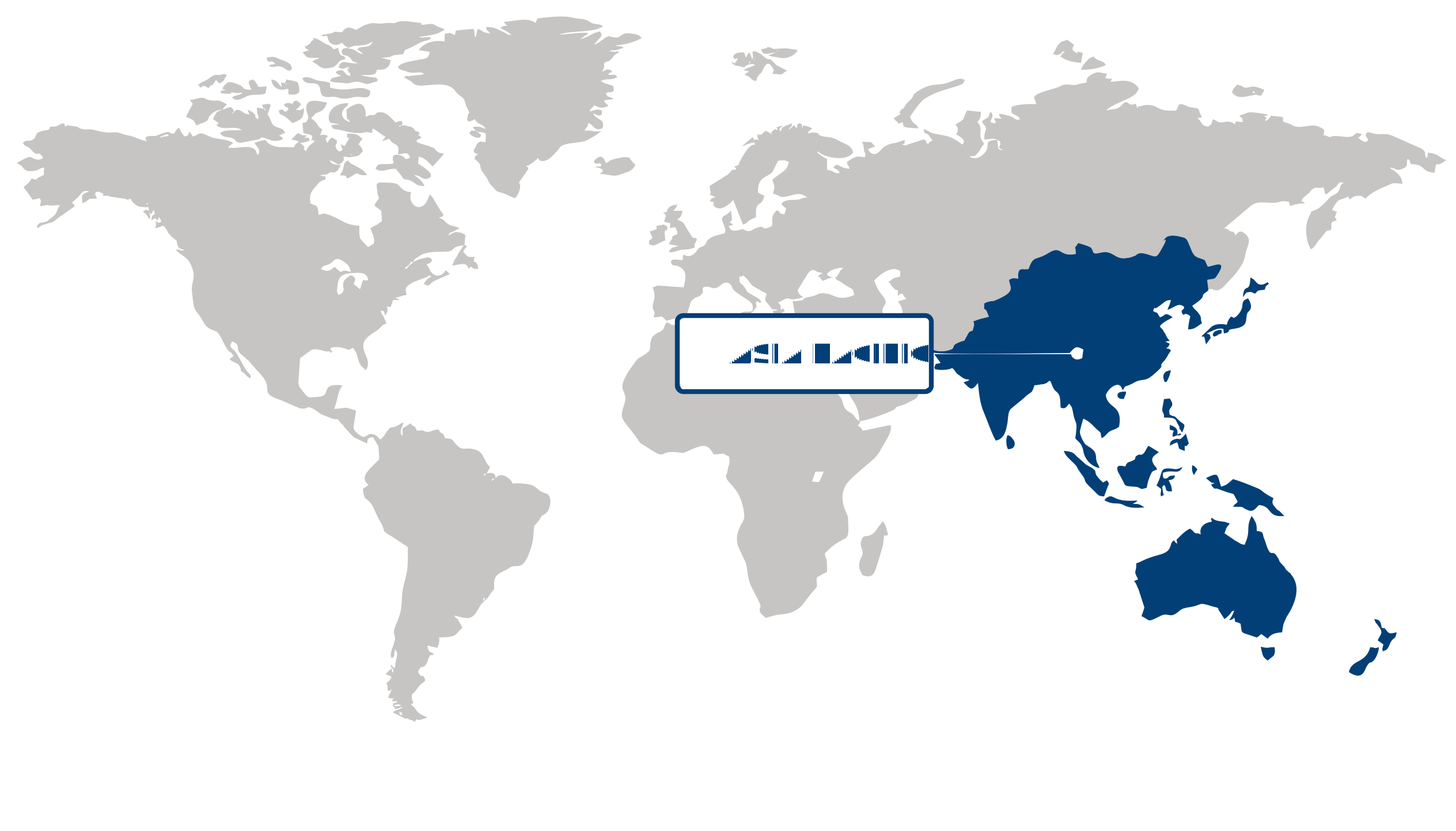
Asia Pacific (Largest Region)
Asia Pacific dominated the rock breaker market in 2026, capturing a 39.96% share, supported by extensive construction activity, infrastructure development, mining operations, and urban expansion across the region. Demand for hydraulic and other mechanized rock-breaking equipment is closely linked to large-scale excavation, road development, tunneling, quarrying, and resource extraction projects. Ongoing industrialization and infrastructure modernization are creating sustained requirements for equipment capable of improving excavation efficiency and reducing reliance on labor-intensive breaking methods. The expansion of mining and construction activities, together with greater adoption of mechanized equipment, reinforces the region’s position as a major market for rock breakers.
North America (Fastest-Growing Region)
North America is experiencing the fastest growth, encouraged by infrastructure renewal, construction activity, and continued investment in mining and resource development. Contractors are increasingly seeking equipment that can improve operational productivity, precision, and safety in demanding excavation environments. Advances in hydraulic systems and equipment design are also supporting the adoption of more efficient rock-breaking solutions across construction, demolition, quarrying, and mining applications. In addition, the modernization of existing infrastructure and continued development of resource-intensive projects are creating favorable conditions for further market expansion.
| Parameter | North America | Asia Pacific | Europe | Latin America | MEA |
|---|---|---|---|---|---|
| Innovation Hub i Scale Nascent Developing Advanced | |||||
| Cost-Sensitive Region i Scale Low Medium High | |||||
| Regulatory Environment i Scale Restrictive Neutral Supportive | |||||
| Demand Drivers i Scale Weak Moderate Strong | |||||
| Development Stage i Scale Emerging Developing Developed | |||||
| Adoption Rate i Scale Low Medium High | |||||
| New Entrants / Startups i Scale Sparse Moderate Dense | |||||
| Macro Indicators i Scale Weak Stable Strong |
Key Country Insights
United States 🇺🇸
Infrastructure Equipment DemandThe U.S. rock breaker market is supported by infrastructure upgrades, quarry operations, and mining activities requiring reliable heavy-duty attachments. U.S. equipment buyers increasingly prioritize productivity, equipment durability, and simplified maintenance to improve project efficiency.
Germany 🇩🇪
Precision Equipment IntegrationGermany emphasizes technologically advanced rock breakers that integrate with modern construction and quarry equipment. German manufacturers focus on operational efficiency, lower vibration, and equipment longevity to meet demanding industrial applications.
Japan 🇯🇵
Compact Performance SolutionsJapan favors compact, efficient rock breakers suited for urban construction and space-constrained infrastructure projects. Japanese equipment suppliers prioritize hydraulic efficiency and reduced operating noise while maintaining consistent breaking performance.
South Korea 🇰🇷
Heavy Machinery CompatibilitySouth Korea strengthens demand for rock breakers through construction equipment manufacturing and infrastructure development. South Korean suppliers focus on attachment compatibility, durability, and efficient hydraulic performance across diverse excavation applications.
France 🇫🇷
Quarry Operations SupportFrance relies on rock breakers for quarry production, road construction, and civil engineering projects requiring dependable material fragmentation. French equipment users increasingly seek solutions that balance productivity with lower maintenance requirements and operational efficiency.
Italy 🇮🇹
Construction Fleet ModernizationItaly continues modernizing construction equipment fleets with hydraulic rock breakers that improve excavation efficiency and equipment utilization. Italian contractors increasingly value versatile attachments capable of supporting infrastructure renovation and quarry operations.
Segment Leadership and Growth Trends
Rock Breaker Market Share (%), by Product, 2026
Go beyond the chart, access full insights & data tables
Request Free Sample ReportProduct Segment Analysis: Premium (Largest & Fastest-Growing Segment)
The premium segment dominated the rock breaker market with a 59.52% share in 2026 and is also expected to remain the fastest-growing segment during the forecast period. Demand for premium rock breakers is driven by the increasing need for high-performance equipment capable of operating under demanding mining, quarrying, and construction conditions while maintaining durability and productivity. These products are designed to deliver superior impact force, longer service life, and reduced maintenance requirements, enabling operators to improve operational efficiency and minimize equipment downtime. Growing investments in large-scale infrastructure development and mining activities, coupled with the preference for technologically advanced machinery that offers greater reliability and lower lifecycle costs, continue to reinforce the segment's leading position.
Type Segment Analysis: Hydraulic (Largest Segment) vs Pneumatic (Fastest-Growing Segment)
The hydraulic segment led the rock breaker market with a 69.12% share in 2026. Hydraulic rock breakers are extensively used because they provide high breaking power, precise operation, and compatibility with a wide range of excavators and heavy construction equipment. Their ability to efficiently break hard rock and reinforced concrete while maintaining consistent performance has made them the preferred choice across mining, demolition, and infrastructure projects. Continuous advancements in hydraulic systems and increasing adoption of automated construction equipment have further strengthened the segment's dominance.
The pneumatic segment is anticipated to witness the fastest growth during the forecast period. Rising demand for lightweight and portable rock-breaking equipment in specific construction, quarrying, and maintenance applications is supporting the adoption of pneumatic systems. Their relatively simple design, ease of operation, and suitability for environments where hydraulic systems may be less practical are expected to contribute to sustained market expansion.
Equipment Size Segment Analysis: Medium (Largest Segment) vs Large (Fastest-Growing Segment)
Holding the largest position in the rock breaker market, the medium equipment size segment accounted for the dominant share in 2026. Medium-sized rock breakers offer an effective balance between power, operational flexibility, and compatibility with commonly used construction and mining equipment. Their versatility enables deployment across a broad range of excavation, demolition, and quarrying applications, making them a preferred solution for contractors seeking efficient performance across diverse project requirements.
The large equipment size segment is expected to register the fastest growth during the forecast period. Expanding mining operations, major infrastructure developments, and large-scale quarrying projects are increasing demand for heavy-duty rock breakers capable of handling more challenging excavation tasks. As project complexity and productivity requirements continue to rise, adoption of larger-capacity equipment is expected to accelerate.
| Segment | Sub-Segment | Largest Segment | Fastest Growing |
|---|---|---|---|
| Product | Premium, Non-premium | Premium | Premium |
| Type | Hydraulic, Pneumatic, Others | Hydraulic | Pneumatic |
| Equipment Size | Small, Medium, Large | Medium | Large |
| End Use | Construction, Mining, Government, Private | Construction | Mining |
| Application | Quarrying, Demolition, Tunneling, Scaling, Others | Quarrying | Tunneling |
Competitive Landscape and Market Positioning
Top players in the rock breaker market:
- Caterpillar, Inc. (United States)
- Komatsu Ltd. (Japan)
- Volvo Construction Equipment (Sweden)
- Hitachi Construction Machinery Co., Ltd. (Japan)
- Sandvik AB (Sweden)
- Epiroc AB (Sweden)
- JCB Ltd. (United Kingdom)
- FurUKawa Rock Drill Co., Ltd. (Japan)
- Doosan Infracore Co., Ltd. (South Korea)
- NPK Construction Equipment, Inc. (United States)
Demand for equipment capable of operating efficiently across varied mining, quarrying, and construction environments is changing how suppliers compete in the rock breaker market. Manufacturers are placing greater emphasis on durability, hydraulic efficiency, and compatibility with multiple carrier platforms, while aftermarket support and rapid availability of replacement components have become increasingly influential in purchasing decisions. Competitive differentiation is also emerging through equipment reliability in demanding operating conditions, as customers place growing value on minimizing downtime and extending service intervals instead of focusing solely on initial equipment acquisition.
| Company | Market Share | Company Revenue | Revenue CAGR (%) | Product Portfolio | Geographic Presence | Innovation / R&D Focus | Strategic Developments |
|---|---|---|---|---|---|---|---|
| Caterpillar Inc. (United States) | |||||||
| Komatsu Ltd. (Japan) | |||||||
| Volvo Construction Equipment (Sweden) | |||||||
| Hitachi Construction Machinery Co. Ltd. (Japan) | |||||||
| Sandvik AB (Sweden) | |||||||
| Epiroc AB (Sweden) | |||||||
| JCB Ltd. (United Kingdom) | |||||||
| Furukawa Rock Drill Co. Ltd. (Japan) | |||||||
| Doosan Infracore Co. Ltd. (South Korea) | |||||||
| NPK Construction Equipment Inc. (United States) |
Industry Development/News
| Company Name | Date | Key Development |
|---|---|---|
| Normet Xrock | Dec-25 | Normet Xrock launched the Xrock Autobreaker, an autonomous underground rock-breaking system designed to remove human operators from hazardous zones. The solution provides continuous, reliable operation in high-risk mining environments, marking a significant advancement in site safety and the automation of underground material processing workflows. |
| Sandvik | Dec-25 | Sandvik acquired an industrial IoT platform provider to integrate advanced digital connectivity into its Rammer rock breaker portfolio. This move facilitates enhanced telematics, remote monitoring, and predictive maintenance capabilities, transitioning the company toward service-oriented business models and improving uptime for operators in mining and construction. |
| Furukawa Rock Drill | Nov-25 | Furukawa Rock Drill introduced a remote-controlled hydraulic breaker specifically for underground mining scaling operations. By allowing operators to manage equipment from up to 100 meters away, the system eliminates exposure to high-risk environments and has demonstrated a 30% increase in productivity in initial deployments in Australia and Canada. |
| NPK Construction Equipment | Oct-25 | NPK Construction Equipment opened a new distribution center in Singapore to serve the Southeast Asian market. The facility consolidates parts warehousing, technical training, and customer service operations to support the growing regional demand for heavy equipment and maintenance solutions in Indonesia, Thailand, Vietnam, the Philippines, and Malaysia. |
| Indeco | Aug-25 | Indeco launched a specialized hydraulic underwater breaker engineered for marine construction and dam maintenance. Equipped with corrosion-resistant materials and enhanced sealing systems, the tool supports specialized demolition and underwater concrete repair projects, expanding the company’s reach into complex marine infrastructure applications. |
| Volvo Construction Equipment | Jul-25 | Volvo Construction Equipment partnered with an autonomous systems developer to create self-operating excavators integrated with rock breakers. By leveraging AI and computer vision, the initiative aims to commercialize fully autonomous rock-breaking solutions for quarries and mining applications by 2028, targeting significant gains in operational consistency. |
| Toku | Apr-25 | Toku introduced the Striker Rock Breaker System, a solution designed for direct mounting onto crushers to prevent blockages in hoppers. The system improves material flow and minimizes costly operational downtime caused by oversized rock fragments, providing a targeted performance enhancement for primary crushing and mineral processing operations. |
| Epiroc | — | Epiroc launched an intelligent breaker platform utilizing AI-based control systems and cloud-connected telematics. The technology enables real-time performance optimization by automatically adjusting impact frequency based on material hardness, resulting in a 15% efficiency increase and 25% improvement in component lifespan, while supporting predictive maintenance protocols. |
| Caterpillar | — | Caterpillar announced a development program for electric hydraulic breakers compatible with emerging electric excavator platforms. Targeting a 2028 commercial launch, the program focuses on medium-duty breakers for urban demolition and construction, supporting the industry-wide transition toward zero-emission machinery in environmentally sensitive and regulated project environments. |
| Komatsu | — | Komatsu invested USD 50 million to expand its Indian manufacturing facility, increasing production capacity for rock breakers by 40%. The expansion incorporates advanced manufacturing and testing infrastructure to meet the rising demand for heavy equipment across South Asia and the Middle East, strengthening its regional supply chain and export capabilities. |
Customize Your Report
Explore examples of how this report can be tailored to different research needs, including custom segments, additional topics or chapters, and related reports. Click a section of the wheel or its numbered marker to explore the available options.
Rock Breaker Market — Custom Segments
| Segment | Sub-Segment |
|---|---|
| Carrier Equipment | Excavators, Backhoe Loaders, Skid Steer Loaders, Wheel Loaders |
| Sales Model | Direct Sales, Distributor Sales, Dealer Sales |
| Rental vs. Ownership | Equipment Ownership, Equipment Rental, Equipment Leasing |
Rock Breaker Market — Custom TOC
| Custom Chapter | Custom Details |
|---|---|
| Construction Equipment Fleet Modernization |
|
| Quarry & Mining Adoption Strategy |
|
| Aftermarket Service Network Strategy |
|
Need a different cut of the data?
Request Custom ResearchWhat is the current revenue of the rock breaker market?
How much is the rock breaker industry expected to grow by 2036?
How are infrastructure and mining investments influencing rock breaker deployment?
How is automation improving productivity in rock breaking operations?
Why are hydraulic rock breakers the leading type in the market?
What is fueling the growth of large equipment size rock breakers?
Why does Asia Pacific dominate the rock breaker market?
How is North America supporting faster rock breaker market growth?
Which companies are driving growth in the rock breaker landscape?
Our Clients
"Your insights on workforce structures were spot-on. The analysis on mid-to-senior level roles validated some of our hiring decisions and highlighted gaps."
Ateliers De France
"The report gave us insights on competitors in the market. It helped our team refine our bidding strategy for upcoming contracts."
Clark Construction
"The reports provided a deep dive into market trends, and competitive landscape. The strategic insights and recommendations have been very helpful."
Rudolph and Sletten
Our Research Team & Methodology
Every Fundamental Business Insights report is built by a dedicated vertical research team, validated through a structured primary-and-secondary methodology, and reviewed for accuracy before it reaches you.
Research Team Overview
Prepared by the Construction & Manufacturing Research Team
Delivery
Published
Demand
Available
Support
Trust & Compliance
Research Domains
10 coverage areasResearch Intelligence
| Source | Reference |
|---|---|
| International Organization for Standardization (ISO) | www.iso.org |
| ASTM International | www.astm.org |
| National Institute of Standards and Technology (NIST) | www.nist.gov |
| International Code Council (ICC) | www.iccsafe.org |
| American Concrete Institute (ACI) | www.concrete.org |
| American Institute of Steel Construction (AISC) | www.aisc.org |
| Construction Industry Institute (CII) | www.construction-institute.org |
| Associated General Contractors of America (AGC) | www.agc.org |
| Association of Equipment Manufacturers (AEM) | www.aem.org |
| Building Owners and Managers Association (BOMA) | www.boma.org |
| American Society of Civil Engineers (ASCE) | www.asce.org |
| National Ready Mixed Concrete Association (NRMCA) | www.nrmca.org |
| International Facility Management Association (IFMA) | www.ifma.org |
| World Green Building Council (WorldGBC) | worldgbc.org |
| International Federation of Consulting Engineers (FIDIC) | fidic.org |
| International Labour Organization (ILO) | www.ilo.org |
| American Society of Mechanical Engineers (ASME) | www.asme.org |
| Society of Manufacturing Engineers (SME) | www.sme.org |
| National Association of Home Builders (NAHB) | www.nahb.org |
| European Construction Industry Federation (FIEC) | www.fiec.eu |
Research Workflow & Quality Assurance
Data Collection
Verified information gathered through primary and secondary research.
Data Triangulation
Cross-validation using multiple independent data sources.
Forecast Modelling
Market estimates developed using historical trends and analytical models.
Analyst Validation
Findings reviewed by domain experts for accuracy and consistency.
Editorial & Quality Review
Final editorial, quality, and compliance checks before publication.
Final Publication
Released after successful completion of the internal review process.
Report Coverage
📊 Market Assessment
- Market Size & Forecast
- Market Segmentation
- Regional Analysis
- Growth Drivers & Challenges
- Market Dynamics
🏢 Competitive Intelligence
- Competitive Landscape
- Company Profiles
- Competitive Benchmarking
- Mergers & Acquisitions
- Market Share Analysis or Key Company Strategies
🔍 Strategic Analysis
- Value Chain Analysis
- Porter's Five Forces
- PESTLE Analysis
- Pricing Trends
- Supply-Demand Analysis
🚀 Future Outlook
- Technology Landscape
- Regulatory Landscape
- Investment & Funding Landscape
- Emerging Opportunities
- Future Market Outlook
Have a question about this report or need a custom scope?
Request Customization