Renewable Energy Investments Market Size & Forecasts 2026-2035, By Segments (Sector, Industry), Growth Opportunities, Innovation Landscape, Regulatory Shifts, Strategic Regional Insights (U.S., Japan, China, South Korea, UK, Germany, France), and Competitive Dynamics (NextEra Energy, Enel, Iberdrola, Orsted, Vestas)
Market Size and Growth Outlook
Renewable Energy Investments Market size is predicted to expand from USD 1.61 trillion in 2025 to USD 4.21 trillion by 2035, with growth underpinned by a CAGR above 10.1% between 2026 and 2035. The industry revenue outlook for 2026 is USD 1.75 trillion.
Get more details on this report
Request Free Sample ReportRenewable Energy Investments Market Intelligence Snapshot
Regional Market Dynamics
Segment Momentum
Market Expansion Drivers
Leading Market Participants
Global Market Forecast Snapshot
Market Outlook
Regional and Segment Outlook
Market Growth Drivers and Industry Trends
Government policies and tax incentives have become pivotal in accelerating the renewable energy investments market. Regulatory bodies such as the U.S. Department of Energy and the European Commission have introduced robust frameworks like Investment Tax Credits (ITCs) and accelerated depreciation to reduce upfront costs and enhance project viability. These actions stimulate capital inflows by mitigating financial risks, encouraging institutional investors and private equity firms to increase exposure to renewables. For established corporations, incentives lower barriers to scaling operations, while startups can leverage government grants to innovate in emerging technologies. The continued expansion of such programs worldwide signals a strategic advantage for market participants that actively engage with evolving policy landscapes, ensuring competitive positioning as regulatory environments tighten around carbon-intensive alternatives.
Institutional & Private Renewable Investments
The surge in institutional and private renewable investments is reshaping the renewable energy investments market by diversifying funding sources and deepening capital pools. Leading asset managers like BlackRock and pension funds such as Canada Pension Plan Investment Board have significantly raised allocations to clean energy projects, reflecting growing demand for sustainable portfolios. This influx drives broader market liquidity and supports the development of large-scale infrastructure, facilitating economies of scale. Traditional energy firms see strategic opportunities to partner with these investors to de-risk ventures, while private equity can focus on early-stage innovation. This trend underpins a more resilient market structure, with a growing pipeline of finance-ready projects that align with global sustainability commitments mandated by entities like the International Energy Agency.
Emerging Market Infrastructure Expansion
Infrastructure expansion in emerging markets is increasingly influential in shaping the renewable energy investments market through the rising energy needs and urbanization processes in these regions. Countries in Asia, Africa, and Latin America are witnessing accelerated deployment of solar and wind capacities supported by multilaterals such as the World Bank and regional development banks. This expansion meets expanding electricity demand while bypassing legacy fossil fuel dependencies, thus attracting global investors aiming for yield and impact. Established multinationals gain market entry by collaborating with local developers, while new entrants can capitalize on less saturated landscapes with innovative off-grid and microgrid solutions. The ongoing infrastructure build-out is thus creating a dynamic, diversified investment terrain crucial for long-term market stability and growth.
Industry Restraints:
Regulatory Complexity and Inconsistency
The renewable energy investment market faces significant constraints from uneven and evolving regulatory frameworks across key regions, complicating project development and financing. Diverse permitting requirements and shifting subsidy policies create operational uncertainties, discouraging both incumbent utilities and emerging clean-tech firms from scaling investments. For instance, the U.S. Federal Energy Regulatory Commission’s patchwork of state-level regulations often delays project approvals, while the European Commission’s frequent adjustments to renewable support mechanisms increase compliance costs, as highlighted in reports by the International Renewable Energy Agency (IRENA). This regulatory mosaic forces investors to allocate greater resources toward legal and administrative processes, diminishing capital efficiency. Companies must balance regional regulatory risk against their strategic expansion plans, often retreating from markets where policy volatility undermines predictable returns. Moving forward, unless harmonization efforts gain traction—such as the EU’s Green Deal initiatives—regulatory complexity will persist as a critical barrier, particularly affecting cross-border investments and integrated renewable infrastructure development.
Supply Chain Bottlenecks and Material Scarcity
The renewable energy sector’s growth is increasingly hampered by persistent supply chain disruptions and critical raw material shortages, impeding timely project execution and inflating costs. Global dependencies on specialized components—such as photovoltaic cells, wind turbine blades, and lithium for battery storage—are exemplified by supply constraints reported by Tesla and Siemens Gamesa, which have publicly disclosed project delays linked to material scarcity and logistics challenges. According to the World Economic Forum, rare earth elements’ concentrated production in select countries introduces geopolitical risks that further strain supply reliability. Such vulnerabilities compel investors and developers to factor in extended lead times and cost overruns, disproportionately impacting smaller players lacking diversified supply agreements or vertical integration capabilities. Addressing these bottlenecks demands strategic partnerships and investment in alternative materials or circular economy models. Without significant innovation and supply chain resilience improvements, these constraints will continue to throttle capital deployment velocity across renewables globally.
| Growth Driver | Impact on CAGR | Regulatory Influence | Geographic Relevance | Adoption Rate | Impact Timeline |
|---|---|---|---|---|---|
| Institutional & Private Renewable Investments | 3.50% | Short term (≤ 2 yrs) | North America, Europe; Spillover: Asia Pacific | Medium | Fast |
| Policy Support & Tax Incentives for Investors | 3.00% | Medium term (2–5 yrs) | Europe, North America; Spillover: Asia Pacific | High | Fast |
| Emerging Market Infrastructure Expansion | 3.00% | Long term (5+ yrs) | Asia Pacific, Latin America; Spillover: North America | Medium | Moderate |
Unlock insights tailored to your business with our bespoke market research solutions.
Click to get your customized report now.
Regional Demand Dynamics
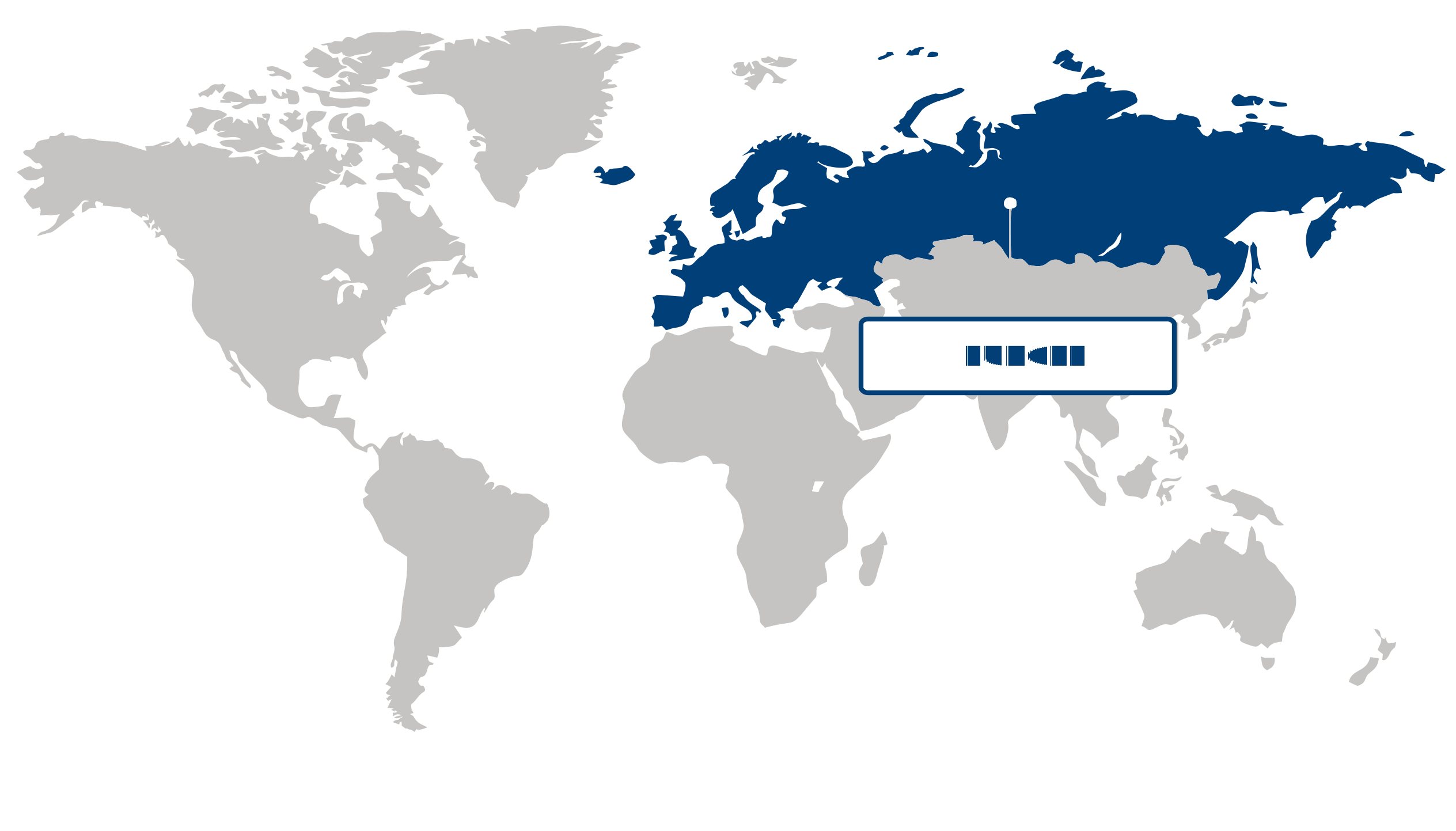
Europe dominated the renewable energy investments market in 2025, capturing over 44% of the global share. This leadership stems from the region's robust commitment to achieving net-zero emissions by 2050, which fosters significant green financing initiatives. Government bodies like the European Investment Bank have intensified funding for clean energy projects, while policies from the European Commission mandate aggressive shifts toward sustainable energy. Such regulatory frameworks, combined with increasing capital flow from green bonds and sustainability-linked loans, accelerate deployment of wind, solar, and biomass technologies. Moreover, Europe's energy transition is buoyed by a mature technological ecosystem and responsive consumer bases adapting to cleaner energy solutions. This alignment of finance, policy, and technology positions Europe as a prime hub for innovation and infrastructure expansion in renewable energy investments.
Germany stands as a powerhouse within Europe’s renewable energy investments market, driven by its expansive Energiewende policy promoting renewable capacity growth. The German government’s consistent subsidies for solar and wind, highlighted through the Federal Ministry for Economic Affairs and Energy, stimulate private sector involvement and technology upgrades. Companies such as Siemens Gamesa and EnBW reinforce the country’s leadership with strategic investments in offshore wind farms. This momentum not only consolidates Germany’s role as an industry innovator but also underpins Europe’s broader market expansion by serving as a benchmark for integrating renewables at scale.
France plays a strategic role in Europe’s renewable energy investments market, leveraging its nuclear phase-down plans to intensify renewable deployment. The French government, through ADEME (Agency for Ecological Transition), incentivizes solar and green hydrogen projects, fostering diversified energy solutions. Large utilities like Engie are increasing capital allocations to wind and solar, supported by the Multiannual Energy Programme (PPE). Cultural acceptance and shifting energy consumption patterns reinforce demand for sustainable alternatives. France’s approach complements wider European efforts, promoting a balanced energy mix that enhances regional resilience and unlocks further investment prospects across renewable technologies.
Asia Pacific Market Analysis:
Asia Pacific emerged as the fastest-growing region in the renewable energy investments market, registering a robust CAGR of 14.14%. This rapid expansion is largely driven by significant government-backed infrastructure projects and favorable tax subsidies that incentivize both domestic and foreign investments. Countries in this region are increasingly prioritizing sustainability by aggressively scaling up renewable capacity to meet rising energy demands and reduce carbon footprints, as evidenced by strategic plans shared by the Asia-Pacific Economic Cooperation (APEC). Enhanced regulatory frameworks and a shift toward digital energy management technologies have further strengthened market dynamics. The region’s vast and diverse consumer base, combined with investments in grid modernization and supply chain resilience, position Asia Pacific as a critical hub for renewable energy innovation and deployment, offering substantial opportunities for investors seeking long-term growth.
Japan plays a pivotal role in Asia Pacific’s renewable energy investments market through its concerted efforts to diversify energy sources within a highly industrialized economy. The government’s implementation of favorable tax subsidies and large-scale infrastructure initiatives, such as those announced by the Ministry of Economy, Trade and Industry (METI), have accelerated renewable adoption, particularly solar and offshore wind projects. Consumer demand is rapidly aligning with national sustainability goals, reflecting increased corporate commitments to carbon neutrality. Japan’s technological prowess and advanced grid systems support the integration of variable renewable energy, enhancing market stability and investor confidence. These factors affirm Japan’s strategic significance in sustaining Asia Pacific’s regional momentum in renewable energy deployment.
China’s vast renewable energy investments market is propelled by its unparalleled scale of government-backed infrastructure projects and policy-driven tax incentives, as highlighted by recent directives from the National Energy Administration (NEA). The country’s focus on expanding wind and solar farms coupled with accelerated electrification initiatives underpins consumer shifts toward clean energy solutions in both urban and rural areas. Competitive enterprises like State Grid Corporation of China are leading digital transformation efforts in energy distribution and smart grid development, amplifying operational efficiencies. China’s robust supply chain capabilities and innovation ecosystems further elevate its leadership role and serve as a cornerstone that amplifies Asia Pacific’s overall market growth trajectory in renewable energy investments.
North America Market Trends:
North America maintained a notable presence in the renewable energy investments market, driven by an evolving energy landscape that integrates ambitious sustainability targets and technological advancements. The region’s dynamic regulatory framework, exemplified by the U.S. Inflation Reduction Act incentives, has accelerated capital flows toward clean energy infrastructure, fostering a shift from fossil fuels to renewables. Consumer preferences increasingly favor low-carbon solutions, encouraging utilities and private investors to expand wind, solar, and battery storage projects. Supply chain resilience, propelled by collaborative governmental initiatives aimed at domestic manufacturing, boosts project execution reliability. The presence of a skilled workforce alongside digital innovation in smart grids elevates operational efficiency, as seen in deployments led by NextEra Energy and Tesla. These factors position North America as a fertile ground for scalable investments, promising robust opportunities as energy transition priorities intensify across the continent.
The United States plays a pivotal role in the renewable energy investments market within North America by leveraging policy-driven momentum and market competitiveness. The Inflation Reduction Act has incentivized large-scale solar and wind projects, enabling firms like Avangrid Renewables to scale operations rapidly. Additionally, the U.S. Department of Energy’s Advanced Research Projects Agency-Energy (ARPA-E) is advancing technologies in grid modernization and energy storage, addressing intermittency challenges and boosting asset value. Consumer demand for clean energy, especially in states like California and Texas, catalyzes decentralized generation models and corporate procurement agreements. This confluence of regulatory support, technology innovation, and market demand consolidates the U.S. as a regional innovation hub, reinforcing North America’s position as a sustainable energy investment destination.
| Parameter | North America | Asia Pacific | Europe | Latin America | MEA |
|---|---|---|---|---|---|
| Innovation Hub i Scale Nascent Developing Advanced | |||||
| Cost-Sensitive Region i Scale Low Medium High | |||||
| Regulatory Environment i Scale Restrictive Neutral Supportive | |||||
| Demand Drivers i Scale Weak Moderate Strong | |||||
| Development Stage i Scale Emerging Developing Developed | |||||
| Adoption Rate i Scale Low Medium High | |||||
| New Entrants / Startups i Scale Sparse Moderate Dense | |||||
| Macro Indicators i Scale Weak Stable Strong |
Segment Leadership and Growth Trends
Renewable Energy Investments Market Share (%), by Sector, 2026
Go beyond the chart, access full insights & data tables
Request Free Sample ReportThe private sector held the largest share in the renewable energy investments market in 2025, driven primarily by escalating private investments targeting competitive returns and sustainability objectives. This leadership reflects a growing appetite among institutional investors, corporate ventures, and green finance funds that prioritize environmental, social, and governance (ESG) criteria alongside profitability. The surge in private capital aligns with increasing corporate commitments to net-zero goals and the proliferation of innovative financing models, as reported by the International Finance Corporation (IFC). These dynamics generate strategic opportunities for established firms to leverage expertise and for emerging players to introduce disruptive technologies and business models. Given the sustained integration of ESG investing and expanding venture capital interest in green technologies, the private sector’s influence in renewable energy financing is poised to remain impactful in the near to medium term.
Analysis by Industry
The solar energy industry represented the largest share within the renewable energy investments market in 2025, propelled by robust capital inflows driven by attractive returns and reinforced policy frameworks. Its dominance stems from technological advancements, declining levelized costs, and expanding global demand for decentralized and utility-scale solar installations. National Renewable Energy Laboratory (NREL) data highlights the progressive efficiency gains and supply chain maturation bolstering solar adoption. Moreover, consumer preference for clean energy and government incentives have accelerated solar electrification across residential, commercial, and industrial sectors. These factors create fertile ground for incumbent energy conglomerates and innovative startups alike to expand capacity and integrate digital solutions. As cost competitiveness and regulatory support persist, solar energy investments are expected to sustain their pivotal role in the renewable energy landscape.
| Segment | Sub-Segment | Largest Segment | Fastest Growing |
|---|---|---|---|
| Sector | Private Sector, Public Sector | ||
| Industry | Solar Energy Industry, Hydro Energy Industry, Wind Energy Industry, Others |
Competitive Landscape and Market Positioning
The competitive environment is marked by dynamic endeavors to expand technological capabilities and geographical reach. Collaborative ventures and asset acquisitions are prevalent, enabling these players to enhance renewable capacity and diversify offerings. For instance, Denmark’s Orsted and Siemens Gamesa continuously innovate within offshore wind, reinforcing leadership. Similarly, European giants like EDF Renewables and EDP Renewables increasingly integrate digital platforms and storage technologies to optimize asset performance. Enel and Iberdrola’s strategic alignment with emerging markets underscores their proactive adaptation to changing energy policies, while North American entities prioritize scaling green infrastructure through multi-stakeholder engagements. These concerted movements collectively intensify competition, drive innovation, and enable rapid market penetration.
Strategic / Actionable Recommendations for Regional Players
In North America, aligning with technology innovators and infrastructure developers can accelerate deployment of next-generation renewable assets. Emphasizing partnerships that integrate smart grid solutions will enhance system reliability amidst evolving energy demands. Players may also focus on scalable solar and battery storage projects tailored to regional needs to capitalize on growing environmental mandates.
Within Asia Pacific, deeper engagement with local market leaders and technology adopters can unlock high-growth potential in wind and solar sectors. Embracing digital tools and fostering regional alliances can optimize operational efficiency and accelerate clean energy transitions in emerging urban centers. Attention to hybrid renewable systems may also differentiate portfolios.
European entities should continue refining sustainability-linked collaborations that integrate offshore wind advancements and digital energy management. Expanding service models that address de-carbonization across industries will sustain competitive differentiation. Investing in cross-border partnerships can further consolidate innovation leadership and market reach in a policy-driven environment.
| Company | Market Share | Company Revenue | Revenue CAGR (%) | Product Portfolio | Geographic Presence | Innovation / R&D Focus | Strategic Developments |
|---|---|---|---|---|---|---|---|
| No companies available. | |||||||
Industry Development/News
| Company Name | Date | Key Development |
|---|
Customize Your Report
Explore examples of how this report can be tailored to different research needs, including custom segments, additional topics or chapters, and related reports. Click a section of the wheel or its numbered marker to explore the available options.
Renewable Energy Investments Market — Custom Segments
| Segment | Sub-Segment |
|---|---|
| No segment data available. | |
Renewable Energy Investments Market — Custom TOC
| Custom Chapter | Custom Details | ||
|---|---|---|---|
| No custom TOC data available. | |||
Need a different cut of the data?
Request Custom ResearchWhat are the growth projections for the renewable energy investments industry?
Which region shows the largest market footprint in the renewable energy investments market?
Which geography represents the strongest growth trajectory for the renewable energy investments sector?
What share does private sector segment hold in the renewable energy investments sector as of 2025?
Where is the solar energy industry segment seeing the strongest adoption within the renewable energy investments industry?
Who are the leading players in the renewable energy investments landscape?
Our Clients
"The information presented in the report was genuinely insightful. The data was clear and easy to understand, which made it much easier to interpret the findings."
Amara Raja Group
"The responsiveness and professionalism exhibited by the team were exemplary. They were readily available to address queries, provide clarifications, and offer additional insights."
ONGC
"The reports offered a comprehensive analysis of various segments within the market. The detailed insights into market trends, and regulatory landscapes were excellent."
TotalEnergies
Our Research Team & Methodology
Every Fundamental Business Insights report is built by a dedicated vertical research team, validated through a structured primary-and-secondary methodology, and reviewed for accuracy before it reaches you.
Research Team Overview
Prepared by the Energy & Power Research Team
Delivery
Published
Demand
Available
Support
Trust & Compliance
Research Domains
10 coverage areasResearch Intelligence
| Source | Reference |
|---|---|
| International Energy Agency (IEA) | www.iea.org |
| U.S. Energy Information Administration (EIA) | www.eia.gov |
| International Renewable Energy Agency (IRENA) | www.irena.org |
| International Electrotechnical Commission (IEC) | www.iec.ch |
| International Organization for Standardization (ISO) | www.iso.org |
| IEEE | www.ieee.org |
| CIGRE (International Council on Large Electric Systems) | www.cigre.org |
| World Energy Council (WEC) | www.worldenergy.org |
| U.S. Department of Energy (DOE) | www.energy.gov |
| International Atomic Energy Agency (IAEA) | www.iaea.org |
| American Petroleum Institute (API) | www.api.org |
| Society of Petroleum Engineers (SPE) | www.spe.org |
| Hydrogen Council | hydrogencouncil.com |
| Battery Council International (BCI) | batterycouncil.org |
| Global Wind Energy Council (GWEC) | gwec.net |
| SolarPower Europe | www.solarpowereurope.org |
| World Bioenergy Association (WBA) | worldbioenergy.org |
| International Hydropower Association (IHA) | www.hydropower.org |
| Edison Electric Institute (EEI) | www.eei.org |
| National Renewable Energy Laboratory (NREL) | www.nrel.gov |
Research Workflow & Quality Assurance
Data Collection
Verified information gathered through primary and secondary research.
Data Triangulation
Cross-validation using multiple independent data sources.
Forecast Modelling
Market estimates developed using historical trends and analytical models.
Analyst Validation
Findings reviewed by domain experts for accuracy and consistency.
Editorial & Quality Review
Final editorial, quality, and compliance checks before publication.
Final Publication
Released after successful completion of the internal review process.
Report Coverage
📊 Market Assessment
- Market Size & Forecast
- Market Segmentation
- Regional Analysis
- Growth Drivers & Challenges
- Market Dynamics
🏢 Competitive Intelligence
- Competitive Landscape
- Company Profiles
- Competitive Benchmarking
- Mergers & Acquisitions
- Market Share Analysis or Key Company Strategies
🔍 Strategic Analysis
- Value Chain Analysis
- Porter's Five Forces
- PESTLE Analysis
- Pricing Trends
- Supply-Demand Analysis
🚀 Future Outlook
- Technology Landscape
- Regulatory Landscape
- Investment & Funding Landscape
- Emerging Opportunities
- Future Market Outlook
Have a question about this report or need a custom scope?
Request Customization