Radio Frequency Components Market Size & Forecasts 2026-2035, By Segments (Product, Application), Growth Opportunities, Innovation Landscape, Regulatory Shifts, Strategic Regional Insights (U.S., Japan, China, South Korea, UK, Germany, France), and Competitive Dynamics (Qorvo, Skyworks Solutions, Broadcom, Murata Manufacturing, Taiyo Yuden)
Market Size and Growth Outlook
Radio Frequency Components Market size is likely to expand from USD 38.08 billion in 2025 to USD 125.87 billion by 2035, posting a CAGR above 12.7% across 2026-2035. The industry’s revenue potential for 2026 is USD 42.4 billion.
Get more details on this report
Request Free Sample ReportRadio Frequency Components Market Intelligence Snapshot
Regional Market Dynamics
Segment Momentum
Market Expansion Drivers
Leading Market Participants
Global Market Forecast Snapshot
Market Outlook
Regional and Segment Outlook
Market Growth Drivers and Industry Trends
The global roll‑out of 5G by operators such as Verizon, Deutsche Telekom, and China Mobile is directly reshaping the radio frequency components market by increasing demand for multi‑band RF front‑ends, mmWave modules, and beamforming arrays. Qualcomm and Ericsson public announcements detailing chipset roadmaps and network deployment plans illustrate how higher throughput and densification requirements drive supplier roadmaps. Established RF suppliers (Skyworks, Qorvo, Broadcom) can leverage scale and design partnerships with OEMs, while new entrants can capture niche opportunities in turnkey mmWave modules or regional assembly. Given ongoing deployments and 5G feature additions in 3GPP releases, component complexity and demand are set to remain anchored to observable operator buildouts and vendor product cycles.
Miniaturization and integration of RF components in consumer electronics
Pressure from device makers such as Apple and Samsung, together with packaging innovations by TSMC and Murata, is accelerating integration of filters, duplexers, and RF front‑ends into system‑in‑package formats, changing supplier value chains and the radio frequency components market. Qualcomm’s announcements on integrated RF‑front end chipsets and Murata’s SiP products demonstrate how consumer preferences for thinner, multi‑radio devices are pushing consolidation of discrete parts. incumbents can monetize design‑to‑manufacture scale and premium coexistence IP, while agile entrants or OSATs can win design wins in advanced packaging and antenna tuning services. Observable investments in SiP and advanced packaging point to continued vertical consolidation around integrated RF solutions.
Regulatory alignment on spectrum allocation and RF standards
Decisions at the ITU World Radiocommunication Conference (WRC), FCC rulemakings, and 3GPP standard releases are harmonizing bands and certification processes, directly influencing component specifications and the radio frequency components market. FCC and ITU documents and 3GPP Release announcements provide concrete signals on band plans and coexistence rules that suppliers use to prioritize multi‑band tunability and certification capabilities. Large suppliers can optimize portfolios for harmonized bands and streamline certification, while specialist entrants can offer reconfigurable front‑ends, test services, and compliance tooling. As regulators across regions converge on spectrum frameworks and 3GPP milestones continue, supply chains and product roadmaps will align to the emerging common technical requirements.
Industry Restraints:
Geopolitical Export Controls and Supply Chain Concentration
Export controls and geographic concentration of advanced manufacturing constrain RF component availability and increase lead times and cost volatility. The U.S. Department of Commerce’s export restrictions targeting certain Chinese entities (e.g., actions affecting Huawei) and ongoing U.S.-China technology policies have limited supplier addressable markets and forced re‑routing of supply chains, while TSMC’s capacity allocation toward advanced nodes has created scarcity pressures for RF front‑end chipsets. Qorvo and Skyworks have publicly cited supply and allocation pressures in recent investor communications. Strategically, incumbent suppliers with diversified sourcing and long-term foundry agreements are better positioned to absorb disruption, whereas startups face elevated capital and procurement barriers. Near to medium term, persistent geopolitical tension and multiyear fab ramp cycles mean constrained supply dynamics will continue to shape pricing, design choices, and partner selection.
Regulatory Complexity and Certification Burdens
Divergent spectrum regimes and rigorous equipment authorization processes slow product deployment and raise compliance costs across markets. The Federal Communications Commission’s equipment authorization framework, the European Union’s Radio Equipment Directive (RED 2014/53/EU), and coordination efforts at the International Telecommunication Union impose testing, electromagnetic compatibility, and radio‑access rules that extend time‑to‑market; GSMA has repeatedly called for more predictable spectrum policy to reduce fragmentation. These certification requirements favor established vendors with test labs and regulatory expertise, while new entrants confront lengthy approvals and retrofit costs. Looking ahead, tighter national security vetting and accelerating reallocations of mid‑band spectrum for 5G/6G use will keep compliance burdens high and continue to shape product roadmaps and go‑to‑market sequencing.
| Growth Driver | Impact on CAGR | Regulatory Influence | Geographic Relevance | Adoption Rate | Impact Timeline |
|---|---|---|---|---|---|
| Expansion of 5G networks increasing RF component demand | 4.00% | Short term (≤ 2 yrs) | North America, Asia Pacific | Medium | Fast |
| Miniaturization and integration of RF components in consumer electronics | 3.00% | Medium term (2–5 yrs) | Europe, Asia Pacific | Low | Moderate |
| Regulatory alignment on spectrum allocation and RF standards | 2.00% | Long term (5+ yrs) | North America, Europe | High | Slow |
Unlock insights tailored to your business with our bespoke market research solutions.
Click to get your customized report now.
Regional Demand Dynamics
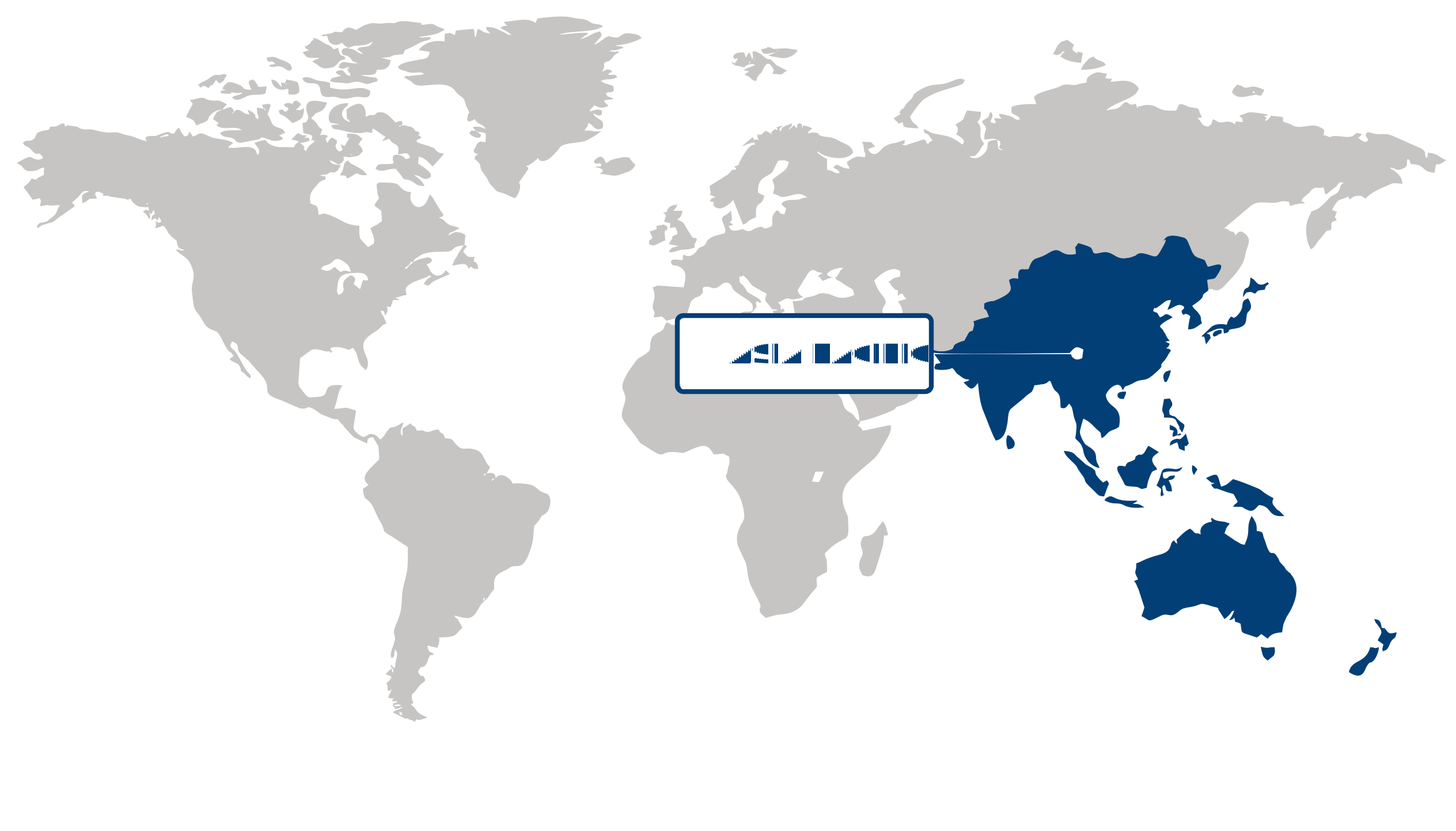
Asia Pacific captured over 56.2% of the global market in 2025, and the radio frequency components market is the largest region by share driven by the region’s deep electronics manufacturing ecosystem and intense demand for RF parts in smartphones, wireless devices, and 5G infrastructure. The concentration of contract manufacturers such as Hon Hai Precision Industry (Foxconn) and leading foundries like Taiwan Semiconductor Manufacturing Company (TSMC), together with large network investments by China Mobile and aggressive rollout plans cited by the Ministry of Industry and Information Technology (MIIT), underpin scale and rapid uptake. GSMA Intelligence data on 5G adoption and corporate announcements from Huawei further validate demand patterns. Continued investments in localized supply chains and telecom upgrades make Asia Pacific a primary opportunity zone for RF component suppliers and integrators.
Japan is positioned as a pivotal hub in Asia Pacific; the radio frequency components market in Japan leverages high-value component design and quality manufacturing for premium devices and network equipment. Companies such as Murata Manufacturing and Sony, combined with policy engagement from the Ministry of Economy, Trade and Industry (METI) and field trials reported by NTT DOCOMO, drive demand for compact, high-performance RF modules used in 5G and IoT. Japan’s strengths in precision ceramics, RF filters, and system integration create a market for high-margin, specialized components, making Japanese partnerships strategically valuable for regional suppliers.
China anchors regional volume and scale; the radio frequency components market in China benefits from massive handset production, rapid 5G base-station deployment, and vertically integrated suppliers. MiIT reporting on domestic telecom rollout, major network investment by China Mobile, and product roadmaps from Huawei illustrate robust domestic demand and localized sourcing. Contract manufacturers such as Hon Hai and major smartphone OEMs sustain high volumes of RF front-end modules, while policy support for semiconductor localization increases onshore opportunities. For investors and strategists, China offers scale-driven entry points and catalytic demand that reinforce broader Asia Pacific leadership.
North America Market Analysis:
North America emerged as the fastest-growing region in the radio frequency components market, posting a robust CAGR of 14.2% driven by rising 5G deployments, new device launches, and strong semiconductor investment stimuli. Carrier network rollouts by Verizon, AT&T, and T-Mobile alongside spectrum actions by the Federal Communications Commission (FCC) have increased demand for RF filters, antennas, and front-end modules. Device and chipset activity—illustrated by product roadmaps and announcements from Qualcomm and Apple—has expanded RF integration needs, while the CHIPS and Science Act implementation overseen by the U.S. Department of Commerce is catalyzing domestic fabrication and test capacity. These combined dynamics, supported by growing capital expenditure and dense urban use cases, position the region to capture continued RF component value across networks and devices.
The U.S. serves as the primary growth engine for the radio frequency components market in North America, where carrier-led 5G densification and federal incentives concentrate procurement, R&D, and manufacturing. Major operators’ densification plans at Verizon and T-Mobile, handset launches from Apple and Samsung leveraging Qualcomm RF platforms, and fabrication investments by TSMC in Arizona and expansion plans from Intel have created localized demand and supplier partnerships. Regulatory facilitation and CHIPS-backed funding through the U.S. Department of Commerce are improving supply-chain resilience and attracting test-and-assembly activity. For investors and OEMs, the U.S. market’s convergence of carriers, chipmakers, and government stimulus creates high-return opportunities for onshore RF component production, design centers, and integrated solutions that reinforce North American leadership.
Europe Market Trends:
Europe's radio frequency components market experienced moderate growth and maintained a notable presence driven by broadened 5G rollouts, industrial connectivity uptake, and rising automotive electronics demand. Regional momentum is visible in European Commission digital and spectrum initiatives, GSMA Intelligence reporting steady 5G device and network expansion, and supplier activity from Nokia and Ericsson accelerating infrastructure upgrades. Research contributions from Fraunhofer-Gesellschaft and procurement signals from Airbus illustrate demand across civil and aerospace segments. Supply-chain resilience measures and corporate sustainability commitments are nudging sourcing and design choices. These dynamics position Europe to capture near-term commercial opportunities in component integration and mid-term value from system-level upgrades across industries.
Germany's radio frequency components market serves as a technology and manufacturing hub where moderate growth is anchored in automotive electrification and industrial automation. OEMs such as Volkswagen and suppliers like Bosch are increasing RF use in ADAS and vehicle connectivity, while the Bundesministerium für Wirtschaft und Klimaschutz and Fraunhofer-Gesellschaft support local production and R&D initiatives. Deutsche Telekom's network programs further stimulate component demand for carrier-grade equipment. Germany’s manufacturing depth and policy-backed capacity upgrades make it a strategic anchor for regional supply-chain scaling and higher-value component production.
France's radio frequency components market acts as a systems and defense-driven engine contributing to Europe’s moderate growth profile through aerospace, defense, and large-scale telecom programs. Prime contractors Thales and Airbus France, together with Orange’s network investments, create steady demand for specialized RF modules; the Ministère des Armées and CEA signal continued defense and research procurement. France’s system-integration capabilities and public procurement focus enable pathway opportunities for suppliers targeting avionics, secure communications, and space applications, reinforcing cross-border collaborations that amplify regional market potential.
| Parameter | North America | Asia Pacific | Europe | Latin America | MEA |
|---|---|---|---|---|---|
| Innovation Hub i Scale Nascent Developing Advanced | |||||
| Cost-Sensitive Region i Scale Low Medium High | |||||
| Regulatory Environment i Scale Restrictive Neutral Supportive | |||||
| Demand Drivers i Scale Weak Moderate Strong | |||||
| Development Stage i Scale Emerging Developing Developed | |||||
| Adoption Rate i Scale Low Medium High | |||||
| New Entrants / Startups i Scale Sparse Moderate Dense | |||||
| Macro Indicators i Scale Weak Stable Strong |
Segment Leadership and Growth Trends
Radio Frequency Components Market Share (%), by Product, 2026
Go beyond the chart, access full insights & data tables
Request Free Sample ReportPower Amplifiers dominated the radio frequency components market in 2025, taking the largest share as 5G infrastructure rollout and strong demand for high-power signal transmission in base stations and mobile devices concentrated investment in high-linearity, high-efficiency PA solutions. Leadership reflects carrier densification and vendor roadmaps—Ericsson Mobility Report highlights macro and small-cell deployments—while Qualcomm and Qorvo press releases cite advances in GaN and integrated RF front-end PAs that improve energy efficiency. Customer preference for longer battery life, operator focus on spectral efficiency, supply-chain specialization, and regulatory approvals for higher-frequency bands reinforced adoption. This favors incumbents with scale and IP and challengers offering GaN/mmWave niches, and continued 5G densification supports near-term relevance.
Analysis by Application
Consumer Electronics represented largest share in the radio frequency components market in 2025, propelled by expanding smartphone, tablet and smart-home device penetration that concentrates RF module demand across handset and consumer OEM supply chains. GSMA Intelligence documents sustained device growth, and Apple Inc. product briefs and Samsung Electronics statements describe increasingly sophisticated RF subsystems and integrated antenna strategies that validate OEM-driven demand. Preferences for compact form factors, higher throughput, energy efficiency, and certification dynamics have driven modularization and regional sourcing. The segment gives scale advantages to established RF suppliers and quick market access for specialized module makers targeting Wi‑Fi, Bluetooth, and antenna tuning, and ongoing device refresh cycles keep it strategically important in the near to medium term.
| Segment | Sub-Segment | Largest Segment | Fastest Growing |
|---|---|---|---|
| Product | Filters, Duplexer, Power Amplifiers, Antenna Switches, Modulators & Demodulators, Others | ||
| Application | Consumer electronics, Mobile phones, Tablets, Smart TVs & set-top boxes, Laptops & notebooks, Automotive, Military, Wireless Communication |
Competitive Landscape and Market Positioning
The competitive landscape is shaped by leaders securing complementary capabilities through corporate transactions, forming cross‑industry links, introducing advanced product families, and amplifying R&D in GaN, mmWave, filter integration, and system‑level RF solutions. Such moves deepen IP portfolios, accelerate time‑to‑market, and shift positioning from component suppliers to platform partners, pressuring peers to prioritize vertical integration, design‑win capture, and high‑reliability offerings to retain competitiveness.
Strategic / Actionable Recommendations for Regional Players
North America: Leverage strengths in high‑performance GaN, mmWave, and defense/space heritage by aligning with systems integrators and cloud/telecom OEMs to secure design wins, selectively pursue complementary corporate transactions to broaden system capabilities, and deepen IP‑led product roadmaps.
Asia Pacific: Exploit manufacturing scale and close OEM relationships by accelerating integrated passive‑active modules, partnering with handset and IoT device makers to shorten design‑to‑production cycles, and targeting high‑volume RF filter and module subsegments.
Europe: Build on automotive and industrial credibility by working with Tier‑1 automotive suppliers and industrial automation firms, emphasizing mixed‑signal integration and functional safety, and focusing investment on niche, high‑reliability RF components to defend specialized markets.
| Company | Market Share | Company Revenue | Revenue CAGR (%) | Product Portfolio | Geographic Presence | Innovation / R&D Focus | Strategic Developments |
|---|---|---|---|---|---|---|---|
| No companies available. | |||||||
Industry Development/News
| Company Name | Date | Key Development |
|---|
Customize Your Report
Explore examples of how this report can be tailored to different research needs, including custom segments, additional topics or chapters, and related reports. Click a section of the wheel or its numbered marker to explore the available options.
Radio Frequency Components Market — Custom Segments
| Segment | Sub-Segment |
|---|---|
| No segment data available. | |
Radio Frequency Components Market — Custom TOC
| Custom Chapter | Custom Details | ||
|---|---|---|---|
| No custom TOC data available. | |||
Need a different cut of the data?
Request Custom ResearchWhat is the market size of radio frequency components?
How will the radio frequency components industry grow in terms of size and CAGR by 2035?
Which region emerges as the top contributor to the radio frequency components market revenue?
Which geographical area is witnessing the highest growth rate in the radio frequency components sector?
How much is the power amplifiers segment expected to grow in the radio frequency components industry beyond 2025?
What factors give consumer electronics segment a competitive edge in the radio frequency components sector?
Which organizations are considered leaders in the radio frequency components landscape?
Our Clients
"Working with FBI has been a good experience. The market report provided a holistic view, covering everything from emerging trends to potential risks."
Semtech Corporation
"The experience was highly positive. The team showcased remarkable flexibility in adapting to our specific needs and delivered report that perfectly aligned with all our requirements."
TSMC
"What really stood out to me was how clearly and promptly the Fundamental Business Insights team communicated throughout. It made the collaboration feel effortless."
NXP Semiconductors
Our Research Team & Methodology
Every Fundamental Business Insights report is built by a dedicated vertical research team, validated through a structured primary-and-secondary methodology, and reviewed for accuracy before it reaches you.
Research Team Overview
Prepared by the Electronics & Semiconductors Research Team
Delivery
Published
Demand
Available
Support
Trust & Compliance
Research Domains
10 coverage areasResearch Intelligence
| Source | Reference |
|---|---|
| Semiconductor Industry Association (SIA) | www.semiconductors.org |
| SEMI | www.semi.org |
| JEDEC Solid State Technology Association | www.jedec.org |
| IEEE | www.ieee.org |
| IPC – Association Connecting Electronics Industries | www.ipc.org |
| International Electrotechnical Commission (IEC) | www.iec.ch |
| International Organization for Standardization (ISO) | www.iso.org |
| U.S. Bureau of Industry and Security (BIS) | www.bis.gov |
| U.S. Patent and Trademark Office (USPTO) | www.uspto.gov |
| European Patent Office (EPO) | www.epo.org |
| Taiwan Semiconductor Industry Association (TSIA) | www.tsia.org.tw |
| World Semiconductor Trade Statistics (WSTS) | www.wsts.org |
| International Energy Agency (IEA) | www.iea.org |
| GSMA | www.gsma.com |
| 3GPP | www.3gpp.org |
| ITU (International Telecommunication Union) | www.itu.int |
| Omdia (public insights) | omdia.tech.informa.com |
| Display Supply Chain Consultants (DSCC) | www.displaysupplychain.com |
| U.S. Department of Energy (DOE) | www.energy.gov |
| NIST (National Institute of Standards and Technology) | www.nist.gov |
Research Workflow & Quality Assurance
Data Collection
Verified information gathered through primary and secondary research.
Data Triangulation
Cross-validation using multiple independent data sources.
Forecast Modelling
Market estimates developed using historical trends and analytical models.
Analyst Validation
Findings reviewed by domain experts for accuracy and consistency.
Editorial & Quality Review
Final editorial, quality, and compliance checks before publication.
Final Publication
Released after successful completion of the internal review process.
Report Coverage
📊 Market Assessment
- Market Size & Forecast
- Market Segmentation
- Regional Analysis
- Growth Drivers & Challenges
- Market Dynamics
🏢 Competitive Intelligence
- Competitive Landscape
- Company Profiles
- Competitive Benchmarking
- Mergers & Acquisitions
- Market Share Analysis or Key Company Strategies
🔍 Strategic Analysis
- Value Chain Analysis
- Porter's Five Forces
- PESTLE Analysis
- Pricing Trends
- Supply-Demand Analysis
🚀 Future Outlook
- Technology Landscape
- Regulatory Landscape
- Investment & Funding Landscape
- Emerging Opportunities
- Future Market Outlook
Have a question about this report or need a custom scope?
Request Customization