Printed Electronics Market Size & Growth Forecast 2027–2036, By Segments (Material, Technology, Devices), Regional Demand Trends (North America, Asia Pacific, Europe), Key Country Insights (U.S., Japan, South Korea, Germany, France, Italy), and Competitive Landscape
Market Size and Growth Outlook
Printed Electronics Market size was around USD 23.2 billion in 2026 and is slated to grow at a 22.33% CAGR from 2027 to 2036, attaining USD 174.11 billion by 2036. The industry revenue for 2027 is estimated at USD 27.56 billion.
Get more details on this report
Request Free Sample ReportPrinted Electronics Market Intelligence Snapshot
Regional Market Dynamics
- Asia Pacific held a 49.82% market share in 2026, supported by its strong electronics manufacturing base, integrated supply chains, and high-volume production of flexible electronic components.
- Asia Pacific is projected to grow at a 23.87% CAGR as manufacturers expand flexible sensors, displays, and conductive components through cost-efficient production, faster product development, and strong downstream demand.
Segment Momentum
- Inks lead with a 75.65% share due to their critical role in conductivity and device functionality, directly influencing performance across sensors, displays, and photovoltaic applications in large-scale production.
- Substrates are growing fastest as demand rises for flexible, lightweight base materials that enable new device architectures, improved bendability, and better integration across emerging flexible electronics applications.
Market Expansion Drivers
- Rapid IoT device proliferation accelerating adoption of flexible printed electronic components.
- Rising demand for OLED displays and RFID solutions enabling smart packaging expansion.
- Automotive and healthcare integration of lightweight printed sensors and wearable devices.
Leading Market Participants
- Major players in the printed electronics market include LG Display Co., Ltd. (South Korea), DuPont de Nemours, Inc. (United States), BASF SE (Germany), Molex, LLC (United States), E Ink Holdings Inc. (Taiwan), Agfa-Gevaert Group (Belgium), NovaCentrix (United States), Kurz Holding GmbH & Co. KG (Germany), Canatu Oy (Finland), Optomec, Inc. (United States).
Global Market Forecast Snapshot
Market Outlook
- 2026 Market Size: USD 23.2 billion
- 2027 Estimated Market Size: USD 27.56 billion.
- Projected Market Size: USD 174.11 billion by 2036
- Growth Forecast: 22.33% CAGR (2027-2036)
Regional and Segment Outlook
- Leading Regional Market: Asia Pacific
- High-Growth Regional Hub: Asia Pacific
- Core Revenue Segment: Inks (Material) | Inkjet (Technology) | Display Devices (Devices)
- Emerging Opportunity Segment: Substrates (Material) | Inkjet (Technology) | RFID (Devices)
Market Growth Drivers and Industry Trends
Rapid IoT device proliferation accelerating adoption of flexible printed electronic components
The rapid expansion of connected devices is creating new opportunities for the printed electronics market by increasing the need for compact, lightweight, and adaptable electronic components that can be integrated into increasingly diverse IoT products. Flexible printed circuits, sensors, antennas, and conductive components can be incorporated into devices with unconventional shapes and space-constrained designs, supporting applications across connected consumer products, smart environments, and industrial systems. As IoT architectures become more widespread, manufacturers are seeking electronics that can support greater functionality without adding substantial weight or bulk. The ability of printed technologies to facilitate scalable production and integration into flexible surfaces is particularly relevant for next-generation connected devices.
Rising demand for OLED displays and RFID solutions enabling smart packaging expansion
Increasing adoption of advanced displays and identification technologies is supporting the printed electronics market as manufacturers pursue thinner, flexible, and more functional electronic solutions. OLED displays benefit from printed manufacturing approaches that can support lightweight and adaptable display structures, while RFID technologies enable packaging to incorporate identification, tracking, authentication, and inventory-management capabilities. These developments are expanding the role of electronics beyond conventional rigid devices and creating opportunities for smart packaging across consumer goods, logistics, retail, and other applications. The integration of electronic functionality into packaging can also improve product visibility and enable more interactive consumer experiences, encouraging investment in printed conductive materials and components.
Automotive and healthcare integration of lightweight printed sensors and wearable devices
Growing use of electronics in vehicles and healthcare applications is creating additional demand for printed technologies capable of delivering sensing and monitoring functions in lightweight formats. Within automotive applications, printed sensors can be incorporated into surfaces and components where conventional electronics may be difficult to install, supporting functions related to vehicle monitoring, occupant interaction, and advanced interior systems. Healthcare applications are similarly benefiting from flexible sensors and wearable devices that can conform to the body while enabling continuous or convenient monitoring. The ability to manufacture thin electronic structures suitable for curved, flexible, or wearable applications is encouraging broader integration across these sectors.
| Growth Driver | Impact on CAGR | Regulatory Influence | Geographic Relevance | Adoption Rate | Impact Timeline |
|---|---|---|---|---|---|
| Rapid IoT device proliferation accelerating adoption of flexible printed electronic components | 2.00% | Moderate | Asia Pacific, North America | High | Near Term |
| Rising demand for OLED displays and RFID solutions enabling smart packaging expansion | 1.80% | Moderate | Asia Pacific, Europe | High | Near Term |
| Automotive and healthcare integration of lightweight printed sensors and wearable devices | 1.60% | Moderate | North America, Europe | High | Mid Term |
Unlock insights tailored to your business with our bespoke market research solutions.
Click to get your customized report now.
Regional Demand Dynamics
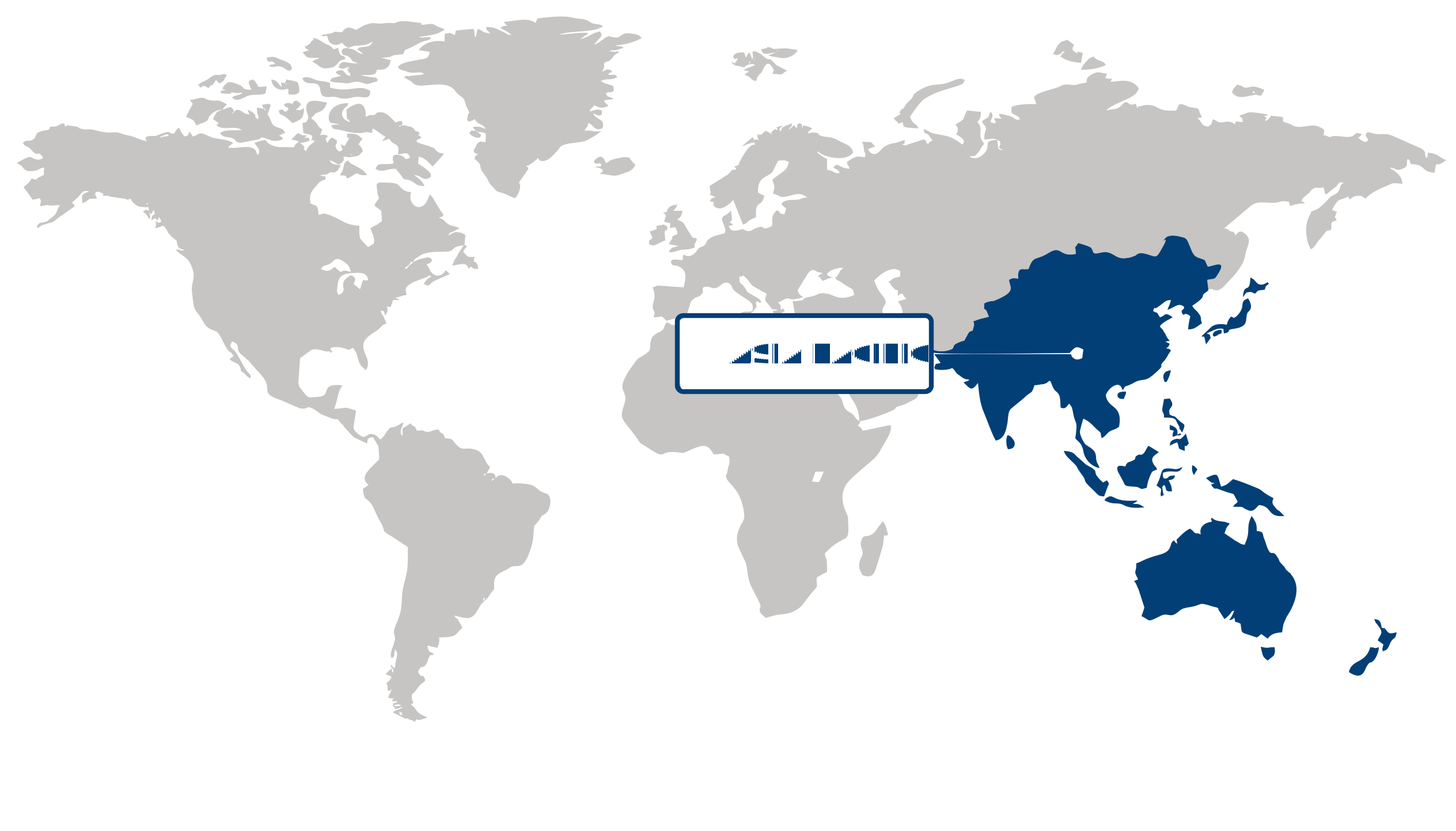
Asia Pacific (Largest & Fastest-Growing Region)
Asia Pacific dominated the printed electronics market and accounted for a 49.82% share in 2026, with the region combining a strong electronics manufacturing ecosystem with expanding demand for lightweight, flexible, and cost-efficient electronic components. High-volume production of consumer electronics, automotive systems, displays, sensors, and smart devices creates favorable conditions for printed conductive materials and flexible electronic structures. The region's extensive manufacturing infrastructure, established supply chains, and ongoing investments in advanced electronics production further support commercialization. Increasing adoption of flexible displays, wearable technologies, smart packaging, and connected devices is also broadening application opportunities, while continued industrial automation and miniaturization are encouraging manufacturers to explore printed electronics for efficient component integration.
| Parameter | North America | Asia Pacific | Europe | Latin America | MEA |
|---|---|---|---|---|---|
| Innovation Hub i Scale Nascent Developing Advanced | |||||
| Cost-Sensitive Region i Scale Low Medium High | |||||
| Regulatory Environment i Scale Restrictive Neutral Supportive | |||||
| Demand Drivers i Scale Weak Moderate Strong | |||||
| Development Stage i Scale Emerging Developing Developed | |||||
| Adoption Rate i Scale Low Medium High | |||||
| New Entrants / Startups i Scale Sparse Moderate Dense | |||||
| Macro Indicators i Scale Weak Stable Strong |
Key Country Insights
Germany 🇩🇪
Industrial Process IntegrationGermany emphasizes printed electronics for industrial automation, automotive systems, and smart manufacturing environments. Manufacturers are refining production precision, material compatibility, and quality assurance to support reliable integration into advanced industrial applications.
France 🇫🇷
Sustainable Functional MaterialsFrance is expanding the use of printed electronics through sustainable materials and innovative sensor applications. Market participants increasingly focus on environmentally responsible manufacturing while supporting demand from healthcare, packaging, and industrial monitoring sectors.
Italy 🇮🇹
Specialty Manufacturing AdoptionItaly is integrating printed electronics into specialized manufacturing applications, including smart labels, industrial sensors, and consumer products. Businesses are strengthening collaboration between material suppliers and equipment developers to improve production flexibility and product customization.
Japan 🇯🇵
Miniaturized Device DevelopmentJapan focuses on printed electronics that enable lightweight, compact, and high-performance electronic components for consumer and healthcare products. Continuous improvements in printing technologies and functional inks support increasingly sophisticated electronic device designs.
South Korea 🇰🇷
Display Technology ApplicationsSouth Korea leverages printed electronics to strengthen innovation in displays, wearable devices, and flexible consumer electronics. Companies continue investing in printable materials and manufacturing efficiency to support commercialization of advanced electronic products.
United States 🇺🇸
Flexible Electronics InnovationThe U.S. printed electronics market is supported by commercialization across healthcare, aerospace, and smart packaging applications. Companies in the U.S. are prioritizing scalable manufacturing processes and advanced conductive materials to accelerate product integration into next-generation electronic devices.
Segment Leadership and Growth Trends
Printed Electronics Market Share (%), by Material, 2026
Go beyond the chart, access full insights & data tables
Request Free Sample ReportMaterial Segment Analysis: Inks (Largest Segment) vs Substrates (Fastest-Growing Segment)
Inks dominated the printed electronics market with a 75.65% share in 2026, reflecting their fundamental role in creating conductive, functional, and other printed electronic patterns. Advances in functional formulations are enabling manufacturers to produce electronic components and circuits through printing processes that can support flexible and lightweight product designs. Growing adoption of printed electronics across consumer, automotive, healthcare, and other applications is consequently sustaining demand for specialized electronic inks.
Substrates represent the fastest-growing material segment as printed electronics increasingly move toward flexible, lightweight, and conformable product formats. Substrate materials provide the foundation for printed circuits and sensors while influencing flexibility, durability, and compatibility with different manufacturing processes. Rising interest in wearable electronics, flexible displays, smart labels, and other emerging applications is encouraging greater development and use of substrates suited to advanced printed electronic designs.
Technology Segment Analysis: Inkjet (Largest & Fastest-Growing Segment)
Inkjet technology held the largest share of the printed electronics market at 75.65% in 2026 and is also the fastest-growing technology segment. Its ability to deposit functional materials precisely and selectively supports efficient fabrication of intricate electronic patterns while reducing material waste. The technology is particularly well suited to flexible and customized electronic applications because digital printing enables design flexibility without requiring conventional patterning approaches. Increasing demand for miniaturized, lightweight, and increasingly sophisticated electronic products is further strengthening the adoption of inkjet-based manufacturing.
| Segment | Sub-Segment | Largest Segment | Fastest Growing |
|---|---|---|---|
| Material | Inks, Substrates | Inks | Substrates |
| Technology | Inkjet, Screen, Gravure, Flexographic Technologies | Inkjet | Inkjet |
| Devices | Display Devices, Photovoltaic, Lighting, RFID, Other | Display Devices | RFID |
Competitive Landscape and Market Positioning
Prominent players in the printed electronics market:
1. LG Display Co. Ltd. (South Korea)
2. DuPont de Nemours Inc. (United States)
3. BASF SE (Germany)
4. Molex LLC (United States)
5. E Ink Holdings Inc. (Taiwan)
6. Agfa-Gevaert Group (Belgium)
7. NovaCentrix (United States)
8. Kurz Holding GmbH & Co. KG (Germany)
9. Canatu Oy (Finland)
10. Optomec Inc. (United States)
Continuous material innovation is transforming the printed electronics market, with research focused on flexible substrates, conductive inks, and scalable manufacturing processes. Technological advancements are expanding applications across healthcare, consumer electronics, and smart packaging.
| Company | Market Share | Company Revenue | Revenue CAGR (%) | Product Portfolio | Geographic Presence | Innovation / R&D Focus | Strategic Developments |
|---|---|---|---|---|---|---|---|
| LG Display Co. Ltd. (South Korea) | |||||||
| DuPont de Nemours Inc. (United States) | |||||||
| BASF SE (Germany) | |||||||
| Molex LLC (United States) | |||||||
| E Ink Holdings Inc. (Taiwan) | |||||||
| Agfa-Gevaert Group (Belgium) | |||||||
| NovaCentrix (United States) | |||||||
| Kurz Holding GmbH & Co. KG (Germany) | |||||||
| Canatu Oy (Finland) | |||||||
| Optomec Inc. (United States). |
Industry Development/News
| Company Name | Date | Key Development |
|---|---|---|
| Ricoh | Mar-26 | Ricoh is restructuring its strategic priorities to emphasize commercial and industrial printing, as well as inkjet technologies for new sectors. This repositioning aims to capitalize on growth opportunities in functional and printed electronics, marking a pivot toward advanced industrial printing applications to offset declining performance in legacy office segments. |
| Streiff & Helmold GmbH | Feb-26 | Streiff & Helmold GmbH implemented printed electronics to enable illuminated packaging solutions for the champagne market. This deployment highlights the integration of functional printed electronics into premium packaging to drive product differentiation and interactive consumer engagement, expanding the commercial footprint of the technology in specialty sectors. |
| Epishine | Nov-25 | Epishine successfully integrated its indoor solar energy harvesting technology into a Google TV remote control. This development demonstrates the practical commercialization of printed electronics for self-powered, low-power consumer devices, showcasing the viability of printed energy solutions in mass-market applications. |
| TracXon | Sep-25 | TracXon secured €4.75 million in funding from DeepTechXL, Invest-NL, and BOM to advance sustainable printed circuit board (PCB) production. This capital injection supports the scaling of environmentally efficient manufacturing processes and strengthens the company’s competitive position in next-generation electronics fabrication technology. |
| SP Manufacturing | Dec-24 | SP Manufacturing expanded its global footprint by launching a new facility in Malaysia and acquiring Ideal Jacobs Corporation. These initiatives enhance the company’s electronics manufacturing services (EMS) capabilities and support greater supply chain integration for industrial and printed electronics across international markets. |
| Henkel | Oct-24 | Henkel formed a strategic partnership with pad printing machine manufacturer Teca-Print to advance pad printing solutions for printed electronics. The collaboration integrates R&D through production feasibility studies, targeting high-growth applications including antennas, digital healthcare, 3D electronics, and smart mobility. |
| Komori Corporation | May-24 | Komori Corporation entered a comprehensive collaboration with Yamagata University to accelerate the commercialization of next-generation printed electronics. By combining the university’s materials expertise with Komori’s printing technology, the partnership focuses on organic EL electrodes, flexible hybrid electronics, and shared infrastructure to drive industrial adoption. |
| Naxnova | Mar-24 | Naxnova acquired a 74% stake in Quad Industries Belgium, expanding its manufacturing and materials capabilities. This acquisition strengthens the company’s presence in European markets and enhances its portfolio across automotive, healthcare, and industrial applications, reinforcing its competitive positioning in next-generation electronics manufacturing. |
| LITEON+ Technology | Jan-24 | LITEON+ Technology and Elephantech signed an MOU to integrate Elephantech’s low-carbon Pure Additive manufacturing method into backlit keyboard module production. This initiative targets increased operational efficiency and reduced environmental impact, signaling a shift toward sustainable fabrication processes in the Asia-Pacific electronics supply chain. |
Customize Your Report
Explore examples of how this report can be tailored to different research needs, including custom segments, additional topics or chapters, and related reports. Click a section of the wheel or its numbered marker to explore the available options.
Printed Electronics Market — Custom Segments
| Segment | Sub-Segment |
|---|---|
| End-use Industry | Consumer Electronics, Automotive, Healthcare, Industrial, Aerospace & Defense |
| Integration Level | Standalone Printed Components, Embedded Components, Hybrid Printed-Electronic Systems |
| Functional Layer | Conductive Layers, Dielectric Layers, Semiconductor Layers, Insulating & Protective Layers |
Printed Electronics Market — Custom TOC
| Custom Chapter | Custom Details |
|---|---|
| Commercialization Readiness by End-Use Industry |
|
| Manufacturing Scale-Up & Capacity Benchmarking |
|
| OEM Adoption & Design-Win Intelligence |
|
Need a different cut of the data?
Request Custom ResearchHow large is the printed electronics market?
What is the anticipated CAGR of the printed electronics industry?
How is rapid IoT adoption reshaping investment priorities in the printed electronics market?
Why are OLED displays and RFID adoption accelerating commercialization in the printed electronics market?
Why do inks dominate the printed electronics market?
How are substrates driving growth in the printed electronics market?
Why does Asia Pacific lead the printed electronics market?
What is driving the rapid growth of printed electronics in Asia Pacific?
Who holds a significant market share in the printed electronics landscape?
Our Clients
"Working with FBI has been a good experience. The market report provided a holistic view, covering everything from emerging trends to potential risks."
Semtech Corporation
"The experience was highly positive. The team showcased remarkable flexibility in adapting to our specific needs and delivered report that perfectly aligned with all our requirements."
TSMC
"What really stood out to me was how clearly and promptly the Fundamental Business Insights team communicated throughout. It made the collaboration feel effortless."
NXP Semiconductors
Our Research Team & Methodology
Every Fundamental Business Insights report is built by a dedicated vertical research team, validated through a structured primary-and-secondary methodology, and reviewed for accuracy before it reaches you.
Research Team Overview
Prepared by the Electronics & Semiconductors Research Team
Delivery
Published
Demand
Available
Support
Trust & Compliance
Research Domains
10 coverage areasResearch Intelligence
| Source | Reference |
|---|---|
| Semiconductor Industry Association (SIA) | www.semiconductors.org |
| SEMI | www.semi.org |
| JEDEC Solid State Technology Association | www.jedec.org |
| IEEE | www.ieee.org |
| IPC – Association Connecting Electronics Industries | www.ipc.org |
| International Electrotechnical Commission (IEC) | www.iec.ch |
| International Organization for Standardization (ISO) | www.iso.org |
| U.S. Bureau of Industry and Security (BIS) | www.bis.gov |
| U.S. Patent and Trademark Office (USPTO) | www.uspto.gov |
| European Patent Office (EPO) | www.epo.org |
| Taiwan Semiconductor Industry Association (TSIA) | www.tsia.org.tw |
| World Semiconductor Trade Statistics (WSTS) | www.wsts.org |
| International Energy Agency (IEA) | www.iea.org |
| GSMA | www.gsma.com |
| 3GPP | www.3gpp.org |
| ITU (International Telecommunication Union) | www.itu.int |
| Omdia (public insights) | omdia.tech.informa.com |
| Display Supply Chain Consultants (DSCC) | www.displaysupplychain.com |
| U.S. Department of Energy (DOE) | www.energy.gov |
| NIST (National Institute of Standards and Technology) | www.nist.gov |
Research Workflow & Quality Assurance
Data Collection
Verified information gathered through primary and secondary research.
Data Triangulation
Cross-validation using multiple independent data sources.
Forecast Modelling
Market estimates developed using historical trends and analytical models.
Analyst Validation
Findings reviewed by domain experts for accuracy and consistency.
Editorial & Quality Review
Final editorial, quality, and compliance checks before publication.
Final Publication
Released after successful completion of the internal review process.
Report Coverage
📊 Market Assessment
- Market Size & Forecast
- Market Segmentation
- Regional Analysis
- Growth Drivers & Challenges
- Market Dynamics
🏢 Competitive Intelligence
- Competitive Landscape
- Company Profiles
- Competitive Benchmarking
- Mergers & Acquisitions
- Market Share Analysis or Key Company Strategies
🔍 Strategic Analysis
- Value Chain Analysis
- Porter's Five Forces
- PESTLE Analysis
- Pricing Trends
- Supply-Demand Analysis
🚀 Future Outlook
- Technology Landscape
- Regulatory Landscape
- Investment & Funding Landscape
- Emerging Opportunities
- Future Market Outlook
Have a question about this report or need a custom scope?
Request Customization