Power Tools Market Size & Growth Forecast 2027–2036, By Segments (Applications, Mode of Operations, Product), Regional Demand Trends (North America, Asia Pacific, Europe), Key Country Insights (U.S., Japan, South Korea, Germany, France, Italy), and Competitive Landscape
Market Size and Growth Outlook
Power Tools Market size was over USD 37.3 billion in 2026 and is likely to grow at a 9.41% CAGR between 2027 and 2036, crossing USD 91.68 billion by 2036. The industry revenue for 2027 is estimated at USD 40.25 billion.
Get more details on this report
Request Free Sample ReportPower Tools Market Intelligence Snapshot
Regional Market Dynamics
- Asia Pacific accounted for 38.37% of the market in 2026, driven by its extensive manufacturing base, large-scale construction activity, and sustained demand from industrial and commercial users.
- North America is expected to grow at an 8.25% CAGR, supported by replacement demand, expanding use of advanced cordless tools, and strong adoption across construction, maintenance, and industrial repair sectors.
Segment Momentum
- Industrial held a 59.95% share in 2026 because manufacturing, construction, automotive, and maintenance sectors require durable, high-performance tools for continuous professional use and regular replacement cycles.
- Pneumatic tools are growing fastest because they deliver high power-to-weight performance and reliable operation for demanding, repetitive industrial tasks where productivity is the primary purchasing priority.
Market Expansion Drivers
- Government infrastructure investments accelerating construction equipment demand.
- Rising lithium-ion battery adoption enabling cordless power tool expansion.
- Growth of DIY retail channels and connected smart tool ecosystems.
Leading Market Participants
- Top companies in the power tools market include Stanley Black & Decker, Inc. (United States), Robert Bosch GmbH (Germany), Makita Corporation (Japan), Techtronic Industries Company Limited (Hong Kong), Hilti Corporation (Liechtenstein), Koki Holdings Co., Ltd. (Japan), Atlas Copco AB (Sweden), Apex Tool Group, LLC (United States), Emerson Electric Co. (United States), Ingersoll Rand Inc. (United States).
Global Market Forecast Snapshot
Market Outlook
- 2026 Market Size: USD 37.3 billion
- 2027 Estimated Market Size: USD 40.25 billion.
- Projected Market Size: USD 91.68 billion by 2036
- Growth Forecast: 9.41% CAGR (2027-2036)
Regional and Segment Outlook
- Leading Regional Market: Asia Pacific
- High-Growth Regional Hub: North America
- Core Revenue Segment: Industrial (Applications) | Electric (Mode of Operations) | Drills (Product)
- Emerging Opportunity Segment: Residential (Applications) | Pneumatic (Mode of Operations) | Wrenches (Product)
Market Growth Drivers and Industry Trends
Government infrastructure investments accelerating construction equipment demand
Government spending on roads, bridges, utilities, public facilities, and other infrastructure projects will drive the power tools market by increasing construction and maintenance activity across multiple applications. Contractors require portable equipment for drilling, fastening, cutting, grinding, demolition, and finishing work, particularly where mobility and rapid task completion are important. Infrastructure programs can also stimulate demand for tools capable of operating across demanding jobsite conditions and supporting both large construction projects and subsequent maintenance activities. As project execution expands across transportation, energy, utilities, and public infrastructure, professional users are increasing their reliance on efficient handheld and portable equipment.
Rising lithium-ion battery adoption enabling cordless power tool expansion
The wider adoption of lithium-ion battery technology is reshaping the power tools market by improving the practicality and performance of cordless equipment. Lithium-ion batteries provide high energy density, reduced maintenance requirements, and greater portability compared with traditional corded configurations, allowing users to operate tools in locations where access to electrical outlets is limited. Improvements in battery management and charging technologies are also supporting longer operating periods and more efficient tool utilization. The availability of cordless drills, saws, grinders, impact drivers, and other equipment is encouraging professional contractors and individual users to replace or supplement corded tools with battery-powered alternatives.
Growth of DIY retail channels and connected smart tool ecosystems
Expansion of do-it-yourself activities and digital retail access will propel the power tools market as consumers gain easier access to equipment, accessories, instructional content, and project-related products. Online and specialized retail channels allow users to compare tool specifications and select products suited to home improvement, repair, woodworking, and other applications. At the same time, connected tool ecosystems are introducing features such as equipment tracking, battery monitoring, usage management, and digital diagnostics, making power tools more integrated with modern work environments. These developments are broadening consumer engagement with power equipment while giving professional users additional ways to manage tool fleets and maintenance activities.
| Growth Driver | Impact on CAGR | Regulatory Influence | Geographic Relevance | Adoption Rate | Impact Timeline |
|---|---|---|---|---|---|
| Government infrastructure investments accelerating construction equipment demand | 2.30% | Moderate | Asia Pacific, North America | High | Near Term |
| Rising lithium-ion battery adoption enabling cordless power tool expansion | 2.00% | Low | North America, Asia Pacific | High | Mid Term |
| Growth of DIY retail channels and connected smart tool ecosystems | 1.50% | Low | North America, Europe | Medium | Mid Term |
Unlock insights tailored to your business with our bespoke market research solutions.
Click to get your customized report now.
Regional Demand Dynamics
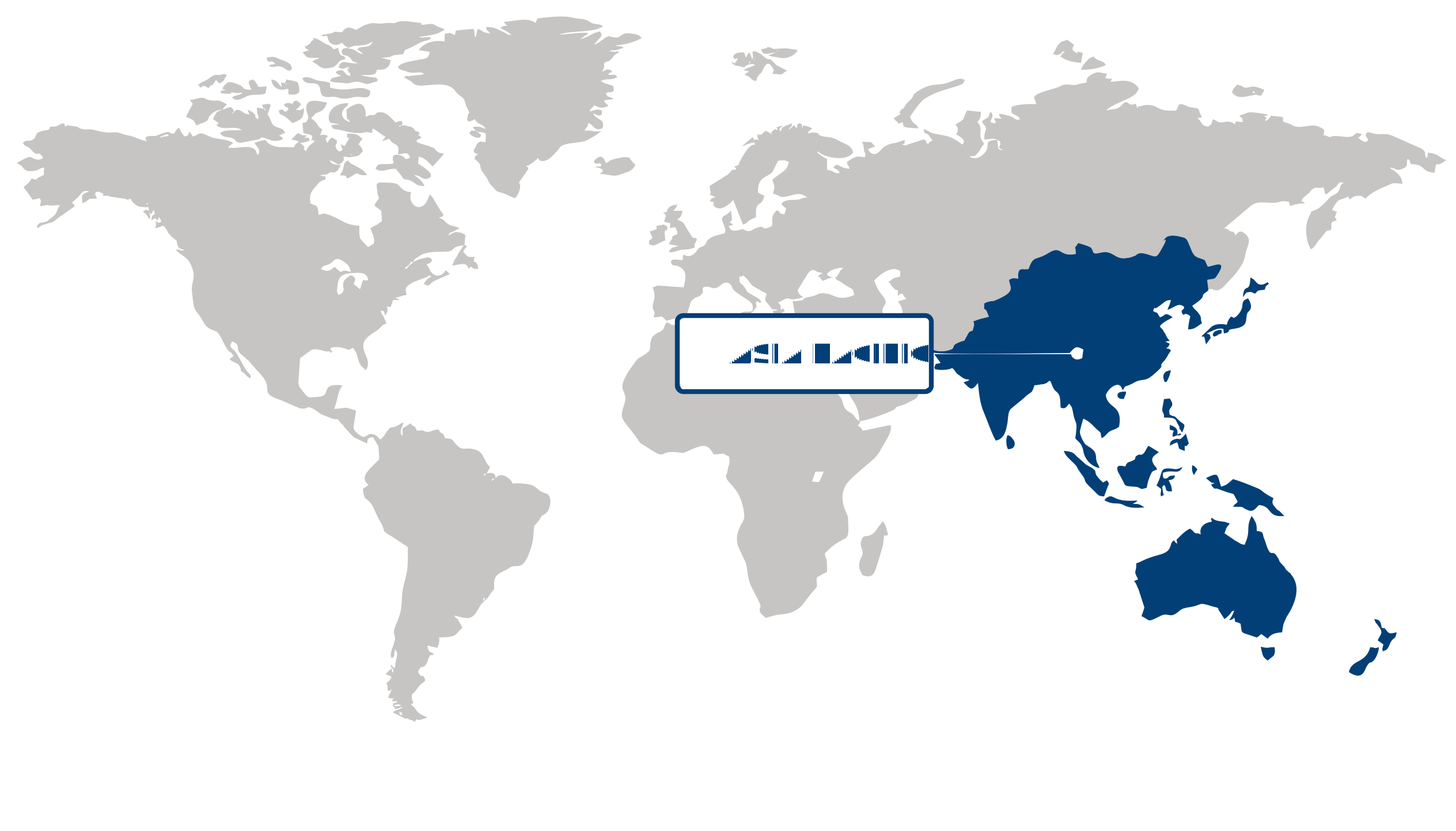
Asia Pacific (Largest Region)
Asia Pacific held the largest share of the power tools market at 38.37% in 2026, supported by extensive manufacturing activity, infrastructure development, construction projects, and expanding industrial production. Demand for cordless and electric power tools is increasing as manufacturers, contractors, and professional users seek greater productivity, portability, and operational efficiency. Rapid urbanization is also generating applications across residential construction, renovation, woodworking, automotive servicing, and general industrial operations. The region benefits from established manufacturing supply chains and increasing availability of technologically advanced tools, including products incorporating improved battery systems, ergonomic designs, and enhanced safety features. Growing adoption among professional and do-it-yourself users is further broadening the regional customer base.
North America (Fastest-Growing Region)
North America is experiencing the fastest growth, supported by construction and renovation activity, increasing adoption of cordless equipment, and rising demand for tools that improve productivity and user convenience. Professional contractors are increasingly seeking lightweight and portable solutions that can perform across varied job sites, while consumers are showing greater interest in versatile tools for home improvement and maintenance. Advancements in battery technology are improving the usability of cordless products and reducing dependence on traditional power sources. The expansion of residential remodeling, infrastructure maintenance, and commercial construction is also creating diverse demand opportunities. Greater emphasis on workplace safety and ergonomic tool design is encouraging users to replace older equipment with more efficient and user-friendly alternatives, supporting regional market momentum.
| Parameter | North America | Asia Pacific | Europe | Latin America | MEA |
|---|---|---|---|---|---|
| Innovation Hub i Scale Nascent Developing Advanced | |||||
| Cost-Sensitive Region i Scale Low Medium High | |||||
| Regulatory Environment i Scale Restrictive Neutral Supportive | |||||
| Demand Drivers i Scale Weak Moderate Strong | |||||
| Development Stage i Scale Emerging Developing Developed | |||||
| Adoption Rate i Scale Low Medium High | |||||
| New Entrants / Startups i Scale Sparse Moderate Dense | |||||
| Macro Indicators i Scale Weak Stable Strong |
Key Country Insights
Germany 🇩🇪
Precision Manufacturing FocusGermany prioritizes high-performance power tools that support advanced manufacturing, automotive production, and precision engineering. Demand centers on durable equipment with enhanced efficiency, ergonomic design, and compliance with stringent workplace safety standards.
France 🇫🇷
Renovation Equipment DemandFrance supports demand for power tools through residential renovation, commercial refurbishment, and sustainable building upgrades. Professional users increasingly seek energy-efficient, low-noise equipment that aligns with evolving workplace and environmental requirements.
Italy 🇮🇹
Craftsmanship Productivity ToolsItaly's power tools market reflects demand from furniture, metalworking, and construction industries where precision and versatility are valued. Businesses continue investing in ergonomic, high-quality equipment that supports specialized manufacturing and renovation activities.
Japan 🇯🇵
Compact Engineering SolutionsJapan favors compact, lightweight power tools suited to precision assembly, maintenance, and space-constrained industrial environments. Japanese manufacturers continue integrating efficient motors and advanced battery technologies to improve productivity across professional applications.
South Korea 🇰🇷
Smart Industrial AdoptionSouth Korea is expanding the use of intelligent power tools across electronics manufacturing, shipbuilding, and infrastructure projects. Connected diagnostics and cordless technologies are increasingly adopted to improve operational efficiency and equipment management.
United States 🇺🇸
Professional Innovation HubThe U.S. power tools market emphasizes cordless platforms, connected jobsite solutions, and productivity-enhancing equipment for construction and industrial users. Manufacturers continue expanding premium product portfolios while strengthening aftermarket services and battery ecosystem compatibility.
Segment Leadership and Growth Trends
Power Tools Market Share (%), by Applications, 2026
Go beyond the chart, access full insights & data tables
Request Free Sample ReportApplications Segment Analysis: Industrial (Largest Segment) vs Residential (Fastest-Growing Segment)
Industrial applications dominated the power tools market in 2026, representing a 59.95% share, as power tools remain essential across manufacturing, construction, fabrication, maintenance, and other industrial operations. Demand is supported by the need for efficient drilling, cutting, fastening, grinding, and material-processing activities, where productivity and consistent performance are critical. Increasing industrial automation, infrastructure development, and emphasis on reducing manual effort are further reinforcing the use of power tools in professional operating environments.
Residential applications are growing at the fastest pace as homeowners increasingly adopt power tools for maintenance, renovation, repair, and do-it-yourself projects. Improvements in ease of operation, portability, and user-friendly designs are making power tools more accessible to non-professional users. Rising interest in home improvement and greater consumer willingness to undertake repair and renovation activities are creating favorable conditions for continued residential adoption.
Mode of Operations Segment Analysis: Electric (Largest Segment) vs Pneumatic (Fastest-Growing Segment)
Electric power tools accounted for the largest share of the power tools market in 2026, reaching 64.31%, owing to their broad applicability across industrial, commercial, and residential environments. Electric tools offer convenient operation, reliable power delivery, and compatibility with a wide range of drilling, cutting, fastening, and grinding tasks. Their accessibility and suitability for diverse working conditions have established them as a preferred operating mode, while ongoing improvements in cordless and energy-efficient tool designs continue to strengthen demand.
Pneumatic power tools are experiencing the fastest growth as industrial users seek durable and efficient equipment for demanding operating environments. These tools are particularly suited to applications requiring continuous operation, consistent torque, and reduced dependence on electric motors. Their use in manufacturing, automotive, construction, and maintenance activities is being supported by increasing focus on productivity and equipment performance, while improvements in compressed-air systems are further encouraging adoption.
| Segment | Sub-Segment | Largest Segment | Fastest Growing |
|---|---|---|---|
| Applications | Industrial, Residential | Industrial | Residential |
| Mode of Operations | Electric, Pneumatic, Others | Electric | Pneumatic |
| Product | Drills, Saws, Wrenches, Grinders, Sanders, Others | Drills | Wrenches |
Competitive Landscape and Market Positioning
Leading companies in the power tools market:
1. Stanley Black & Decker Inc. (United States)
2. Robert Bosch GmbH (Germany)
3. Makita Corporation (Japan)
4. Techtronic Industries Company Limited (Hong Kong)
5. Hilti Corporation (Liechtenstein)
6. Koki Holdings Co. Ltd. (Japan)
7. Atlas Copco AB (Sweden)
8. Apex Tool Group LLC (United States)
9. Emerson Electric Co. (United States)
10. Ingersoll Rand Inc. (United States)
The power tools market is experiencing strong transformation driven by the shift toward cordless, smart-enabled, and energy-efficient devices. Tool performance upgrades are improving precision and usability across construction and industrial applications. The power tools market is also advancing through workflow optimization features that enhance productivity and reduce operational downtime.
| Company | Market Share | Company Revenue | Revenue CAGR (%) | Product Portfolio | Geographic Presence | Innovation / R&D Focus | Strategic Developments |
|---|---|---|---|---|---|---|---|
| Stanley Black & Decker Inc. (United States) | |||||||
| Robert Bosch GmbH (Germany) | |||||||
| Makita Corporation (Japan) | |||||||
| Techtronic Industries Company Limited (Hong Kong) | |||||||
| Hilti Corporation (Liechtenstein) | |||||||
| Koki Holdings Co. Ltd. (Japan) | |||||||
| Atlas Copco AB (Sweden) | |||||||
| Apex Tool Group LLC (United States) | |||||||
| Emerson Electric Co. (United States) | |||||||
| Ingersoll Rand Inc. (United States). |
Industry Development/News
| Company Name | Date | Key Development |
|---|---|---|
| Kreg Tool | Nov-24 | Kreg Tool launched its inaugural line of cordless power tools, introducing 23 new SKUs. This strategic expansion marks the company’s entry into the battery-powered tools segment, broadening its product portfolio beyond traditional manual tools to better address the needs of both professional and consumer woodworking markets seeking more portable, efficient solutions. |
| NEFCO | Nov-24 | NEFCO acquired Sheinberg Tool in Corpus Christi, Texas, expanding its footprint to 43 branch locations across the United States. This acquisition strengthens NEFCO’s regional distribution network and operational scale within the construction and industrial supply sector, enhancing its ability to provide professional-grade tools and services to a wider base of commercial clients. |
| TTI (Techtronic Industries) | Oct-24 | TTI is scaling its manufacturing capacity at its Milwaukee production facility in Ho Chi Minh City, Vietnam. This expansion is designed to increase output for the company's power tool and outdoor equipment brands, supporting its global supply chain resilience and ability to meet rising market demand for high-performance professional tools. |
| STIHL | Oct-24 | STIHL opened a new distribution center in Mebane, North Carolina, enhancing its logistics infrastructure in the United States. This facility improves regional product distribution efficiency and reinforces the company's operational footprint in the North American power tools and outdoor power equipment market, supporting more rapid and reliable inventory fulfillment for its retail and professional partners. |
| Bosch Group | Oct-24 | Bosch Group announced the divestiture of its Communications, Security and Safety Systems business—including brands such as Electro-Voice and Telex—to Triton Partners. This strategic portfolio realignment allows Bosch to concentrate capital and management resources on its core mobility, industrial, and consumer-focused power tool businesses, streamlining operations for improved long-term competitive positioning. |
Customize Your Report
Explore examples of how this report can be tailored to different research needs, including custom segments, additional topics or chapters, and related reports. Click a section of the wheel or its numbered marker to explore the available options.
Power Tools Market — Custom Segments
| Segment | Sub-Segment |
|---|---|
| End-user Industry | Construction, Automotive, Manufacturing, Aerospace & Defense, Energy & Utilities, Other Industrial Industries |
| Distribution Channel | Specialty Tool Stores, Hardware & Home Improvement Stores, Industrial Distributors, Online Retail |
| Tool Mobility | Corded Tools, Cordless Tools, Stationary Tools |
Power Tools Market — Custom TOC
| Custom Chapter | Custom Details |
|---|---|
| Cordless Tool Ecosystem Evolution |
|
| Contractor Purchasing Behavior Insights |
|
| Industrial Application Opportunity Mapping |
|
Need a different cut of the data?
Request Custom ResearchWhat is the market valuation of power tools?
How much is the power tools industry expected to grow by 2036?
How are government infrastructure investments influencing industrial demand patterns for power tools in construction and manufacturing environments?
How is the shift toward lithium-ion batteries reshaping cordless power tool adoption and purchasing ecosystems?
Why does the Industrial application dominate the power tools market?
Why is Pneumatic the fastest-growing mode of operation in the power tools market?
Why does Asia Pacific hold the largest share of the power tools market?
What is fueling growth in the North American power tools market?
Which companies dominate the power tools landscape?
Our Clients
"The team at Fundamental Business Insights & Consulting demonstrated a commitment to excellence, not only in the quality of the report but also in their client-centric approach."
FANUC
"The level of detail in the market segmentation provided were particularly noteworthy. The detailed country-level insights were also very helpful."
B&R Industrial Automation GmbH
"The consultant took the time to understand our specific business objectives, ensuring that the reports were tailored to address our unique challenges and opportunities."
KUKA SE & Co. KGaA
Our Research Team & Methodology
Every Fundamental Business Insights report is built by a dedicated vertical research team, validated through a structured primary-and-secondary methodology, and reviewed for accuracy before it reaches you.
Research Team Overview
Prepared by the Industrial Automation & Equipment Research Team
Delivery
Published
Demand
Available
Support
Trust & Compliance
Research Domains
10 coverage areasResearch Intelligence
| Source | Reference |
|---|---|
| International Society of Automation (ISA) | www.isa.org |
| International Organization for Standardization (ISO) | www.iso.org |
| National Institute of Standards and Technology (NIST) | www.nist.gov |
| IEEE | www.ieee.org |
| VDMA (German Mechanical Engineering Industry Association) | www.vdma.org |
| Association for Advancing Automation (A3) | www.automate.org |
| International Federation of Robotics (IFR) | ifr.org |
| ASME (American Society of Mechanical Engineers) | www.asme.org |
| ASHRAE | www.ashrae.org |
| American Society of Heating, Refrigerating and Air-Conditioning Engineers (ASHRAE) | www.ashrae.org |
| Material Handling Industry (MHI) | www.mhi.org |
| OSHA (Occupational Safety and Health Administration) | www.osha.gov |
| National Fire Protection Association (NFPA) | www.nfpa.org |
| ASTM International | www.astm.org |
| International Electrotechnical Commission (IEC) | www.iec.ch |
| Open Process Automation Forum (The Open Group) | www.opengroup.org/open-process-automation-forum |
| AGMA (American Gear Manufacturers Association) | www.agma.org |
| Association of Equipment Manufacturers (AEM) | www.aem.org |
| Food and Agriculture Organization (FAO) | www.fao.org |
| International Labour Organization (ILO) | www.ilo.org |
Research Workflow & Quality Assurance
Data Collection
Verified information gathered through primary and secondary research.
Data Triangulation
Cross-validation using multiple independent data sources.
Forecast Modelling
Market estimates developed using historical trends and analytical models.
Analyst Validation
Findings reviewed by domain experts for accuracy and consistency.
Editorial & Quality Review
Final editorial, quality, and compliance checks before publication.
Final Publication
Released after successful completion of the internal review process.
Report Coverage
📊 Market Assessment
- Market Size & Forecast
- Market Segmentation
- Regional Analysis
- Growth Drivers & Challenges
- Market Dynamics
🏢 Competitive Intelligence
- Competitive Landscape
- Company Profiles
- Competitive Benchmarking
- Mergers & Acquisitions
- Market Share Analysis or Key Company Strategies
🔍 Strategic Analysis
- Value Chain Analysis
- Porter's Five Forces
- PESTLE Analysis
- Pricing Trends
- Supply-Demand Analysis
🚀 Future Outlook
- Technology Landscape
- Regulatory Landscape
- Investment & Funding Landscape
- Emerging Opportunities
- Future Market Outlook
Have a question about this report or need a custom scope?
Request Customization