Power Electronics Market Size & Forecasts 2026-2035, By Segments (Type, Device, Application), Growth Opportunities, Innovation Landscape, Regulatory Shifts, Strategic Regional Insights (U.S., Japan, China, South Korea, UK, Germany, France), and Competitive Dynamics (Infineon Technologies, STMicroelectronics, Texas Instruments, ON Semiconductor, Mitsubishi Electric)
Market Size and Growth Outlook
Power Electronics Market size is forecast to climb from USD 49.84 billion in 2025 to USD 89.26 billion by 2035, expanding at a CAGR of over 6% during 2026-2035. Industry revenue in 2026 is projected at USD 52.44 billion.
Get more details on this report
Request Free Sample ReportPower Electronics Market Intelligence Snapshot
Regional Market Dynamics
Segment Momentum
Market Expansion Drivers
Leading Market Participants
Global Market Forecast Snapshot
Market Outlook
Regional and Segment Outlook
Market Growth Drivers and Industry Trends
Growing electrification in vehicles and factory automation is a primary accelerator for the power electronics market, driven by OEM roadmaps and heavy investment in electric drivetrains and motor drives. Tesla and Volkswagen public roadmaps and Bosch announcements about high-voltage modules, alongside Siemens and ABB investments in industrial drives, provide qualitative evidence of sustained demand for traction inverters and medium-voltage converters. Established suppliers can deepen system-level integrations and long-term OEM contracts, while startups can capture niche value in software-defined control, thermal management, and aftermarket retrofits. Given OEM production plans and factory modernization programs from Siemens and Volkswagen, adoption is likely to continue expanding in line with announced deployments and supply-chain scaling.
Advances in High-Efficiency Converters and Inverters
Breakthroughs in SiC and GaN device adoption are reshaping product architecture across the power electronics market, supported by technology roadmaps and product releases from Infineon Technologies, Wolfspeed, and STMicroelectronics that emphasize higher switching frequencies and improved thermal performance. These innovations reduce system losses and enable smaller, lighter inverters for EVs and industrial power supplies, creating opportunities for incumbents to offer vertically integrated modules and for new entrants to specialize in power-semiconductor-enabled subsystems and advanced packaging. With recent product launches and foundry investments from Infineon and Wolfspeed, the ecosystem is moving from lab to production-ready solutions, tightening time-to-market advantages for early adopters.
Regulatory Support for Energy Efficiency and Grid Integration
Policy signals and grid modernization mandates are compelling utilities and integrators to deploy advanced converters and storage interfaces, influencing the power electronics market through standards and procurement cycles cited by the International Energy Agency (IEA), the U.S. Department of Energy Office of Energy Efficiency & Renewable Energy (EERE), and regulatory actions such as FERC Order 2222. These endorsements for distributed energy resources and efficiency standards create commercial prospects for incumbent suppliers to secure utility-scale contracts and for nimble entrants to offer aggregation, control software, and retrofit solutions. As regulator-driven pilots and utility solicitations documented by DOE and FERC move from demonstration to procurement, vendors can align roadmaps to meet specified interoperability and grid-support requirements.
Industry Restraints:
Supply Chain Vulnerabilities: Persistent shortages of silicon carbide (SiC), gallium nitride (GaN) substrates and power semiconductors, together with concentrated wafer and chip capacity, materially constrain supply responsiveness and raise input costs. Wolfspeed and Infineon Technologies have publicly cited extended lead times and multi-year capacity buildouts for SiC, and the U.S. Department of Energy has highlighted semiconductor supply fragility in energy-transition components, while the International Energy Agency notes material bottlenecks tied to electrification. For incumbents this favors firms with owned fabs or long-term contracts; for new entrants it elevates working capital needs and time-to-market risk. Expect continued prioritization of vertical integration, strategic sourcing, and offtake agreements in the near to medium term as demand outpaces incremental capacity additions.
Regulatory and Standards Fragmentation: Divergent regional requirements for efficiency, safety and electromagnetic compatibility force repeated redesigns and protracted certification, slowing commercialization. The European Commission’s Ecodesign rules, Underwriters Laboratories (UL) safety certifications, and differing International Electrotechnical Commission (IEC) and national EMC regimes (and Federal Communications Commission constraints in the U.S.) create multiple compliance tracks and testing burdens. Large firms with regulatory teams and scale can amortize certification costs; smaller firms face prohibitive barriers and delayed revenue realization. Over the near to medium term, tightening efficiency mandates and persistent regional divergence will favor modular, platform-based designs and partnerships with accredited test houses to accelerate cross-market entry.
| Growth Driver | Impact on CAGR | Regulatory Influence | Geographic Relevance | Adoption Rate | Impact Timeline |
|---|---|---|---|---|---|
| Growing adoption of power electronics in automotive and industrial applications | 2.50% | Short term (≤ 2 yrs) | Asia Pacific, North America | Medium | Fast |
| Advancements in high-efficiency converters and inverters | 2.00% | Medium term (2–5 yrs) | Europe, Asia Pacific | Low | Moderate |
| Regulatory support for energy efficiency and grid integration | 1.50% | Long term (5+ yrs) | North America, Europe | High | Slow |
Unlock insights tailored to your business with our bespoke market research solutions.
Click to get your customized report now.
Regional Demand Dynamics
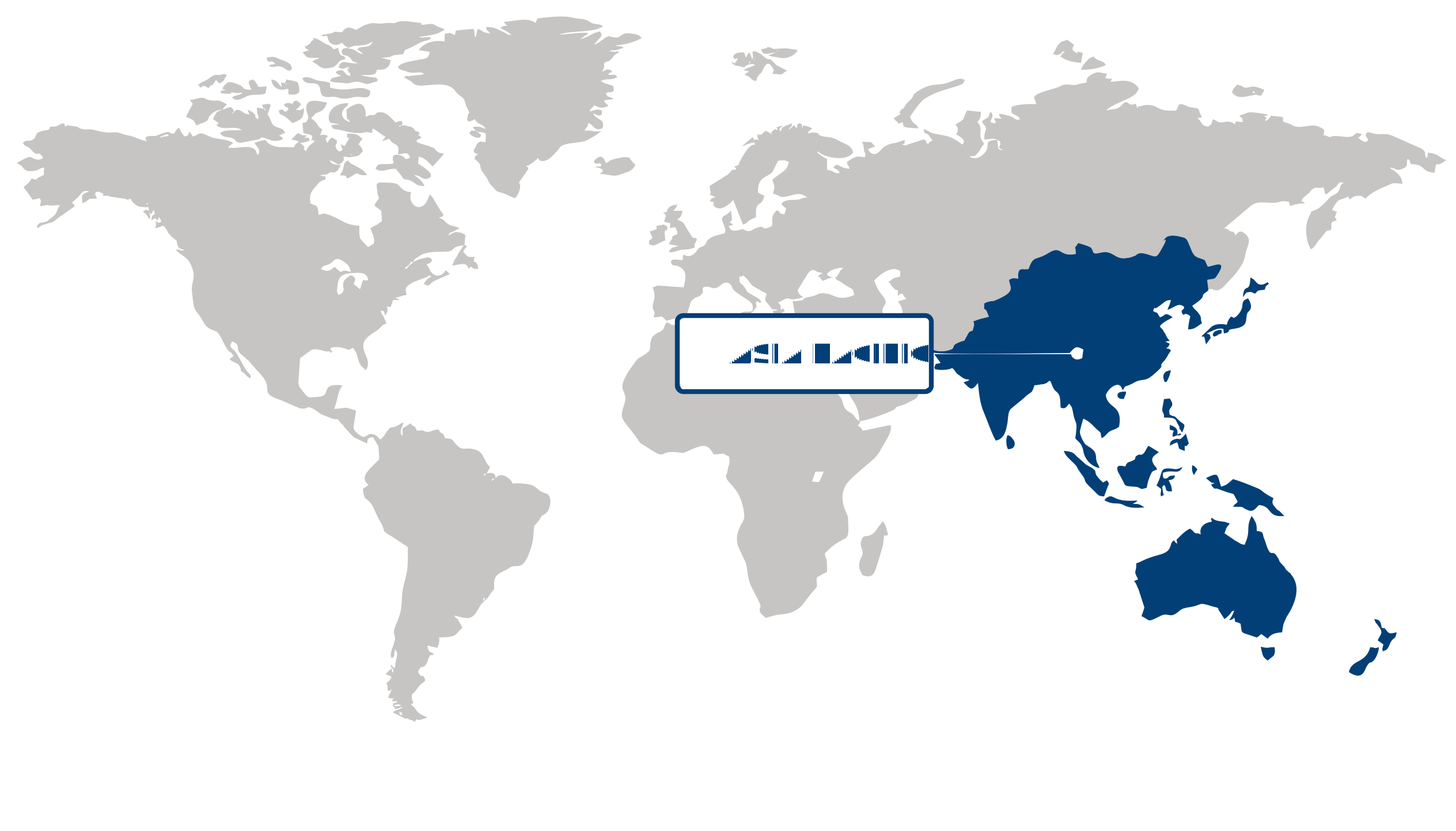
Asia Pacific captured over 54.4% of the power electronics market in 2025, the largest regional share driven by large-scale solar and wind farm inverter upgrades and a concentration of major semiconductor fabs. The International Energy Agency (IEA) highlights Asia’s renewables build-out, while China’s National Energy Administration (NEA) has prioritized utility retrofit programs; vendors such as Sungrow and Huawei Digital Power report sustained inverter demand, and foundries including TSMC and Samsung Foundry are expanding capacity to serve power-semiconductor needs. Together these dynamics—scale renewables, local device supply, and system integration—position the region for ongoing investment into grid modernization, EV infrastructure, and industrial electrification opportunities.
Japan is positioned as a pivotal hub in Asia Pacific, and its power electronics market is characterized by advanced OEM capabilities and focused industrial policy. Established suppliers like Mitsubishi Electric, Fuji Electric, and Toshiba supply high-reliability inverters and converters for transmission and transport, while the Ministry of Economy, Trade and Industry (METI) and NEDO back demonstration projects for grid resilience and next-generation power devices. Japan’s emphasis on quality, standards, and system integration creates niches for premium modules and controls that complement regional scale plays and attract partnerships for cross-border deployment.
China anchors the region, and its power electronics market is propelled by utility-scale inverter retrofits and a dense manufacturing ecosystem. The State Grid Corporation of China’s upgrade programs and NEA targets have accelerated demand; domestic suppliers such as Sungrow, Huawei Digital Power, and module makers like JinkoSolar capture large project pipelines, while SMIC and related fabs bolster local power-semiconductor supply chains. China’s combination of project scale, cost competitiveness, and rapid deployment capability offers strategic entry points for vendors and investors seeking volume-driven growth across Asia Pacific.
Europe Market Analysis:
Europe emerged as the fastest-growing region in the power electronics market, posting a robust CAGR of 8.1%; this acceleration is driven primarily by stringent vehicle emission regulations and the rapid expansion of EV charging infrastructure. Tight CO2 standards under the European Commission’s Fit for 55 agenda and rising EV registrations documented by the European Automobile Manufacturers Association (ACEA) are shifting demand toward high-efficiency inverters, onboard chargers, and DC fast-charging power stacks. Simultaneously, deployment metrics from the International Energy Agency (IEA) and the European Alternative Fuels Observatory (EAFO) show rapid charger rollouts, while suppliers such as ABB, Siemens, and Schneider Electric are scaling modular power-electronics platforms. These regulatory and infrastructure dynamics, coupled with industrial digitalization and grid reinforcement, make Europe a strategic hub for scalable, high-margin power-electronics investments focused on EV and charger ecosystems.
Germany anchors the region’s industrial capacity in the power electronics market, leveraging deep automotive OEM ecosystems and advanced manufacturing clusters. Major automakers and suppliers—Volkswagen, BMW Group, and Robert Bosch GmbH—are emphasizing in-house power-electronics R&D and high-volume production of SiC MOSFET modules and integrated traction inverters, while the Bundesministerium für Wirtschaft und Klimaschutz and the Bundesministerium für Digitales und Verkehr support charging expansion and grid adaptation. Grid oversight by Bundesnetzagentur and financing channels such as KfW further de-risk large-scale deployment. For investors and strategists, Germany’s vertically integrated supply chains and strong OEM partnerships create near-term opportunities for component localization and collaborative product qualification.
France acts as a policy-driven adopter in the power electronics market, where national targets and utility-led programs accelerate charger deployment and commercial adoption. The Ministère de la Transition écologique and ADEME have backed electrification pathways and infrastructure incentives under France Relance, while utilities and energy companies—EDF and TotalEnergies—are operationalizing large public and commercial charging networks that demand robust AC/DC conversion and grid-interactive power electronics. Automotive OEMs such as Renault pair vehicle launch programs with local charging partnerships, creating bundled procurement demand. France’s coordinated public–private approach and strong utility engagement make it a fertile market for grid-compliant power-electronics solutions and differentiated service models that reinforce Europe’s broader growth trajectory.
North America Market Trends:
Held a commanding share, the North America power electronics market is driven by coordinated investments in grid resilience, renewable integration and cross-border manufacturing, supported by policy and industry commitments. U.S. Department of Energy (DOE) funding for grid modernization and National Renewable Energy Laboratory (NREL) research on converters, coupled with Natural Resources Canada (NRCan) initiatives on electrification and Mexico’s Secretaría de Energía (SENER) support for transmission upgrades, illustrate demand for higher-efficiency inverters and converters. Supply-chain adjustments under the USMCA and vendor moves by Siemens Energy and General Electric underscore regional competitive intensity and scale. These dynamics position North America to capture long-term value from decarbonization, transport electrification and industrial digitalization. As a result, investor opportunities concentrate on modular hardware, system integration and servicing capabilities tied to large infrastructure programs.
As the regional leader, the U.S. power electronics market reflects concentrated demand from electric vehicles, utility upgrades and industrial automation that accelerate adoption of advanced converters and silicon-carbide devices. The U.S. Department of Energy’s Bipartisan Infrastructure Law commitments, the CHIPS and Science Act incentives noted by the U.S. Department of Commerce, and NREL collaborations with manufacturers demonstrate coordinated public–private deployment; examples include GE and Tesla announcements on in-house inverter and traction electronics projects. These forces create heightened competition for talent and localized manufacturing while improving margins for firms that scale quickly. Strategically, U.S. execution of federal programs will amplify North American uptake, making U.S.-focused supply and innovation hubs critical entry points for regional investors and partners.
| Parameter | North America | Asia Pacific | Europe | Latin America | MEA |
|---|---|---|---|---|---|
| Innovation Hub i Scale Nascent Developing Advanced | |||||
| Cost-Sensitive Region i Scale Low Medium High | |||||
| Regulatory Environment i Scale Restrictive Neutral Supportive | |||||
| Demand Drivers i Scale Weak Moderate Strong | |||||
| Development Stage i Scale Emerging Developing Developed | |||||
| Adoption Rate i Scale Low Medium High | |||||
| New Entrants / Startups i Scale Sparse Moderate Dense | |||||
| Macro Indicators i Scale Weak Stable Strong |
Segment Leadership and Growth Trends
Power Electronics Market Share (%), by Type, 2026
Go beyond the chart, access full insights & data tables
Request Free Sample ReportPower Discrete dominated the power electronics market's Type segment in 2025, taking the largest share as rising demand for discrete power semiconductors in automotive and industrial applications accelerated. Leadership stems from strong adoption in EV powertrains and industrial drives, evidenced by product roadmaps and press releases from Infineon Technologies and STMicroelectronics that emphasize discrete MOSFETs and diodes for traction and motor-control systems; ABB and Schneider Electric deployments further validate industrial demand. This creates scale and margin advantages for incumbents while opening niche supply-chain and localization opportunities for challengers; continued vehicle electrification and factory automation suggest sustained relevance in the near to medium term.
Analysis by Device
Insulated-Gate Bipolar Transistor represented largest share of the power electronics market's Device segment in 2025, propelled by uptake in renewable-energy inverters and high-voltage EV systems where efficient, robust switching is essential. Adoption is visible in offerings from Mitsubishi Electric and Fuji Electric and in grid modernization initiatives referenced by the U.S. Department of Energy, reflecting reliability and high-voltage performance. Incumbent suppliers can monetize proven IGBT platforms while newcomers pursue SiC and GaN alternatives; as renewable integration and fast-charging infrastructure expand, IGBTs will remain central to high-power conversion solutions.
Analysis by Application
Consumer Electronics held largest share of the power electronics market's Application segment in 2025, supported by widespread integration of power-efficient components and advanced chargers in smartphones, laptops, and wearable devices. Demand drivers include product strategies from Apple and Samsung and standards activity by the USB Implementers Forum and regulatory pushes from the European Commission toward higher energy-efficiency, prompting OEMs to prioritize compact, efficient power designs. This favors established semiconductor suppliers and enables startups to capture share with GaN chargers and integrated power-ICs; ongoing consumer expectations for longer battery life and stricter efficiency rules point to continued importance.
| Segment | Sub-Segment | Largest Segment | Fastest Growing |
|---|---|---|---|
| Type | Power IC, Power Module, Power Discrete | ||
| Device | Power Diodes, Metal-Oxide-Semiconductor Field-Effect Transistor, Bipolar-Junction Transistor, Insulated-Gate Bipolar Transistor, Thyristor | ||
| Application | Consumer Electronics, Energy & Power, Industrial System, Inverter & UPS, Others |
Competitive Landscape and Market Positioning
The competitive landscape shows intensified portfolio consolidation and platform evolution among these players. Many are broadening end-to-end offerings through targeted combinations of internal development and external collaboration, accelerating adoption of SiC/GaN, tighter integration of power ICs with control firmware, and modular system approaches. These moves shift value toward suppliers that can deliver integrated silicon, packaging, and software-enabled services, raising entry thresholds for commodity suppliers and creating opportunities for specialized partners focused on niche system architectures.
Strategic / Actionable Recommendations for Regional Players
North America: Leverage strong customer proximity to cloud, automotive, and industrial OEMs by deepening commercial ties and co-developing system-level power platforms that integrate wide-bandgap devices and control IP; pair this with alliances that secure advanced packaging and test capacity to shorten product cycles.
Asia Pacific: Build scale in manufacturing and supply-chain integration while collaborating with regional OEMs on turnkey modules for EV charging and renewable inverters; prioritize investments in GaN/SiC pilot lines and software-enabled power management to capture fast-growing application pockets.
Europe: Capitalize on automotive and industrial electrification expertise by aligning with tier-1s and energy integrators to deliver certified, modular solutions; focus on combining high-reliability power modules with digital services and standard-compliant system integration to defend premium positioning.
| Company | Market Share | Company Revenue | Revenue CAGR (%) | Product Portfolio | Geographic Presence | Innovation / R&D Focus | Strategic Developments |
|---|---|---|---|---|---|---|---|
| No companies available. | |||||||
Industry Development/News
| Company Name | Date | Key Development |
|---|
Customize Your Report
Explore examples of how this report can be tailored to different research needs, including custom segments, additional topics or chapters, and related reports. Click a section of the wheel or its numbered marker to explore the available options.
Power Electronics Market — Custom Segments
| Segment | Sub-Segment |
|---|---|
| No segment data available. | |
Power Electronics Market — Custom TOC
| Custom Chapter | Custom Details | ||
|---|---|---|---|
| No custom TOC data available. | |||
Need a different cut of the data?
Request Custom ResearchWhat is the current revenue of the power electronics market?
What is the forecasted size of the power electronics industry?
Which geographical area accounts for the highest portion of the power electronics market?
In which region is the power electronics sector expanding most rapidly?
Which is the largest sub-segment within the type segment for power electronics industry?
Why does insulated-gate bipolar transistor sub-segment dominate the device segment of power electronics sector?
How does consumer electronics segment fare in the power electronics industry?
Which companies are driving growth in the power electronics landscape?
Our Clients
"Working with FBI has been a good experience. The market report provided a holistic view, covering everything from emerging trends to potential risks."
Semtech Corporation
"The experience was highly positive. The team showcased remarkable flexibility in adapting to our specific needs and delivered report that perfectly aligned with all our requirements."
TSMC
"What really stood out to me was how clearly and promptly the Fundamental Business Insights team communicated throughout. It made the collaboration feel effortless."
NXP Semiconductors
Our Research Team & Methodology
Every Fundamental Business Insights report is built by a dedicated vertical research team, validated through a structured primary-and-secondary methodology, and reviewed for accuracy before it reaches you.
Research Team Overview
Prepared by the Electronics & Semiconductors Research Team
Delivery
Published
Demand
Available
Support
Trust & Compliance
Research Domains
10 coverage areasResearch Intelligence
| Source | Reference |
|---|---|
| Semiconductor Industry Association (SIA) | www.semiconductors.org |
| SEMI | www.semi.org |
| JEDEC Solid State Technology Association | www.jedec.org |
| IEEE | www.ieee.org |
| IPC – Association Connecting Electronics Industries | www.ipc.org |
| International Electrotechnical Commission (IEC) | www.iec.ch |
| International Organization for Standardization (ISO) | www.iso.org |
| U.S. Bureau of Industry and Security (BIS) | www.bis.gov |
| U.S. Patent and Trademark Office (USPTO) | www.uspto.gov |
| European Patent Office (EPO) | www.epo.org |
| Taiwan Semiconductor Industry Association (TSIA) | www.tsia.org.tw |
| World Semiconductor Trade Statistics (WSTS) | www.wsts.org |
| International Energy Agency (IEA) | www.iea.org |
| GSMA | www.gsma.com |
| 3GPP | www.3gpp.org |
| ITU (International Telecommunication Union) | www.itu.int |
| Omdia (public insights) | omdia.tech.informa.com |
| Display Supply Chain Consultants (DSCC) | www.displaysupplychain.com |
| U.S. Department of Energy (DOE) | www.energy.gov |
| NIST (National Institute of Standards and Technology) | www.nist.gov |
Research Workflow & Quality Assurance
Data Collection
Verified information gathered through primary and secondary research.
Data Triangulation
Cross-validation using multiple independent data sources.
Forecast Modelling
Market estimates developed using historical trends and analytical models.
Analyst Validation
Findings reviewed by domain experts for accuracy and consistency.
Editorial & Quality Review
Final editorial, quality, and compliance checks before publication.
Final Publication
Released after successful completion of the internal review process.
Report Coverage
📊 Market Assessment
- Market Size & Forecast
- Market Segmentation
- Regional Analysis
- Growth Drivers & Challenges
- Market Dynamics
🏢 Competitive Intelligence
- Competitive Landscape
- Company Profiles
- Competitive Benchmarking
- Mergers & Acquisitions
- Market Share Analysis or Key Company Strategies
🔍 Strategic Analysis
- Value Chain Analysis
- Porter's Five Forces
- PESTLE Analysis
- Pricing Trends
- Supply-Demand Analysis
🚀 Future Outlook
- Technology Landscape
- Regulatory Landscape
- Investment & Funding Landscape
- Emerging Opportunities
- Future Market Outlook
Have a question about this report or need a custom scope?
Request Customization