Photovoltaics (PV) Market Size & Forecasts 2026-2035, By Segments (Type, Component, Installation Type, Application, Technology), Growth Opportunities, Innovation Landscape, Regulatory Shifts, Strategic Regional Insights (U.S., Japan, China, South Korea, UK, Germany, France), and Competitive Dynamics (LONGi, JinkoSolar, Canadian Solar, Trina Solar, First Solar)
Market Size and Growth Outlook
Photovoltaics Market size is expected to advance from USD 108.69 billion in 2025 to USD 209.85 billion by 2035, registering a CAGR of more than 6.8% across 2026-2035. By 2026, the industry is anticipated to generate USD 115.15 billion in revenue.
Get more details on this report
Request Free Sample ReportPhotovoltaics (PV) Market Intelligence Snapshot
Regional Market Dynamics
Segment Momentum
Market Expansion Drivers
Leading Market Participants
Global Market Forecast Snapshot
Market Outlook
Regional and Segment Outlook
Market Growth Drivers and Industry Trends
The continuous reduction in solar panel prices is fundamentally expanding the affordability and accessibility of the photovoltaics (PV) market. This trend, driven by innovations in manufacturing processes and economies of scale achieved by major producers like LONGi Green Energy and JinkoSolar, enables broader adoption among residential, commercial, and utility-scale customers. The decrease in capital expenditure lowers entry barriers for new market participants and enhances the competitive positioning of incumbent manufacturers capable of leveraging cost-efficient technologies. As reported by the International Renewable Energy Agency (IRENA), module prices have declined steadily, incentivizing accelerated deployment globally. This cost dynamic encourages market players to innovate further in production efficiency and integrate advanced installation capabilities, fostering a more diverse and scalable supply chain. Looking ahead, ongoing cost reductions will sustain momentum for solar energy integration into conventional grids and off-grid applications, stimulating diverse growth opportunities.
Government Incentives for PV Adoption
Government-led policies and subsidies remain essential catalysts in shaping the photovoltaics (PV) market landscape, significantly influencing installation rates and investment flows. Programs implemented by entities such as the U.S. Department of Energy and the European Commission demonstrate the impact of tax credits, feed-in tariffs, and grants in de-risking project development and enhancing end-user value propositions. These regulatory measures encourage utility companies and developers to accelerate portfolio diversification towards cleaner energy, positioning incumbents and disruptive startups to capitalize on evolving subsidy frameworks. As exemplified by China's Golden Sun Program, targeted financing mechanisms have successfully stimulated large-scale photovoltaic capacity build-out. These initiatives not only mitigate project risks but also direct innovation in financing models and grid integration technologies. The persistence of supportive government action is poised to maintain the photovoltaics market’s positive trajectory amid transitioning national energy policies worldwide.
Development of High-Efficiency PV Materials
Advancements in high-efficiency photovoltaic materials are redefining performance benchmarks and driving competitive differentiation within the photovoltaics (PV) market. Innovations such as perovskite tandem cells and passivated emitter rear cells, pioneered by research entities like the National Renewable Energy Laboratory (NREL), offer substantial gains in conversion efficiency, directly impacting system output and return on investment. These material breakthroughs enable players to deliver more power per unit area, appealing to space-constrained installations and premium segments. Established manufacturers are investing in R&D partnerships to integrate these next-generation materials, while emerging ventures specialize in scaling novel compounds. This progress not only enhances product offerings but also creates pathways for supply chain diversification and intellectual property development. Given the current trajectory of material innovation, the photovoltaics market will increasingly benefit from technology-driven differentiation, reinforcing sustainable growth amidst intensifying competition.
Industry Restraints:
Intermittency and Grid Integration Challenges
The inherent intermittency of solar power significantly restrains PV market expansion by complicating grid management and reliability. As solar generation fluctuates with weather and daylight, utilities face operational inefficiencies in balancing supply and demand, causing increased reliance on backup fossil fuel plants or energy storage. The U.S. Department of Energy highlights that inadequate grid infrastructure and limited energy storage capacity curb the full utilization of solar energy. This volatility deters large-scale utility investments and induces hesitation among policy-makers regarding aggressive solar mandates. For incumbents, integrating variable PV power necessitates costly grid upgrades and storage solutions, while new entrants grapple with uncertain market entry conditions. Moving forward, unless breakthroughs in grid modernization and scalable storage ensue, intermittency will remain a critical bottleneck, shaping investment priorities and slowing the seamless integration of photovoltaics into mainstream energy systems.
Supply Chain Disruptions and Resource Constraints
Ongoing supply chain disruptions and critical material shortages, notably polysilicon and rare earth elements, pose a substantial restraint on the PV market’s growth trajectory. The COVID-19 pandemic and geopolitical tensions have exposed vulnerabilities in the global PV supply chain, as observed in delayed deliveries and price volatility reported by Hanwha Q CELLS and First Solar. Additionally, environmental restrictions in China, which dominates polysilicon production, have led to capacity constraints, hindering scaling efforts. These supply issues elevate costs and extend project timelines, pressuring manufacturing margins and complicating procurement for both established players and startups. Strategically, companies must diversify sourcing and invest in recycling technologies to mitigate risks. In the near to medium term, supply chain resilience efforts will be paramount, with geographic and technological diversification becoming critical levers to sustain photovoltaic market advancement amidst persistent material availability challenges.
| Growth Driver | Impact on CAGR | Regulatory Influence | Geographic Relevance | Adoption Rate | Impact Timeline |
|---|---|---|---|---|---|
| Declining Solar Panel Costs | 2.00% | Short term (≤ 2 yrs) | Asia Pacific, Europe; Spillover: North America | Medium | Fast |
| Government Incentives for PV Adoption | 2.50% | Medium term (2–5 yrs) | Europe, North America; Spillover: Asia Pacific | High | Fast |
| Development of High-Efficiency PV Materials | 2.30% | Long term (5+ yrs) | Asia Pacific, Europe; Spillover: North America | Medium | Moderate |
Unlock insights tailored to your business with our bespoke market research solutions.
Click to get your customized report now.
Regional Demand Dynamics
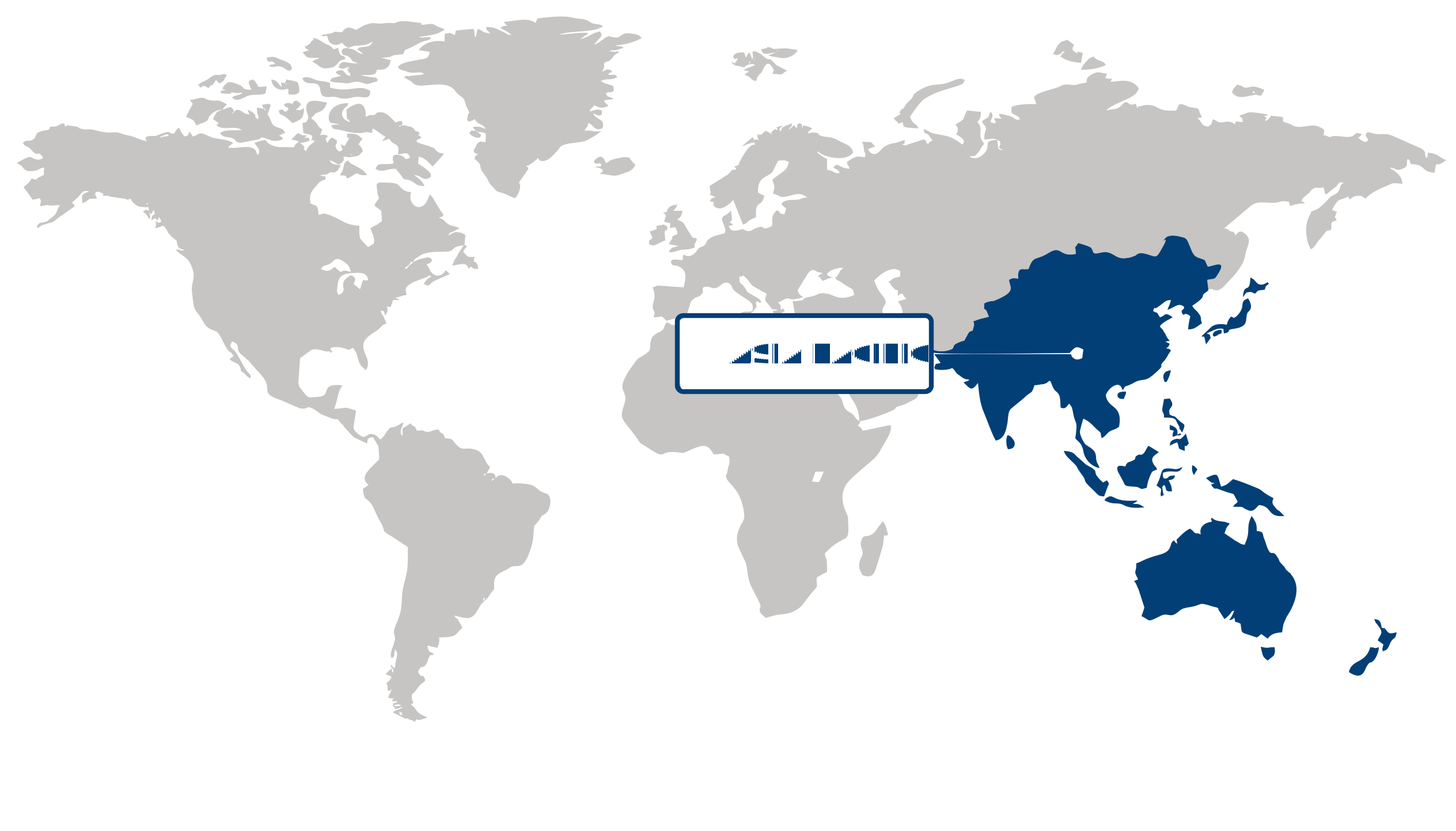
Asia Pacific dominated the photovoltaics (PV) market in 2025, capturing over 42% of the global share. The region's leadership stems from its manufacturing dominance and robust regulatory frameworks, particularly within emerging economies. Countries like China and India have rapidly scaled production capacities, driven by strategic investments and government policies aimed at bolstering renewable energy adoption. The International Energy Agency highlights China's expansive solar panel manufacturing sector, which underpins global supply chains. Simultaneously, regulatory incentives across the region have accelerated solar installation rates, reflecting heightened sustainability priorities and evolving energy policies. This confluence of manufacturing strength and progressive policy creates a resilient ecosystem for PV growth. The Asia Pacific photovoltaics market offers significant opportunities as continued advancements in technology and infrastructure expand demand, positioning it as a focal point for global renewable energy investors and strategists seeking to capitalize on shifting energy paradigms.
China anchors the Asia Pacific photovoltaics (PV) market with its unparalleled manufacturing infrastructure and aggressive policy support. The Chinese government’s subsidies and the National Energy Administration’s clear renewable targets have propelled domestic PV capacity to world-leading levels. Companies like LONGi Green Energy are exemplars, expanding production while innovating high-efficiency solar cells. This dynamic supply environment sustains competitive pricing and international export growth, reinforcing China's pivotal role in global solar value chains. These developments consolidate China’s contribution to regional leadership, creating abundant opportunities for market participants leveraging cost advantages and policy momentum in Asia Pacific.
Japan is positioned as a pivotal hub in the Asia Pacific photovoltaics (PV) market, driven by stringent environmental regulations and a public commitment to energy diversification following the 2011 nuclear incident. Government initiatives such as the Feed-in Tariff (FIT) scheme have stimulated widespread PV adoption among residential and commercial consumers, as supported by the Ministry of Economy, Trade, and Industry (METI). Leading corporations, including Sharp Corporation, continue to innovate PV technologies tailored to limited land availability and urban environments. Japan’s focused regulatory environment and technological advancements complement the region’s manufacturing strengths, underscoring Asia Pacific’s integrated approach and sustained growth trajectory in the photovoltaics market.
Europe Market Analysis:
Europe emerged as the fastest-growing region in the photovoltaics (PV) market, registering a robust CAGR of 9.52%. This dynamic growth is primarily propelled by increasing consumer demand for clean energy alongside stringent greenhouse gas reduction targets set across numerous European countries. Heightened sustainability priorities and progressive regulatory frameworks, including the European Green Deal, are accelerating investments in solar energy infrastructure. Key players such as the European Commission and sector-leading firms like Siemens Energy have actively supported technological advancements and deployment, reinforcing Europe’s role as a frontrunner in PV adoption. The region's robust logistical networks and supportive policy incentives are also streamlining supply chains and project rollouts. With escalating commitments to carbon neutrality and rising digital transformation in energy management, Europe offers compelling long-term opportunities for expanding photovoltaic solutions across residential, commercial, and industrial segments.
Germany commands a pivotal role in Europe’s photovoltaics (PV) market, driven by progressive clean energy policies and strong consumer awareness regarding sustainability. The country’s Energiewende (energy transition) initiative has catalyzed substantial PV capacity additions, supported by government agencies like the Federal Ministry for Economic Affairs and Climate Action. German utilities, including E.ON and EnBW, have adopted innovative business models integrating solar with smart grid technologies, accentuating operational efficiency and consumer engagement. Robust demand for rooftop solar installations reflects shifting purchasing behaviors toward decentralization and self-consumption, positioning Germany as a benchmark for renewable energy integration in Europe. These developments underscore Germany’s strategic importance as a growth engine, reinforcing regional progress toward achieving ambitious climate goals.
France plays an increasingly influential role in Europe’s photovoltaics (PV) market, with its trajectory shaped by bold national climate objectives and growing consumer preference for renewable solutions. The French government’s support through the Multiannual Energy Plan (Programmation Pluriannuelle de l’Énergie) has enhanced the regulatory landscape, fostering project viability and investor confidence. Leading energy groups such as EDF have boosted solar project pipelines, leveraging advances in both utility-scale and distributed PV systems. Cultural shifts toward eco-consciousness and rising adoption of green tariffs are further stimulating market demand. France’s expanding solar capacity complements broader European clean energy strategies, strengthening the region’s collective capacity to meet stringent emission reduction targets and underscoring expansive prospects for PV market growth across Europe.
North America Market Trends:
North America held a substantial share of the photovoltaics (PV) market, driven by a combination of robust energy transition policies and increasing corporate commitments to sustainability. The region’s capacity to integrate advanced manufacturing technologies and digital solutions has enhanced operational efficiencies, supporting steady expansion. Influenced by consumer preferences favoring clean energy and government incentives such as the U.S. Inflation Reduction Act, North America has witnessed notable investment inflows and supply chain stabilization efforts, even amid global disruptions. Support from agencies like the U.S. Department of Energy and collaborations among industry leaders like First Solar underscore a collaborative ecosystem fostering innovation. This blend of regulatory backing and market maturity positions North America to capitalize on upcoming grid modernization and large-scale project developments, indicating significant future opportunities.
The U.S. plays a pivotal role in North America’s photovoltaics (PV) market, propelled by aggressive federal policies targeting carbon neutrality and clean energy adoption. The Inflation Reduction Act, coupled with state-level renewable portfolio standards, has catalyzed consumer demand and enterprise-scale solar deployments. Leading companies, such as SunPower and Tesla, are leveraging technological advancements to enhance panel efficiency and lower system costs, reinforcing competitive dynamics. Moreover, investments in domestic supply chains, evidenced by initiatives from the Solar Energy Industries Association, are enhancing resilience against global material shortages. These factors collectively highlight the U.S. as a cornerstone for regional growth, underpinning broader North American opportunities in scaling PV market capacity and innovation.
| Parameter | North America | Asia Pacific | Europe | Latin America | MEA |
|---|---|---|---|---|---|
| Innovation Hub i Scale Nascent Developing Advanced | |||||
| Cost-Sensitive Region i Scale Low Medium High | |||||
| Regulatory Environment i Scale Restrictive Neutral Supportive | |||||
| Demand Drivers i Scale Weak Moderate Strong | |||||
| Development Stage i Scale Emerging Developing Developed | |||||
| Adoption Rate i Scale Low Medium High | |||||
| New Entrants / Startups i Scale Sparse Moderate Dense | |||||
| Macro Indicators i Scale Weak Stable Strong |
Segment Leadership and Growth Trends
Photovoltaics (PV) Market Share (%), by Type, 2026
Go beyond the chart, access full insights & data tables
Request Free Sample ReportLow Concentration Photovoltaic represented the largest share in the photovoltaics (PV) market in 2025, driven primarily by its widespread adoption across commercial and residential sectors due to significant cost advantages. This segment benefits from evolving customer preferences favoring affordable and scalable solar solutions, alongside robust supply chain enhancements reducing manufacturing costs. Regulatory milestones promoting sustainable energy, such as incentives from the U.S. Department of Energy, emphasize deployment of low-concentration systems. Leading companies like First Solar leverage economies of scale to strengthen competitiveness in this segment. The broad applicability and cost-efficiency open strategic opportunities for both established manufacturers and new entrants to capture diverse market niches. Given ongoing improvements in material efficiency and sustained government support, low concentration photovoltaic systems are expected to maintain their dominant position, driven by persistent demand for accessible and economically viable solar power installations.
Analysis by Component
Modules held the largest share in the photovoltaics (PV) market in 2025 owing to their role as the fundamental building block of all solar power systems globally. This leadership arises from continuous technological advancements enhancing module efficiency and durability, supported by rising global solar capacity installations, as reported by the International Renewable Energy Agency (IRENA). Customer demand consistently favors high-performance modules that maximize energy yield, while digital transformation in manufacturing processes accelerates product innovation and cost reduction. Major suppliers, including JinkoSolar and Trina Solar, sustain competitive advantage through rapid scaling and diversified product portfolios. The module segment offers vital strategic benefits by enabling firms to innovate and tailor solutions across utility-scale and distributed solar markets. Given the integral function of modules and ongoing advancements, this segment remains indispensable to the photovoltaics value chain for the foreseeable future.
Analysis by Installation Type
Ground-Mounted installations dominated the photovoltaics (PV) market in 2025, reflecting the rapid expansion of large-scale utility and commercial solar farms aimed at fulfilling global renewable energy mandates. The segment’s growth is closely tied to scalable land availability, regulatory frameworks favoring utility-scale projects, and significant capital investments from institutional players like the Solar Energy Corporation of India (SECI). Market dynamics reveal a strong alignment with sustainability priorities and infrastructure development plans targeting grid modernization and energy transition goals. Competitive pressures drive adoption of advanced tracking systems and optimized ground-mounted designs to enhance output. For companies, this segment represents substantial opportunities to capture volume-driven economies and deliver integrated project solutions. With international commitments to expand solar capacity and ongoing cost declines in balance-of-system components, ground-mounted installations will continue to lead as a cornerstone of global photovoltaics deployment strategies.
| Segment | Sub-Segment | Largest Segment | Fastest Growing |
|---|---|---|---|
| Type | Low Concentration Photovoltaic, High Concentration Photovoltaic | ||
| Component | Modules, Balance of System, Inverters | ||
| Installation Type | Ground-Mounted, Rooftop-Mounted, Others | ||
| Application | Commercial, Utility, Residential | ||
| Technology | Monocrystalline Silicon, Thin Film, Polycrystalline Silicon, Others |
Competitive Landscape and Market Positioning
The competitive landscape reflects a dynamic interplay of expansion and technological refinement. These key players continuously broaden their product lines and enhance efficiency through sustained R&D efforts. Collaborative ventures and cross-border partnerships foster access to emerging markets and drive cost optimization. Strategic acquisitions have bolstered manufacturing scale and technological capabilities, enabling faster adoption of next-generation PV technologies. The emphasis on sustainability and multi-junction solar cells underscores a commitment to longer-term value creation. This multifaceted approach intensifies rivalry while setting elevated standards for performance, reliability, and customer-centric innovation, influencing overall market evolution.
Strategic / Actionable Recommendations for Regional Players
In North America, fostering stronger synergies with technology innovators and system integrators can accelerate adoption of advanced PV solutions. Emphasizing integration with energy storage and smart grid applications may unlock new revenue streams and differentiate offerings in a competitive landscape.
Asia Pacific players could benefit from deepening cooperative frameworks across countries to enhance supply chain resilience and scale up emerging PV tech, particularly high-efficiency bifacial and tandem cells. Targeting both utility-scale and distributed solar segments will maximize growth opportunities amid regional policy support.
European market participants are advised to prioritize alliances that enhance localized manufacturing and retrofitting capabilities to meet stringent environmental standards. Leveraging digitalization for predictive maintenance and performance optimization can boost competitiveness in mature, sustainability-driven markets.
| Company | Market Share | Company Revenue | Revenue CAGR (%) | Product Portfolio | Geographic Presence | Innovation / R&D Focus | Strategic Developments |
|---|---|---|---|---|---|---|---|
| No companies available. | |||||||
Industry Development/News
| Company Name | Date | Key Development |
|---|
Customize Your Report
Explore examples of how this report can be tailored to different research needs, including custom segments, additional topics or chapters, and related reports. Click a section of the wheel or its numbered marker to explore the available options.
Photovoltaics (PV) Market — Custom Segments
| Segment | Sub-Segment |
|---|---|
| No segment data available. | |
Photovoltaics (PV) Market — Custom TOC
| Custom Chapter | Custom Details | ||
|---|---|---|---|
| No custom TOC data available. | |||
Need a different cut of the data?
Request Custom ResearchWhat is the projected value of the photovoltaics (PV) industry by 2035?
In which region is the photovoltaics (PV) market most concentrated?
Which area is showing the greatest surge in photovoltaics sector?
Why is the low concentration photovoltaic segment leading in the photovoltaics (PV) industry?
Why does modules sub-segment dominate the component segment of photovoltaics (PV) sector?
How much is the ground-mounted segment expected to grow in the photovoltaics (PV) industry beyond 2025?
What factors give utility segment a competitive edge in the photovoltaics (PV) sector?
Which is the largest sub-segment within the technology segment for photovoltaics (PV) industry?
What are the prominent companies operating in the photovoltaics (PV) landscape?
Our Clients
"The information presented in the report was genuinely insightful. The data was clear and easy to understand, which made it much easier to interpret the findings."
Amara Raja Group
"The responsiveness and professionalism exhibited by the team were exemplary. They were readily available to address queries, provide clarifications, and offer additional insights."
ONGC
"The reports offered a comprehensive analysis of various segments within the market. The detailed insights into market trends, and regulatory landscapes were excellent."
TotalEnergies
Our Research Team & Methodology
Every Fundamental Business Insights report is built by a dedicated vertical research team, validated through a structured primary-and-secondary methodology, and reviewed for accuracy before it reaches you.
Research Team Overview
Prepared by the Energy & Power Research Team
Delivery
Published
Demand
Available
Support
Trust & Compliance
Research Domains
10 coverage areasResearch Intelligence
| Source | Reference |
|---|---|
| International Energy Agency (IEA) | www.iea.org |
| U.S. Energy Information Administration (EIA) | www.eia.gov |
| International Renewable Energy Agency (IRENA) | www.irena.org |
| International Electrotechnical Commission (IEC) | www.iec.ch |
| International Organization for Standardization (ISO) | www.iso.org |
| IEEE | www.ieee.org |
| CIGRE (International Council on Large Electric Systems) | www.cigre.org |
| World Energy Council (WEC) | www.worldenergy.org |
| U.S. Department of Energy (DOE) | www.energy.gov |
| International Atomic Energy Agency (IAEA) | www.iaea.org |
| American Petroleum Institute (API) | www.api.org |
| Society of Petroleum Engineers (SPE) | www.spe.org |
| Hydrogen Council | hydrogencouncil.com |
| Battery Council International (BCI) | batterycouncil.org |
| Global Wind Energy Council (GWEC) | gwec.net |
| SolarPower Europe | www.solarpowereurope.org |
| World Bioenergy Association (WBA) | worldbioenergy.org |
| International Hydropower Association (IHA) | www.hydropower.org |
| Edison Electric Institute (EEI) | www.eei.org |
| National Renewable Energy Laboratory (NREL) | www.nrel.gov |
Research Workflow & Quality Assurance
Data Collection
Verified information gathered through primary and secondary research.
Data Triangulation
Cross-validation using multiple independent data sources.
Forecast Modelling
Market estimates developed using historical trends and analytical models.
Analyst Validation
Findings reviewed by domain experts for accuracy and consistency.
Editorial & Quality Review
Final editorial, quality, and compliance checks before publication.
Final Publication
Released after successful completion of the internal review process.
Report Coverage
📊 Market Assessment
- Market Size & Forecast
- Market Segmentation
- Regional Analysis
- Growth Drivers & Challenges
- Market Dynamics
🏢 Competitive Intelligence
- Competitive Landscape
- Company Profiles
- Competitive Benchmarking
- Mergers & Acquisitions
- Market Share Analysis or Key Company Strategies
🔍 Strategic Analysis
- Value Chain Analysis
- Porter's Five Forces
- PESTLE Analysis
- Pricing Trends
- Supply-Demand Analysis
🚀 Future Outlook
- Technology Landscape
- Regulatory Landscape
- Investment & Funding Landscape
- Emerging Opportunities
- Future Market Outlook
Have a question about this report or need a custom scope?
Request Customization