Phenolic Resins Market Size & Growth Forecast 2027–2036, By Segments (Product, Application), Regional Demand Trends (North America, Asia Pacific, Europe), Key Country Insights (U.S., Japan, South Korea, Germany, France, Italy), and Competitive Landscape
Market Size and Growth Outlook
Phenolic Resins Market size was assessed at USD 16.7 billion in 2026 and is poised to grow at a 5.42% CAGR between 2027 and 2036, attaining USD 28.31 billion by 2036. The industry revenue for 2027 is estimated at USD 17.46 billion.
Get more details on this report
Request Free Sample ReportPhenolic Resins Market Intelligence Snapshot
Regional Market Dynamics
- Asia Pacific accounted for 32.78% of the market in 2026, supported by strong manufacturing activity across construction, automotive, electronics, and industrial applications using phenolic resin products.
- Asia Pacific is forecast to grow at a 6.33% CAGR, supported by expanding industrial production, downstream processing capacity, and sustained demand for durable, heat-resistant materials.
Segment Momentum
- Molding accounted for a 25.06% share in 2026 because phenolic resins provide the heat resistance, dimensional stability, and mechanical durability required for demanding industrial molded components.
- Wood Adhesives are growing fastest as manufacturers increasingly require durable, high-strength bonding solutions for structural and industrial wood products where consistent adhesive performance is essential.
Market Expansion Drivers
- Demand for flame-resistant materials in automotive and aerospace applications.
- Growth in energy-efficient construction insulation and safety-focused building materials.
- Increasing electronics laminates and advanced composite applications in manufacturing.
Leading Market Participants
- Prominent companies in the phenolic resins market include Hexion Inc. (United States), DIC Corporation (Japan), Sumitomo Bakelite Co., Ltd. (Japan), SI Group, Inc. (United States), Georgia-Pacific Chemicals LLC (United States), Kolon Industries, Inc. (South Korea), Hexcel Corporation (United States), BASF SE (Germany), Mitsui Chemicals, Inc. (Japan), Prefere Resins Holding GmbH (Germany).
Global Market Forecast Snapshot
Market Outlook
- 2026 Market Size: USD 16.7 billion
- 2027 Estimated Market Size: USD 17.46 billion.
- Projected Market Size: USD 28.31 billion by 2036
- Growth Forecast: 5.42% CAGR (2027-2036)
Regional and Segment Outlook
- Leading Regional Market: Asia Pacific
- High-Growth Regional Hub: Asia Pacific
- Core Revenue Segment: Novolac (Product) | Molding (Application)
- Emerging Opportunity Segment: Novolac (Product) | Wood Adhesives (Application)
Market Growth Drivers and Industry Trends
Demand for flame-resistant materials in automotive and aerospace applications
The phenolic resins market is benefiting from rising demand for materials that provide strong flame resistance and thermal stability in automotive and aerospace applications. Phenolic resins are valued for their ability to maintain structural and functional performance under elevated temperatures while offering favorable fire, smoke, and heat resistance characteristics. In automotive applications, these properties support components exposed to engine heat and demanding operating environments, while aerospace manufacturers require lightweight materials that can satisfy stringent safety and performance requirements. Increasing attention to passenger protection and fire safety is encouraging the incorporation of high-performance resin systems into specialized components, friction materials, insulation, and composite structures.
Growth in energy-efficient construction insulation and safety-focused building materials
Energy-efficient construction is creating new opportunities for the phenolic resins market as builders and material manufacturers seek insulation solutions that combine strong thermal performance with fire resistance. Phenolic-based insulation materials can provide effective resistance to heat transfer while contributing to safer building assemblies, making them suitable for applications where both energy conservation and fire protection are priorities. The expansion of energy-conscious construction practices is increasing the adoption of advanced insulation systems in walls, roofs, floors, and other building structures. Stricter attention to building safety and the need to reduce energy consumption are also encouraging the selection of materials capable of supporting thermal efficiency without compromising fire-performance requirements.
Increasing electronics laminates and advanced composite applications in manufacturing
Increasing use of electronics laminates and advanced composites is expanding the phenolic resins market as manufacturers seek materials that combine dimensional stability, thermal resistance, electrical insulation, and mechanical durability. Phenolic resin systems can serve as binders and matrix materials in applications requiring reliable performance under heat and demanding processing conditions. In electronics manufacturing, their properties support laminate and insulation applications, while advanced composite producers use phenolic-based systems in components where fire resistance and structural integrity are important. Continued development of electronic devices and high-performance manufactured products is increasing the need for specialized resin formulations capable of meeting application-specific performance requirements.
| Growth Driver | Impact on CAGR | Regulatory Influence | Geographic Relevance | Adoption Rate | Impact Timeline |
|---|---|---|---|---|---|
| Demand for flame-resistant materials in automotive and aerospace applications | 2.10% | High | North America, Europe, Asia Pacific | High | Near Term |
| Growth in energy-efficient construction insulation and safety-focused building materials | 1.90% | Moderate | Europe, North America, Asia Pacific | High | Mid Term |
| Increasing electronics laminates and advanced composite applications in manufacturing | 1.50% | High | Asia Pacific, North America | Medium | Long Term |
Unlock insights tailored to your business with our bespoke market research solutions.
Click to get your customized report now.
Regional Demand Dynamics
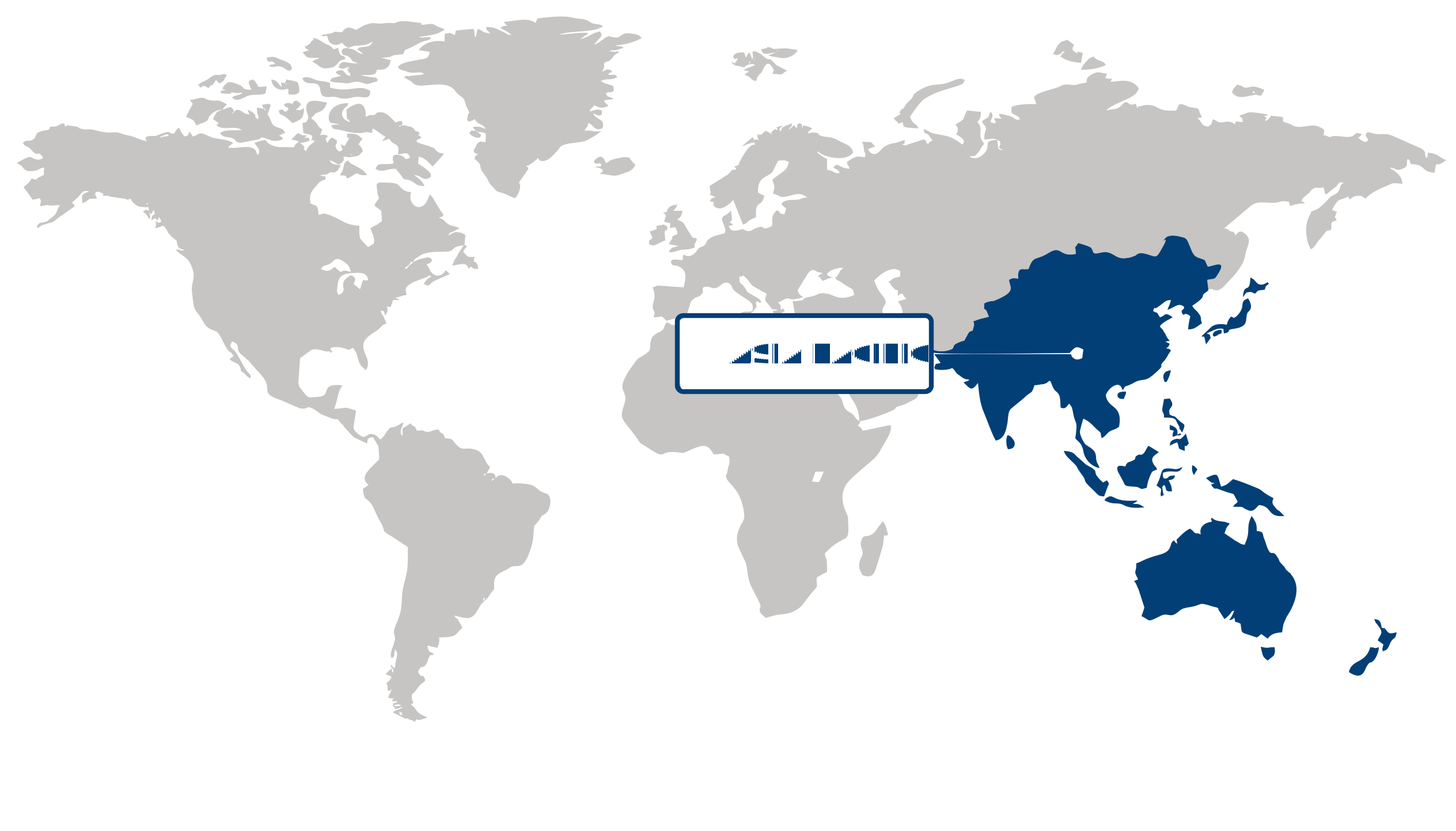
Asia Pacific (Largest & Fastest-Growing Region)
The Asia Pacific phenolic resins market held the largest share in 2026, representing 32.78% share, while also maintaining the region's fastest growth trajectory due to expanding industrial and construction activity. Phenolic resins are widely valued for their heat resistance, mechanical strength, flame-retardant characteristics, and durability, supporting their use in insulation, laminates, adhesives, molding compounds, automotive components, and construction materials. Rapid urbanization and infrastructure development are strengthening demand for engineered materials that can withstand demanding environments. The region's expanding automotive and electronics manufacturing sectors are also creating opportunities for high-performance resin applications. In addition, growing investment in industrial production and modern construction is encouraging the adoption of advanced materials with improved thermal and safety characteristics, reinforcing Asia Pacific's position as a major center for phenolic resin consumption and future market expansion.
| Parameter | North America | Asia Pacific | Europe | Latin America | MEA |
|---|---|---|---|---|---|
| Innovation Hub i Scale Nascent Developing Advanced | |||||
| Cost-Sensitive Region i Scale Low Medium High | |||||
| Regulatory Environment i Scale Restrictive Neutral Supportive | |||||
| Demand Drivers i Scale Weak Moderate Strong | |||||
| Development Stage i Scale Emerging Developing Developed | |||||
| Adoption Rate i Scale Low Medium High | |||||
| New Entrants / Startups i Scale Sparse Moderate Dense | |||||
| Macro Indicators i Scale Weak Stable Strong |
Key Country Insights
Germany 🇩🇪
Industrial Materials FocusGermany prioritizes phenolic resins for automotive components, insulation products, and engineered industrial applications. Producers are investing in sustainable raw materials and process optimization while maintaining the performance standards required by advanced manufacturing sectors.
France 🇫🇷
Sustainable Industrial ApplicationsFrance is encouraging wider use of phenolic resins in construction materials, transportation, and industrial insulation solutions. Manufacturers are balancing product performance with environmental compliance by introducing cleaner production methods and improved resin formulations.
Italy 🇮🇹
Manufacturing Supply ExpansionItaly applies phenolic resins across furniture, automotive, and industrial manufacturing where durable bonding materials are required. Local producers are strengthening specialty product portfolios to meet evolving customer requirements for performance and processing efficiency.
Japan 🇯🇵
Precision Manufacturing SupportJapan utilizes phenolic resins in electronics, friction materials, and specialty industrial products where consistent quality is essential. Domestic suppliers continue refining high-performance formulations to address demanding manufacturing specifications and product reliability requirements.
South Korea 🇰🇷
Electronics Materials IntegrationSouth Korea emphasizes phenolic resins for electronics, semiconductor packaging, and industrial component manufacturing. Companies are expanding specialty resin capabilities to support advanced production processes and enhance material performance across high-value applications.
United States 🇺🇸
Advanced Composites DemandThe U.S. phenolic resins market is supported by demand from aerospace, automotive, and industrial composites requiring durable, heat-resistant materials. Manufacturers are emphasizing lower-emission resin formulations and production efficiency to meet evolving customer and regulatory expectations.
Segment Leadership and Growth Trends
Phenolic Resins Market Share (%), by Product, 2026
Go beyond the chart, access full insights & data tables
Request Free Sample ReportProduct Segment Analysis: Novolac (Largest & Fastest-Growing Segment)
The novolac segment dominated the phenolic resins market and accounted for the largest share in 2026, while also representing the fastest-growing product segment. Novolac resins are valued for their thermal stability, mechanical strength, and dimensional performance, supporting their use in molding compounds, friction materials, abrasives, and industrial components. Their ability to maintain performance under demanding temperature and mechanical conditions makes them particularly relevant to applications requiring durable, heat-resistant materials. Expanding industrial manufacturing and continued demand for high-performance thermosetting materials are supporting the segment's strong position.
Application Segment Analysis: Molding (Largest Segment) vs Wood Adhesives (Fastest-Growing Segment)
Molding applications held the largest share of the phenolic resins market in 2026, accounting for 25.06%, driven by the extensive use of phenolic resins in producing components that require heat resistance, rigidity, dimensional stability, and durability. Molded phenolic materials are widely suited to electrical, automotive, industrial, and consumer applications where reliable performance under mechanical and thermal stress is important. Their established processing characteristics and ability to deliver consistent component performance continue to sustain demand in molding applications.
Wood adhesives are experiencing faster growth as phenolic resin systems provide strong bonding performance and durability in wood-based products exposed to moisture, heat, and demanding service conditions. Their application in engineered wood, structural panels, and other wood products aligns with increasing demand for reliable bonding solutions in construction and furniture manufacturing. The broader use of engineered wood materials is further supporting opportunities for phenolic-based adhesives where long-term bond strength is a key requirement.
| Segment | Sub-Segment | Largest Segment | Fastest Growing |
|---|---|---|---|
| Product | Novolac, Resol, Others | Novolac | Novolac |
| Application | Wood Adhesives, Molding, Insulations, Laminates, Paper Impregnation, Coatings, Others | Molding | Wood Adhesives |
Competitive Landscape and Market Positioning
Prominent players in the phenolic resins market:
1. Hexion Inc. (United States)
2. DIC Corporation (Japan)
3. Sumitomo Bakelite Co. Ltd. (Japan)
4. SI Group Inc. (United States)
5. Georgia-Pacific Chemicals LLC (United States)
6. Kolon Industries Inc. (South Korea)
7. Hexcel Corporation (United States)
8. BASF SE (Germany)
9. Mitsui Chemicals Inc. (Japan)
10. Prefere Resins Holding GmbH (Germany)
The phenolic resins market is witnessing steady growth driven by demand for high-heat resistant and durable polymer materials. Innovation in resin formulation is improving performance across industrial applications. The phenolic resins market is also evolving with advancements that enhance structural strength and thermal stability.
| Company | Market Share | Company Revenue | Revenue CAGR (%) | Product Portfolio | Geographic Presence | Innovation / R&D Focus | Strategic Developments |
|---|---|---|---|---|---|---|---|
| Hexion Inc. (United States) | |||||||
| DIC Corporation (Japan) | |||||||
| Sumitomo Bakelite Co. Ltd. (Japan) | |||||||
| SI Group Inc. (United States) | |||||||
| Georgia-Pacific Chemicals LLC (United States) | |||||||
| Kolon Industries Inc. (South Korea) | |||||||
| Hexcel Corporation (United States) | |||||||
| BASF SE (Germany) | |||||||
| Mitsui Chemicals Inc. (Japan) | |||||||
| Prefere Resins Holding GmbH (Germany). |
Industry Development/News
| Company Name | Date | Key Development |
|---|---|---|
| Arclin Inc. | Aug-24 | Arclin expanded its high-performance materials portfolio through the acquisition of assets from DuPont and Polymer Solutions Group, including the Kevlar and Nomex brands. This $1.8 billion strategic transaction significantly enhances Arclin's competitive positioning in advanced polymer applications and diversifies its presence within industrial material markets. |
| Bakelite Synthetics | Aug-24 | Bakelite Synthetics implemented a photovoltaic self-consumption installation at its Spanish facility in partnership with EDP, projected to reduce operational carbon emissions by 76 tonnes annually. This initiative underscores a strategic commitment to decarbonizing manufacturing operations through the integration of renewable energy solutions into the production infrastructure. |
| Azista USA | Aug-24 | Azista USA advanced its composite materials capabilities by developing novel hot-melt phenolic and phthalonitrile prepregs. This technological innovation is designed for carbon/carbon and ceramic matrix composite applications, expanding the utility of high-performance phenolic-based polymers in demanding aerospace and industrial manufacturing environments. |
Customize Your Report
Explore examples of how this report can be tailored to different research needs, including custom segments, additional topics or chapters, and related reports. Click a section of the wheel or its numbered marker to explore the available options.
Phenolic Resins Market — Custom Segments
| Segment | Sub-Segment |
|---|---|
| End-Use Industry | Automotive & Transportation, Building & Construction, Electrical & Electronics, Consumer Goods, Industrial & Manufacturing |
| Form Type | Liquid Resins, Solid Resins, Powder Resins, Granular Resins |
| Distribution Channel | Direct Sales, Distributors & Specialty Chemical Suppliers, Online B2B Channels |
Phenolic Resins Market — Custom TOC
| Custom Chapter | Custom Details |
|---|---|
| High-Performance Material Adoption Trends |
|
| Low-Emission Resin Development Outlook |
|
| Application Substitution Risk Assessment |
|
Need a different cut of the data?
Request Custom ResearchWhat is the current size of the phenolic resins market?
What is the projected value of the phenolic resins industry by 2036?
How are flame resistance requirements in automotive and aerospace applications influencing phenolic resin adoption in advanced manufacturing?
How is growth in construction insulation and electronics manufacturing shaping demand for phenolic resin-based materials?
Why does molding remain the largest application in the phenolic resins market?
Why is wood adhesives the fastest-growing application in the phenolic resins market?
Why is Asia Pacific the largest phenolic resins market?
What is driving phenolic resins market growth in Asia Pacific?
Who are the leading players in the phenolic resins landscape?
Our Clients
"The report helped us understand emerging consumer trends in our product category. It clarified where to focus innovation for the next product launch."
LyondellBasell
"The regional forecast section was incredibly useful. We were able to identify two new potential partners in Europe thanks to the vendor mapping you included."
SABIC
"We appreciated how actionable the recommendations were. It guided us to improve supply chain resilience."
Olin Corporation
Our Research Team & Methodology
Every Fundamental Business Insights report is built by a dedicated vertical research team, validated through a structured primary-and-secondary methodology, and reviewed for accuracy before it reaches you.
Research Team Overview
Prepared by the Chemicals & Materials Research Team
Delivery
Published
Demand
Available
Support
Trust & Compliance
Research Domains
10 coverage areasResearch Intelligence
| Source | Reference |
|---|---|
| American Chemistry Council (ACC) | www.americanchemistry.com |
| European Chemical Industry Council (Cefic) | cefic.org |
| International Council of Chemical Associations (ICCA) | icca-chem.org |
| European Chemicals Agency (ECHA) | echa.europa.eu |
| U.S. Environmental Protection Agency (EPA) | www.epa.gov |
| ASTM International | www.astm.org |
| International Organization for Standardization (ISO) | www.iso.org |
| National Institute of Standards and Technology (NIST) | www.nist.gov |
| Plastics Industry Association (PLASTICS) | www.plasticsindustry.org |
| European Biplastics | www.european-bioplastics.org |
| The Adhesive and Sealant Council (ASC) | www.ascouncil.org |
| National Association of Corrosion Engineers (AMPP) | www.ampp.org |
| Society of Plastics Engineers (SPE) | www.4spe.org |
| International Fertilizer Association (IFA) | www.fertilizer.org |
| CropLife International | croplife.org |
| Packaging Europe | packagingeurope.com |
| Flexible Packaging Association (FPA) | www.flexpack.org |
| Battery Council International (BCI) | batterycouncil.org |
| International Copper Association (ICA) | internationalcopper.org |
| World Steel Association | worldsteel.org |
Research Workflow & Quality Assurance
Data Collection
Verified information gathered through primary and secondary research.
Data Triangulation
Cross-validation using multiple independent data sources.
Forecast Modelling
Market estimates developed using historical trends and analytical models.
Analyst Validation
Findings reviewed by domain experts for accuracy and consistency.
Editorial & Quality Review
Final editorial, quality, and compliance checks before publication.
Final Publication
Released after successful completion of the internal review process.
Report Coverage
📊 Market Assessment
- Market Size & Forecast
- Market Segmentation
- Regional Analysis
- Growth Drivers & Challenges
- Market Dynamics
🏢 Competitive Intelligence
- Competitive Landscape
- Company Profiles
- Competitive Benchmarking
- Mergers & Acquisitions
- Market Share Analysis or Key Company Strategies
🔍 Strategic Analysis
- Value Chain Analysis
- Porter's Five Forces
- PESTLE Analysis
- Pricing Trends
- Supply-Demand Analysis
🚀 Future Outlook
- Technology Landscape
- Regulatory Landscape
- Investment & Funding Landscape
- Emerging Opportunities
- Future Market Outlook
Have a question about this report or need a custom scope?
Request Customization