Pharmaceuticals Machinery Market Size & Growth Forecast 2027–2036, By Segments (Mode of Operation, Machine Type, Distribution Channel, Application), Regional Demand Trends (North America, Asia Pacific, Europe), Key Country Insights (U.S., Japan, South Korea, Germany, France, Italy), and Competitive Landscape
Market Size and Growth Outlook
Pharmaceuticals Machinery Market size was assessed at USD 28.02 Billion in 2026 and is poised to grow at 6.78% CAGR between 2027 and 2036, crossing USD 54 Billion by 2036. The industry revenue for 2027 is calculated at USD 29.63 Billion.
Get more details on this report
Request Free Sample ReportPharmaceuticals Machinery Market Intelligence Snapshot
Regional Market Dynamics
- Asia Pacific accounted for 42.12% in 2026, driven by expanding pharmaceutical manufacturing, production-capacity investment, infrastructure, automation, and modernization of processing and packaging operations.
- Europe is the fastest-growing region, supported by facility modernization, advanced manufacturing investment, automation, traceability requirements, and emphasis on efficient, high-quality drug production.
Segment Momentum
- Fully automatic machinery accounted for 58.56% of the market in 2026, driven by its ability to improve production consistency, reduce manual intervention, enhance process control, and meet stringent quality requirements.
- Processing Machines are expected to grow the fastest as pharmaceutical manufacturers increasingly invest in advanced equipment to improve process control, production efficiency, and product quality across manufacturing operations.
Market Expansion Drivers
- Rising pharmaceutical demand driving expansion of automated drug manufacturing and packaging equipment
- Growing biopharmaceutical sector increasing need for advanced sterile processing and filling machinery
- Expansion of personalized medicine production requiring flexible modular pharmaceutical manufacturing systems
Leading Market Participants
- Key companies in the pharmaceuticals machinery market include Syntegon Technology GmbH (Germany), IMA Group (Italy), GEA Group AG (Germany), Fette Compacting GmbH (Germany), Romaco Group (Germany), Bausch+Strobel SE + Co. KG (Germany), Glatt GmbH (Germany), Korsch AG (Germany), Sartorius AG (Germany), ACG Worldwide (India)
Global Market Forecast Snapshot
Market Outlook
- 2026 Market Size: USD 28.02 Billion
- 2027 Estimated Market Size: USD 29.63 Billion
- Projected Market Size: USD 54 Billion by 2036
- Growth Forecast: 6.78% CAGR (2027-2036)
Regional and Segment Outlook
- Leading Regional Market: Asia Pacific
- High-Growth Regional Hub: Europe
- Core Revenue Segment: Fully Automatic (Mode of Operation) | Solid Dosage Machine (Machine Type) | Direct Sales (Distribution Channel) | Formulation (Application)
- Emerging Opportunity Segment: Fully Automatic (Mode of Operation) | Processing Machine (Machine Type) | Direct Sales (Distribution Channel) | Filling & Packaging (Application)
Market Growth Drivers and Industry Trends
Rising pharmaceutical demand driving expansion of automated drug manufacturing and packaging equipment
Increasing consumption of prescription medicines, over-the-counter products, and specialty therapeutics is encouraging pharmaceutical manufacturers to expand production capacity while maintaining strict quality standards. The pharmaceuticals machinery market is benefiting from greater investment in automated manufacturing and packaging systems that improve throughput, reduce manual intervention, and ensure consistent product quality across large production volumes. Automation also enhances traceability, minimizes production errors, and supports compliance with stringent regulatory requirements governing drug manufacturing. As manufacturers broaden product portfolios and optimize supply chains, demand continues to rise for integrated machinery capable of handling formulation, filling, inspection, labeling, and packaging operations with high operational efficiency.
Growing biopharmaceutical sector increasing need for advanced sterile processing and filling machinery
The rapid expansion of biologics, vaccines, cell therapies, and other sensitive pharmaceutical products has intensified the need for highly controlled manufacturing environments. Growing production complexity will propel the pharmaceuticals machinery market as biopharmaceutical companies adopt advanced sterile processing, aseptic filling, and contamination-control equipment designed to preserve product integrity throughout manufacturing. These facilities require sophisticated systems that support precise process control, validated cleaning procedures, and reliable environmental monitoring to meet rigorous quality expectations. Manufacturers are also prioritizing equipment that accommodates diverse biologic formulations while maintaining sterility across multiple production batches.
Expansion of personalized medicine production requiring flexible modular pharmaceutical manufacturing systems
Personalized therapies are shifting pharmaceutical production away from conventional large-batch manufacturing toward more adaptable and smaller-scale operations. This transition is creating new opportunities for the pharmaceuticals machinery market, with manufacturers increasingly deploying modular systems that can be rapidly reconfigured to support varying formulations, production volumes, and process requirements. Flexible manufacturing platforms enable efficient product changeovers while reducing downtime and improving facility utilization. Such systems also simplify the integration of advanced digital monitoring technologies, allowing producers to maintain process consistency across specialized therapeutic manufacturing environments.
| Growth Driver | Impact on CAGR | Regulatory Influence | Geographic Relevance | Adoption Rate | Impact Timeline |
|---|---|---|---|---|---|
| Rising pharmaceutical demand driving expansion of automated drug manufacturing and packaging equipment | 2.2% | High | North America, Europe, Asia Pacific | High | Near Term |
| Growing biopharmaceutical sector increasing need for advanced sterile processing and filling machinery | 2% | High | North America, Europe | High | Mid Term |
| Expansion of personalized medicine production requiring flexible modular pharmaceutical manufacturing systems | 1.6% | High | North America, Asia Pacific | Emerging | Long Term |
Unlock insights tailored to your business with our bespoke market research solutions.
Click to get your customized report now.
Regional Demand Dynamics
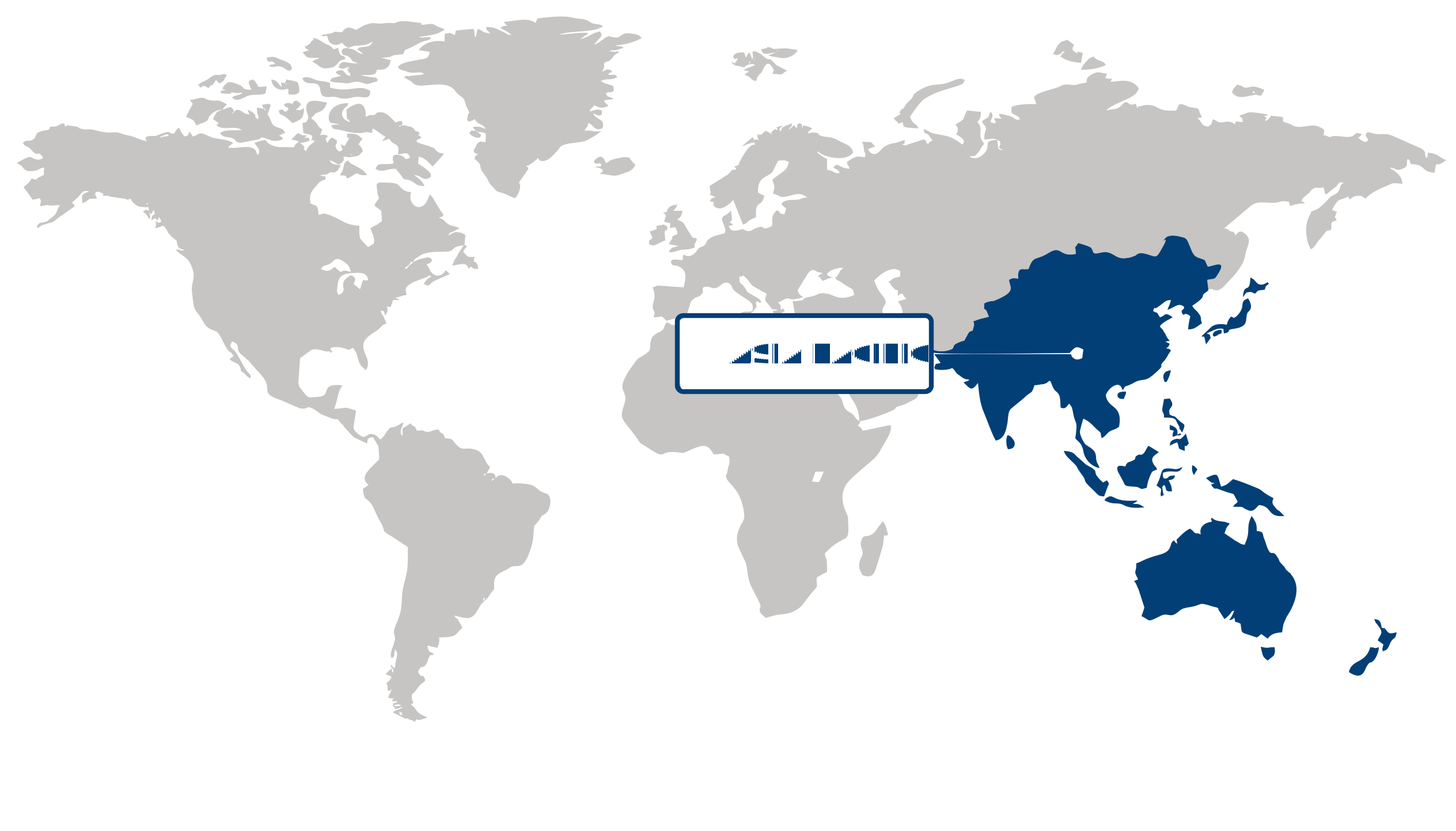
Asia Pacific (Largest Region)
Asia Pacific accounted for the largest share of the pharmaceuticals machinery market, at 42.12% in 2026, supported by the region's expanding pharmaceutical manufacturing base and growing investment in production capacity. Rising demand for medicines, increasing healthcare expenditure, and the development of domestic pharmaceutical industries are encouraging manufacturers to modernize processing and packaging operations. The region's established manufacturing infrastructure and growing emphasis on automation are also driving the adoption of advanced machinery that can improve production efficiency, consistency, and compliance with quality requirements. In addition, the expansion of pharmaceutical facilities across emerging economies is creating demand for equipment used throughout drug manufacturing and packaging processes.
Europe (Fastest-Growing Region)
Europe is emerging as the fastest-growing regional market, supported by the modernization of pharmaceutical production facilities and increasing emphasis on manufacturing quality, automation, and operational efficiency. The region's highly regulated pharmaceutical environment encourages manufacturers to adopt sophisticated machinery capable of maintaining consistent production standards and supporting traceability requirements. Growing investment in advanced manufacturing technologies is also facilitating the transition toward more automated and flexible production processes. Furthermore, the expansion of specialized pharmaceutical manufacturing and increasing focus on efficient, high-quality drug production are creating opportunities for machinery suppliers across the regional market.
| Parameter | North America | Asia Pacific | Europe | Latin America | MEA |
|---|---|---|---|---|---|
| Innovation Hub i Scale Nascent Developing Advanced | |||||
| Cost-Sensitive Region i Scale Low Medium High | |||||
| Regulatory Environment i Scale Restrictive Neutral Supportive | |||||
| Demand Drivers i Scale Weak Moderate Strong | |||||
| Development Stage i Scale Emerging Developing Developed | |||||
| Adoption Rate i Scale Low Medium High | |||||
| New Entrants / Startups i Scale Sparse Moderate Dense | |||||
| Macro Indicators i Scale Weak Stable Strong |
Key Country Insights
United States 🇺🇸
Automated Production SystemsThe U.S. invests in pharmaceutical machinery that improves manufacturing efficiency, regulatory compliance, and production flexibility. Manufacturers in the U.S. increasingly adopt automation and digital monitoring technologies to support high-quality pharmaceutical operations.
Germany 🇩🇪
Precision Manufacturing EquipmentGermany emphasizes advanced pharmaceutical machinery engineered for process accuracy, validation, and consistent product quality. Equipment suppliers in Germany focus on integrated automation and high-performance manufacturing solutions for regulated production environments.
Japan 🇯🇵
High-Quality Process EngineeringJapan prioritizes pharmaceutical machinery that delivers precision manufacturing, contamination control, and operational reliability. Pharmaceutical producers in Japan continue upgrading equipment to support advanced formulations and efficient production workflows.
South Korea 🇰🇷
Biopharma Production ExpansionSouth Korea is strengthening pharmaceutical manufacturing capabilities through investment in modern processing and packaging equipment. Companies in South Korea prioritize machinery that supports scalable production, quality assurance, and digital manufacturing practices.
France 🇫🇷
Regulated Manufacturing ExcellenceFrance focuses on pharmaceutical machinery that enables compliant production, process optimization, and efficient facility modernization. Pharmaceutical manufacturers in France increasingly adopt flexible equipment capable of supporting diverse product portfolios.
Italy 🇮🇹
Flexible Manufacturing LinesItaly advances pharmaceutical production by adopting machinery that supports efficient batch processing and rapid product changeovers. Equipment investment in Italy reflects demand for reliable manufacturing systems that improve productivity while meeting quality standards.
Segment Leadership and Growth Trends
Pharmaceuticals Machinery Market Share (%), by Mode of Operation, 2026
Go beyond the chart, access full insights & data tables
Request Free Sample ReportMode of Operation Segment Analysis: Fully Automatic (Largest & Fastest-Growing Segment)
The fully automatic segment led the pharmaceuticals machinery market and accounted for a 58.56% share in 2026, while also representing the fastest-growing mode of operation. Pharmaceutical manufacturers increasingly rely on automated machinery to improve production consistency, reduce manual intervention, and support stringent quality and regulatory requirements. Fully automatic systems enable greater process control across manufacturing and packaging operations, while also helping manufacturers improve operational efficiency and maintain repeatable output. The continued shift toward advanced production environments and the need to minimize human error are strengthening adoption of fully automatic pharmaceutical machinery.
Machine Type Segment Analysis: Solid Dosage Machine (Largest Segment) vs Processing Machine (Fastest-Growing Segment)
Solid dosage machines held the largest share of the pharmaceuticals machinery market, accounting for 41.15% in 2026. The segment benefits from the widespread production of tablets, capsules, and other solid pharmaceutical formulations, which require specialized equipment for efficient and consistent manufacturing. Growing demand for reliable dosage uniformity, high production efficiency, and controlled processing is supporting the adoption of solid dosage machinery across pharmaceutical manufacturing operations. The established importance of solid formulations in pharmaceutical production continues to reinforce the segment's dominant position.
Processing machines are expected to register the fastest growth, driven by the increasing need for advanced equipment that can improve efficiency, consistency, and process control across pharmaceutical manufacturing operations. Modern drug production increasingly requires precise handling of ingredients and reliable processing conditions to maintain product quality. As manufacturers upgrade production capabilities and adopt more integrated and automated manufacturing workflows, demand for advanced processing machinery is increasing.
Distribution Channel Segment Analysis: Direct Sales (Largest & Fastest-Growing Segment)
Direct sales dominated the distribution channel segment of the pharmaceuticals machinery market, holding the largest position and representing the fastest-growing channel in 2026. Pharmaceutical machinery often requires detailed technical evaluation, customization, installation support, and after-sales service, making direct engagement between equipment manufacturers and pharmaceutical producers particularly valuable. Direct sales enable buyers to receive specialized product information and tailored solutions while facilitating closer coordination throughout the procurement process. The increasing demand for complex and highly specialized machinery, combined with the need for technical support and long-term service relationships, is strengthening the role of direct sales in the market.
| Segment | Sub-Segment | Largest Segment | Fastest Growing |
|---|---|---|---|
| Mode of Operation | Manual, Semi-automatic, Fully Automatic | Fully Automatic | Fully Automatic |
| Machine Type | Solid Dosage Machine, Processing Machine, Analytical Instruments, Packaging Machine, Printing Machine, Others | Solid Dosage Machine | Processing Machine |
| Distribution Channel | Direct Sales, Indirect Sales | Direct Sales | Direct Sales |
| Application | Formulation, Filling & Packaging, Sterilization, Quality Control, Others | Formulation | Filling & Packaging |
Competitive Landscape and Market Positioning
Top players in the pharmaceuticals machinery market:
- Syntegon Technology GmbH (Germany)
- IMA Group (Italy)
- GEA Group AG (Germany)
- Fette Compacting GmbH (Germany)
- Romaco Group (Germany)
- Bausch+Strobel SE + Co. KG (Germany)
- Glatt GmbH (Germany)
- Korsch AG (Germany)
- Sartorius AG (Germany)
- ACG Worldwide (India)
Manufacturing automation is becoming the principal arena of competition in the pharmaceuticals machinery market, with equipment providers expanding beyond standalone processing systems toward digitally connected production platforms. Greater emphasis is being placed on precision control, continuous manufacturing capabilities, and real-time process monitoring to help pharmaceutical manufacturers improve product consistency while meeting increasingly rigorous quality expectations. At the same time, demand for flexible production environments is encouraging the development of modular machinery that can accommodate changing formulations and production scales with minimal disruption. This evolution is rewarding suppliers that integrate software intelligence, validation support, and operational efficiency into their equipment offerings rather than competing primarily on mechanical performance.
| Company | Market Share | Company Revenue | Revenue CAGR (%) | Product Portfolio | Geographic Presence | Innovation / R&D Focus | Strategic Developments |
|---|---|---|---|---|---|---|---|
| Syntegon Technology GmbH (Germany) | |||||||
| IMA Group (Italy) | |||||||
| GEA Group AG (Germany) | |||||||
| Fette Compacting GmbH (Germany) | |||||||
| Romaco Group (Germany) | |||||||
| Bausch+Strobel SE + Co. KG (Germany) | |||||||
| Glatt GmbH (Germany) | |||||||
| Korsch AG (Germany) | |||||||
| Sartorius AG (Germany) | |||||||
| ACG Worldwide (India) |
Industry Development/News
| Company Name | Date | Key Development |
|---|---|---|
| GEA Pharma & Healthcare | Jun-24 | The company introduced the NexGen Press 45, an expansion of its NexGen C series tablet press line. This model enhances the capabilities of the previous NexGen Press 30 by providing advanced containment levels of protection, reflecting a strategic focus on high-performance manufacturing equipment designed to meet stringent industry safety and operational standards. |
| Korsch AG | Mar-24 | Korsch America unveiled the X 5 tablet press for the North American market. Featuring an enhanced turret segment and an increased number of punch stations, the equipment delivers a 50% higher output compared to the XL 400 model. This launch signifies a strategic effort to improve manufacturing throughput without requiring significant changes to existing facility design structures. |
| ACG | Nov-23 | ACG debuted an advanced prototype of its capsule filling machine at CPHI and PMEC India. The development prioritizes operational efficiency, user accessibility, and enhanced safety protocols. By focusing on design improvements that reduce maintenance requirements and minimize unplanned downtime, the company aims to lower total cost of ownership for pharmaceutical manufacturers. |
| Sartorius | Aug-23 | Sartorius and Repligen Corporation launched an integrated bioreactor system combining the Biostat STR bioreactor with XCell ATF technology. This solution streamlines N perfusion processes and seed train operations through an embedded module with advanced control recipes and integrated Process Analytical Technology. The collaboration represents a shift toward more automated and efficient bioprocessing workflows in pharmaceutical production. |
Customize Your Report
Explore examples of how this report can be tailored to different research needs, including custom segments, additional topics or chapters, and related reports. Click a section of the wheel or its numbered marker to explore the available options.
Pharmaceuticals Machinery Market — Custom Segments
| Segment | Sub-Segment |
|---|---|
| Pharmaceutical Company Size | Small & Medium-Sized Companies, Large Pharmaceutical Companies, Multinational Pharmaceutical Companies |
| Manufacturing Facility Type | Conventional Manufacturing Facilities, Contract Manufacturing Facilities, Specialized & High-Containment Facilities, Research & Pilot Facilities |
| Equipment Lifecycle Stage | New Equipment Installation, Capacity Expansion, Replacement & Modernization, Process Upgrade |
Pharmaceuticals Machinery Market — Custom TOC
| Custom Chapter | Custom Details |
|---|---|
| Pharmaceutical Manufacturing Capacity Expansion Roadmap |
|
| GMP Modernization and Compliance Investment Outlook |
|
| Aseptic Processing Equipment Adoption Strategy |
|
Need a different cut of the data?
Request Custom ResearchWhat is the current size of the pharmaceuticals machinery market?
What are the growth projections for the pharmaceuticals machinery industry?
How is pharmaceutical manufacturing automation transforming equipment investment priorities?
Why are flexible manufacturing systems gaining importance in the pharmaceuticals machinery market?
Why is the fully automatic segment leading the pharmaceuticals machinery market?
Which machine type is expected to witness the fastest growth in the pharmaceuticals machinery market?
Why does Asia Pacific hold the largest pharmaceuticals machinery market share?
How is Europe gaining momentum in the pharmaceuticals machinery market?
Who are the leading players in the pharmaceuticals machinery landscape?
Our Clients
"The team took the time to understand our specific business needs and delivered a report that was well aligned with our objectives. Their expertise and understanding of the industry were clearly reflected in the quality and relevance of the insights provided."
Siemens Healthcare
"Our experience in acquiring the research report has been excellent. The depth of analysis, and actionable insights provided have been extremely valuable in supporting our ongoing R&D efforts."
GC Biopharma
"The report offered a comprehensive view of the market trends. The in-depth segmentation and analysis of emerging opportunities gave us a better understanding of the market."
Medtronic
Our Research Team & Methodology
Every Fundamental Business Insights report is built by a dedicated vertical research team, validated through a structured primary-and-secondary methodology, and reviewed for accuracy before it reaches you.
Research Team Overview
Prepared by the Healthcare & Medical Devices Research Team
Delivery
Published
Demand
Available
Support
Trust & Compliance
Research Domains
10 coverage areasResearch Intelligence
| Source | Reference |
|---|---|
| World Health Organization (WHO) | www.who.int |
| U.S. Food & Drug Administration (FDA) | www.fda.gov |
| European Medicines Agency (EMA) | www.ema.europa.eu |
| Centers for Disease Control and Prevention (CDC) | www.cdc.gov |
| National Institutes of Health (NIH) | www.nih.gov |
| National Center for Biotechnology Information (NCBI) | www.ncbi.nlm.nih.gov |
| PubMed | pubmed.ncbi.nlm.nih.gov |
| ClinicalTrials.gov | clinicaltrials.gov |
| International Organization for Standardization (ISO) | www.iso.org |
| ASTM International | www.astm.org |
| Advanced Medical Technology Association (AdvaMed) | www.advamed.org |
| Medical Device Innovation Consortium (MDIC) | mdic.org |
| Biotechnology Innovation Organization (BIO) | www.bio.org |
| International Federation of Pharmaceutical Manufacturers & Associations (IFPMA) | www.ifpma.org |
| U.S. Pharmacopeia (USP) | www.usp.org |
| European Directorate for the Quality of Medicines & HealthCare (EDQM) | www.edqm.eu |
| World Organisation for Animal Health (WOAH) | www.woah.org |
| American Hospital Association (AHA) | www.aha.org |
| OECD Health | www.oecd.org/health |
| World Bank Data | data.worldbank.org |
Research Workflow & Quality Assurance
Data Collection
Verified information gathered through primary and secondary research.
Data Triangulation
Cross-validation using multiple independent data sources.
Forecast Modelling
Market estimates developed using historical trends and analytical models.
Analyst Validation
Findings reviewed by domain experts for accuracy and consistency.
Editorial & Quality Review
Final editorial, quality, and compliance checks before publication.
Final Publication
Released after successful completion of the internal review process.
Report Coverage
📊 Market Assessment
- Market Size & Forecast
- Market Segmentation
- Regional Analysis
- Growth Drivers & Challenges
- Market Dynamics
🏢 Competitive Intelligence
- Competitive Landscape
- Company Profiles
- Competitive Benchmarking
- Mergers & Acquisitions
- Market Share Analysis or Key Company Strategies
🔍 Strategic Analysis
- Value Chain Analysis
- Porter's Five Forces
- PESTLE Analysis
- Pricing Trends
- Supply-Demand Analysis
🚀 Future Outlook
- Technology Landscape
- Regulatory Landscape
- Investment & Funding Landscape
- Emerging Opportunities
- Future Market Outlook
Have a question about this report or need a custom scope?
Request Customization