Passive Fire Protection Market Size & Growth Forecast 2027–2036, By Segments (Product, Application), Regional Demand Trends (North America, Asia Pacific, Europe), Key Country Insights (U.S., Japan, South Korea, Germany, France, Italy), and Competitive Landscape
Market Size and Growth Outlook
Passive Fire Protection Market size was estimated at USD 5 billion in 2026 and is projected to grow at a 5.8% CAGR from 2027 to 2036, exceeding USD 8.79 billion by 2036. The industry revenue for 2027 is assessed at USD 5.24 billion.
Get more details on this report
Request Free Sample ReportPassive Fire Protection Market Intelligence Snapshot
Regional Market Dynamics
- Asia Pacific captured 41.02% of the market in 2026, supported by extensive construction activity, industrial expansion, and widespread adoption of fire-resistant materials across infrastructure and commercial projects.
- North America is forecast to grow at a 6.44% CAGR due to building upgrades, stricter fire safety enforcement, and increasing retrofit demand for certified fire protection systems.
Segment Momentum
- Cementitious materials held a 44.73% share in 2026 due to their cost efficiency, reliable fireproofing performance, and widespread use in protecting structural steel and concrete across commercial and industrial projects.
- Oil & gas is expanding fastest because operators face high-risk fire environments and are increasing investment in specialized protection systems to safeguard critical assets, infrastructure, and personnel.
Market Expansion Drivers
- Stringent fire safety codes driving mandatory adoption of passive fire protection systems.
- Rapid urban infrastructure expansion increasing fire-resistant construction material demand.
- Green building certifications integrating passive fire systems into sustainable construction standards.
Leading Market Participants
- Leading players in the passive fire protection market include Hilti Corporation (Liechtenstein), The Sherwin-Williams Company (United States), PPG Industries, Inc. (United States), Etex Group (Belgium), Morgan Advanced Materials plc (United Kingdom), Carboline Company (United States), Hempel A/S (Denmark), Rudolf Hensel GmbH (Germany), Isolatek International Corporation (United States), 3M Company (United States).
Global Market Forecast Snapshot
Market Outlook
- 2026 Market Size: USD 5 billion
- 2027 Estimated Market Size: USD 5.24 billion.
- Projected Market Size: USD 8.79 billion by 2036
- Growth Forecast: 5.8% CAGR (2027-2036)
Regional and Segment Outlook
- Leading Regional Market: Asia Pacific
- High-Growth Regional Hub: North America
- Core Revenue Segment: Cementitious Materials (Product) | Construction (Application)
- Emerging Opportunity Segment: Intumescent Coating (Product) | Oil & Gas (Application)
Market Growth Drivers and Industry Trends
Stringent fire safety codes driving mandatory adoption of passive fire protection systems
Stringent fire safety requirements are driving the passive fire protection market as building projects increasingly need to incorporate systems that help contain fire and limit its spread. Compliance-oriented construction practices encourage the use of fire-resistant barriers, coatings, and other passive measures within building designs and structural components.
Rapid urban infrastructure expansion increasing fire-resistant construction material demand
Rapid expansion of urban infrastructure is increasing demand across the passive fire protection market as new buildings and facilities require integrated fire-resistant construction solutions. Growing construction activity creates opportunities for materials and systems designed to protect structural elements and compartmentalize buildings during fire events.
Green building certifications integrating passive fire systems into sustainable construction standards
The passive fire protection market is gaining from the integration of fire safety considerations into green building certification frameworks, encouraging developers to incorporate compliant protection systems alongside sustainable construction practices. This alignment supports the inclusion of passive fire measures within building designs that pursue broader environmental and performance standards.
| Growth Driver | Impact on CAGR | Regulatory Influence | Geographic Relevance | Adoption Rate | Impact Timeline |
|---|---|---|---|---|---|
| Stringent fire safety codes driving mandatory adoption of passive fire protection systems | 2.30% | High | Europe, North America | High | Near Term |
| Rapid urban infrastructure expansion increasing fire-resistant construction material demand | 1.80% | Moderate | Asia Pacific, Middle East & Africa | High | Mid Term |
| Green building certifications integrating passive fire systems into sustainable construction standards | 1.50% | High | Europe, North America | Emerging | Mid Term |
Unlock insights tailored to your business with our bespoke market research solutions.
Click to get your customized report now.
Regional Demand Dynamics
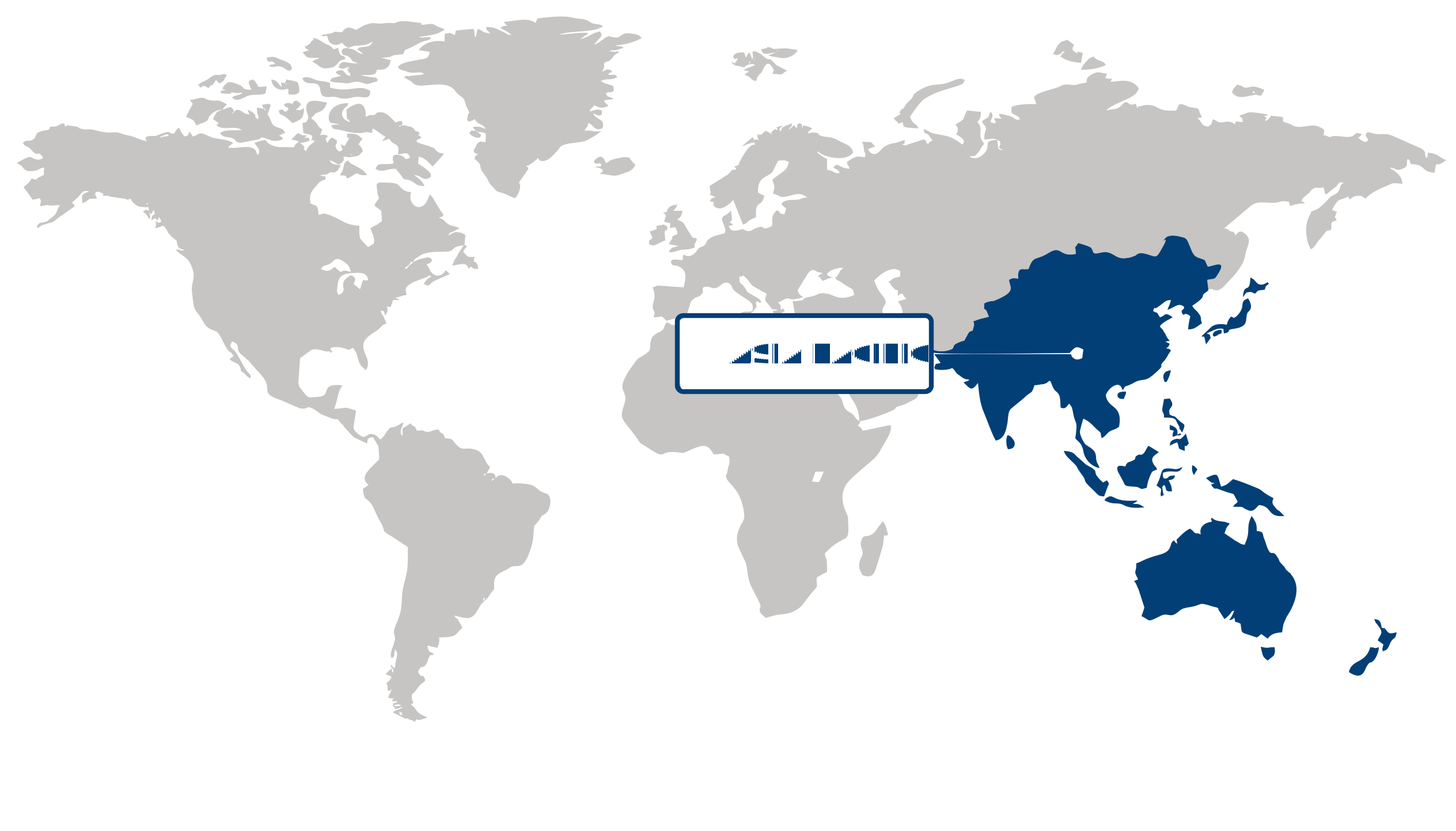
Asia Pacific (Largest Region)
Asia Pacific represented a 41.02% share of the passive fire protection market in 2026, supported by extensive construction activity, rapid urbanization, and continued development of commercial, residential, industrial, and infrastructure projects. Growing emphasis on building safety is increasing demand for fire-resistant structural materials, protective coatings, firestopping systems, and other solutions designed to limit fire and smoke propagation. Strengthening construction standards and greater awareness of fire safety are encouraging developers and building owners to incorporate passive protection measures earlier in project planning. Industrial expansion and infrastructure modernization are also broadening demand across manufacturing facilities, transportation assets, and large-scale buildings, reinforcing the region's market leadership.
North America (Fastest-Growing Region)
North America is the fastest-growing regional market, driven by strong enforcement of building safety requirements, ongoing infrastructure modernization, and increasing focus on fire-resilient construction. Building owners and contractors are placing greater emphasis on protecting structural integrity and limiting fire spread, supporting adoption of passive protection systems across commercial, industrial, and institutional facilities. Renovation and retrofit activity is also creating opportunities as older structures are upgraded to meet evolving safety expectations. Advances in fire-resistant materials and increasing integration of passive protection into comprehensive building safety strategies are further contributing to regional market growth.
| Parameter | North America | Asia Pacific | Europe | Latin America | MEA |
|---|---|---|---|---|---|
| Innovation Hub i Scale Nascent Developing Advanced | |||||
| Cost-Sensitive Region i Scale Low Medium High | |||||
| Regulatory Environment i Scale Restrictive Neutral Supportive | |||||
| Demand Drivers i Scale Weak Moderate Strong | |||||
| Development Stage i Scale Emerging Developing Developed | |||||
| Adoption Rate i Scale Low Medium High | |||||
| New Entrants / Startups i Scale Sparse Moderate Dense | |||||
| Macro Indicators i Scale Weak Stable Strong |
Key Country Insights
Germany 🇩🇪
Industrial Compliance SolutionsGermany emphasizes passive fire protection systems that align with demanding industrial safety standards and engineering practices. Manufacturers and contractors prioritize certified materials that integrate seamlessly into complex construction and renovation projects.
France 🇫🇷
Renovation Safety IntegrationFrance is integrating passive fire protection into both new developments and building refurbishment programs. Project stakeholders are focusing on compliant solutions that improve fire compartmentation without compromising architectural requirements.
Italy 🇮🇹
Heritage Building AdaptationItaly applies passive fire protection across contemporary construction as well as historic building renovations requiring sensitive design approaches. Material selection increasingly balances regulatory compliance, structural preservation, and practical installation requirements.
Japan 🇯🇵
Resilient Building StandardsJapan incorporates passive fire protection into modern building designs with strong attention to structural resilience and occupant safety. Construction projects increasingly specify advanced fire-resistant materials that complement stringent building regulations.
South Korea 🇰🇷
Urban Construction ProtectionSouth Korea is expanding passive fire protection adoption across high-density residential and commercial developments. Developers are selecting efficient fire-resistant systems that support modern construction methods while meeting evolving safety expectations.
United States 🇺🇸
Infrastructure Safety FocusThe U.S. continues investing in passive fire protection solutions for commercial buildings, industrial facilities, and infrastructure projects. Demand is shaped by stricter compliance requirements and the need for durable materials that enhance long-term building resilience.
Segment Leadership and Growth Trends
Passive Fire Protection Market Share (%), by Product, 2026
Go beyond the chart, access full insights & data tables
Request Free Sample ReportProduct Segment Analysis: Cementitious Materials (Largest Segment) vs Intumescent Coating (Fastest-Growing Segment)
Cementitious materials held the largest share of the passive fire protection market in 2026, accounting for 44.73% share. Their strong position is supported by broad use in structural steel and building components where durable fire resistance, thermal insulation, and compatibility with conventional construction practices are important. Cementitious systems are also valued for their ability to provide passive protection across large structural surfaces and for their suitability in commercial, industrial, and infrastructure projects. Growing emphasis on building fire safety, stricter construction requirements, and the integration of fire-resistant materials into modern building designs continue to reinforce demand for this segment.
Intumescent coating is positioned as the fastest-growing product segment, supported by increasing preference for thin, lightweight fire protection systems that preserve the appearance and functionality of protected structures. These coatings expand when exposed to high temperatures, creating an insulating layer that delays structural failure while requiring relatively limited impact on the underlying design. Their adoption is being encouraged by the expansion of modern steel-intensive construction, demand for aesthetically compatible fire protection, and greater attention to efficient installation and maintenance across commercial and industrial facilities.
Application Segment Analysis: Construction (Largest Segment) vs Oil & Gas (Fastest-Growing Segment)
The construction segment led the passive fire protection market in 2026, representing a 36.36% share. Its dominance reflects the widespread requirement for fire-resistant protection in residential, commercial, industrial, and infrastructure structures, where maintaining structural integrity during a fire is essential for occupant safety and property protection. Increasing incorporation of fire safety considerations into building design, along with stronger enforcement of construction standards and growing development of complex structures, continues to sustain demand for passive protection systems. The preference for materials that can be integrated into structural elements without relying on active intervention further supports their use throughout construction projects.
In the oil & gas segment, demand for passive fire protection is expanding as operators place greater emphasis on safeguarding personnel, critical equipment, and process infrastructure from fire-related hazards. Facilities in this industry contain combustible materials and high-risk processing environments, making durable structural fire protection an important component of overall safety strategies. The expansion and modernization of energy infrastructure, combined with greater focus on asset integrity, operational continuity, and risk mitigation, is supporting stronger adoption of specialized passive fire protection systems in oil and gas facilities.
| Segment | Sub-Segment | Largest Segment | Fastest Growing |
|---|---|---|---|
| Product | Cementitious Materials, Intumescent Coating, Fireproofing Cladding, Others | Cementitious Materials | Intumescent Coating |
| Application | Oil & Gas, Construction, Industrial Plants, Warehousing, Other | Construction | Oil & Gas |
Competitive Landscape and Market Positioning
Key companies in the passive fire protection market:
1. Hilti Corporation (Liechtenstein)
2. The Sherwin-Williams Company (United States)
3. PPG Industries Inc. (United States)
4. Etex Group (Belgium)
5. Morgan Advanced Materials plc (United Kingdom)
6. Carboline Company (United States)
7. Hempel A/S (Denmark)
8. Rudolf Hensel GmbH (Germany)
9. Isolatek International Corporation (United States)
10. 3M Company (United States)
The passive fire protection market is shaped by stringent safety regulations and increasing construction safety standards. Advanced fire-resistant materials are improving structural protection capabilities. The passive fire protection market is also moving toward environmentally safer formulations that maintain high-performance resistance characteristics.
| Company | Market Share | Company Revenue | Revenue CAGR (%) | Product Portfolio | Geographic Presence | Innovation / R&D Focus | Strategic Developments |
|---|---|---|---|---|---|---|---|
| Hilti Corporation (Liechtenstein) | |||||||
| The Sherwin-Williams Company (United States) | |||||||
| PPG Industries Inc. (United States) | |||||||
| Etex Group (Belgium) | |||||||
| Morgan Advanced Materials plc (United Kingdom) | |||||||
| Carboline Company (United States) | |||||||
| Hempel A/S (Denmark) | |||||||
| Rudolf Hensel GmbH (Germany) | |||||||
| Isolatek International Corporation (United States) | |||||||
| 3M Company (United States). |
Industry Development/News
| Company Name | Date | Key Development |
|---|---|---|
| Mitie | Jun-26 | Mitie acquired Argus Fire, a UK-based fire systems engineering firm, to bolster its integrated fire protection service capabilities. This transaction enhances Mitie’s ability to provide comprehensive installation, maintenance, and regulatory compliance services across commercial and industrial infrastructure, marking a strategic expansion of its operational footprint in the fire safety sector. |
| Clariant | Jun-26 | Clariant expanded its Exolit AP flame retardant portfolio with the introduction of a new melamine-free grade. This development addresses increasing market demand for environmentally responsible fire protection materials and enhances the company’s ability to meet stringent regulatory requirements for safer flame retardant applications. |
| Huntsman | Jun-26 | Huntsman launched a specialized intumescent polyurethane coating designed for passive fire protection in mobility applications, specifically electric vehicles. This product introduction signifies a strategic move to leverage fire protection expertise in the energy transition sector, addressing the demand for enhanced structural fire resistance in high-risk thermal environments. |
| Promat (Etex Group) | Jun-26 | Etex Group entities, including Promat, Remagin, and Siniat, launched a tested fire integrity solution for façade systems. This innovation improves structural steel infill wall protection by ensuring compliant integration between structural elements and building envelope systems, addressing technical requirements for advanced façade fire safety. |
| Checkmate Fire | May-26 | European private equity firm IK Partners acquired UK-based specialist Checkmate Fire from YFM Equity Partners. This acquisition reflects ongoing consolidation within the passive fire protection industry and positions the company for accelerated growth and expanded service delivery under new private equity ownership. |
| Triangle Fire Systems | Nov-24 | Triangle Fire Systems acquired Intrinsic Fire Protection to consolidate its competitive positioning in the UK passive fire safety market. By integrating Intrinsic’s expertise in fire-stopping and structural protection, Triangle expands its technical capabilities and market reach across critical sectors, including healthcare and residential housing. |
| Nullifire | Aug-23 | Nullifire, a subsidiary of Tremco CPG UK, introduced a line of cavity fire barriers designed to prevent fire and smoke migration through structural gaps. The launch strengthens the company’s passive fire protection portfolio and supports its strategy of providing regulation-compliant safety solutions for contemporary construction environments. |
| PPG Industries, Inc. | Feb-23 | PPG Industries launched the PPG STEELGUARD 951 epoxy intumescent coating to meet evolving architectural steel requirements. The product provides up to three hours of cellulosic fire protection by expanding into a thick, foam-like layer during fire incidents to maintain the structural integrity of steel elements. |
Customize Your Report
Explore examples of how this report can be tailored to different research needs, including custom segments, additional topics or chapters, and related reports. Click a section of the wheel or its numbered marker to explore the available options.
Passive Fire Protection Market — Custom Segments
| Segment | Sub-Segment |
|---|---|
| Material Substrate | Structural Steel, Concrete, Wood, Composite Materials |
| Installation Method | Spray-Applied, Trowel-Applied, Board & Panel Installation, Wrap & Encapsulation |
| Fire Resistance Rating | Up to 1 Hour, More Than 1 to 2 Hours, More Than 2 to 3 Hours, More Than 3 Hours |
Passive Fire Protection Market — Custom TOC
| Custom Chapter | Custom Details |
|---|---|
| Building Safety Compliance |
|
| Infrastructure Modernization Opportunities |
|
| Industrial Risk Mitigation |
|
Need a different cut of the data?
Request Custom ResearchHow much revenue does the passive fire protection market generate?
How is the passive fire protection industry size expected to evolve during the forecast period?
How are stringent fire safety codes reshaping procurement and specification practices in the passive fire protection market?
Why is urban infrastructure expansion accelerating demand for passive fire protection materials and systems?
Why do cementitious materials lead the passive fire protection market?
Why is oil & gas the fastest-growing application in the passive fire protection market?
Why is Asia Pacific the largest regional market for passive fire protection?
What is driving North America's growth in the passive fire protection market?
What are the prominent companies operating in the passive fire protection landscape?
Our Clients
"Your insights on workforce structures were spot-on. The analysis on mid-to-senior level roles validated some of our hiring decisions and highlighted gaps."
Ateliers De France
"The report gave us insights on competitors in the market. It helped our team refine our bidding strategy for upcoming contracts."
Clark Construction
"The reports provided a deep dive into market trends, and competitive landscape. The strategic insights and recommendations have been very helpful."
Rudolph and Sletten
Our Research Team & Methodology
Every Fundamental Business Insights report is built by a dedicated vertical research team, validated through a structured primary-and-secondary methodology, and reviewed for accuracy before it reaches you.
Research Team Overview
Prepared by the Construction & Manufacturing Research Team
Delivery
Published
Demand
Available
Support
Trust & Compliance
Research Domains
10 coverage areasResearch Intelligence
| Source | Reference |
|---|---|
| International Organization for Standardization (ISO) | www.iso.org |
| ASTM International | www.astm.org |
| National Institute of Standards and Technology (NIST) | www.nist.gov |
| International Code Council (ICC) | www.iccsafe.org |
| American Concrete Institute (ACI) | www.concrete.org |
| American Institute of Steel Construction (AISC) | www.aisc.org |
| Construction Industry Institute (CII) | www.construction-institute.org |
| Associated General Contractors of America (AGC) | www.agc.org |
| Association of Equipment Manufacturers (AEM) | www.aem.org |
| Building Owners and Managers Association (BOMA) | www.boma.org |
| American Society of Civil Engineers (ASCE) | www.asce.org |
| National Ready Mixed Concrete Association (NRMCA) | www.nrmca.org |
| International Facility Management Association (IFMA) | www.ifma.org |
| World Green Building Council (WorldGBC) | worldgbc.org |
| International Federation of Consulting Engineers (FIDIC) | fidic.org |
| International Labour Organization (ILO) | www.ilo.org |
| American Society of Mechanical Engineers (ASME) | www.asme.org |
| Society of Manufacturing Engineers (SME) | www.sme.org |
| National Association of Home Builders (NAHB) | www.nahb.org |
| European Construction Industry Federation (FIEC) | www.fiec.eu |
Research Workflow & Quality Assurance
Data Collection
Verified information gathered through primary and secondary research.
Data Triangulation
Cross-validation using multiple independent data sources.
Forecast Modelling
Market estimates developed using historical trends and analytical models.
Analyst Validation
Findings reviewed by domain experts for accuracy and consistency.
Editorial & Quality Review
Final editorial, quality, and compliance checks before publication.
Final Publication
Released after successful completion of the internal review process.
Report Coverage
📊 Market Assessment
- Market Size & Forecast
- Market Segmentation
- Regional Analysis
- Growth Drivers & Challenges
- Market Dynamics
🏢 Competitive Intelligence
- Competitive Landscape
- Company Profiles
- Competitive Benchmarking
- Mergers & Acquisitions
- Market Share Analysis or Key Company Strategies
🔍 Strategic Analysis
- Value Chain Analysis
- Porter's Five Forces
- PESTLE Analysis
- Pricing Trends
- Supply-Demand Analysis
🚀 Future Outlook
- Technology Landscape
- Regulatory Landscape
- Investment & Funding Landscape
- Emerging Opportunities
- Future Market Outlook
Have a question about this report or need a custom scope?
Request Customization