Organic Soap Market Size & Growth Forecast 2027–2036, By Segments (Product, Distribution Channel), Regional Demand Trends (North America, Asia Pacific, Europe), Key Country Insights (U.S., Japan, South Korea, Germany, France, Italy), and Competitive Landscape
Market Size and Growth Outlook
Organic Soap Market size was around USD 490.6 million in 2026 and is slated to grow at a 8.17% CAGR from 2027 to 2036, crossing USD 1.08 billion by 2036. The industry revenue for 2027 is assessed at USD 524.35 million.
Get more details on this report
Request Free Sample ReportOrganic Soap Market Intelligence Snapshot
Regional Market Dynamics
- Asia Pacific leads due to strong demand across populous markets, wide retail distribution including supermarkets, pharmacies, specialty outlets, and e-commerce, supporting consistently high volume consumption and accessibility.
- North America’s 9.83% CAGR is driven by ingredient scrutiny, clean-label preferences, premium positioning, e-commerce growth, and increasing replacement of conventional personal care products with natural alternatives.
Segment Momentum
- Bar soap leads with 70.08% share due to strong consumer familiarity, simple formulations and routine household use, making it a preferred choice in organic personal care purchasing.
- Online channels are growing fastest due to wider product discovery, convenience, repeat purchasing ease and growing consumer preference for digital browsing and home delivery of organic personal care products.
Market Expansion Drivers
- Increasing consumer preference for chemical-free and sustainable personal care products driving organic soap demand.
- Social media and influencer marketing accelerating awareness of natural skincare products.
- Expansion of e-commerce and eco-friendly retail channels improving accessibility of organic soap products.
Leading Market Participants
- Prominent players in the organic soap market include Lush Retail Ltd. (United Kingdom), Laverana GmbH & Co. KG (Germany), EO Products, Inc. (United States), Sundial Brands LLC (United States), Dr. Bronner’s (United States), Pangea Organics (United States), Osmia Organics (United States), Davines S.p.A. (Italy), Weleda AG (Switzerland), The Hain Celestial Group, Inc. (United States).
Global Market Forecast Snapshot
Market Outlook
- 2026 Market Size: USD 490.6 million
- 2027 Estimated Market Size: USD 524.35 million.
- Projected Market Size: USD 1.08 billion by 2036
- Growth Forecast: 8.17% CAGR (2027-2036)
Regional and Segment Outlook
- Leading Regional Market: Asia Pacific
- High-Growth Regional Hub: North America
- Core Revenue Segment: Bar (Product) | Offline (Distribution Channel)
- Emerging Opportunity Segment: Liquid (Product) | Online (Distribution Channel)
Market Growth Drivers and Industry Trends
Increasing consumer preference for chemical-free and sustainable personal care products driving organic soap demand
Growing consumer preference for chemical-free and environmentally conscious personal care is strengthening the organic soap market, as buyers increasingly evaluate products based on both personal-use characteristics and sustainability considerations. Organic soaps align with demand for more naturally positioned skincare options and provide consumers with alternatives to conventional products perceived as less consistent with clean and sustainable personal care preferences.
Social media and influencer marketing accelerating awareness of natural skincare products
Social media and influencer marketing are increasing visibility of natural skincare products, helping the organic soap market reach consumers through digital channels where product preferences and personal care routines are frequently shared. Influencer-led recommendations and educational content can introduce consumers to organic soap benefits, reinforce interest in natural ingredients, and shape purchasing consideration among digitally engaged skincare audiences.
Expansion of e-commerce and eco-friendly retail channels improving accessibility of organic soap products
Expansion of e-commerce and environmentally focused retail channels is improving product availability across the organic soap market, allowing consumers to discover and purchase specialized personal care products through more convenient channels. Online retail also enables broader product selection and easier comparison, while eco-friendly stores provide consumers with shopping environments aligned with their sustainability-oriented personal care preferences.
| Growth Driver | Impact on CAGR | Regulatory Influence | Geographic Relevance | Adoption Rate | Impact Timeline |
|---|---|---|---|---|---|
| Increasing consumer preference for chemical-free and sustainable personal care products driving organic soap demand | 1.80% | Moderate | North America, Europe | High | Near Term |
| Social media and influencer marketing accelerating awareness of natural skincare products | 1.50% | Low | Asia Pacific, North America | High | Mid Term |
| Expansion of e-commerce and eco-friendly retail channels improving accessibility of organic soap products | 1.30% | Moderate | Europe, Asia Pacific | Emerging | Mid Term |
Unlock insights tailored to your business with our bespoke market research solutions.
Click to get your customized report now.
Regional Demand Dynamics
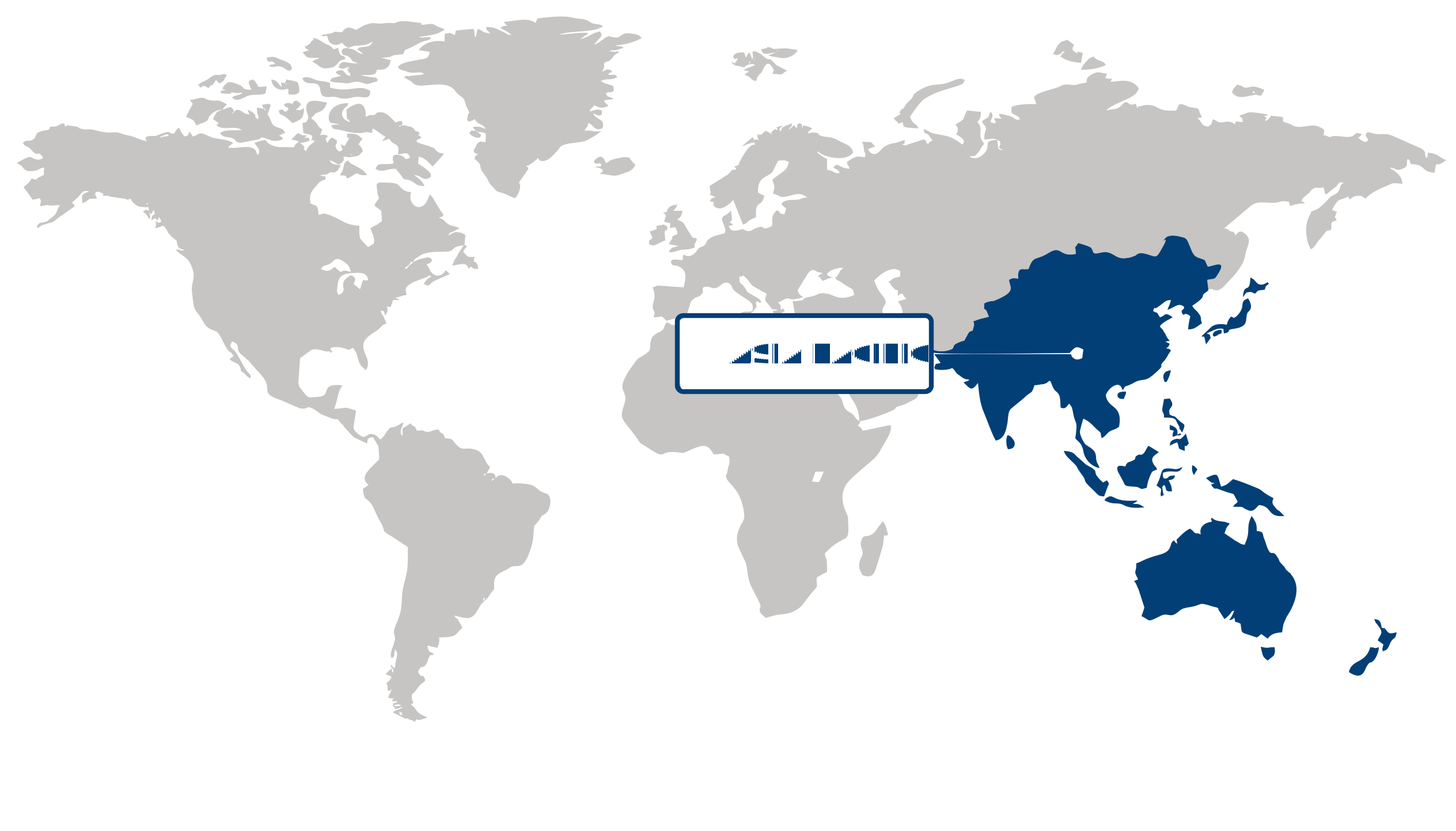
Asia Pacific (Largest Region)
Asia Pacific led the organic soap market in 2026, supported by increasing consumer preference for naturally derived personal care products, expanding awareness of ingredient safety, and the region’s strong connection with plant-based and traditional cleansing practices. Rising urbanization and improving consumer purchasing power are encouraging greater interest in premium personal care products positioned around natural ingredients and environmentally conscious formulations. Growing awareness of skin sensitivity and concerns surrounding synthetic additives are also contributing to demand for organic alternatives. In addition, expanding retail and e-commerce networks are improving access to specialized personal care products across both established and emerging markets, strengthening the region’s overall market position.
North America (Fastest-Growing Region)
North America is projected to be the fastest-growing regional market, driven by heightened consumer awareness of clean-label personal care, sustainability, and transparent ingredient sourcing. Consumers are increasingly examining product formulations and favoring soaps associated with natural ingredients, ethical sourcing, and environmentally responsible production practices. The expansion of online retail has further enabled niche and premium organic products to reach a broader customer base, while growing interest in wellness-oriented lifestyles is supporting demand for personal care products perceived as safer and more sustainable. Continued innovation in botanical formulations, packaging, and environmentally conscious product development is expected to reinforce the region’s growth trajectory.
| Parameter | North America | Asia Pacific | Europe | Latin America | MEA |
|---|---|---|---|---|---|
| Innovation Hub i Scale Nascent Developing Advanced | |||||
| Cost-Sensitive Region i Scale Low Medium High | |||||
| Regulatory Environment i Scale Restrictive Neutral Supportive | |||||
| Demand Drivers i Scale Weak Moderate Strong | |||||
| Development Stage i Scale Emerging Developing Developed | |||||
| Adoption Rate i Scale Low Medium High | |||||
| New Entrants / Startups i Scale Sparse Moderate Dense | |||||
| Macro Indicators i Scale Weak Stable Strong |
Key Country Insights
Germany 🇩🇪
Sustainable Personal CareGermany prioritizes organic soap products that combine certified natural ingredients with environmentally responsible manufacturing. Consumers increasingly favor products offering biodegradable formulations and minimal packaging without compromising product performance.
France 🇫🇷
Botanical Ingredient FocusFrance emphasizes organic soap products made with plant-based ingredients and artisanal formulation expertise. Consumers increasingly seek products that combine natural skincare benefits with environmentally conscious sourcing and packaging practices.
Italy 🇮🇹
Artisan Product AppealItaly maintains demand for organic soap products inspired by traditional craftsmanship and locally sourced botanical ingredients. Manufacturers continue blending natural formulations with premium fragrances to strengthen product differentiation in personal care.
Japan 🇯🇵
Premium Natural FormulationsJapan values organic soap products featuring gentle formulations, refined textures, and naturally sourced ingredients. Manufacturers continue developing premium skincare-oriented products that meet expectations for quality, safety, and everyday usability.
South Korea 🇰🇷
Beauty-Oriented InnovationSouth Korea integrates organic soap development with broader skincare innovation and premium beauty trends. Companies are introducing botanical ingredient combinations that appeal to consumers seeking naturally inspired cleansing solutions.
United States 🇺🇸
Clean Label PreferenceThe U.S. organic soap market is driven by consumer preference for naturally derived ingredients and transparent product labeling. Brands continue expanding formulations that emphasize skin-friendly ingredients, sustainable packaging, and environmentally responsible production.
Segment Leadership and Growth Trends
Organic Soap Market Share (%), by Product, 2026
Go beyond the chart, access full insights & data tables
Request Free Sample ReportProduct Segment Analysis: Bar (Largest Segment) vs Liquid (Fastest-Growing Segment)
The bar segment dominated the organic soap market, accounting for 70.08% share in 2026, supported by its established consumer acceptance, convenient storage, and efficient formulation for everyday cleansing. Bar soaps also align well with the sustainability attributes associated with organic personal care, including reduced reliance on liquid packaging and straightforward ingredient positioning. Strong consumer familiarity and broad availability across retail channels continue to reinforce the segment's leading position.
Liquid organic soap is growing more rapidly as consumers increasingly prioritize convenience, ease of dispensing, and versatile application across household and personal-care settings. Growing interest in premium natural formulations and hygienic dispensing formats is encouraging manufacturers to expand liquid offerings, while greater consumer awareness of plant-derived and environmentally conscious ingredients is supporting adoption.
Distribution Channel Segment Analysis: Offline (Largest Segment) vs Online (Fastest-Growing Segment)
Offline distribution held the largest share of the organic soap market at 76.48% in 2026, reflecting consumers' continued preference for examining personal-care products directly before purchase. Physical retail provides immediate product access and allows shoppers to evaluate packaging, ingredient information, fragrance, and formulation characteristics, while established supermarket, specialty, and health-oriented retail networks provide broad product visibility.
Online distribution is expanding faster as consumers increasingly use digital channels to discover specialized organic products, compare formulations, and review product information before purchasing. E-commerce also enables access to a wider assortment of niche and premium organic soaps than may be available through conventional stores, while convenient home delivery and digital product discovery are strengthening its role in the market.
| Segment | Sub-Segment | Largest Segment | Fastest Growing |
|---|---|---|---|
| Product | Bar, Liquid | Bar | Liquid |
| Distribution Channel | Offline, Online | Offline | Online |
Competitive Landscape and Market Positioning
Leading companies in the organic soap market:
1. Lush Retail Ltd. (United Kingdom)
2. Laverana GmbH & Co. KG (Germany)
3. EO Products Inc. (United States)
4. Sundial Brands LLC (United States)
5. Dr. Bronner’s (United States)
6. Pangea Organics (United States)
7. Osmia Organics (United States)
8. Davines S.p.A. (Italy)
9. Weleda AG (Switzerland)
10. The Hain Celestial Group Inc. (United States)
The organic soap market is increasingly shaped by a shift toward plant-based formulations and environmentally responsible production practices. Rising consumer sensitivity toward ingredient transparency is pushing manufacturers to refine sourcing strategies and adopt greener production methods. Within the organic soap market, product diversification and expanded retail reach are reinforcing steady adoption across wellness-focused consumer groups.
| Company | Market Share | Company Revenue | Revenue CAGR (%) | Product Portfolio | Geographic Presence | Innovation / R&D Focus | Strategic Developments |
|---|---|---|---|---|---|---|---|
| Lush Retail Ltd. (United Kingdom) | |||||||
| Laverana GmbH & Co. KG (Germany) | |||||||
| EO Products Inc. (United States) | |||||||
| Sundial Brands LLC (United States) | |||||||
| Dr. Bronner’s (United States) | |||||||
| Pangea Organics (United States) | |||||||
| Osmia Organics (United States) | |||||||
| Davines S.p.A. (Italy) | |||||||
| Weleda AG (Switzerland) | |||||||
| The Hain Celestial Group Inc. (United States). |
Industry Development/News
| Company Name | Date | Key Development |
|---|---|---|
| Pañpuri | Dec-24 | Pañpuri expanded its international growth platform following its acquisition by the Kosé Group. This strategic integration strengthens the brand's operational reach within the premium wellness and personal care sectors, providing a foundation for scaling its organic soap and fragrance-based product offerings in new global markets. |
| Jabones Beltrán | Feb-24 | Jabones Beltrán launched a revitalized Essabó cosmetics range consisting of handcrafted, organic solid soaps. This product introduction underscores the company's commitment to sustainable manufacturing and innovation within the eco-friendly personal care market, targeting consumers seeking authenticated organic formulations. |
Customize Your Report
Explore examples of how this report can be tailored to different research needs, including custom segments, additional topics or chapters, and related reports. Click a section of the wheel or its numbered marker to explore the available options.
Organic Soap Market — Custom Segments
| Segment | Sub-Segment |
|---|---|
| Price Tier | Mass-Market, Mid-Range, Premium |
| Ingredient Positioning | Botanical & Plant-Based, Essential Oil-Based, Herbal & Ayurvedic, Specialty Organic Formulations |
| Target Consumer Group | General Consumers, Sensitive-Skin Consumers, Children & Family, Eco-Conscious Consumers |
Organic Soap Market — Custom TOC
| Custom Chapter | Custom Details |
|---|---|
| Clean Beauty Consumer Trend Analysis |
|
| Premiumization and Brand Positioning Assessment |
|
| Sustainable Ingredient Sourcing Strategy |
|
Need a different cut of the data?
Request Custom ResearchHow much revenue does the organic soap market generate?
How much is the organic soap industry expected to grow by 2036?
How is growing demand for chemical-free personal care influencing purchasing behavior in the organic soap market?
How are digital channels impacting adoption and visibility in the organic soap market?
Why does bar soap dominate the organic soap market?
Why is online distribution growing in the organic soap market?
Why does Asia Pacific dominate the organic soap market?
What is driving faster growth of the organic soap market in North America?
What are the prominent companies operating in the organic soap landscape?
Our Clients
"The report provided us with a clear direction, and the level of detail was beyond what we expected. I would definitely recommend their services to others."
Haier Appliances
"The collaboration with Fundamental Business Insights has added significant value to our decision-making process, and we look forward to continuing this partnership for our future market research requirements."
Luxottica Group S.p.A.
"The team at FBI delivered an exceptional research report. The insights on industry innovations were particularly impressive and added a lot of value to the overall report."
Nike
Our Research Team & Methodology
Every Fundamental Business Insights report is built by a dedicated vertical research team, validated through a structured primary-and-secondary methodology, and reviewed for accuracy before it reaches you.
Research Team Overview
Prepared by the Consumer Goods & Services Research Team
Delivery
Published
Demand
Available
Support
Trust & Compliance
Research Domains
10 coverage areasResearch Intelligence
| Source | Reference |
|---|---|
| International Organization for Standardization (ISO) | www.iso.org |
| ASTM International | www.astm.org |
| U.S. Consumer Product Safety Commission (CPSC) | www.cpsc.gov |
| European Commission – Consumer Safety | ec.europa.eu/safety-gate |
| Consumer Technology Association (CTA) | www.cta.tech |
| National Retail Federation (NRF) | nrf.com |
| World Retail Congress | www.worldretailcongress.com |
| World Travel & Tourism Council (WTTC) | wttc.org |
| UN Tourism | www.unwto.org |
| Personal Care Products Council (PCPC) | www.personalcarecouncil.org |
| Cosmetics Europe | cosmeticseurope.eu |
| International Housewares Association (IHA) | www.housewares.org |
| American Apparel & Footwear Association (AAFA) | www.aafaglobal.org |
| World Federation of the Sporting Goods Industry (WFSGI) | wfsgi.org |
| Juvenile Products Manufacturers Association (JPMA) | www.jpma.org |
| Pet Industry Joint Advisory Council (PIJAC) | pijac.org |
| International Council of Toy Industries (ICTI) | www.toy-icti.org |
| International Association of Amusement Parks and Attractions (IAAPA) | iaapa.org |
| Organisation for Economic Co-operation and Development (OECD) | www.oecd.org |
| World Bank Data | data.worldbank.org |
Research Workflow & Quality Assurance
Data Collection
Verified information gathered through primary and secondary research.
Data Triangulation
Cross-validation using multiple independent data sources.
Forecast Modelling
Market estimates developed using historical trends and analytical models.
Analyst Validation
Findings reviewed by domain experts for accuracy and consistency.
Editorial & Quality Review
Final editorial, quality, and compliance checks before publication.
Final Publication
Released after successful completion of the internal review process.
Report Coverage
📊 Market Assessment
- Market Size & Forecast
- Market Segmentation
- Regional Analysis
- Growth Drivers & Challenges
- Market Dynamics
🏢 Competitive Intelligence
- Competitive Landscape
- Company Profiles
- Competitive Benchmarking
- Mergers & Acquisitions
- Market Share Analysis or Key Company Strategies
🔍 Strategic Analysis
- Value Chain Analysis
- Porter's Five Forces
- PESTLE Analysis
- Pricing Trends
- Supply-Demand Analysis
🚀 Future Outlook
- Technology Landscape
- Regulatory Landscape
- Investment & Funding Landscape
- Emerging Opportunities
- Future Market Outlook
Have a question about this report or need a custom scope?
Request Customization