Organic Fertilizers Market Size & Growth Forecast 2027–2036, By Segments (Crop Type, Form, Source), Regional Demand Trends (North America, Asia Pacific, Europe), Key Country Insights (U.S., Japan, South Korea, Germany, France, Italy), and Competitive Landscape
Market Size and Growth Outlook
Organic Fertilizers Market size was valued at USD 14.5 billion in 2026 and is anticipated to grow at a 10.07% CAGR from 2027 to 2036, reaching USD 37.85 billion by 2036. The industry revenue for 2027 is estimated at USD 15.73 billion.
Get more details on this report
Request Free Sample ReportOrganic Fertilizers Market Intelligence Snapshot
Regional Market Dynamics
- Asia Pacific held a 36.04% market share in 2026, driven by extensive agricultural activity, broad cultivation acreage, and sustained demand for soil health and nutrient-efficient farming inputs.
- Europe is expected to expand at a 6.78% CAGR, supported by growing organic farming, sustainability-focused cultivation, and stronger adoption of naturally derived nutrient management practices.
Segment Momentum
- Cereals and grains held a 43.46% share in 2026 because of their extensive cultivation area and consistent demand for scalable, cost-manageable soil nutrition across large farming operations.
- Liquid organic fertilizers are expanding rapidly because they support faster nutrient absorption, controlled application, and compatibility with irrigation systems, making them well suited to modern crop-specific nutrient management.
Market Expansion Drivers
- Expanding organic farming adoption improving soil health and boosting demand for natural fertilizers.
- Government incentives and sustainability regulations promoting shift away from synthetic fertilizers.
- Rising demand for high-value residue-free crops increasing organic input usage in horticulture.
Leading Market Participants
- Key players in the organic fertilizers market include Lallemand Inc. (Canada), Rizobacter Argentina S.A. (Argentina), Biolchim S.p.A. (Italy), Midwestern BioAg, Inc. (United States), NatureSafe (United States), T. Stanes and Company Limited (India), PT Pupuk Kalimantan Timur (Indonesia), Cropmate Fertilizers Sdn. Bhd. (Malaysia), Biostar Renewables, LLC (United States), Coromandel International Limited (India).
Global Market Forecast Snapshot
Market Outlook
- 2026 Market Size: USD 14.5 billion
- 2027 Estimated Market Size: USD 15.73 billion.
- Projected Market Size: USD 37.85 billion by 2036
- Growth Forecast: 10.07% CAGR (2027-2036)
Regional and Segment Outlook
- Leading Regional Market: Asia Pacific
- High-Growth Regional Hub: Europe
- Core Revenue Segment: Cereals & Grains (Crop Type) | Dry (Form) | Plant (Source)
- Emerging Opportunity Segment: Fruits & Vegetables (Crop Type) | Liquid (Form) | Animal (Source)
Market Growth Drivers and Industry Trends
Expanding organic farming adoption improving soil health and boosting demand for natural fertilizers
The wider adoption of organic farming practices is strengthening demand for soil-friendly agricultural inputs, and the organic fertilizers market growth is being supported by farmers' focus on maintaining soil fertility and biological activity. Organic fertilizers derived from plant, animal, and other naturally sourced materials can supply nutrients while contributing organic matter to agricultural soils, supporting moisture retention and improved soil structure. As producers seek farming practices that preserve long-term soil productivity and reduce dependence on intensive synthetic inputs, the use of compost-based fertilizers, manure-derived products, bio-based nutrient formulations, and other natural fertilizers is becoming increasingly relevant across organic cultivation systems.
Government incentives and sustainability regulations promoting shift away from synthetic fertilizers
Government initiatives aimed at encouraging sustainable agriculture are creating a supportive environment for natural nutrient management, which will propel the organic fertilizers market growth. Incentives, certification frameworks, environmental programs, and regulations addressing soil quality and agricultural sustainability can encourage farmers to adopt organic nutrient sources as part of broader resource-efficient farming practices. Policy support can also improve awareness of organic cultivation methods and encourage investments in production and distribution infrastructure for organic inputs, while tighter attention to the environmental effects of excessive synthetic fertilizer use is prompting agricultural stakeholders to consider nutrient solutions with a stronger emphasis on sustainable soil management.
Rising demand for high-value residue-free crops increasing organic input usage in horticulture
Growing consumer and producer preference for high-value crops with stringent residue requirements is increasing the use of organic inputs in horticultural production, supporting demand across the organic fertilizers market. Fruit, vegetable, herb, and specialty crop growers often require nutrient management practices that align with organic production standards and market expectations for cleaner cultivation. Organic fertilizers can provide nutrient sources compatible with these production systems while supporting soil conditioning and crop development, making them particularly relevant for premium horticultural operations where product quality, cultivation practices, and compliance with residue-related requirements influence market access.
| Growth Driver | Impact on CAGR | Regulatory Influence | Geographic Relevance | Adoption Rate | Impact Timeline |
|---|---|---|---|---|---|
| Expanding organic farming adoption improving soil health and boosting demand for natural fertilizers | 2.20% | High | Asia Pacific, Latin America | High | Near Term |
| Government incentives and sustainability regulations promoting shift away from synthetic fertilizers | 2.00% | High | Europe, Asia Pacific | High | Mid Term |
| Rising demand for high-value residue-free crops increasing organic input usage in horticulture | 1.70% | Moderate | Latin America, Asia Pacific | High | Near Term |
Unlock insights tailored to your business with our bespoke market research solutions.
Click to get your customized report now.
Regional Demand Dynamics
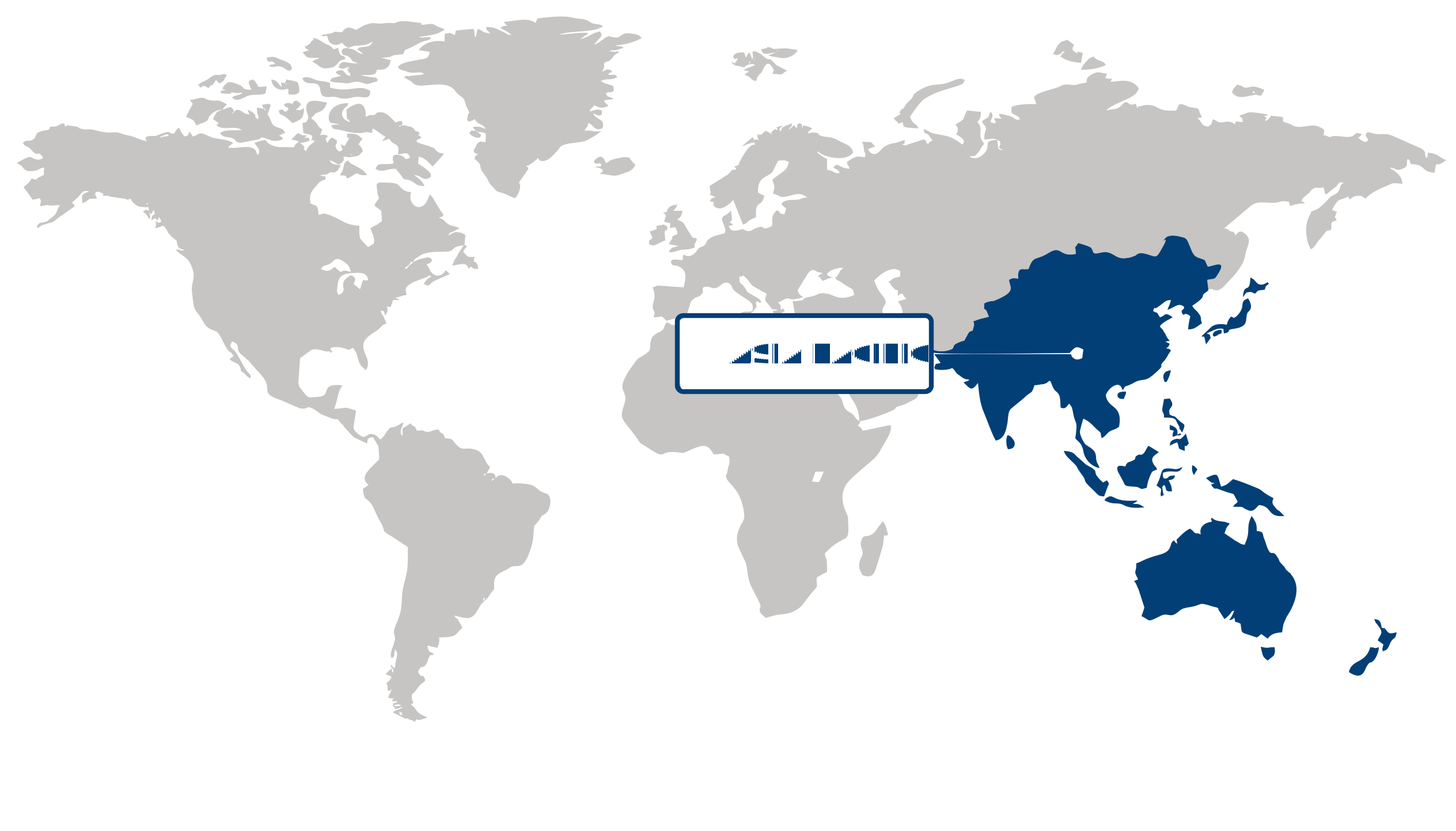
Asia Pacific (Largest Region)
Asia Pacific accounted for the largest share of the organic fertilizers market at 36.04% in 2026, supported by extensive agricultural activity, growing interest in sustainable farming practices, and increasing awareness of soil health. Rising efforts to improve agricultural productivity while reducing reliance on conventional inputs are creating favorable conditions for organic fertilizer adoption.
Europe (Fastest-Growing Region)
Europe represents the fastest-growing regional market, driven by stronger emphasis on environmentally responsible agriculture, soil conservation, and sustainable input use. Increasing farmer awareness of organic cultivation practices and continued focus on improving agricultural sustainability are supporting wider adoption of organic fertilizers across the region.
| Parameter | North America | Asia Pacific | Europe | Latin America | MEA |
|---|---|---|---|---|---|
| Innovation Hub i Scale Nascent Developing Advanced | |||||
| Cost-Sensitive Region i Scale Low Medium High | |||||
| Regulatory Environment i Scale Restrictive Neutral Supportive | |||||
| Demand Drivers i Scale Weak Moderate Strong | |||||
| Development Stage i Scale Emerging Developing Developed | |||||
| Adoption Rate i Scale Low Medium High | |||||
| New Entrants / Startups i Scale Sparse Moderate Dense | |||||
| Macro Indicators i Scale Weak Stable Strong |
Key Country Insights
Germany 🇩🇪
Circular Nutrient SystemsGermany prioritizes organic fertilizers that align with circular economy objectives and environmentally responsible farming. Local demand encourages products derived from recycled organic waste while supporting compliance with sustainable agricultural standards.
France 🇫🇷
Vineyard Soil SolutionsFrance sees strong interest in organic fertilizers for vineyards and premium agricultural production where long-term soil vitality is a priority. Market participants are expanding natural nutrient products that support sustainable cultivation practices.
Italy 🇮🇹
Mediterranean Crop SupportItaly is focusing on organic fertilizers suited for fruit, vegetable, and olive cultivation where balanced soil fertility is essential. Manufacturers are strengthening product portfolios designed for diversified Mediterranean farming systems.
Japan 🇯🇵
Specialty Crop NutritionJapan emphasizes organic fertilizers tailored for high-value horticulture and specialty crops where soil quality and product consistency are essential. Manufacturers are developing refined formulations suitable for intensive cultivation and limited farmland.
South Korea 🇰🇷
Sustainable Input AdoptionSouth Korea is encouraging wider adoption of organic fertilizers to improve soil health while reducing dependence on synthetic nutrients. Suppliers are introducing efficient formulations that fit modern greenhouse and intensive farming operations.
United States 🇺🇸
Regenerative Farming FocusThe U.S. organic fertilizers market is supported by expanding regenerative agriculture practices and demand for sustainable soil management. Producers are emphasizing nutrient efficiency, bio-based inputs, and compatibility with precision farming systems across commercial crop production.
Segment Leadership and Growth Trends
Organic Fertilizers Market Share (%), by Crop Type, 2026
Go beyond the chart, access full insights & data tables
Request Free Sample ReportCrop Type Segment Analysis: Cereals & Grains (Largest Segment) vs Fruits & Vegetables (Fastest-Growing Segment)
Cereals & grains dominated the organic fertilizers market in 2026, accounting for a 43.46% share. Their leading position reflects the extensive cultivation of staple crops and the growing emphasis on maintaining soil fertility through more sustainable nutrient management practices. Organic fertilizers can support soil health by contributing organic matter while supplying nutrients required for crop development. Increasing interest in sustainable agriculture, soil quality improvement, and reduced dependence on synthetic agricultural inputs continues to support organic fertilizer use across cereal and grain production.
Fruits & vegetables are expected to experience the fastest growth as producers increasingly emphasize soil health, crop quality, and sustainable cultivation practices. These crops are particularly responsive to nutrient management, creating demand for fertilizer solutions that can support plant development while aligning with organic and environmentally conscious production approaches. Rising consumer interest in sustainably produced food and greater adoption of organic cultivation practices are further encouraging the use of organic fertilizers in fruit and vegetable farming.
Form Segment Analysis: Dry (Largest Segment) vs Liquid (Fastest-Growing Segment)
The dry form held the largest share of the organic fertilizers market in 2026, supported by its established use across agricultural operations and its suitability for efficient storage, handling, and application. Dry organic fertilizers can be incorporated into soil through established farm practices and are suitable for a wide range of crop production systems. Their familiarity among growers and compatibility with conventional spreading and soil-management methods continue to support broad adoption, particularly among producers seeking practical organic nutrient solutions.
Liquid organic fertilizers are projected to grow at the fastest pace as growers increasingly seek flexible nutrient application methods that can be integrated into modern crop management practices. Liquid formulations can facilitate more targeted application and enable nutrients to be incorporated into irrigation and other agricultural delivery systems where appropriate. Growing interest in precision agriculture, efficient nutrient utilization, and adaptable fertilization practices is supporting greater demand for liquid organic fertilizer solutions.
| Segment | Sub-Segment | Largest Segment | Fastest Growing |
|---|---|---|---|
| Crop Type | Cereals & Grains, Oilseed & Pulses, Fruits & Vegetables, Others | Cereals & Grains | Fruits & Vegetables |
| Form | Dry, Liquid | Dry | Liquid |
| Source | Plant, Animal, Mineral | Plant | Animal |
Competitive Landscape and Market Positioning
Top players in the organic fertilizers market:
1. Lallemand Inc. (Canada)
2. Rizobacter Argentina S.A. (Argentina)
3. Biolchim S.p.A. (Italy)
4. Midwestern BioAg Inc. (United States)
5. NatureSafe (United States)
6. T. Stanes and Company Limited (India)
7. PT Pupuk Kalimantan Timur (Indonesia)
8. Cropmate Fertilizers Sdn. Bhd. (Malaysia)
9. Biostar Renewables LLC (United States)
10. Coromandel International Limited (India)
Rising sustainability-driven demand is reshaping the organic fertilizers market, pushing producers toward eco-friendly nutrient solutions. New formulations are being introduced to improve soil productivity and crop yield efficiency. Continuous research activity is also supporting expansion into diversified agricultural applications.
| Company | Market Share | Company Revenue | Revenue CAGR (%) | Product Portfolio | Geographic Presence | Innovation / R&D Focus | Strategic Developments |
|---|---|---|---|---|---|---|---|
| Lallemand Inc. (Canada) | |||||||
| Rizobacter Argentina S.A. (Argentina) | |||||||
| Biolchim S.p.A. (Italy) | |||||||
| Midwestern BioAg Inc. (United States) | |||||||
| NatureSafe (United States) | |||||||
| T. Stanes and Company Limited (India) | |||||||
| PT Pupuk Kalimantan Timur (Indonesia) | |||||||
| Cropmate Fertilizers Sdn. Bhd. (Malaysia) | |||||||
| Biostar Renewables LLC (United States) | |||||||
| Coromandel International Limited (India). |
Industry Development/News
| Company Name | Date | Key Development |
|---|---|---|
| Den Ouden Groep | Sep-25 | Den Ouden Groep is establishing a new production plant in Vietnam dedicated to organic fertilizer granules. This strategic move marks a key milestone in the company’s international expansion, designed to capitalize on the increasing demand for sustainable soil amendments in Southeast Asia and bolster its localized manufacturing capacity within the regional agricultural inputs market. |
| Green Carbon Inc | Sep-25 | Green Carbon Inc has entered into a memorandum of understanding with Living Roots Pte. Ltd. to develop large-scale biochar-derived organic fertilizers for rubber plantations in Thailand. This initiative focuses on converting biomass into soil-enhancing inputs while leveraging regenerative agriculture practices to generate carbon credits, reinforcing the company's strategic focus on nature-based carbon solutions. |
| Vanguard Renewables | Sep-25 | Vanguard Renewables has withdrawn its proposal for a biowaste processing facility in Murray County intended to produce renewable natural gas and fertilizer products. This cancellation represents a notable setback for the company’s planned infrastructure expansion in the organic waste-to-energy and fertilizer sectors, highlighting the challenges of scaling industrial-scale waste conversion operations amid local regulatory and community opposition. |
| Nitricity | Aug-25 | Nitricity secured $50 million in Series B funding to accelerate the commercialization of its low-carbon nitrogen fertilizer technology. This capital infusion supports the expansion of production capacity for its organic-compatible solutions, aiming to enhance the availability of sustainable agricultural inputs and reduce the greenhouse gas intensity typically associated with conventional nitrogen fertilizer manufacturing processes. |
| Hello Nature | Aug-25 | Hello Nature has commissioned a 300,000-square-foot manufacturing facility in Wabash, Indiana. By utilizing poultry manure as a primary feedstock to produce organic fertilizers and bio-based soil inputs, the company has significantly increased its domestic production capacity, strengthening its position within the sustainable nutrient recycling value chain and expanding its commercial supply footprint. |
| BSOG Energy | Aug-25 | BSOG Energy is developing a large-scale facility in Romania in partnership with Unigrains Trading to integrate biomethane production with organic fertilizer manufacturing. The project targets an annual output of over 250,000 tons of organic fertilizer, representing a significant infrastructure investment that advances circular economy models by repurposing agricultural waste streams into nutrient-rich soil amendments. |
| Convertus | Aug-25 | Convertus has secured final permitting for a new anaerobic digestion facility in Ontario to process organic waste into renewable natural gas and fertilizer products. The project serves as a strategic addition to regional circular economy infrastructure, enabling the conversion of organic waste into high-quality, nutrient-dense fertilizer outputs as a value-added co-product of biogas generation. |
| Del Monte Kenya | Aug-25 | Del Monte Kenya has inaugurated its De l’Ora Bio facility, a dedicated production plant for biofertilizers. By integrating this manufacturing capability directly into its fresh produce operations, the company is operationalizing its sustainability strategy, aiming to improve soil health and promote circular agricultural practices through the on-site conversion of agricultural byproducts into sustainable nutrient solutions. |
| Pehle Jaisa | Aug-25 | Agritech startup Pehle Jaisa raised $300,000 in pre-Series A funding to scale its circular economy platform. The company focuses on converting rural organic waste into value-added agricultural inputs, including organic fertilizers, with the objective of decentralizing fertilizer production within India’s rural agricultural ecosystem and improving soil health at the farm level. |
Customize Your Report
Explore examples of how this report can be tailored to different research needs, including custom segments, additional topics or chapters, and related reports. Click a section of the wheel or its numbered marker to explore the available options.
Organic Fertilizers Market — Custom Segments
| Segment | Sub-Segment |
|---|---|
| Farming Practice | Conventional Farming, Organic Farming, Integrated Farming, Regenerative Farming |
| Distribution Channel | Direct Sales, Agricultural Cooperatives & Associations, Retail & Specialty Stores, Online Channels |
| Certification Status | Certified Organic, Non-Certified Organic |
Organic Fertilizers Market — Custom TOC
| Custom Chapter | Custom Details |
|---|---|
| Farm Adoption and Grower Behavior Analysis |
|
| Crop-Specific Demand Opportunity Mapping |
|
| Carbon Farming and Regenerative Agriculture Impact Study |
|
Need a different cut of the data?
Request Custom ResearchWhat is the current revenue of the organic fertilizers market?
What is the projected value of the organic fertilizers industry by 2036?
How is the expansion of organic farming practices driving demand in the organic fertilizers market?
How are government policies and sustainability regulations shaping adoption in the organic fertilizers market?
Why do cereals and grains represent the largest crop type in the organic fertilizers market?
Why is the liquid form segment growing faster in the organic fertilizers market?
Why does Asia Pacific dominate the organic fertilizers market?
Why is Europe the fastest-growing regional market for organic fertilizers?
Which companies are driving growth in the organic fertilizers landscape?
Our Clients
"The report helped us understand emerging consumer trends in our product category. It clarified where to focus innovation for the next product launch."
LyondellBasell
"The regional forecast section was incredibly useful. We were able to identify two new potential partners in Europe thanks to the vendor mapping you included."
SABIC
"We appreciated how actionable the recommendations were. It guided us to improve supply chain resilience."
Olin Corporation
Our Research Team & Methodology
Every Fundamental Business Insights report is built by a dedicated vertical research team, validated through a structured primary-and-secondary methodology, and reviewed for accuracy before it reaches you.
Research Team Overview
Prepared by the Chemicals & Materials Research Team
Delivery
Published
Demand
Available
Support
Trust & Compliance
Research Domains
10 coverage areasResearch Intelligence
| Source | Reference |
|---|---|
| American Chemistry Council (ACC) | www.americanchemistry.com |
| European Chemical Industry Council (Cefic) | cefic.org |
| International Council of Chemical Associations (ICCA) | icca-chem.org |
| European Chemicals Agency (ECHA) | echa.europa.eu |
| U.S. Environmental Protection Agency (EPA) | www.epa.gov |
| ASTM International | www.astm.org |
| International Organization for Standardization (ISO) | www.iso.org |
| National Institute of Standards and Technology (NIST) | www.nist.gov |
| Plastics Industry Association (PLASTICS) | www.plasticsindustry.org |
| European Biplastics | www.european-bioplastics.org |
| The Adhesive and Sealant Council (ASC) | www.ascouncil.org |
| National Association of Corrosion Engineers (AMPP) | www.ampp.org |
| Society of Plastics Engineers (SPE) | www.4spe.org |
| International Fertilizer Association (IFA) | www.fertilizer.org |
| CropLife International | croplife.org |
| Packaging Europe | packagingeurope.com |
| Flexible Packaging Association (FPA) | www.flexpack.org |
| Battery Council International (BCI) | batterycouncil.org |
| International Copper Association (ICA) | internationalcopper.org |
| World Steel Association | worldsteel.org |
Research Workflow & Quality Assurance
Data Collection
Verified information gathered through primary and secondary research.
Data Triangulation
Cross-validation using multiple independent data sources.
Forecast Modelling
Market estimates developed using historical trends and analytical models.
Analyst Validation
Findings reviewed by domain experts for accuracy and consistency.
Editorial & Quality Review
Final editorial, quality, and compliance checks before publication.
Final Publication
Released after successful completion of the internal review process.
Report Coverage
📊 Market Assessment
- Market Size & Forecast
- Market Segmentation
- Regional Analysis
- Growth Drivers & Challenges
- Market Dynamics
🏢 Competitive Intelligence
- Competitive Landscape
- Company Profiles
- Competitive Benchmarking
- Mergers & Acquisitions
- Market Share Analysis or Key Company Strategies
🔍 Strategic Analysis
- Value Chain Analysis
- Porter's Five Forces
- PESTLE Analysis
- Pricing Trends
- Supply-Demand Analysis
🚀 Future Outlook
- Technology Landscape
- Regulatory Landscape
- Investment & Funding Landscape
- Emerging Opportunities
- Future Market Outlook
Have a question about this report or need a custom scope?
Request Customization