Optoelectronic Component Market Size & Forecasts 2026-2035, By Segments (Component, Application, Material, Vertical), Growth Opportunities, Innovation Landscape, Regulatory Shifts, Strategic Regional Insights (U.S., Japan, China, South Korea, UK, Germany, France), and Competitive Dynamics (II-VI, Lumentum, Finisar, Broadcom, Hamamatsu)
Market Size and Growth Outlook
Optoelectronic Component Market size is projected to grow steadily from USD 46.78 billion in 2025 to USD 79.91 billion by 2035, demonstrating a CAGR exceeding 5.5% through the forecast period (2026-2035). The 2026 revenue is estimated at USD 49.01 billion.
Get more details on this report
Request Free Sample ReportOptoelectronic Component Market Intelligence Snapshot
Regional Market Dynamics
Segment Momentum
Market Expansion Drivers
Leading Market Participants
Global Market Forecast Snapshot
Market Outlook
Regional and Segment Outlook
Market Growth Drivers and Industry Trends
The surge in feature-rich smartphones, wearable AR devices, and advanced cameras is directly reshaping the optoelectronic component market, as vendors integrate more sensors, photodiodes, and illumination modules into compact form factors. Evidence of this pivot appears in Apple press materials for iPhone and Apple Vision Pro that highlight multi‑sensor arrays, Samsung press releases describing enhanced camera systems, and Sony announcements around its image sensor roadmaps. For incumbents this raises the bar for scale, supply security, and system-level differentiation; for entrants it creates niches in sensor fusion, miniaturized modules, and software-enabled subsystems. Given visible product roadmaps from these OEMs, integration of richer optical stacks into consumer devices will remain an organizing theme for product and supply strategies.
Advancements in high-efficiency LEDs, photodiodes, and sensors
Breakthroughs in GaN LEDs, silicon photonics, and stacked photodiodes are expanding applications and lowering energy footprints, materially altering the optoelectronic component market by enabling new form factors and power profiles. Signify (Philips Lighting) and Osram product announcements on high‑efficiency LEDs, Wolfspeed/Cree developments in GaN power devices, and Hamamatsu Photonics releases on next‑generation photodiodes exemplify this technology trajectory. Established suppliers can monetize improved margins through platform upgrades and integrated modules, while startups can capture value by commercializing novel materials, PICs, and sensor ICs. Observed patent filings and successive product launches across these vendors point to continued incremental performance gains that buyers will convert into differentiated end products.
Regulatory standards for optoelectronic safety and environmental compliance
Tighter safety and substance‑control regimes are steering design and sourcing decisions across the optoelectronic component market: IEC 62471 photobiological safety guidance, the European Commission RoHS directive, and REACH restrictions are already shaping material selection and testing workflows. Compliance work by certification bodies such as TÜV Rheinland and enforcement actions referenced by the European Commission and the U.S. Food and Drug Administration (FDA) increase the cost of nonconformance and raise market entry barriers for poorly prepared suppliers. For incumbents, certification and traceability can become a competitive moat; for newcomers, offering pre‑qualified, certified subassemblies or third‑party testing services is a clear route to market. Ongoing regulatory updates and visible enforcement activity make compliance capabilities a durable procurement requirement.
Industry Restraints:
Supply Chain Concentration and Export Controls
Concentration of critical optical and semiconductor suppliers and tightening export controls materially constrain component availability and time-to-market. The U.S. Department of Commerce Bureau of Industry and Security (BIS) restrictions on advanced chipmaking technologies and the Ministry of Economic Affairs and Climate Policy (Netherlands) controls affecting ASML shipments have limited access to key lithography and photonics equipment, while heavy dependence on Taiwan Semiconductor Manufacturing Company (TSMC) for advanced foundry capacity creates single‑point bottlenecks. Incumbents face longer lead times and higher inventory costs; new entrants encounter prohibitive sourcing barriers. In the near to medium term, procurement uncertainty and regionalization pressures will continue to shape sourcing and partnership strategies.
High Capital Intensity and Manufacturing Complexity
The need for multibillion‑dollar fabs and specialized tooling slows market expansion and product iteration. TSMC and Intel public capex commitments and the high unit cost of ASML lithography systems illustrate the scale and technical investment required, and the U.S. CHIPS and Science Act highlights reliance on government support to underwrite these costs. This dynamic advantages well‑capitalized incumbents and strategic integrators while constraining startups and reducing supplier diversity. Expect ongoing consolidation, strategic alliances, and longer product lead times as firms amortize complex manufacturing investments over larger volumes.
| Growth Driver | Impact on CAGR | Regulatory Influence | Geographic Relevance | Adoption Rate | Impact Timeline |
|---|---|---|---|---|---|
| Growing demand for optoelectronic components in consumer electronics | 2.00% | Short term (≤ 2 yrs) | Asia Pacific, North America | Low | Fast |
| Advancements in high-efficiency LEDs, photodiodes, and sensors | 2.00% | Medium term (2–5 yrs) | Europe, Asia Pacific | Medium | Moderate |
| Regulatory standards for optoelectronic safety and environmental compliance | 1.50% | Long term (5+ yrs) | North America, Europe | High | Slow |
Unlock insights tailored to your business with our bespoke market research solutions.
Click to get your customized report now.
Regional Demand Dynamics
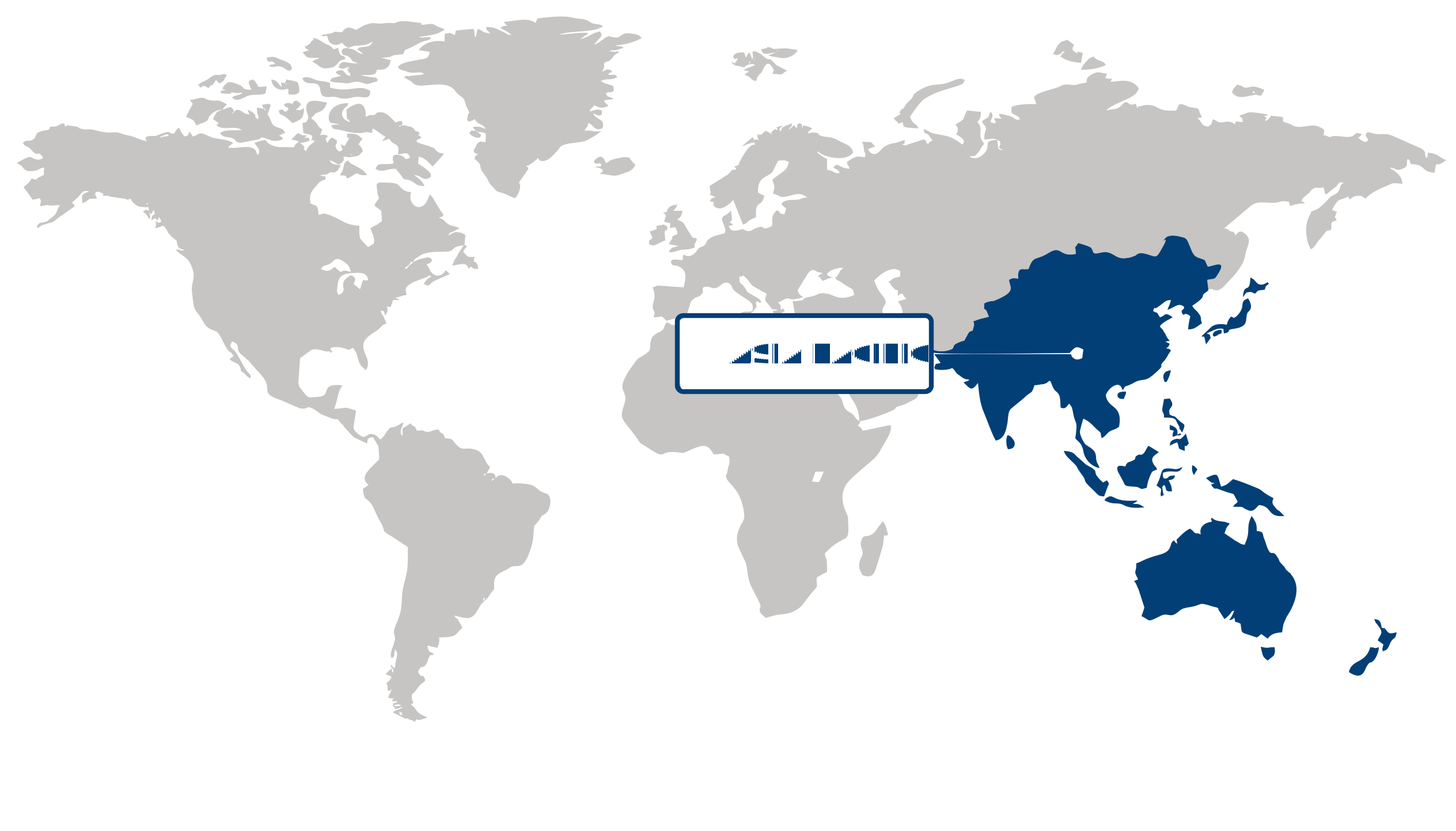
Asia Pacific dominated with approximately 45.00% share of the optoelectronic component market in 2025 and is the largest and fastest-growing region at a 7.7% CAGR. This leadership reflects concentrated consumer-electronics manufacturing and rapid 5G deployment: Hon Hai Precision Industry Co. (Foxconn) and other contract manufacturers maintain high-volume assemblies, while Huawei Technologies Co., Ltd. and GSMA Intelligence document accelerating 5G rollouts that raise demand for optical transceivers and photonics. Government backing—from the Ministry of Industry and Information Technology of the People's Republic of China (MIIT) to Japan’s Ministry of Economy, Trade and Industry (METI)—and suppliers such as Hamamatsu Photonics K.K. provide technological depth and supply-chain resilience, positioning the region for continued capture of component value as device makers localize optical subsystems.
Japan is positioned as a pivotal hub in Asia Pacific for the optoelectronic component market, with strengths in high-value sensors and precision photonics. Corporates such as Sony Corporation and Hamamatsu Photonics K.K. supply advanced image sensors, LiDAR modules, and photodetectors used across consumer electronics and automotive segments, while METI-backed initiatives and Japan External Trade Organization (JETRO) investment facilitation underpin commercialization. This specialization attracts downstream OEMs seeking quality and innovation, reinforcing regional supplier networks and premium-margin opportunities.
China anchors Asia Pacific's scale advantage in the optoelectronic component market through mass production capacity and rapid network expansion. Policies from the Ministry of Industry and Information Technology of the People's Republic of China (MIIT), large-scale manufacturing by Hon Hai Precision Industry Co., and equipment and infrastructure deployments by Huawei Technologies Co., Ltd., supported by GSMA Intelligence data on 5G adoption, amplify demand for optical modules, LEDs, and photonic packaging. For investors and strategists, China’s cost and volume platform complements Japan’s technology nodes, creating a full-value-chain proposition across the region.
North America Market Analysis:
North America held a substantial share in the optoelectronic component market, supported by concentrated R&D clusters, broad commercial demand across datacom, automotive sensing and medical imaging, and active public–private scale-up programs in both Canada and the United States. The Semiconductor Industry Association (SIA) has documented rising demand for optical and photonic devices from hyperscalers and telecom operators, while the National Research Council Canada has prioritized photonics research and prototype development to accelerate commercialization. Innovation, Science and Economic Development Canada (ISED) initiatives to support advanced manufacturing further underpin capacity expansion. These combined demand, research and policy dynamics position the region to capture higher-value segments and accelerate supply-chain resilience going forward.
U.S. plays the central role in North America as the primary innovation and production hub for the optoelectronic component market, propelled by targeted industrial policy, large enterprise procurement and private-sector capacity investments. The U.S. Department of Commerce’s implementation of the CHIPS and Science Act channels incentives that are enabling domestic photonics manufacturing, while the U.S. Department of Defense and DARPA continue to fund advanced optoelectronic research for sensing and communications. Corporate actions—illustrated by announcements from Intel Corporation on domestic fabs and Lumentum Holdings Inc. on capacity expansions—are translating policy into scale. This combination of policy backing and commercial demand makes the U.S. the strategic anchor for North America’s optoelectronics opportunity.
Europe Market Trends:
optoelectronic component market maintained notable presence in North America, reflecting moderate growth driven by diversified demand across data centers, automotive ADAS, and defense procurement; the U.S. Department of Commerce CHIPS Program and Semiconductor Industry Association (SIA) investment data show increased capital allocation to domestic photonics and packaging, while the National Institute of Standards and Technology (NIST) and corporate actions such as Teledyne Technologies press releases and Lumentum Holdings announcements highlight capacity and standards activity—creating opportunities from supply-chain reshoring, resilient procurement, and commercial scale-up for optical transceivers and sensors.
optoelectronic component market in Germany serves as a technology-intense supplier hub, where industrial automation and automotive sensor adoption underpin steady expansion; Bundesministerium für Wirtschaft und Klimaschutz (BMWK) policy incentives and Fraunhofer Gesellschaft research commercialization programs, together with product and partnership disclosures from Infineon Technologies, illustrate strong OEM–supplier integration—positioning German precision manufacturing and systems expertise as complementary to North American sourcing and platform needs.
optoelectronic component market in France emphasizes defense, aerospace, and research-driven innovation, with targeted public funding accelerating commercialization; the French government’s France 2030 plan (Ministère de l'Économie) and R&D outputs from CEA (Commissariat à l'énergie atomique et aux énergies alternatives), plus Thales Group press releases on optical sensor programs, signal clustered capabilities in niche photonics—offering North American investors strategic partnership routes for specialized modules and dual-use technologies.
| Parameter | North America | Asia Pacific | Europe | Latin America | MEA |
|---|---|---|---|---|---|
| Innovation Hub i Scale Nascent Developing Advanced | |||||
| Cost-Sensitive Region i Scale Low Medium High | |||||
| Regulatory Environment i Scale Restrictive Neutral Supportive | |||||
| Demand Drivers i Scale Weak Moderate Strong | |||||
| Development Stage i Scale Emerging Developing Developed | |||||
| Adoption Rate i Scale Low Medium High | |||||
| New Entrants / Startups i Scale Sparse Moderate Dense | |||||
| Macro Indicators i Scale Weak Stable Strong |
Segment Leadership and Growth Trends
Optoelectronic Component Market Share (%), by Component, 2026
Go beyond the chart, access full insights & data tables
Request Free Sample ReportLED dominated the optoelectronic component market in 2025 as the largest share among components, driven by energy-efficient lighting and display applications that favor solid-state solutions. Leadership reflects broad adoption for retrofit and new-build projects, sustainability-driven procurement, and demand for higher luminous efficacy; evidence of large-scale deployment and technology roadmaps is visible in U.S. Department of Energy solid-state lighting guidance and Signify product roadmaps. This creates strategic openings for established luminaire makers to bundle services and for newcomers to supply compact LED modules and smart drivers. Continued regulatory emphasis on efficiency and ongoing LED cost declines support near- to medium-term relevance.
Analysis by Application
Lighting represented largest share in the optoelectronic component market in 2025 among applications, propelled by the shift to LED-based general and commercial lighting. Adoption is reinforced by municipal retrofit programs, corporate sustainability targets, and standards such as European Commission ecodesign rules and LightingEurope advocacy, which steer procurement toward LED systems and connected lighting. Opportunities include integrated IoT-enabled lighting platforms and lighting-as-a-service models for incumbents and niche integrators. Ongoing urbanization, energy codes, and smart building upgrades indicate sustained importance through the medium term.
Analysis by Material
Gallium Nitride held largest share in the optoelectronic component market in 2025 among materials, as GaN enables higher efficiency and performance in LEDs, power electronics, and RF devices critical for next-generation uses. Industry players such as Wolfspeed and GaN Systems cite GaN’s advantages in press releases and product briefs, and technical coverage in IEEE highlights performance benefits for 5G and power conversion. The material advantage opens value for wafer suppliers, power module integrators, and RF specialists investing in packaging and thermal solutions. Strengthening manufacturing capacity and demand from telecom and EV charging ecosystems support continued relevance in the near to medium term.
| Segment | Sub-Segment | Largest Segment | Fastest Growing |
|---|---|---|---|
| Component | LED, Sensor, Infrared Components, Laser Diode | ||
| Application | Lighting, Security & Surveillance, Communications, Measurement, Others | ||
| Material | Silicon Carbide, Gallium Phosphide, Gallium Arsenide, Gallium Nitride, Silicon Germanium, Indium Phosphide | ||
| Vertical | Residential, Telecommunication, Manufacturing, Consumer Electronics, Medical, Automotive, Military & Aerospace, Commercial, Others |
Competitive Landscape and Market Positioning
Competitive dynamics reflect intensified portfolio expansion, faster product introductions, and deeper system-level focus across datacom, sensing, illumination, and industrial optics. Leading vendors have broadened capabilities through targeted transactions and joint programs, prioritized R&D in VCSELs, silicon photonics, high-efficiency LEDs and sensor fusion, and moved toward greater vertical integration and OEM alignment. These moves shift differentiation toward performance, power efficiency, and integrated subsystems, raising technical and supply-chain thresholds for new entrants.
Strategic / Actionable Recommendations for Regional Players
North America: deepen engagement with cloud and systems OEMs, scale silicon-photonics and VCSEL module capability, and reinforce IP and flexible manufacturing to capture datacom and lidar opportunities.
Asia Pacific: enhance compound-semiconductor capacity and local assembly/test linkages, accelerate application-led LED and sensing product roadmaps for automotive, mobile, and consumer ecosystems.
Europe: align precision-sensor and industrial-optics strengths with automotive and medical users, concentrate on high-reliability packaging, niche system integration, and close ties to industrial automation partners.
| Company | Market Share | Company Revenue | Revenue CAGR (%) | Product Portfolio | Geographic Presence | Innovation / R&D Focus | Strategic Developments |
|---|---|---|---|---|---|---|---|
| No companies available. | |||||||
Industry Development/News
| Company Name | Date | Key Development |
|---|
Customize Your Report
Explore examples of how this report can be tailored to different research needs, including custom segments, additional topics or chapters, and related reports. Click a section of the wheel or its numbered marker to explore the available options.
Optoelectronic Component Market — Custom Segments
| Segment | Sub-Segment |
|---|---|
| No segment data available. | |
Optoelectronic Component Market — Custom TOC
| Custom Chapter | Custom Details | ||
|---|---|---|---|
| No custom TOC data available. | |||
Need a different cut of the data?
Request Custom ResearchHow much is the optoelectronic component market worth?
How is the optoelectronic component industry expected to grow over the next 10 years?
Which geographical region leads the optoelectronic component market market?
Which region is experiencing the fastest growth in the optoelectronic component sector?
How does LED segment fare in the optoelectronic component industry?
What share does lighting segment hold in the optoelectronic component sector as of 2025?
Where is the gallium nitride segment seeing the strongest adoption within the optoelectronic component industry?
When did consumer electronics sub-segment emerge as the largest sub-segment in the vertical segment of optoelectronic component sector?
What are the key competitors in the optoelectronic component landscape?
Our Clients
"Working with FBI has been a good experience. The market report provided a holistic view, covering everything from emerging trends to potential risks."
Semtech Corporation
"The experience was highly positive. The team showcased remarkable flexibility in adapting to our specific needs and delivered report that perfectly aligned with all our requirements."
TSMC
"What really stood out to me was how clearly and promptly the Fundamental Business Insights team communicated throughout. It made the collaboration feel effortless."
NXP Semiconductors
Our Research Team & Methodology
Every Fundamental Business Insights report is built by a dedicated vertical research team, validated through a structured primary-and-secondary methodology, and reviewed for accuracy before it reaches you.
Research Team Overview
Prepared by the Electronics & Semiconductors Research Team
Delivery
Published
Demand
Available
Support
Trust & Compliance
Research Domains
10 coverage areasResearch Intelligence
| Source | Reference |
|---|---|
| Semiconductor Industry Association (SIA) | www.semiconductors.org |
| SEMI | www.semi.org |
| JEDEC Solid State Technology Association | www.jedec.org |
| IEEE | www.ieee.org |
| IPC – Association Connecting Electronics Industries | www.ipc.org |
| International Electrotechnical Commission (IEC) | www.iec.ch |
| International Organization for Standardization (ISO) | www.iso.org |
| U.S. Bureau of Industry and Security (BIS) | www.bis.gov |
| U.S. Patent and Trademark Office (USPTO) | www.uspto.gov |
| European Patent Office (EPO) | www.epo.org |
| Taiwan Semiconductor Industry Association (TSIA) | www.tsia.org.tw |
| World Semiconductor Trade Statistics (WSTS) | www.wsts.org |
| International Energy Agency (IEA) | www.iea.org |
| GSMA | www.gsma.com |
| 3GPP | www.3gpp.org |
| ITU (International Telecommunication Union) | www.itu.int |
| Omdia (public insights) | omdia.tech.informa.com |
| Display Supply Chain Consultants (DSCC) | www.displaysupplychain.com |
| U.S. Department of Energy (DOE) | www.energy.gov |
| NIST (National Institute of Standards and Technology) | www.nist.gov |
Research Workflow & Quality Assurance
Data Collection
Verified information gathered through primary and secondary research.
Data Triangulation
Cross-validation using multiple independent data sources.
Forecast Modelling
Market estimates developed using historical trends and analytical models.
Analyst Validation
Findings reviewed by domain experts for accuracy and consistency.
Editorial & Quality Review
Final editorial, quality, and compliance checks before publication.
Final Publication
Released after successful completion of the internal review process.
Report Coverage
📊 Market Assessment
- Market Size & Forecast
- Market Segmentation
- Regional Analysis
- Growth Drivers & Challenges
- Market Dynamics
🏢 Competitive Intelligence
- Competitive Landscape
- Company Profiles
- Competitive Benchmarking
- Mergers & Acquisitions
- Market Share Analysis or Key Company Strategies
🔍 Strategic Analysis
- Value Chain Analysis
- Porter's Five Forces
- PESTLE Analysis
- Pricing Trends
- Supply-Demand Analysis
🚀 Future Outlook
- Technology Landscape
- Regulatory Landscape
- Investment & Funding Landscape
- Emerging Opportunities
- Future Market Outlook
Have a question about this report or need a custom scope?
Request Customization