Open Radio Access Network (Open RAN) Market Size & Forecasts 2026-2035, By Segments (Network, Frequency, Deployment, Component), Growth Opportunities, Innovation Landscape, Regulatory Shifts, Strategic Regional Insights (U.S., Japan, China, South Korea, UK, Germany, France), and Competitive Dynamics (Rakuten Symphony, Mavenir, Altiostar, NEC, Parallel Wireless)
Market Size and Growth Outlook
Open Radio Access Network Market size is anticipated to rise from USD 2.19 billion in 2025 to USD 10 billion by 2035, reflecting a CAGR surpassing 16.4% over the forecast horizon of 2026-2035. The estimated revenue for 2026 is USD 2.51 billion.
Get more details on this report
Request Free Sample ReportOpen Radio Access Network (Open RAN) Market Intelligence Snapshot
Regional Market Dynamics
Segment Momentum
Market Expansion Drivers
Leading Market Participants
Global Market Forecast Snapshot
Market Outlook
Regional and Segment Outlook
Market Growth Drivers and Industry Trends
Major operators’ decisions to adopt open architectures are reshaping the open radio access network (open RAN) market by shifting procurement toward multi-vendor ecosystems and cloud-native operations. Evidence includes Rakuten Mobile’s commercial deployment and Vodafone’s Open RAN trials with vendors such as Mavenir and Parallel Wireless, and DISH Network’s U.S. buildout, which illustrate operator-driven demand for interoperability and faster feature velocity. For incumbents this creates opportunities to offer systems-integration, managed services, and proprietary value-adds; for new entrants it lowers barriers to compete with software, white-box radios, and orchestration stacks. Ongoing operator commitments point to steady demand and deeper supplier collaboration rather than ad-hoc experimentation.
Expansion of 5G Network Infrastructure
The accelerating buildout of 5G capacity increases demand for flexible, cost-efficient RAN architectures, directly benefiting the open radio access network (open RAN) market as operators seek densification and edge compute agility. Operators and vendors such as NTT DOCOMO, Verizon, Ericsson, and Nokia have publicized 5G expansion programs and trials that emphasize virtualization and disaggregation, signaling practical deployment pathways. Established vendors can adapt by modularizing product lines and offering integration packages; challengers can capture share with specialized software, xApps/rApps, and edge orchestration. Observable network rollouts and vendor roadmaps indicate open, disaggregated approaches will play a material role in 5G deployments going forward.
Standardization and Ecosystem Maturation for Open RAN
Progress in standards and collaborative initiatives is reducing integration risk and enabling scale in the open radio access network (open RAN) market, as exemplified by O-RAN Alliance specifications, Telecom Infra Project (TIP) OpenRAN activities, and ecosystem contributions from Intel, Qualcomm, and Samsung. These developments improve testability, multi-vendor interoperability, and supply chain diversification, aligning with regulatory and procurement shifts favoring open standards. Large incumbents can monetize expertise in compliance, test labs, and end-to-end solutions, while startups can specialize in interoperable components, automation, and certification services. The observable deepening of standards bodies and vendor participation suggests steadily increasing confidence among buyers and procurement authorities.
Industry Restraints:
Security and Regulatory Scrutiny
Security concerns and evolving regulatory requirements are a primary brake on open RAN adoption because operators and governments demand demonstrable trustworthiness across disaggregated supply chains, delaying procurement and trials. The Federal Communications Commission’s Secure and Trusted Communications Networks Reimbursement Program and the European Commission’s 5G Toolbox have heightened vendor vetting and exclusion risks, while GSMA guidance has flagged specific security considerations for open interfaces. For established vendors this increases compliance and certification costs; for challengers it raises barriers to entry and delays commercial acceptance. Expect continued phased deployments tied to formal assurance frameworks and certification programs, meaning regulatory scrutiny will shape buyer selection and pace of rollouts in the near to medium term.
Interoperability and Integration Complexity
Open RAN’s multi-vendor promise is constrained by real-world integration complexity: disparate software, cloud-native stacks, and radios require extensive interoperability testing and orchestration, which increases deployment time and operational overhead. The O-RAN Alliance’s plugfest activities and Telecom Infra Project integration labs illustrate progress but also underscore remaining gaps observed in deployments by Rakuten Mobile and Dish Wireless, which relied on partners such as NEC, Fujitsu, Mavenir, and Altiostar to resolve integration issues. Strategically, large operators with engineering scale can internalize integration risk, while smaller incumbents and new entrants face higher implementation costs and slower time-to-market. As conformance testing and orchestration tools mature, integration friction will ease, but complexity will remain a near-term constraint on broad commercial rollout.
| Growth Driver | Impact on CAGR | Regulatory Influence | Geographic Relevance | Adoption Rate | Impact Timeline |
|---|---|---|---|---|---|
| Telecom operators adopting Open RAN standards | 6.00% | Short term (≤ 2 yrs) | North America, Europe | Medium | Fast |
| Expansion of 5G network infrastructure | 5.00% | Medium term (2–5 yrs) | Asia Pacific, North America | Medium | Moderate |
| Standardization and ecosystem maturation for Open RAN | 3.00% | Long term (5+ yrs) | Europe, Asia Pacific | Medium | Slow |
Unlock insights tailored to your business with our bespoke market research solutions.
Click to get your customized report now.
Regional Demand Dynamics
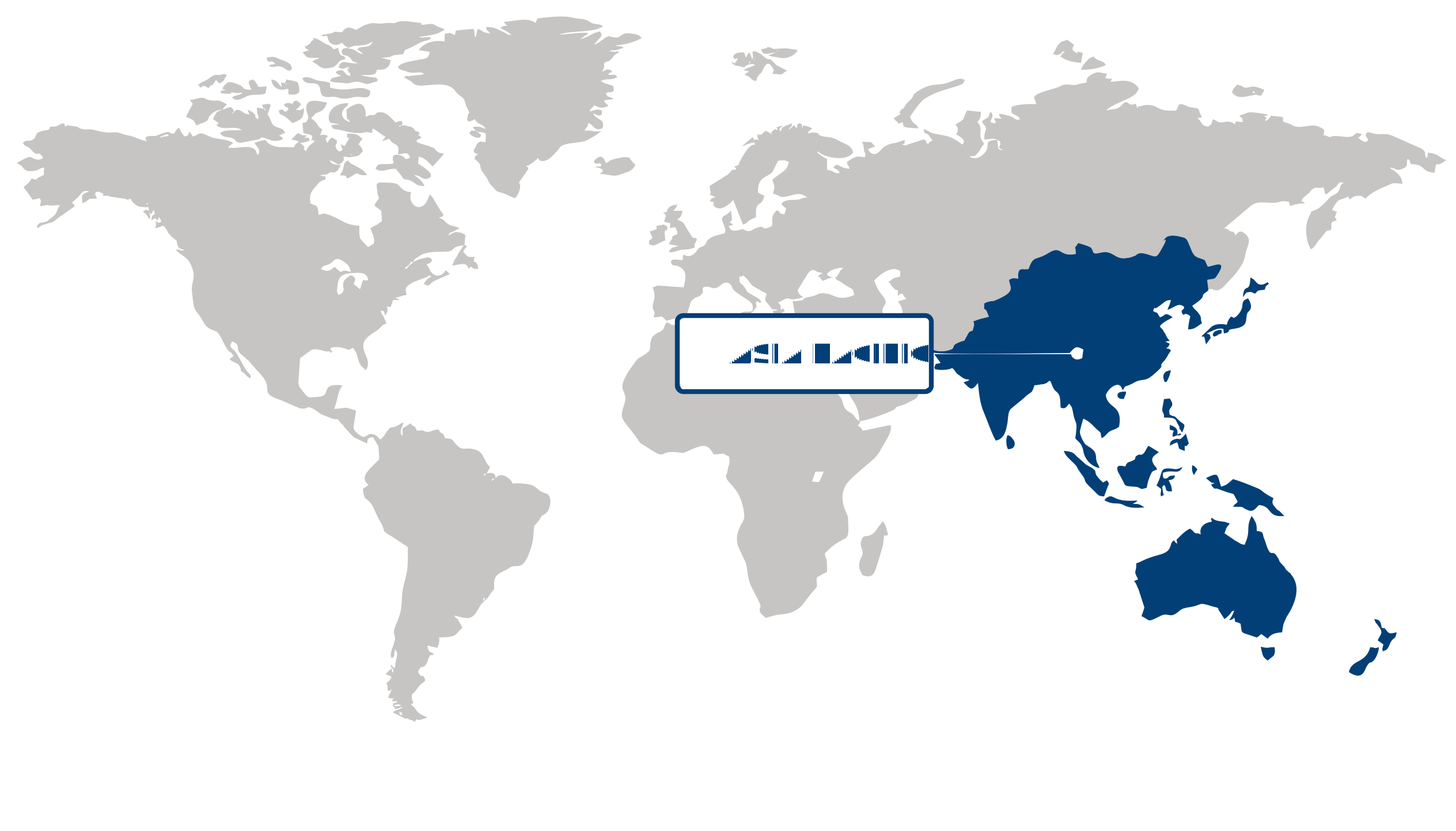
The Asia Pacific open radio access network (open RAN) market captured over 40.7% of the global market in 2025 and, with a 22.2% CAGR, is the largest and fastest-growing region. Rapid 5G rollouts and large-scale network modernization programs—driven by government incentives and operator investment—explain leadership: the Ministry of Industry and Information Technology (MIIT) and the GSMA both document accelerating 5G deployments, while operator announcements from China Mobile and Rakuten Mobile highlight multi-vendor and cloud-native initiatives. Demand for capacity and cost-efficient architectures, policy support for supply-chain diversification, and strong enterprise digitalization are converging to expand addressable spend and supplier ecosystems. These factors position APAC as a high-opportunity market for vendors, system integrators, and investors seeking scale and early adopter references.
Japan's open radio access network (open RAN) market is positioned as a pivotal hub in Asia Pacific, anchored by commercial proof points and government alignment. Rakuten Mobile’s commercial cloud-native RAN launch and trial work reported by NTT DOCOMO, alongside guidance from the Ministry of Internal Affairs and Communications (MIC), illustrate a national push toward disaggregated architectures and domestic supplier participation (e.g., NEC, Fujitsu). Higher urban data consumption and operator willingness to trial new operational models create a testbed for interoperability and cost optimization, making Japan a strategic node for scaling solutions regionally.
China's open radio access network (open RAN) market anchors the Asia Pacific region through scale-driven modernization and policy signals that shape supplier dynamics. Corporate press releases from China Mobile and directives from MIIT emphasize rapid 5G expansion and network cloudification, while a strong domestic vendor base (e.g., Huawei, ZTE) informs a pathway where open interfaces may be adopted selectively within operator modernization programs. The combination of enormous traffic growth, centralized procurement practices, and R&D capacity means China will drive large-volume demand and force ecosystem players to adapt technology and supply strategies to win regional share.
North America Market Analysis:
North America held a commanding share in the open radio access network (open RAN) market, driven by concentrated operator investment, a deep vendor ecosystem, and policy engagement that accelerate adoption. Large carrier trials and proof-of-concepts by Verizon and AT&T, combined with greenfield build commitments from DISH Network, validate commercial demand and interoperability efforts; the Open RAN Policy Coalition and Federal Communications Commission activity around secure, diverse supply chains has reduced procurement risk and mobilized private and public funding. Strong enterprise 5G appetite, cloud-native skills in major tech hubs, and proximity to chipset and software suppliers create operational advantages. These dynamics position North America as a strategic launchpad for scalable Open RAN deployments and vendor specialization over the next procurement cycles.
The U.S. is the primary force within North America for the open radio access network (open RAN) market, where operator-driven trials, procurement incentives, and security scrutiny shape adoption pathways. U.S. carriers’ public trials with vendors such as Mavenir and statements from DISH Network about cloud-native network builds illustrate commercial and technical commitment, while the Federal Communications Commission’s engagement and the Open RAN Policy Coalition’s advocacy inform regulatory and procurement frameworks. Talent concentration in software-defined networking and edge cloud, combined with enterprise demand for private 5G, creates a testing ground for interoperable solutions. For investors and strategists, U.S. activity signals near-term commercialization opportunities that can scale regionally through vendor partnerships and policy-aligned procurement.
Europe Market Trends:
The open radio access network (open RAN) market in North America maintained a substantial share, reflecting a mix of greenfield builds, operator trials, and supplier ecosystem activity that has accelerated commercial interest. Regional significance stems from large carrier scale, concerted policy attention to supply-chain diversity, and active industry consortia: Dish Network’s public plans for a cloud-native 5G stack, ongoing work at the O-RAN Alliance, and engagement by the Federal Communications Commission and the National Telecommunications and Information Administration have all provided visible momentum. These signals, plus vendor investment and trial partnerships supported by Telecom Infra Project collaborations, position the region for continued deployment and vendor diversification opportunities. Investors should view North America as a strategic center for scale-up and standards-aligned commercialization.
The open radio access network (open RAN) market in the United States is the regional innovation hub where scale and commercial proof points converge. U.S. dynamics are shaped by large addressable demand and operator-led experimentation: Dish Network’s public trajectory toward an open, virtualized RAN and active membership in the O-RAN Alliance illustrate operator-led adoption, while U.S. regulatory and research entities such as the Federal Communications Commission and the National Telecommunications and Information Administration have signaled interest in supply-chain resilience and interoperability. For vendors and investors, the U.S. offers high-reward opportunities to capture volume and to commercialize cloud-native RAN solutions that can be exported across allied markets.
The open radio access network (open RAN) market in Canada is an emerging adopter prioritizing interoperability and rural coverage enhancements. Canadian momentum is shaped by policy levers and connectivity programs from Innovation, Science and Economic Development Canada (ISED) and oversight by the Canadian Radio-television and Telecommunications Commission (CRTC), which together create demand signals for cost-effective, modular RAN solutions to extend service to underserved areas. This environment creates tactical openings for vendors offering turnkey integration and for investors to fund pilots that can scale regionally and feed into broader North American commercial rollouts.
| Parameter | North America | Asia Pacific | Europe | Latin America | MEA |
|---|---|---|---|---|---|
| Innovation Hub i Scale Nascent Developing Advanced | |||||
| Cost-Sensitive Region i Scale Low Medium High | |||||
| Regulatory Environment i Scale Restrictive Neutral Supportive | |||||
| Demand Drivers i Scale Weak Moderate Strong | |||||
| Development Stage i Scale Emerging Developing Developed | |||||
| Adoption Rate i Scale Low Medium High | |||||
| New Entrants / Startups i Scale Sparse Moderate Dense | |||||
| Macro Indicators i Scale Weak Stable Strong |
Segment Leadership and Growth Trends
Open Radio Access Network (Open RAN) Market Share (%), by Network, 2026
Go beyond the chart, access full insights & data tables
Request Free Sample Report5G dominated the open radio access network (open RAN) market in 2025 as the largest share, propelled by rapid global roll‑out and operators’ preference for next‑gen open architecture. Leadership stems from operators prioritizing disaggregated, software‑centric RAN to accelerate deployments—an approach championed by O‑RAN Alliance and demonstrated in Rakuten Mobile and NTT DOCOMO field initiatives. Customers favor flexible, vendor‑diverse stacks that lower supply‑chain risk and speed innovation, while regulators in Europe and Japan support interoperability. This segment creates strategic openings for incumbent vendors to offer managed services and for agile entrants to supply specialized software and automation, and it should remain central as 5G densification and virtualization continue near term.
Analysis by Frequency
Sub-6 GHz represented largest share of the open radio access network (open RAN) market in 2025 due to its wide coverage, penetration and legacy compatibility. Its leadership reflects operators’ demand for broad, cost‑effective mid‑band capacity—an industry trend noted in GSMA commentary and spectrum harmonization actions by the European Commission and FCC. Service providers such as Vodafone have pursued Open RAN trials in Sub‑6 bands to balance urban capacity and rural reach. The segment favors players offering multi‑band radio units and software tuning, and it will remain pivotal as mid‑band spectrum and network modernization drive sustained demand.
Analysis by Deployment
Public Cloud held largest share of the open radio access network (open RAN) market in 2025, supported by widespread public macrocell deployments and operator moves to cloud‑native architectures. Cloud providers and ecosystem partners—Amazon Web Services (Wavelength), Microsoft Azure (Azure for Operators) and Google Cloud collaborations with vendors—have enabled scalable RAN functions and rapid CI/CD workflows endorsed by O‑RAN Alliance guidance. Operators seek cloud economics, resilience and faster feature delivery while supply‑chain diversification supports vendor neutrality. This opens opportunities for hyperscalers, systems integrators and cloud‑native software vendors, and public‑cloud deployment is likely to persist as operators pursue virtualization and operational agility in the near to medium term.
| Segment | Sub-Segment | Largest Segment | Fastest Growing |
|---|---|---|---|
| Network | 5G, 4G | ||
| Frequency | mmWave, Sub-6 GHz | ||
| Deployment | Public Cloud, Hybrid Cloud, Private Cloud | ||
| Component | Services, Hardware, Software |
Competitive Landscape and Market Positioning
The competitive environment is shaped by intensified ecosystem orchestration and capability consolidation among the Top 10. Many players are expanding through strategic tie‑ins and targeted portfolio enhancements while others push disaggregated, software-led offerings to accelerate multivendor interoperability and deployment speed. Focus on cloud-native stacks, open interfaces, and integrated verification is shifting differentiation toward systems integration, lifecycle automation, and services-led propositions. Those aligning operator relationships with chipset and cloud partners are shortening commercial ramp-up and raising the bar on deployment maturity.
Strategic / Actionable Recommendations for Regional Players
North America: Prioritize collaborations with hyperscalers and enterprise integrators to capture private 5G and edge computing demand, accelerate proofs of concept for software-led deployments, and deepen ties with silicon and orchestration providers to secure end-to-end stacks for enterprise and neutral-host customers.
Asia Pacific: Leverage strong operator partnerships and local manufacturing capabilities to scale cost-competitive radio units and turnkey integrations for dense urban and greenfield initiatives; marry cloud-native software with regional deployment expertise and regulatory engagement to convert pilots into broader rollouts.
Europe: Emphasize interoperability, security assurance, and sustainability in propositions to win public-sector and rural connectivity programs; work closely with standards bodies and local integrators to tailor disaggregated solutions for industrial and transport verticals while countering scale-driven incumbents.
| Company | Market Share | Company Revenue | Revenue CAGR (%) | Product Portfolio | Geographic Presence | Innovation / R&D Focus | Strategic Developments |
|---|---|---|---|---|---|---|---|
| No companies available. | |||||||
Industry Development/News
| Company Name | Date | Key Development |
|---|
Customize Your Report
Explore examples of how this report can be tailored to different research needs, including custom segments, additional topics or chapters, and related reports. Click a section of the wheel or its numbered marker to explore the available options.
Open Radio Access Network (Open RAN) Market — Custom Segments
| Segment | Sub-Segment |
|---|---|
| No segment data available. | |
Open Radio Access Network (Open RAN) Market — Custom TOC
| Custom Chapter | Custom Details | ||
|---|---|---|---|
| No custom TOC data available. | |||
Need a different cut of the data?
Request Custom ResearchWhat is the market size of open radio access network?
What is the anticipated CAGR of the open radio access network (open RAN) industry?
Which part of the world shows the greatest dominance in the open radio access network (open RAN) market?
Which geographical area is witnessing the highest growth rate in the open radio access network sector?
Why does 5G sub-segment dominate the network segment of open radio access network (open RAN) sector?
How does sub-6 GHz segment fare in the open radio access network (open RAN) industry?
What share does public cloud segment hold in the open radio access network (open RAN) sector as of 2025?
Where is the hardware segment seeing the strongest adoption within the open radio access network (open RAN) industry?
Which organizations are considered leaders in the open radio access network (open RAN) landscape?
Our Clients
"The team demonstrated a great understanding of our business needs, and the reports were tailored to address our specific concerns and objectives."
Infosys
"The report was up-to-date with the latest industry trends and technological advancements. The detailed competitive landscape analysis was quite helpful."
Zebra Technologies
"The data presented in the report was accurate and well-researched. I also found the market dynamics section particularly useful."
Arlo Technologies
Our Research Team & Methodology
Every Fundamental Business Insights report is built by a dedicated vertical research team, validated through a structured primary-and-secondary methodology, and reviewed for accuracy before it reaches you.
Research Team Overview
Prepared by the Smart Technologies Research Team
Delivery
Published
Demand
Available
Support
Trust & Compliance
Research Domains
10 coverage areasResearch Intelligence
| Source | Reference |
|---|---|
| National Institute of Standards and Technology (NIST) | www.nist.gov |
| International Organization for Standardization (ISO) | www.iso.org |
| Institute of Electrical and Electronics Engineers (IEEE) | www.ieee.org |
| Internet Engineering Task Force (IETF) | www.ietf.org |
| World Wide Web Consortium (W3C) | www.w3.org |
| Cloud Security Alliance (CSA) | cloudsecurityalliance.org |
| Open Source Initiative (OSI) | opensource.org |
| Linux Foundation | www.linuxfoundation.org |
| FinOps Foundation | www.finops.org |
| PCI Security Standards Council | www.pcisecuritystandards.org |
| SWIFT | www.swift.com |
| Financial Stability Board (FSB) | www.fsb.org |
| GSMA | www.gsma.com |
| International Telecommunication Union (ITU) | www.itu.int |
| OWASP Foundation | owasp.org |
| MITRE | www.mitre.org |
| World Economic Forum (WEF) | www.weforum.org |
| OECD Digital Economy | www.oecd.org/digital |
| World Bank Data | data.worldbank.org |
| U.S. Census Bureau | www.census.gov |
Research Workflow & Quality Assurance
Data Collection
Verified information gathered through primary and secondary research.
Data Triangulation
Cross-validation using multiple independent data sources.
Forecast Modelling
Market estimates developed using historical trends and analytical models.
Analyst Validation
Findings reviewed by domain experts for accuracy and consistency.
Editorial & Quality Review
Final editorial, quality, and compliance checks before publication.
Final Publication
Released after successful completion of the internal review process.
Report Coverage
📊 Market Assessment
- Market Size & Forecast
- Market Segmentation
- Regional Analysis
- Growth Drivers & Challenges
- Market Dynamics
🏢 Competitive Intelligence
- Competitive Landscape
- Company Profiles
- Competitive Benchmarking
- Mergers & Acquisitions
- Market Share Analysis or Key Company Strategies
🔍 Strategic Analysis
- Value Chain Analysis
- Porter's Five Forces
- PESTLE Analysis
- Pricing Trends
- Supply-Demand Analysis
🚀 Future Outlook
- Technology Landscape
- Regulatory Landscape
- Investment & Funding Landscape
- Emerging Opportunities
- Future Market Outlook
Have a question about this report or need a custom scope?
Request Customization