Onshore Wind Turbine Blade Market Size & Growth Forecast 2027–2036, By Segments (Size, Capacity, Material), Regional Demand Trends (North America, Asia Pacific, Europe), Key Country Insights (U.S., Japan, South Korea, Germany, France, Italy), and Competitive Landscape
Market Size and Growth Outlook
Onshore Wind Turbine Blade Market size was around USD 84.36 Billion in 2026 and is slated to grow at 6.04% CAGR from 2027 to 2036, crossing USD 151.65 Billion by 2036. The industry revenue for 2027 is calculated at USD 88.69 Billion.
Get more details on this report
Request Free Sample ReportOnshore Wind Turbine Blade Market Intelligence Snapshot
Regional Market Dynamics
- Asia Pacific led in 2026 due to accelerating renewable energy deployment, major onshore wind investments, grid development, and supportive renewable energy policies.
- Expanding wind farms, rising electricity demand, decarbonization efforts, suitable wind resources, and advances in blade materials are supporting regional market expansion.
Segment Momentum
- The 31–60 M blade segment leads the market because it balances energy capture, transportation, installation, and compatibility across diverse onshore wind projects, supporting widespread deployment in utility-scale applications.
- Carbon fibre is the fastest-growing material segment as manufacturers increasingly adopt lightweight, high-strength materials to develop longer blades, improve aerodynamic performance, and support higher-capacity wind turbines.
Market Expansion Drivers
- Regulatory incentives and investments accelerating wind blade deployment
- R&D advancements improving blade efficiency and reducing lifecycle costs
- Large-scale repowering of aging wind farms driving blade replacement demand
Leading Market Participants
- Major companies in the onshore wind turbine blade market include Vestas Wind Systems A/S (Denmark), Siemens Gamesa Renewable Energy S.A. (Spain), Nordex SE (Germany), Suzlon Energy Ltd. (India), Enercon GmbH (Germany), Acciona S.A. (Spain), Sinoma Wind Power Blade Co., Ltd. (China), GE Vernova Inc. (United States)
Global Market Forecast Snapshot
Market Outlook
- 2026 Market Size: USD 84.36 Billion
- 2027 Estimated Market Size: USD 88.69 Billion
- Projected Market Size: USD 151.65 Billion by 2036
- Growth Forecast: 6.04% CAGR (2027-2036)
Regional and Segment Outlook
- Leading Regional Market: Asia Pacific
- High-Growth Regional Hub: Asia Pacific
- Core Revenue Segment: 31 - 60 M (Size) | > 5 MW (Capacity) | Glass Fibre (Material)
- Emerging Opportunity Segment: 61 - 90 M (Size) | > 5 MW (Capacity) | Carbon Fibre (Material)
Market Growth Drivers and Industry Trends
Regulatory incentives and investments accelerating wind blade deployment
Government commitments toward renewable energy expansion are encouraging utilities and developers to increase wind capacity additions, strengthening demand within the onshore wind turbine blade market. Supportive policies, clean energy targets, and investment programs are improving project feasibility by reducing barriers associated with large-scale wind farm development. As more onshore installations are commissioned, manufacturers are required to supply advanced blade systems that balance aerodynamic performance, durability, and compatibility with evolving turbine designs.
R&D advancements improving blade efficiency and reducing lifecycle costs
Continuous improvements in blade materials, manufacturing processes, and aerodynamic engineering are enhancing the performance economics of wind energy projects. The onshore wind turbine blade market benefits from innovations that enable longer operating life, improved energy capture, and reduced maintenance requirements throughout turbine operation. Research into lightweight composite structures and optimized blade designs allows developers to increase output while managing lifecycle expenses associated with installation, inspection, and replacement activities.
Large-scale repowering of aging wind farms driving blade replacement demand
The modernization of existing wind assets is creating significant opportunities for blade replacement and upgrade activities across established wind regions. Aging turbines require updated components to improve efficiency, extend operational life, and comply with newer performance expectations, supporting the onshore wind turbine blade market. Repowering projects often involve larger and more efficient blade configurations that allow operators to generate higher output from existing sites without developing entirely new wind farm locations.
| Growth Driver | Impact on CAGR | Regulatory Influence | Geographic Relevance | Adoption Rate | Impact Timeline |
|---|---|---|---|---|---|
| Regulatory incentives and investments accelerating wind blade deployment | 2% | High | Europe, Asia Pacific | High | Near Term |
| R&D advancements improving blade efficiency and reducing lifecycle costs | 1.8% | Moderate | North America, Europe | High | Mid Term |
| Large-scale repowering of aging wind farms driving blade replacement demand | 1.5% | Moderate | Europe, North America | Medium | Mid Term |
Unlock insights tailored to your business with our bespoke market research solutions.
Click to get your customized report now.
Regional Demand Dynamics
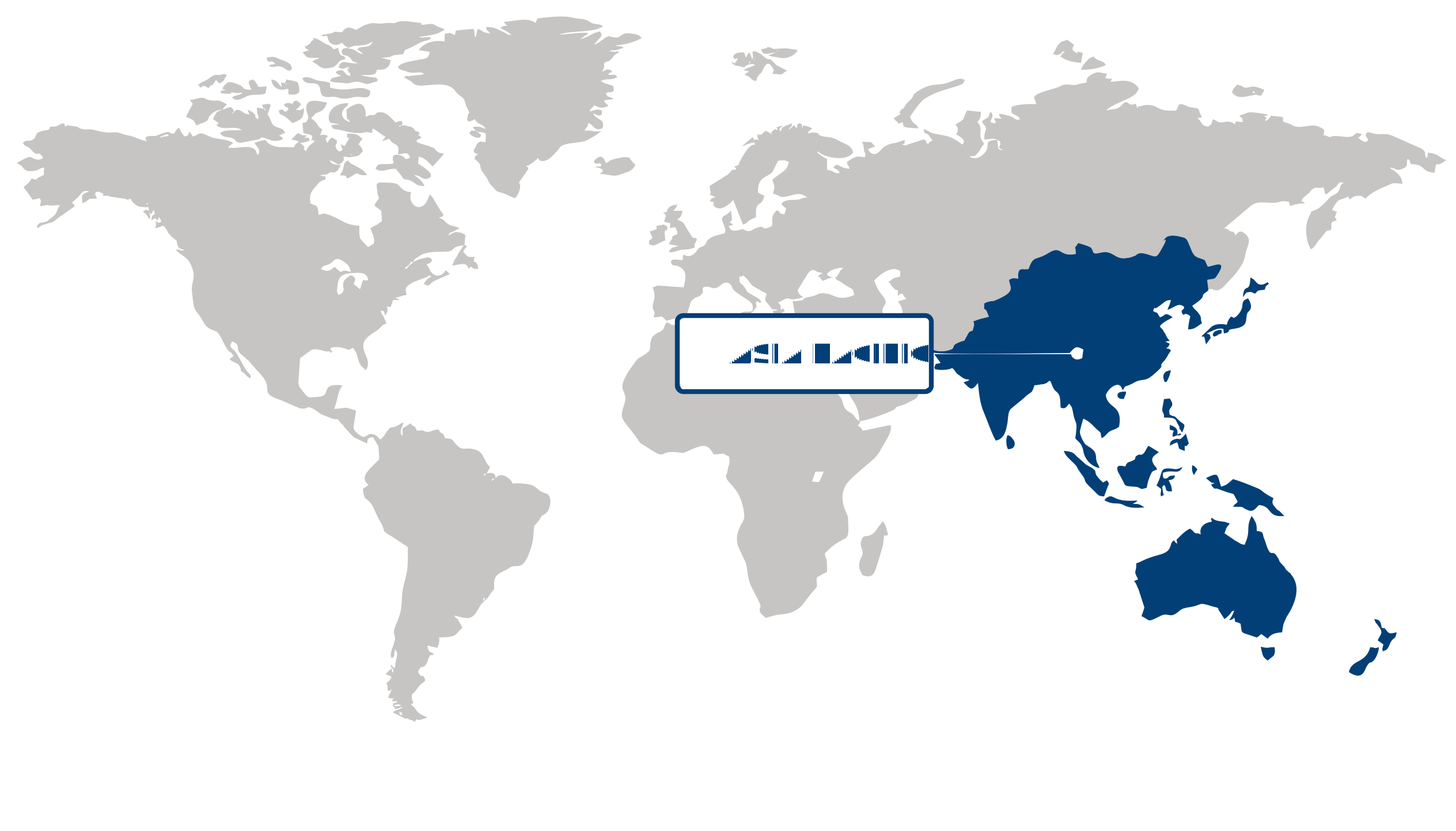
Asia Pacific (Largest & Fastest-Growing Region)
Asia Pacific held the largest position in the onshore wind turbine blade market in 2026 while also representing the fastest-growing regional market, driven by accelerating renewable energy deployment and strong investments in onshore wind infrastructure. Governments across the region are prioritizing clean power generation to address rising electricity demand, reduce dependence on conventional energy sources, and advance decarbonization objectives. The expansion of wind farms is creating sustained requirements for larger, more efficient turbine blades, while improvements in blade materials and manufacturing technologies are supporting performance and project economics. Increasing grid development, favorable renewable energy policies, and the availability of suitable wind resources are expected to reinforce the region's leading market position.
| Parameter | North America | Asia Pacific | Europe | Latin America | MEA |
|---|---|---|---|---|---|
| Innovation Hub i Scale Nascent Developing Advanced | |||||
| Cost-Sensitive Region i Scale Low Medium High | |||||
| Regulatory Environment i Scale Restrictive Neutral Supportive | |||||
| Demand Drivers i Scale Weak Moderate Strong | |||||
| Development Stage i Scale Emerging Developing Developed | |||||
| Adoption Rate i Scale Low Medium High | |||||
| New Entrants / Startups i Scale Sparse Moderate Dense | |||||
| Macro Indicators i Scale Weak Stable Strong |
Key Country Insights
United States 🇺🇸
Utility Repowering FocusThe U.S. is prioritizing longer and more efficient onshore wind turbine blades to improve energy output from new installations and repowering projects. Manufacturers are emphasizing domestic production, transport-friendly blade designs, and materials that reduce maintenance requirements across diverse wind conditions.
Germany 🇩🇪
Engineering Optimization HubGermany is emphasizing advanced blade engineering to maximize efficiency at sites with varying wind resources. The market is focused on lightweight composite materials, improved aerodynamics, and compatibility with modern high-capacity onshore turbines supporting renewable energy deployment.
Japan 🇯🇵
Typhoon Resilience DesignJapan is advancing onshore wind turbine blades engineered for durability under typhoon-prone conditions and challenging terrain. Suppliers are concentrating on structural reliability, compact logistics, and blade technologies suited for geographically constrained installation sites.
South Korea 🇰🇷
Composite Manufacturing IntegrationSouth Korea is strengthening composite manufacturing capabilities to support advanced onshore wind turbine blade production. Local companies are investing in automation, quality consistency, and collaboration with turbine manufacturers to improve supply chain responsiveness for regional projects.
France 🇫🇷
Regional Deployment SupportFrance is aligning blade procurement with expanding onshore renewable energy projects across multiple regions. The market favors durable blade solutions that improve operational efficiency while supporting local maintenance networks and long-term asset performance.
Italy 🇮🇹
Terrain-Specific SolutionsItaly is adopting onshore wind turbine blades optimized for mountainous and variable wind environments. Developers are seeking designs that simplify transportation, improve turbine efficiency, and reduce operational challenges across geographically diverse installation locations.
Segment Leadership and Growth Trends
Onshore Wind Turbine Blade Market Share (%), by Size, 2026
Go beyond the chart, access full insights & data tables
Request Free Sample ReportSize Segment Analysis: 31 - 60 M (Largest Segment) vs 61 - 90 M (Fastest-Growing Segment)
The 31 - 60 M blade segment accounted for the largest share of the onshore wind turbine blade market in 2026. These blades provide a practical balance between energy capture, transportation requirements, installation considerations, and compatibility with a broad range of onshore wind projects. Their suitability for diverse site conditions and established deployment across utility-scale and other land-based installations supports strong demand. Continued expansion of onshore wind capacity and the need for reliable blade designs that can be deployed across varied project environments are reinforcing the segment's leading position.
61 - 90 M blades are expected to be the fastest-growing size segment as wind developers increasingly seek to improve energy capture and maximize the productivity of onshore wind installations. Longer blades can support greater swept areas and improved utilization of available wind resources, making them attractive for projects seeking higher output from individual turbines. Advances in blade design, materials, manufacturing, and transportation planning are helping address the challenges associated with larger components and supporting increasing adoption of this segment.
Capacity Segment Analysis: > 5 MW (Largest & Fastest-Growing Segment)
The > 5 MW capacity segment dominated the onshore wind turbine blade market in 2026 and is also the fastest-growing capacity category. Higher-capacity turbines enable developers to generate more electricity from individual installations and improve the efficiency of land and infrastructure utilization. The increasing focus on maximizing project output, reducing the number of turbines required for a given development, and improving the economics of large-scale wind projects is supporting demand for blades designed for higher-capacity turbines. Continued technological progress in turbine engineering and the expansion of large onshore wind projects are expected to strengthen this segment.
Material Segment Analysis: Glass Fibre (Largest Segment) vs Carbon Fibre (Fastest-Growing Segment)
Glass fibre held the largest share of the onshore wind turbine blade market in 2026. Its widespread use is supported by its favorable balance of strength, durability, manufacturability, and cost for large-scale blade production. Glass fibre composites are well established in wind turbine manufacturing and can be produced using established industrial processes, making them suitable for a broad range of onshore applications. The continued expansion of wind power installations and the need for scalable blade manufacturing are supporting the segment's leading position.
Carbon fibre is projected to be the fastest-growing material segment as turbine manufacturers increasingly seek lightweight materials that can support the development of longer and more advanced blades. Carbon fibre offers high strength and stiffness relative to its weight, helping address structural and weight-related challenges associated with larger blade designs. The growing demand for higher-capacity turbines, longer blades, and improved aerodynamic performance is expected to encourage greater use of carbon fibre in advanced onshore wind turbine blade applications.
| Segment | Sub-Segment | Largest Segment | Fastest Growing |
|---|---|---|---|
| Size | ≤ 30 M, 31 - 60 M, 61 - 90 M | 31 - 60 M | 61 - 90 M |
| Capacity | < 3 MW, 3 - 5 MW, > 5 MW | > 5 MW | > 5 MW |
| Material | Carbon Fibre, Glass Fibre | Glass Fibre | Carbon Fibre |
Competitive Landscape and Market Positioning
Prominent players in the onshore wind turbine blade market:
- Vestas Wind Systems A/S (Denmark)
- Siemens Gamesa Renewable Energy S.A. (Spain)
- Nordex SE (Germany)
- Suzlon Energy Ltd. (India)
- Enercon GmbH (Germany)
- Acciona S.A. (Spain)
- Sinoma Wind Power Blade Co., Ltd. (China)
- GE Vernova, Inc. (United States)
Manufacturers in the onshore wind turbine blade market are increasingly competing through advances in blade engineering that improve energy capture, structural durability, and operational reliability under diverse environmental conditions. Innovation is centered on lightweight composite materials, aerodynamic optimization, and manufacturing processes that enhance production consistency while reducing maintenance demands over the asset lifecycle. As wind project developers seek greater operational efficiency from installed capacity, suppliers are expanding design, testing, and technical support capabilities to deliver blades tailored to specific site conditions, making engineering expertise and long-term performance assurance central to competitive differentiation.
| Company | Market Share | Company Revenue | Revenue CAGR (%) | Product Portfolio | Geographic Presence | Innovation / R&D Focus | Strategic Developments |
|---|---|---|---|---|---|---|---|
| Vestas Wind Systems A/S (Denmark) | |||||||
| Siemens Gamesa Renewable Energy S.A. (Spain) | |||||||
| Nordex SE (Germany) | |||||||
| Suzlon Energy Ltd. (India) | |||||||
| Enercon GmbH (Germany) | |||||||
| Acciona S.A. (Spain) | |||||||
| Sinoma Wind Power Blade Co. Ltd. (China) | |||||||
| GE Vernova Inc. (United States) |
Industry Development/News
| Company Name | Date | Key Development |
|---|---|---|
| Adani New Industries | Mar-26 | Adani New Industries unveiled India’s longest 91.2-metre onshore wind turbine blade at its Mundra facility. This development significantly enhances domestic manufacturing capabilities, supporting the deployment of high-capacity turbines in low-to-medium wind regions and aligning with India's goal to scale renewable energy infrastructure. |
| Hitachi Power Solutions | Apr-22 | Hitachi Power Solutions integrated AI-powered drone technology into its "Blade Total Service" maintenance program. The solution optimizes inspection accuracy and efficiency for wind power facilities, providing a digitalized, condition-based approach to mitigate operational risks and extend the life-cycle of turbine assets. |
| ZEBRA Consortium | Mar-22 | The ZEBRA consortium, led by partners including LM Wind Power, Owens Corning, and Arkema, produced the first prototype of a recyclable thermoplastic wind turbine blade. The initiative demonstrated the feasibility of closed-loop recycling using high-performance glass materials and Elium resin, advancing circular economy standards in blade manufacturing. |
Customize Your Report
Explore examples of how this report can be tailored to different research needs, including custom segments, additional topics or chapters, and related reports. Click a section of the wheel or its numbered marker to explore the available options.
Onshore Wind Turbine Blade Market — Custom Segments
| Segment | Sub-Segment |
|---|---|
| Installation Stage | New Installations, Repowering Projects, Replacement Installations |
| Turbine OEM Platform | Vestas, Siemens Gamesa, GE Vernova, Nordex, Other OEM Platforms |
| Wind Farm Project Ownership | Independent Power Producers, Utility-Owned Projects, Corporate & Commercial Projects |
Onshore Wind Turbine Blade Market — Custom TOC
| Custom Chapter | Custom Details |
|---|---|
| Blade Repowering Opportunity Assessment |
|
| Blade Circularity & End-of-Life Pathways |
|
| Wind Farm Logistics & Installation Constraints |
|
Need a different cut of the data?
Request Custom ResearchWhat is the current revenue of the onshore wind turbine blade market?
What is the forecasted size of the onshore wind turbine blade industry?
How are renewable energy policies influencing the onshore wind turbine blade market?
Why is wind farm repowering creating new opportunities for blade manufacturers?
Why do 31–60 M blades hold the largest share of the onshore wind turbine blade market?
Which material segment is growing the fastest in the onshore wind turbine blade market?
Why is Asia Pacific the leading onshore wind turbine blade market?
What is driving onshore wind turbine blade growth in Asia Pacific?
Which companies are driving growth in the onshore wind turbine blade landscape?
Our Clients
"The information presented in the report was genuinely insightful. The data was clear and easy to understand, which made it much easier to interpret the findings."
Amara Raja Group
"The responsiveness and professionalism exhibited by the team were exemplary. They were readily available to address queries, provide clarifications, and offer additional insights."
ONGC
"The reports offered a comprehensive analysis of various segments within the market. The detailed insights into market trends, and regulatory landscapes were excellent."
TotalEnergies
Our Research Team & Methodology
Every Fundamental Business Insights report is built by a dedicated vertical research team, validated through a structured primary-and-secondary methodology, and reviewed for accuracy before it reaches you.
Research Team Overview
Prepared by the Energy & Power Research Team
Delivery
Published
Demand
Available
Support
Trust & Compliance
Research Domains
10 coverage areasResearch Intelligence
| Source | Reference |
|---|---|
| International Energy Agency (IEA) | www.iea.org |
| U.S. Energy Information Administration (EIA) | www.eia.gov |
| International Renewable Energy Agency (IRENA) | www.irena.org |
| International Electrotechnical Commission (IEC) | www.iec.ch |
| International Organization for Standardization (ISO) | www.iso.org |
| IEEE | www.ieee.org |
| CIGRE (International Council on Large Electric Systems) | www.cigre.org |
| World Energy Council (WEC) | www.worldenergy.org |
| U.S. Department of Energy (DOE) | www.energy.gov |
| International Atomic Energy Agency (IAEA) | www.iaea.org |
| American Petroleum Institute (API) | www.api.org |
| Society of Petroleum Engineers (SPE) | www.spe.org |
| Hydrogen Council | hydrogencouncil.com |
| Battery Council International (BCI) | batterycouncil.org |
| Global Wind Energy Council (GWEC) | gwec.net |
| SolarPower Europe | www.solarpowereurope.org |
| World Bioenergy Association (WBA) | worldbioenergy.org |
| International Hydropower Association (IHA) | www.hydropower.org |
| Edison Electric Institute (EEI) | www.eei.org |
| National Renewable Energy Laboratory (NREL) | www.nrel.gov |
Research Workflow & Quality Assurance
Data Collection
Verified information gathered through primary and secondary research.
Data Triangulation
Cross-validation using multiple independent data sources.
Forecast Modelling
Market estimates developed using historical trends and analytical models.
Analyst Validation
Findings reviewed by domain experts for accuracy and consistency.
Editorial & Quality Review
Final editorial, quality, and compliance checks before publication.
Final Publication
Released after successful completion of the internal review process.
Report Coverage
📊 Market Assessment
- Market Size & Forecast
- Market Segmentation
- Regional Analysis
- Growth Drivers & Challenges
- Market Dynamics
🏢 Competitive Intelligence
- Competitive Landscape
- Company Profiles
- Competitive Benchmarking
- Mergers & Acquisitions
- Market Share Analysis or Key Company Strategies
🔍 Strategic Analysis
- Value Chain Analysis
- Porter's Five Forces
- PESTLE Analysis
- Pricing Trends
- Supply-Demand Analysis
🚀 Future Outlook
- Technology Landscape
- Regulatory Landscape
- Investment & Funding Landscape
- Emerging Opportunities
- Future Market Outlook
Have a question about this report or need a custom scope?
Request Customization