Near-infrared Spectroscopy Market Size & Growth Forecast 2027–2036, By Segments (Product, Type, Application), Regional Demand Trends (North America, Asia Pacific, Europe), Key Country Insights (U.S., Japan, South Korea, Germany, France, Italy), and Competitive Landscape
Market Size and Growth Outlook
Near-infrared Spectroscopy Market size stood at USD 1.6 billion in 2026 and is predicted to grow at a 7.98% CAGR from 2027 to 2036, surpassing USD 3.45 billion by 2036. The industry revenue for 2027 is calculated at USD 1.71 billion.
Get more details on this report
Request Free Sample ReportNear-infrared Spectroscopy Market Intelligence Snapshot
Regional Market Dynamics
- Europe accounted for 41.22% of the market in 2026, driven by widespread use of spectroscopy in pharmaceutical, food, and industrial quality control with strong laboratory and manufacturing adoption.
- Asia Pacific is expected to expand at a 6.67% CAGR as manufacturers and laboratories increasingly adopt spectroscopy systems for faster production, inspection, and quality assurance workflows.
Segment Momentum
- FT-NIR Spectrometers held a 76.42% share in 2026 because they deliver consistent spectral resolution, repeatable results, and strong compatibility with laboratory quality-control workflows.
- Portable systems are the fastest-growing type as organizations increasingly value on-site analysis, quicker decision-making, and reduced delays associated with centralized laboratory testing.
Market Expansion Drivers
- Increasing pharmaceutical quality control and counterfeit detection driving NIR spectroscopy adoption.
- Expansion of food and nutraceutical testing applications improving rapid analysis demand.
- Growing integration of AI-powered spectral analysis enhancing accuracy and automation capabilities.
Leading Market Participants
- Top players in the near-infrared spectroscopy market include Thermo Fisher Scientific Inc. (United States), Bruker Corporation (United States), ABB Ltd. (Switzerland), Metrohm AG (Switzerland), Oxford Instruments plc (United Kingdom), Malvern Panalytical Ltd. (United Kingdom), KPM Analytics (United States), Agilent Technologies, Inc. (United States), Shimadzu Corporation (Japan).
Global Market Forecast Snapshot
Market Outlook
- 2026 Market Size: USD 1.6 billion
- 2027 Estimated Market Size: USD 1.71 billion.
- Projected Market Size: USD 3.45 billion by 2036
- Growth Forecast: 7.98% CAGR (2027-2036)
Regional and Segment Outlook
- Leading Regional Market: Europe
- High-Growth Regional Hub: Asia Pacific
- Core Revenue Segment: Fourier Transform Based (FT-NIR) Spectrometers (Product) | Benchtop (Type) | Particle Measurement (Application)
- Emerging Opportunity Segment: Fourier Transform Based (FT-NIR) Spectrometers (Product) | Portable (Type) | Medical Applications (Application)
Market Growth Drivers and Industry Trends
Increasing pharmaceutical quality control and counterfeit detection driving NIR spectroscopy adoption
The near-infrared spectroscopy market is gaining momentum as pharmaceutical manufacturers strengthen quality control procedures and seek faster methods to identify product inconsistencies and counterfeit medicines. NIR spectroscopy can evaluate the composition of raw materials, intermediates, and finished products with limited sample preparation, supporting more efficient inspection across pharmaceutical workflows. Its ability to distinguish material characteristics and detect variations can help manufacturers verify ingredient identity, monitor batch consistency, and support authentication processes. As pharmaceutical supply chains become more complex, the need for rapid analytical techniques that can be incorporated into routine production and quality assurance activities is increasing the relevance of NIR-based testing.
Expansion of food and nutraceutical testing applications improving rapid analysis demand
Growing requirements for food quality, ingredient verification, and nutraceutical assessment are creating broader application opportunities for the near-infrared spectroscopy market. Food processors and nutraceutical manufacturers can use NIR techniques to rapidly examine characteristics such as moisture, composition, and raw-material consistency without extensive destructive testing. This enables analytical checks to be incorporated more efficiently into production environments while supporting quality management and process optimization. Increasing consumer attention to product composition and the need for consistent nutritional formulations are also encouraging producers to adopt faster analytical technologies capable of evaluating materials throughout processing and final-product inspection.
Growing integration of AI-powered spectral analysis enhancing accuracy and automation capabilities
Integration of artificial intelligence with spectroscopy is strengthening the analytical capabilities of the near-infrared spectroscopy market by enabling more sophisticated interpretation of complex spectral information. AI and machine learning algorithms can identify patterns across large datasets, assist with material classification, and improve the ability of analytical systems to detect subtle variations that may be difficult to interpret manually. Automated spectral analysis can also reduce dependence on highly specialized intervention during routine testing and support faster decision-making in industrial environments. As laboratories and manufacturers increasingly pursue intelligent quality-control systems, the combination of NIR instruments with advanced data-processing capabilities is improving workflow automation and analytical consistency.
| Growth Driver | Impact on CAGR | Regulatory Influence | Geographic Relevance | Adoption Rate | Impact Timeline |
|---|---|---|---|---|---|
| Growing adoption of NIR spectroscopy in quality control | 2.00% | Short term (≤ 2 yrs) | North America, Europe (spillover: Asia Pacific) | Medium | Fast |
| Expansion in pharmaceuticals, food, and agriculture applications | 1.80% | Medium term (2–5 yrs) | Europe, Asia Pacific (spillover: North America) | Medium | Moderate |
| Technological advancements in portable NIR devices | 2.10% | Long term (5+ yrs) | North America, Europe (spillover: Asia Pacific) | Medium | Slow |
| Increasing pharmaceutical quality control and counterfeit detection driving NIR spectroscopy adoption | 2.50% | High | Europe, North America | High | Near Term |
| Expansion of food and nutraceutical testing applications improving rapid analysis demand | 2.20% | Moderate | Global | Medium | Mid Term |
| Growing integration of AI-powered spectral analysis enhancing accuracy and automation capabilities | 1.90% | Moderate | North America, Asia Pacific | Medium | Mid Term |
Unlock insights tailored to your business with our bespoke market research solutions.
Click to get your customized report now.
Regional Demand Dynamics
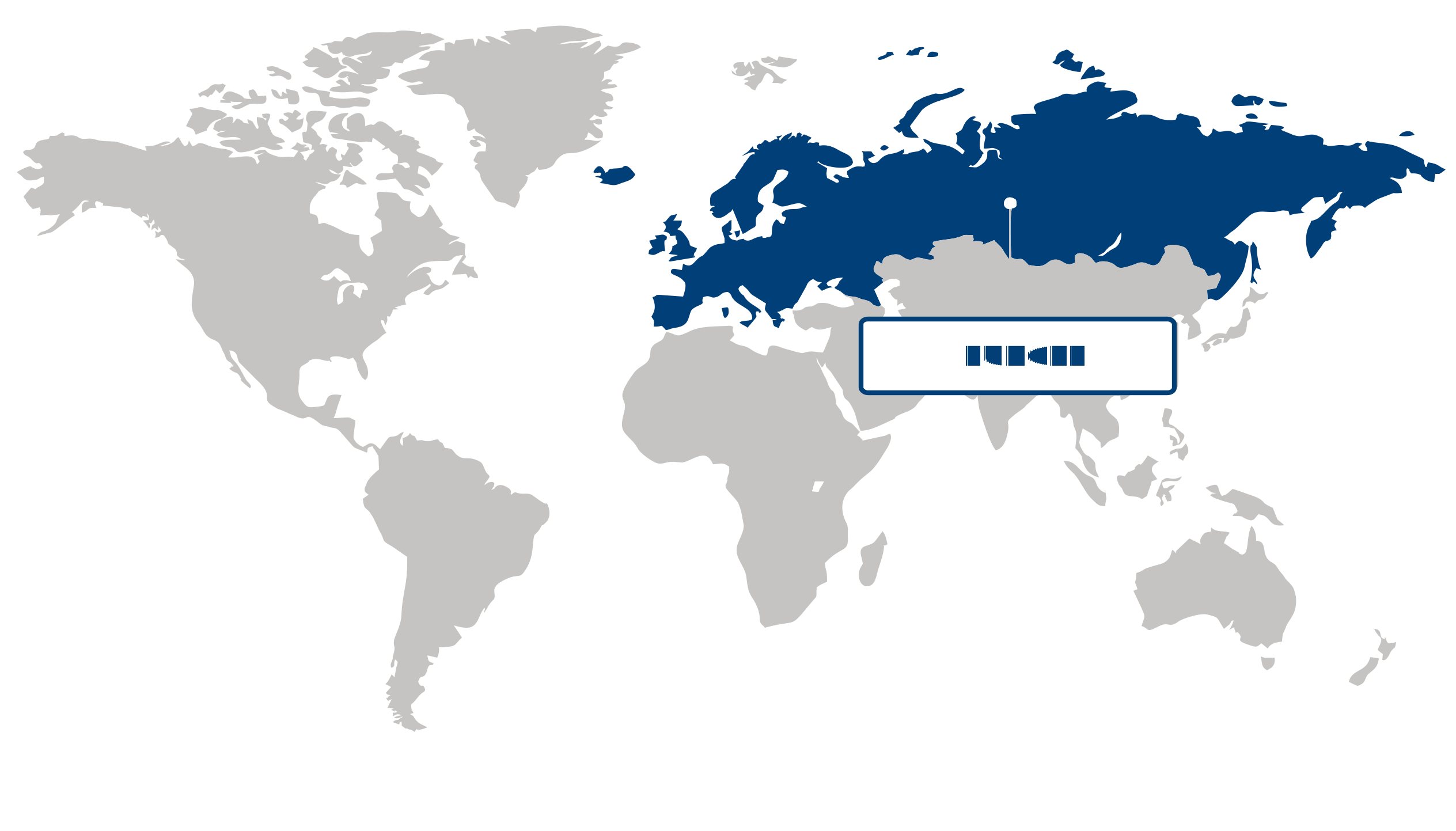
Europe (Largest Region)
In the near-infrared spectroscopy market, Europe held the largest share of 41.22% in 2026, supported by its established analytical instrumentation ecosystem, strong pharmaceutical and food processing industries, and emphasis on quality control and process monitoring. The region's highly regulated manufacturing environment encourages the use of rapid, non-destructive analytical techniques for assessing raw materials, monitoring production processes, and verifying product consistency. Growing adoption of process analytical technologies across pharmaceutical, chemical, agricultural, and food applications is strengthening demand for near-infrared spectroscopy solutions. In addition, increasing focus on laboratory automation, efficient resource utilization, and real-time quality assurance is encouraging industries to integrate spectroscopy into digital manufacturing and analytical workflows.
Asia Pacific (Fastest-Growing Region)
Asia Pacific is the fastest-growing region, driven by expanding pharmaceutical, food and beverage, agriculture, and chemical manufacturing activities and increasing investment in modern analytical infrastructure. Rapid industrial development is encouraging manufacturers to improve quality control while reducing reliance on time-intensive conventional testing methods. Near-infrared spectroscopy is gaining relevance for rapid material characterization, process optimization, and monitoring of production consistency across diverse industrial applications. Growing adoption of automation and digital manufacturing technologies is further supporting integration of spectroscopy-based analysis into production environments. Increasing emphasis on product quality, regulatory compliance, and efficient manufacturing is creating favorable conditions for broader deployment throughout the region.
| Parameter | North America | Asia Pacific | Europe | Latin America | MEA |
|---|---|---|---|---|---|
| Innovation Hub i Scale Nascent Developing Advanced | |||||
| Cost-Sensitive Region i Scale Low Medium High | |||||
| Regulatory Environment i Scale Restrictive Neutral Supportive | |||||
| Demand Drivers i Scale Weak Moderate Strong | |||||
| Development Stage i Scale Emerging Developing Developed | |||||
| Adoption Rate i Scale Low Medium High | |||||
| New Entrants / Startups i Scale Sparse Moderate Dense | |||||
| Macro Indicators i Scale Weak Stable Strong |
Key Country Insights
Germany 🇩🇪
Precision Manufacturing AnalyticsGermany deploys near-infrared spectroscopy extensively in manufacturing and chemical industries where rapid and non-destructive testing is essential. German companies are integrating spectroscopy systems into production environments to strengthen quality assurance and process optimization initiatives.
France 🇫🇷
Research-Led Application ExpansionFrance continues to broaden the use of near-infrared spectroscopy through research institutions and specialized industrial applications. French organizations are exploring advanced analytical methods that support pharmaceutical development, food testing, and environmental monitoring activities.
Italy 🇮🇹
Industrial Quality VerificationItaly's near-infrared spectroscopy market is supported by demand from food processing, pharmaceuticals, and materials testing sectors. Businesses in Italy are increasingly adopting spectroscopy technologies that provide rapid quality verification and reduce dependence on time-intensive laboratory methods.
Japan 🇯🇵
High-Accuracy Instrument DemandJapan emphasizes highly precise and compact near-infrared spectroscopy systems for laboratory and industrial applications. Demand in Japan is increasingly centered on instruments capable of supporting advanced material analysis and stringent quality requirements across multiple sectors.
South Korea 🇰🇷
Smart Process MonitoringSouth Korea is expanding the use of near-infrared spectroscopy in biotechnology, electronics, and food manufacturing environments. Companies in South Korea are investing in real-time analytical solutions that complement smart factory initiatives and improve production consistency.
United States 🇺🇸
Advanced Analytical IntegrationThe U.S. near-infrared spectroscopy market is characterized by widespread use across pharmaceuticals, agriculture, and industrial quality control applications. Organizations in the U.S. are prioritizing automated and data-integrated spectroscopy platforms that improve process monitoring and operational efficiency.
Segment Leadership and Growth Trends
Near-infrared Spectroscopy Market Share (%), by Product, 2026
Go beyond the chart, access full insights & data tables
Request Free Sample ReportProduct Segment Analysis: Fourier Transform Based (FT-NIR) Spectrometers (Largest & Fastest-Growing Segment)
Fourier transform based (FT-NIR) spectrometers accounted for a 76.42% share in 2026 and represented both the largest and fastest-growing product segment in the near-infrared spectroscopy market. Their strong position is supported by high analytical accuracy, rapid measurement capabilities, and the ability to perform non-destructive analysis across applications such as food quality control, pharmaceuticals, agriculture, and industrial processing. FT-NIR platforms can analyze multiple material properties with limited sample preparation, helping laboratories and production facilities improve process efficiency, quality consistency, and real-time decision-making. Increasing adoption of automated analytical workflows and data-driven quality management further strengthens demand for these systems.
Type Segment Analysis: Benchtop (Largest Segment) vs Portable (Fastest-Growing Segment)
The benchtop segment held the largest share of the near-infrared spectroscopy market, accounting for 73.82% in 2026. Benchtop instruments remain widely used because they provide robust analytical performance, stable operating environments, and comprehensive capabilities suited to laboratory-based testing and quality control. Their integration into established laboratory workflows makes them particularly valuable for applications requiring repeatable measurements, detailed material characterization, and centralized testing across food, pharmaceutical, chemical, and agricultural processes.
Portable systems are the fastest-growing type as near-infrared analysis increasingly moves beyond centralized laboratories into production floors, field operations, warehouses, and other decentralized environments. Compact instruments allow users to conduct rapid material assessment closer to the point of sampling, reducing delays associated with transporting specimens to laboratory facilities. Improvements in miniaturized optical components, battery-powered operation, connectivity, and user-friendly analytical software are broadening the practical use of portable spectroscopy across industries.
| Segment | Sub-Segment | Largest Segment | Fastest Growing |
|---|---|---|---|
| Product | Dispersive Infrared Spectroscopy, Fourier Transform Based (FT-NIR) Spectrometers | Fourier Transform Based (FT-NIR) Spectrometers | Fourier Transform Based (FT-NIR) Spectrometers |
| Type | Benchtop, Portable | Benchtop | Portable |
| Application | Medical Applications, Astronomical Spectroscopy, Remote Monitoring, Agriculture, Particle Measurement, Material Science, Industrial Use | Particle Measurement | Medical Applications |
Competitive Landscape and Market Positioning
Major players in the near-infrared spectroscopy market:
1. Thermo Fisher Scientific Inc. (United States)
2. Bruker Corporation (United States)
3. ABB Ltd. (Switzerland)
4. Metrohm AG (Switzerland)
5. Oxford Instruments plc (United Kingdom)
6. Malvern Panalytical Ltd. (United Kingdom)
7. KPM Analytics (United States)
8. Agilent Technologies Inc. (United States)
9. Shimadzu Corporation (Japan)
The near-infrared spectroscopy market is advancing rapidly due to increased integration in analytical and quality control applications. Continuous improvements in sensor precision and data interpretation capabilities are expanding usage across industrial and laboratory settings. New system introductions are enhancing speed and accuracy, while sustained R&D focus is improving calibration efficiency and usability. These developments are strengthening differentiation and accelerating adoption across the near-infrared spectroscopy market.
| Company | Market Share | Company Revenue | Revenue CAGR (%) | Product Portfolio | Geographic Presence | Innovation / R&D Focus | Strategic Developments |
|---|---|---|---|---|---|---|---|
| Thermo Fisher Scientific Inc. (United States) | |||||||
| Bruker Corporation (United States) | |||||||
| ABB Ltd. (Switzerland) | |||||||
| Metrohm AG (Switzerland) | |||||||
| Oxford Instruments plc (United Kingdom) | |||||||
| Malvern Panalytical Ltd. (United Kingdom) | |||||||
| KPM Analytics (United States) | |||||||
| Agilent Technologies Inc. (United States) | |||||||
| Shimadzu Corporation (Japan). |
Industry Development/News
| Company Name | Date | Key Development |
|---|---|---|
| Canon | May-26 | Canon launched the TR-A100 Raman plastic analyzer in North America, integrating advanced optical sensing to improve identification of challenging materials like black plastics. By enhancing material classification accuracy, the system facilitates more efficient waste sorting workflows, supporting the broader adoption of spectroscopy-based technologies within circular economy and high-throughput recycling infrastructure. |
| TerraBlaster | May-26 | TerraBlaster is scaling its real-time NPK soil mapping technology, targeting a doubling of operational scanning speeds to 10 mph. This advancement improves the efficiency of high-resolution spectral sensing in precision agriculture, enabling faster, data-driven nutrient analysis and optimized crop management, thereby demonstrating the strategic utility of spectroscopy in modern farming productivity. |
| OSR Holdings | Jan-26 | OSR Holdings completed the acquisition of Woori IO, integrating its proprietary near-infrared spectroscopy (NIRS)-based needle-free continuous glucose monitoring technology. This strategic move strengthens the company's medical device platform and expands its footprint in the biosensing market, leveraging spectroscopic measurement principles to provide non-invasive diagnostic solutions for global diabetes management. |
| Philips | Jan-26 | Philips finalized the acquisition of SpectraWAVE, incorporating its AI-enabled HyperVue Imaging System and fractional flow reserve assessment technology into its coronary imaging portfolio. The addition of these advanced intravascular diagnostics enhances Philips’ image-guided therapy capabilities, supporting more precise, real-time clinical decision-making and improving surgical outcomes in cardiovascular care procedures. |
| Kernel | Aug-25 | Kernel successfully advanced the deployment of its miniaturized time-domain functional near-infrared spectroscopy (TD-fNIRS) system. By enabling high-resolution neural activity monitoring in portable, non-clinical settings, the technology expands the practical application of near-infrared spectroscopy in cognitive neuroscience, offering a scalable alternative to traditional, fixed-location neuroimaging equipment in research and assistive technology markets. |
Customize Your Report
Explore examples of how this report can be tailored to different research needs, including custom segments, additional topics or chapters, and related reports. Click a section of the wheel or its numbered marker to explore the available options.
Near-infrared Spectroscopy Market — Custom Segments
| Segment | Sub-Segment |
|---|---|
| Buyer Type | Industrial Manufacturers, Research & Academic Institutions, Testing & Inspection Laboratories, Healthcare & Clinical Institutions |
| Technology Integration | Standalone Systems, Process-Integrated Systems, Automated & Connected Systems |
| Sales Channel | Direct Sales, Distributors & Dealers, System Integrators & OEMs |
Near-infrared Spectroscopy Market — Custom TOC
| Custom Chapter | Custom Details |
|---|---|
| Emerging Application Opportunities |
|
| End-use Industry Adoption Roadmap |
|
| Service-Based Business Model Opportunities |
|
Need a different cut of the data?
Request Custom ResearchHow big is the near-infrared spectroscopy market?
How will the near-infrared spectroscopy industry grow in terms of size and CAGR by 2036?
Why is pharmaceutical quality control becoming a key driver for near-infrared spectroscopy adoption in regulated manufacturing environments?
How is the shift toward food, nutraceutical testing, and AI-enabled analysis changing deployment patterns in the near-infrared spectroscopy market?
Why do FT-NIR spectrometers dominate the near-infrared spectroscopy market?
Which type segment is expanding fastest in the near-infrared spectroscopy market?
Why is Europe the leading market for near-infrared spectroscopy?
What is fueling near-infrared spectroscopy market growth in Asia Pacific?
Who are the major participants shaping the near-infrared spectroscopy landscape?
Our Clients
"The team took the time to understand our specific business needs and delivered a report that was well aligned with our objectives. Their expertise and understanding of the industry were clearly reflected in the quality and relevance of the insights provided."
Siemens Healthcare
"Our experience in acquiring the research report has been excellent. The depth of analysis, and actionable insights provided have been extremely valuable in supporting our ongoing R&D efforts."
GC Biopharma
"The report offered a comprehensive view of the market trends. The in-depth segmentation and analysis of emerging opportunities gave us a better understanding of the market."
Medtronic
Our Research Team & Methodology
Every Fundamental Business Insights report is built by a dedicated vertical research team, validated through a structured primary-and-secondary methodology, and reviewed for accuracy before it reaches you.
Research Team Overview
Prepared by the Healthcare & Medical Devices Research Team
Delivery
Published
Demand
Available
Support
Trust & Compliance
Research Domains
10 coverage areasResearch Intelligence
| Source | Reference |
|---|---|
| World Health Organization (WHO) | www.who.int |
| U.S. Food & Drug Administration (FDA) | www.fda.gov |
| European Medicines Agency (EMA) | www.ema.europa.eu |
| Centers for Disease Control and Prevention (CDC) | www.cdc.gov |
| National Institutes of Health (NIH) | www.nih.gov |
| National Center for Biotechnology Information (NCBI) | www.ncbi.nlm.nih.gov |
| PubMed | pubmed.ncbi.nlm.nih.gov |
| ClinicalTrials.gov | clinicaltrials.gov |
| International Organization for Standardization (ISO) | www.iso.org |
| ASTM International | www.astm.org |
| Advanced Medical Technology Association (AdvaMed) | www.advamed.org |
| Medical Device Innovation Consortium (MDIC) | mdic.org |
| Biotechnology Innovation Organization (BIO) | www.bio.org |
| International Federation of Pharmaceutical Manufacturers & Associations (IFPMA) | www.ifpma.org |
| U.S. Pharmacopeia (USP) | www.usp.org |
| European Directorate for the Quality of Medicines & HealthCare (EDQM) | www.edqm.eu |
| World Organisation for Animal Health (WOAH) | www.woah.org |
| American Hospital Association (AHA) | www.aha.org |
| OECD Health | www.oecd.org/health |
| World Bank Data | data.worldbank.org |
Research Workflow & Quality Assurance
Data Collection
Verified information gathered through primary and secondary research.
Data Triangulation
Cross-validation using multiple independent data sources.
Forecast Modelling
Market estimates developed using historical trends and analytical models.
Analyst Validation
Findings reviewed by domain experts for accuracy and consistency.
Editorial & Quality Review
Final editorial, quality, and compliance checks before publication.
Final Publication
Released after successful completion of the internal review process.
Report Coverage
📊 Market Assessment
- Market Size & Forecast
- Market Segmentation
- Regional Analysis
- Growth Drivers & Challenges
- Market Dynamics
🏢 Competitive Intelligence
- Competitive Landscape
- Company Profiles
- Competitive Benchmarking
- Mergers & Acquisitions
- Market Share Analysis or Key Company Strategies
🔍 Strategic Analysis
- Value Chain Analysis
- Porter's Five Forces
- PESTLE Analysis
- Pricing Trends
- Supply-Demand Analysis
🚀 Future Outlook
- Technology Landscape
- Regulatory Landscape
- Investment & Funding Landscape
- Emerging Opportunities
- Future Market Outlook
Have a question about this report or need a custom scope?
Request Customization