Natural Refrigerants Market Size & Growth Forecast 2027–2036, By Segments (End User, Application, Type), Regional Demand Trends (North America, Asia Pacific, Europe), Key Country Insights (U.S., Japan, South Korea, Germany, France, Italy), and Competitive Landscape
Market Size and Growth Outlook
Natural Refrigerants Market size was worth USD 1.94 Billion in 2026 and is expected to grow at 3.56% CAGR between 2027 and 2036, surpassing USD 2.75 Billion by 2036. The industry revenue for 2027 is estimated at USD 2 Billion.
Get more details on this report
Request Free Sample ReportNatural Refrigerants Market Intelligence Snapshot
Regional Market Dynamics
- Europe leads through strong environmental policies, restrictions on high-global-warming-potential refrigerants, sustainable cooling priorities, and investment in energy-efficient refrigeration infrastructure.
- Rising cooling demand, urbanization, expanding cold-chain infrastructure, and greater environmental focus are accelerating investment in modern systems using natural refrigerants.
Segment Momentum
- The industrial segment accounted for 56.39% of the market in 2026, driven by large-scale refrigeration needs in food processing, cold storage, and manufacturing, alongside demand for energy-efficient, environmentally responsible cooling systems.
- Carbon dioxide is the fastest-growing refrigerant because its low environmental impact, expanding commercial and industrial applications, and improving refrigeration technologies support the shift toward more sustainable cooling solutions.
Market Expansion Drivers
- Global shift toward low-GWP refrigerants accelerating natural refrigerant adoption across HVAC systems
- Lifecycle energy-cost savings driving transition from synthetic refrigerants to natural alternatives
- ESG-driven corporate sustainability strategies promoting eco-friendly refrigeration system deployment
Leading Market Participants
- Major players in the natural refrigerants market include Carrier Global Corporation (USA), Daikin Industries Ltd. (Japan), Johnson Controls International plc (Ireland), Danfoss A/S (Denmark), Emerson Electric Co. (USA), Linde plc (Ireland), Air Liquide S.A. (France), Honeywell International Inc. (USA), Midea Group Co., Ltd. (China), Gree Electric Appliances Inc. (China)
Global Market Forecast Snapshot
Market Outlook
- 2026 Market Size: USD 1.94 Billion
- 2027 Estimated Market Size: USD 2 Billion
- Projected Market Size: USD 2.75 Billion by 2036
- Growth Forecast: 3.56% CAGR (2027-2036)
Regional and Segment Outlook
- Leading Regional Market: Europe
- High-Growth Regional Hub: Asia Pacific
- Core Revenue Segment: Industrial (End User) | Cold Storage (Application) | Ammonia (Type)
- Emerging Opportunity Segment: Commercial (End User) | Air Conditioners (Application) | Carbon Dioxide (Type)
Market Growth Drivers and Industry Trends
Global shift toward low-GWP refrigerants accelerating natural refrigerant adoption across HVAC systems
The transition toward refrigerants with lower global warming potential is reshaping the heating, ventilation, air conditioning, and refrigeration industry as businesses seek environmentally responsible cooling solutions. The natural refrigerants market growth is driven by increasing adoption of refrigerants such as carbon dioxide, ammonia, and hydrocarbons that offer significantly lower environmental impact compared with many conventional synthetic alternatives. Regulatory changes, evolving environmental standards, and growing awareness of climate-related emissions are encouraging equipment manufacturers and end users to redesign HVAC systems for compatibility with natural refrigerants. This transition is also stimulating innovation in refrigeration technologies that balance performance, safety, and regulatory compliance across commercial and industrial applications.
Lifecycle energy-cost savings driving transition from synthetic refrigerants to natural alternatives
Organizations are placing greater emphasis on reducing operating expenses by selecting refrigeration systems that deliver long-term energy efficiency and lower ownership costs. This trend will drive the natural refrigerants market growth as many natural refrigerant-based systems offer improved thermodynamic performance that can reduce energy consumption under appropriate operating conditions. Lower maintenance requirements, extended equipment reliability, and improved system efficiency contribute to favorable lifecycle economics for commercial facilities, industrial plants, and cold storage operations. As energy management becomes an increasingly important business objective, end users are evaluating refrigeration technologies based on total operational value rather than initial installation costs alone.
ESG-driven corporate sustainability strategies promoting eco-friendly refrigeration system deployment
Corporate sustainability initiatives are influencing investment decisions across industries as organizations work to reduce environmental impacts throughout their operations. In the natural refrigerants market, environmental, social, and governance priorities are encouraging businesses to replace conventional refrigeration systems with solutions that support emissions reduction and responsible resource management. Companies operating supermarkets, food processing facilities, warehouses, and manufacturing plants are integrating natural refrigerant technologies into broader sustainability programs aimed at improving environmental performance and demonstrating commitment to responsible business practices. These strategies are also strengthening demand for refrigeration infrastructure that aligns with long-term decarbonization and environmental stewardship objectives.
| Growth Driver | Impact on CAGR | Regulatory Influence | Geographic Relevance | Adoption Rate | Impact Timeline |
|---|---|---|---|---|---|
| Global shift toward low-GWP refrigerants accelerating natural refrigerant adoption across HVAC systems | 2.3% | High | Europe, Asia Pacific | High | Near Term |
| Lifecycle energy-cost savings driving transition from synthetic refrigerants to natural alternatives | 2% | High | North America, Europe | High | Mid Term |
| ESG-driven corporate sustainability strategies promoting eco-friendly refrigeration system deployment | 1.8% | Moderate | Europe, North America | High | Mid Term |
Unlock insights tailored to your business with our bespoke market research solutions.
Click to get your customized report now.
Regional Demand Dynamics
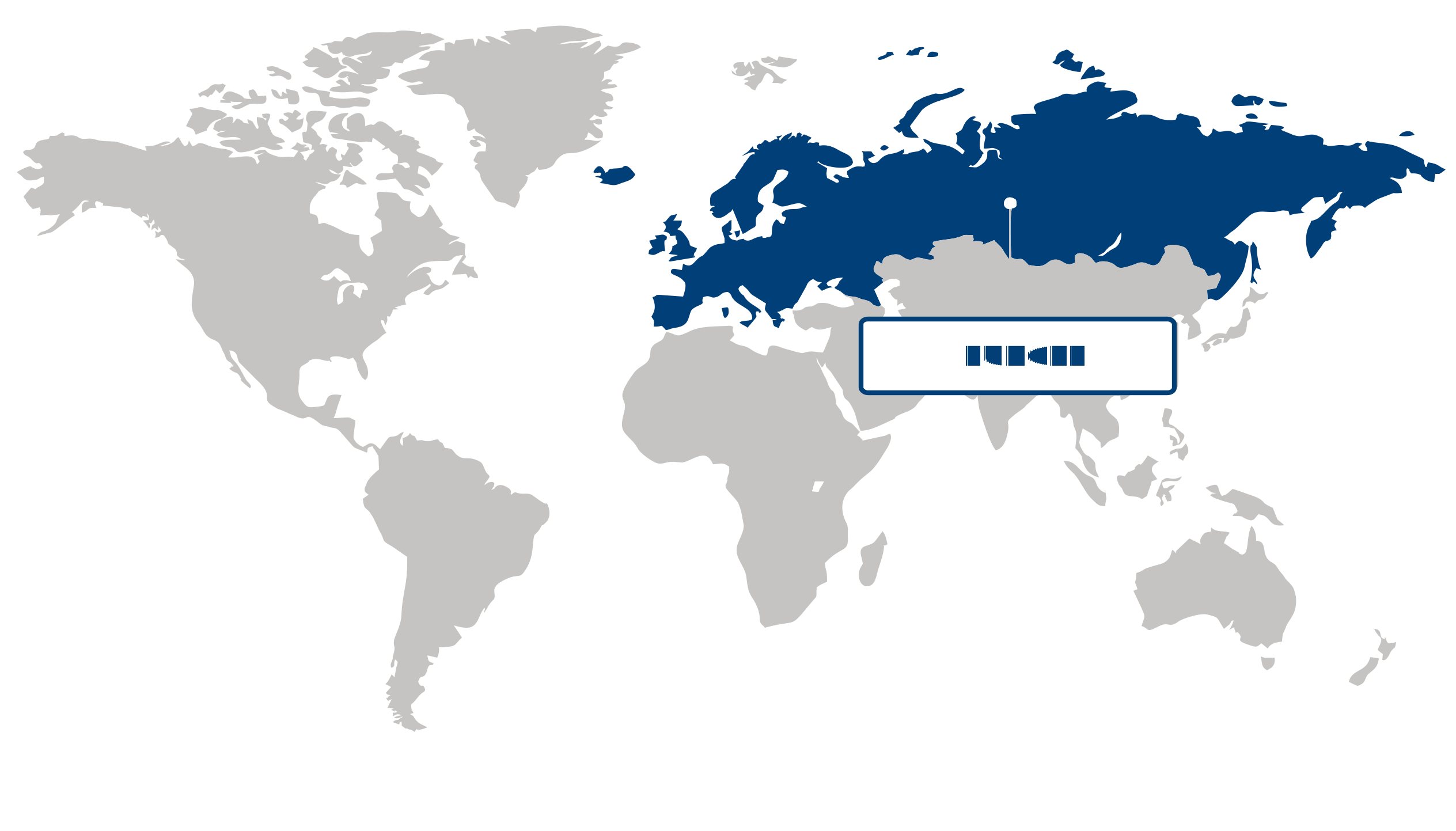
Europe (Largest Region)
Europe accounted for the largest share of the natural refrigerants market in 2026. The region’s leading position is closely associated with strong environmental policies, regulations aimed at reducing the use of high-global-warming-potential refrigerants, and growing emphasis on sustainable cooling systems. Commercial refrigeration, industrial cooling, and heat pump applications are increasingly incorporating natural refrigerants as businesses seek to meet environmental requirements and improve long-term system efficiency. The region’s established sustainability framework and continued investment in energy-efficient refrigeration infrastructure further support adoption.
Asia Pacific (Fastest-Growing Region)
Asia Pacific is projected to expand at the fastest pace in the natural refrigerants market, supported by rapid growth in refrigeration and cooling demand across residential, commercial, food processing, and industrial applications. Rising temperatures, urbanization, and expanding cold-chain infrastructure are increasing the need for efficient cooling systems. At the same time, governments and businesses are placing greater emphasis on reducing environmental impacts from refrigeration, encouraging the transition toward natural refrigerants such as ammonia, carbon dioxide, and hydrocarbons. Growing investment in modern refrigeration infrastructure is expected to further accelerate regional adoption.
| Parameter | North America | Asia Pacific | Europe | Latin America | MEA |
|---|---|---|---|---|---|
| Innovation Hub i Scale Nascent Developing Advanced | |||||
| Cost-Sensitive Region i Scale Low Medium High | |||||
| Regulatory Environment i Scale Restrictive Neutral Supportive | |||||
| Demand Drivers i Scale Weak Moderate Strong | |||||
| Development Stage i Scale Emerging Developing Developed | |||||
| Adoption Rate i Scale Low Medium High | |||||
| New Entrants / Startups i Scale Sparse Moderate Dense | |||||
| Macro Indicators i Scale Weak Stable Strong |
Key Country Insights
United States 🇺🇸
Low-Emission Cooling FocusThe U.S. is expanding the adoption of natural refrigerants as businesses modernize refrigeration and cooling systems with lower environmental impact. Equipment suppliers are investing in compatible technologies, technician training, and application-specific solutions.
Germany 🇩🇪
Sustainable Refrigeration TransitionGermany promotes natural refrigerants across commercial and industrial refrigeration projects aligned with evolving environmental standards. Manufacturers prioritize system efficiency, refrigerant safety, and long-term operational reliability in new installations.
Japan 🇯🇵
Efficient Cooling InnovationJapan advances natural refrigerant technologies through energy-efficient refrigeration systems for commercial and industrial users. Companies are refining compact equipment designs while improving operational safety and performance consistency.
South Korea 🇰🇷
Industrial Refrigeration ModernizationSouth Korea is integrating natural refrigerants into industrial cooling infrastructure to improve environmental performance and operational efficiency. Equipment suppliers are enhancing system compatibility and maintenance capabilities for large-scale facilities.
France 🇫🇷
Climate-Friendly RefrigerationFrance encourages wider use of natural refrigerants in retail, food processing, and commercial cooling applications. Manufacturers are expanding compliant refrigeration technologies that balance environmental objectives with dependable cooling performance.
Italy 🇮🇹
Commercial Cooling UpgradesItaly is adopting natural refrigerants across supermarkets, hospitality, and industrial refrigeration projects. Suppliers are focusing on reliable system integration, technician support, and equipment optimization for evolving refrigeration requirements.
Segment Leadership and Growth Trends
Natural Refrigerants Market Share (%), by End User, 2026
Go beyond the chart, access full insights & data tables
Request Free Sample ReportEnd User Segment Analysis: Industrial (Largest Segment) vs Commercial (Fastest-Growing Segment)
The industrial segment dominated the natural refrigerants market with a 56.39% share in 2026, supported by the extensive use of natural refrigerants in large-scale refrigeration and cooling operations. Industrial facilities require reliable, efficient, and environmentally responsible refrigeration systems for applications such as food processing, cold storage, and manufacturing. Ammonia and carbon dioxide-based systems are particularly suited to demanding industrial environments because of their strong thermal performance and suitability for high-capacity applications. Growing regulatory pressure to reduce the environmental impact of conventional synthetic refrigerants, combined with the need for energy-efficient cooling infrastructure, further strengthens the position of industrial users.
Commercial applications are expected to represent the fastest-growing segment, driven by the increasing adoption of environmentally sustainable refrigeration and air-conditioning solutions across retail, hospitality, food service, and other commercial establishments. Businesses are increasingly seeking refrigeration technologies that can reduce environmental impact while maintaining reliable cooling performance and managing operating costs. The transition toward natural refrigerants is also being supported by stricter environmental regulations and greater awareness of low-global-warming-potential alternatives. As commercial facilities modernize their cooling infrastructure, natural refrigerants are gaining traction as practical solutions aligned with sustainability objectives and evolving refrigeration requirements.
Application Segment Analysis: Cold Storage (Largest Segment) vs Air Conditioners (Fastest-Growing Segment)
Holding the largest share of the natural refrigerants market in 2026, the cold storage segment accounted for 33.05%, reflecting the critical role of refrigeration in preserving temperature-sensitive food and other perishable products. The expansion of cold-chain infrastructure and the growing emphasis on maintaining product quality throughout storage and distribution are supporting demand for efficient refrigeration systems. Natural refrigerants are increasingly attractive for cold storage because they combine effective cooling performance with lower environmental impact, helping operators respond to sustainability goals and regulatory requirements. The need for dependable temperature control across large-scale storage facilities further reinforces the segment's market position.
The air conditioners segment is anticipated to experience the fastest growth, encouraged by rising cooling demand and the gradual transition toward refrigerants with lower environmental impact. Increasing temperatures, expanding urbanization, and greater adoption of air-conditioning systems are creating opportunities for natural refrigerant technologies in cooling applications. At the same time, environmental regulations targeting high-impact synthetic refrigerants are encouraging equipment manufacturers and end users to explore alternatives with improved sustainability profiles. Continued innovation in air-conditioning system design and refrigerant technology is expected to support broader adoption of natural refrigerants in this application.
Type Segment Analysis: Ammonia (Largest Segment) vs Carbon Dioxide (Fastest-Growing Segment)
In the natural refrigerants market, the ammonia segment held the largest position in 2026, supported by its established use in industrial refrigeration and its strong thermodynamic efficiency. Ammonia is particularly well suited to high-capacity refrigeration systems used in applications such as food processing, cold storage, and other industrial operations. Its long-standing presence in large refrigeration installations, combined with its effective heat-transfer characteristics and low environmental impact, continues to support widespread adoption. The growing focus on energy-efficient refrigeration and the replacement of environmentally harmful synthetic refrigerants further contributes to ammonia's leading role.
Carbon dioxide is projected to be the fastest-growing type, driven by its expanding application across commercial and industrial refrigeration systems and increasing demand for environmentally preferable refrigerant options. Its low environmental impact and suitability for modern refrigeration architectures make it increasingly attractive as businesses seek to align cooling infrastructure with sustainability and regulatory objectives. Technological advances in carbon dioxide refrigeration systems are also improving their practicality across a wider range of operating conditions and applications. This broader applicability, coupled with the transition toward lower-impact refrigerants, is accelerating interest in carbon dioxide-based solutions.
| Segment | Sub-Segment | Largest Segment | Fastest Growing |
|---|---|---|---|
| End User | Industrial, Commercial, Residential | Industrial | Commercial |
| Application | Cold Storage, Freezers, Food Processing, Air Conditioners, Others | Cold Storage | Air Conditioners |
| Type | Ammonia, Carbon Dioxide, Hydrocarbon, Others | Ammonia | Carbon Dioxide |
Competitive Landscape and Market Positioning
Leading companies in the natural refrigerants market:
- Carrier Global Corporation (USA)
- Daikin Industries Ltd. (Japan)
- Johnson Controls International plc (Ireland)
- Danfoss A/S (Denmark)
- Emerson Electric Co. (USA)
- Linde plc (Ireland)
- Air Liquide S.A. (France)
- Honeywell International, Inc. (USA)
- Midea Group Co., Ltd. (China)
- Gree Electric Appliances, Inc. (China)
Regulatory shifts toward environmentally sustainable cooling technologies are reshaping competitive priorities, encouraging suppliers to strengthen expertise in refrigerants that combine low environmental impact with reliable operational performance. Success increasingly depends on the ability to deliver complete application support, including system compatibility, technical guidance, and safety expertise for industries transitioning away from conventional refrigerants. Competition is also extending into equipment optimization, where participants work to improve efficiency across commercial, industrial, and cold-chain installations, creating differentiation through engineering capabilities rather than refrigerant supply alone. This evolution is encouraging broader collaboration across the refrigeration value chain as customers seek integrated solutions that simplify adoption while meeting changing compliance expectations.
| Company | Market Share | Company Revenue | Revenue CAGR (%) | Product Portfolio | Geographic Presence | Innovation / R&D Focus | Strategic Developments |
|---|---|---|---|---|---|---|---|
| Carrier Global Corporation (USA) | |||||||
| Daikin Industries Ltd. (Japan) | |||||||
| Johnson Controls International plc (Ireland) | |||||||
| Danfoss A/S (Denmark) | |||||||
| Emerson Electric Co. (USA) | |||||||
| Linde plc (Ireland) | |||||||
| Air Liquide S.A. (France) | |||||||
| Honeywell International Inc. (USA) | |||||||
| Midea Group Co. Ltd. (China) | |||||||
| Gree Electric Appliances Inc. (China) |
Industry Development/News
| Company Name | Date | Key Development |
|---|---|---|
| Vertiv | Jun-26 | Vertiv finalized the acquisition of ThermoKey to expand its thermal management portfolio and manufacturing footprint. The transaction integrates specialized heat rejection and heat-exchange technologies into Vertiv's lineup, strengthening its natural refrigerant cooling solutions targeted at high-density data centers and AI factory infrastructure. |
| Epta | Feb-26 | Epta finalized the acquisition of Austrian commercial refrigeration manufacturer Hauser. This strategic consolidation expands Epta's geographic footprint within the European retail refrigeration sector and enhances its overall production capabilities for specialized natural refrigerant and commercial cooling equipment. |
| Bluu Unit | Feb-26 | Bluu Unit expanded its European HVAC&R operational network through the strategic acquisition of Irish contractor Tech RAC. The transaction strengthens the alliance's regional market presence and enhances its service and deployment capabilities for natural refrigerant-based commercial cooling solutions. |
| Nordic Climate Group | Nov-25 | Nordic Climate Group executed its market expansion into the United Kingdom through the acquisition of a local refrigeration specialist. The transaction establishes a direct regional presence to accelerate the delivery of its natural refrigerant cooling and heating solutions in the UK. |
| Star Refrigeration | Jul-25 | Star Refrigeration added 2.75MW of ammonia refrigeration capacity at NewCold’s cold storage site in the United Kingdom. The industrial expansion increases storage capability by 75,000 pallet positions, showcasing large-scale deployment of ammonia-based systems in high-density logistics. |
| Advansor | Jun-25 | Advansor deployed a large-scale 5.5MW CO2 refrigeration system at Maersk’s Rotterdam distribution facility. Delivering 2.4MW of cooling, 700kW of freezing, and 2.4MW of heating, the project marks a significant benchmark for high-capacity CO2 natural refrigerant systems in major logistics infrastructure. |
| TCCI | May-25 | TCCI established a dedicated Manufacturing Innovation Center in Illinois focused exclusively on natural refrigerant technologies for electric vehicles. The facility drives system-level testing and engineering for R290 propane and CO2 thermal management applications in the automotive sector. |
| Copeland | Mar-25 | Copeland established a new Research & Development center in Pune, India, designed to accelerate the deployment of natural refrigerant systems. The facility focuses on engineering tailored HVAC, data center, and cold chain technologies utilizing CO2 and alternative low-GWP refrigerants. |
| Carrier | Jan-24 | Carrier completed its €12 billion acquisition of Viessmann Climate Solutions, securing direct access to Viessmann’s advanced heat pump technologies including R290 propane-based units. The transaction accelerates Carrier's position in natural refrigerant-based climate solutions and enhances its European heating and cooling portfolio. |
| Danfoss | Mar-23 | Danfoss completed the acquisition of BOCK GmbH, a specialist manufacturer of carbon dioxide and low-GWP compressors. The transaction integrates one of the industry's largest portfolios of compressors for natural refrigerants, such as hydrocarbons and CO2 (R744), into Danfoss's climate solutions segment to accelerate its global market footprint. |
Customize Your Report
Explore examples of how this report can be tailored to different research needs, including custom segments, additional topics or chapters, and related reports. Click a section of the wheel or its numbered marker to explore the available options.
Natural Refrigerants Market — Custom Segments
| Segment | Sub-Segment |
|---|---|
| New Installation vs. Retrofit | New Equipment Installations, System Retrofit, Refrigerant Conversion |
| Refrigeration System Architecture | Centralized Systems, Distributed Systems, Cascade Systems, Packaged Systems |
| Regulatory Transition Stage | Emerging Adoption Markets, Phase-Down Transition Markets, Mature Compliance Markets |
Natural Refrigerants Market — Custom TOC
| Custom Chapter | Custom Details |
|---|---|
| Refrigerant Transition Roadmap |
|
| Refrigerant Reclamation Economics |
|
| Carbon Policy Impact Assessment |
|
Need a different cut of the data?
Request Custom ResearchHow much revenue does the natural refrigerants market generate?
How is the natural refrigerants industry size expected to evolve during the forecast period?
What factors are accelerating the transition to natural refrigerants across HVAC and refrigeration systems?
Why are organizations prioritizing natural refrigerant systems in long-term investment strategies?
Why is the industrial segment the largest end user in the natural refrigerants market?
Why is carbon dioxide the fastest-growing refrigerant type in the natural refrigerants market?
Why does Europe lead the natural refrigerants market?
What is driving Asia Pacific's fastest growth in natural refrigerants?
What are the prominent companies operating in the natural refrigerants landscape?
Our Clients
"The report helped us understand emerging consumer trends in our product category. It clarified where to focus innovation for the next product launch."
LyondellBasell
"The regional forecast section was incredibly useful. We were able to identify two new potential partners in Europe thanks to the vendor mapping you included."
SABIC
"We appreciated how actionable the recommendations were. It guided us to improve supply chain resilience."
Olin Corporation
Our Research Team & Methodology
Every Fundamental Business Insights report is built by a dedicated vertical research team, validated through a structured primary-and-secondary methodology, and reviewed for accuracy before it reaches you.
Research Team Overview
Prepared by the Chemicals & Materials Research Team
Delivery
Published
Demand
Available
Support
Trust & Compliance
Research Domains
10 coverage areasResearch Intelligence
| Source | Reference |
|---|---|
| American Chemistry Council (ACC) | www.americanchemistry.com |
| European Chemical Industry Council (Cefic) | cefic.org |
| International Council of Chemical Associations (ICCA) | icca-chem.org |
| European Chemicals Agency (ECHA) | echa.europa.eu |
| U.S. Environmental Protection Agency (EPA) | www.epa.gov |
| ASTM International | www.astm.org |
| International Organization for Standardization (ISO) | www.iso.org |
| National Institute of Standards and Technology (NIST) | www.nist.gov |
| Plastics Industry Association (PLASTICS) | www.plasticsindustry.org |
| European Biplastics | www.european-bioplastics.org |
| The Adhesive and Sealant Council (ASC) | www.ascouncil.org |
| National Association of Corrosion Engineers (AMPP) | www.ampp.org |
| Society of Plastics Engineers (SPE) | www.4spe.org |
| International Fertilizer Association (IFA) | www.fertilizer.org |
| CropLife International | croplife.org |
| Packaging Europe | packagingeurope.com |
| Flexible Packaging Association (FPA) | www.flexpack.org |
| Battery Council International (BCI) | batterycouncil.org |
| International Copper Association (ICA) | internationalcopper.org |
| World Steel Association | worldsteel.org |
Research Workflow & Quality Assurance
Data Collection
Verified information gathered through primary and secondary research.
Data Triangulation
Cross-validation using multiple independent data sources.
Forecast Modelling
Market estimates developed using historical trends and analytical models.
Analyst Validation
Findings reviewed by domain experts for accuracy and consistency.
Editorial & Quality Review
Final editorial, quality, and compliance checks before publication.
Final Publication
Released after successful completion of the internal review process.
Report Coverage
📊 Market Assessment
- Market Size & Forecast
- Market Segmentation
- Regional Analysis
- Growth Drivers & Challenges
- Market Dynamics
🏢 Competitive Intelligence
- Competitive Landscape
- Company Profiles
- Competitive Benchmarking
- Mergers & Acquisitions
- Market Share Analysis or Key Company Strategies
🔍 Strategic Analysis
- Value Chain Analysis
- Porter's Five Forces
- PESTLE Analysis
- Pricing Trends
- Supply-Demand Analysis
🚀 Future Outlook
- Technology Landscape
- Regulatory Landscape
- Investment & Funding Landscape
- Emerging Opportunities
- Future Market Outlook
Have a question about this report or need a custom scope?
Request Customization