Moscato Wine Market Size & Growth Forecast 2027–2036, By Segments (Type, Sales Channel), Regional Demand Trends (North America, Asia Pacific, Europe), Key Country Insights (U.S., Japan, South Korea, Germany, France, Italy), and Competitive Landscape
Market Size and Growth Outlook
Moscato Wine Market size was assessed at USD 2.48 billion in 2026 and is poised to grow at a 10.74% CAGR between 2027 and 2036, attaining USD 6.88 billion by 2036. The industry revenue for 2027 is estimated at USD 2.7 billion.
Get more details on this report
Request Free Sample ReportMoscato Wine Market Intelligence Snapshot
Regional Market Dynamics
- Europe held a 45.69% share in 2026, supported by its established wine production base, mature distribution networks, recognized winemaking traditions, and broad retail availability.
- Asia Pacific is projected to grow at a 12.54% CAGR as imported wine exposure, changing consumer preferences, e-commerce expansion, and modern retail increase Moscato adoption.
Segment Momentum
- Moscato Bianco accounted for 39.11% of the market in 2026, supported by strong consumer familiarity, dependable retail placement, and broad recognition that helps producers and distributors maintain consistent sales volumes.
- Online retail is the fastest-growing sales channel because it offers broader product assortments, easy brand and price comparisons, and convenient home purchasing that encourages product discovery and repeat buying.
Market Expansion Drivers
- Increasing consumer preference for sweet, low-alcohol wines expanding global Moscato consumption.
- Growth of online wine retail and direct-to-consumer channels boosting premium wine accessibility.
- Premiumization and sustainable wine production practices enhancing brand differentiation.
Leading Market Participants
- Prominent companies in the moscato wine market include COPPO S.R.L. (Italy), Michele Chiarlo S.r.l. (Italy), Barefoot Cellars (United States), Azienda Agricola Saracco (Italy), Casella Family Brands (Australia), San Antonio Winery, Inc. (United States), Sutter Home Winery, Inc. (United States), Bartenura Wines (Italy), Innocent Bystander (Australia), La Spinetta (Italy).
Global Market Forecast Snapshot
Market Outlook
- 2026 Market Size: USD 2.48 billion
- 2027 Estimated Market Size: USD 2.7 billion.
- Projected Market Size: USD 6.88 billion by 2036
- Growth Forecast: 10.74% CAGR (2027-2036)
Regional and Segment Outlook
- Leading Regional Market: Europe
- High-Growth Regional Hub: Asia Pacific
- Core Revenue Segment: Moscato Bianco (Type) | Supermarkets & Hypermarkets (Sales Channel)
- Emerging Opportunity Segment: Moscato Giallo (Type) | Online Retail (Sales Channel)
Market Growth Drivers and Industry Trends
Increasing consumer preference for sweet, low-alcohol wines expanding global Moscato consumption
Changing drinking preferences among consumers are supporting the moscato wine market, particularly as sweet and approachable wines attract individuals seeking lighter and more accessible alcoholic beverages. Moscato's naturally sweet flavor profile and comparatively lower-alcohol positioning can appeal to consumers who prefer less intense wine styles or are entering the wine category. Its compatibility with casual occasions, social gatherings, desserts, and varied cuisines also broadens its consumption opportunities. Younger and occasional wine drinkers seeking approachable flavors are contributing to demand for sweeter wine varieties that require less familiarity with traditional dry wine profiles.
Growth of online wine retail and direct-to-consumer channels boosting premium wine accessibility
Expansion of digital purchasing channels is widening access to specialty and premium products, creating favorable conditions for the moscato wine market as consumers increasingly discover and purchase wines through online retail and direct-to-consumer platforms. Digital storefronts allow buyers to explore product descriptions, flavor profiles, origin information, and recommendations without being limited to the selection available at nearby physical stores. These channels also enable wineries and wine sellers to reach consumers across broader geographic markets while presenting premium moscato products to targeted customer segments. Greater convenience in ordering and home delivery is particularly relevant for consumers seeking distinctive wines for personal consumption or social occasions.
Premiumization and sustainable wine production practices enhancing brand differentiation
Premiumization is encouraging producers within the moscato wine market to emphasize distinctive quality, provenance, production methods, and presentation to appeal to consumers willing to seek higher-value wine experiences. At the same time, growing interest in environmentally responsible consumption is increasing attention toward sustainable vineyard management, resource-efficient production, and environmentally conscious packaging. These attributes can help producers differentiate their offerings in a competitive wine category while strengthening their appeal among consumers who consider both product quality and production practices when making purchasing decisions. Premium positioning combined with sustainability-oriented credentials can also support greater engagement with consumers looking for wines that align with lifestyle and environmental preferences.
| Growth Driver | Impact on CAGR | Regulatory Influence | Geographic Relevance | Adoption Rate | Impact Timeline |
|---|---|---|---|---|---|
| Growing demand for premium and sweet wines | 3.50% | Short term (≤ 2 yrs) | Europe, North America | Low | Fast |
| Expansion of online wine retail and delivery | 3.80% | Medium term (2–5 yrs) | North America, Asia Pacific | Low | Moderate |
| Tourism and wine consumption growth in emerging regions | 3.90% | Long term (5+ yrs) | Asia Pacific, Latin America | Low | Slow |
| Increasing consumer preference for sweet, low-alcohol wines expanding global Moscato consumption | 2.60% | Low | North America, Europe | High | Near Term |
| Growth of online wine retail and direct-to-consumer channels boosting premium wine accessibility | 2.30% | Moderate | North America, Asia Pacific | High | Near Term |
| Premiumization and sustainable wine production practices enhancing brand differentiation | 1.80% | Moderate | Europe, North America | Medium | Mid Term |
Unlock insights tailored to your business with our bespoke market research solutions.
Click to get your customized report now.
Regional Demand Dynamics
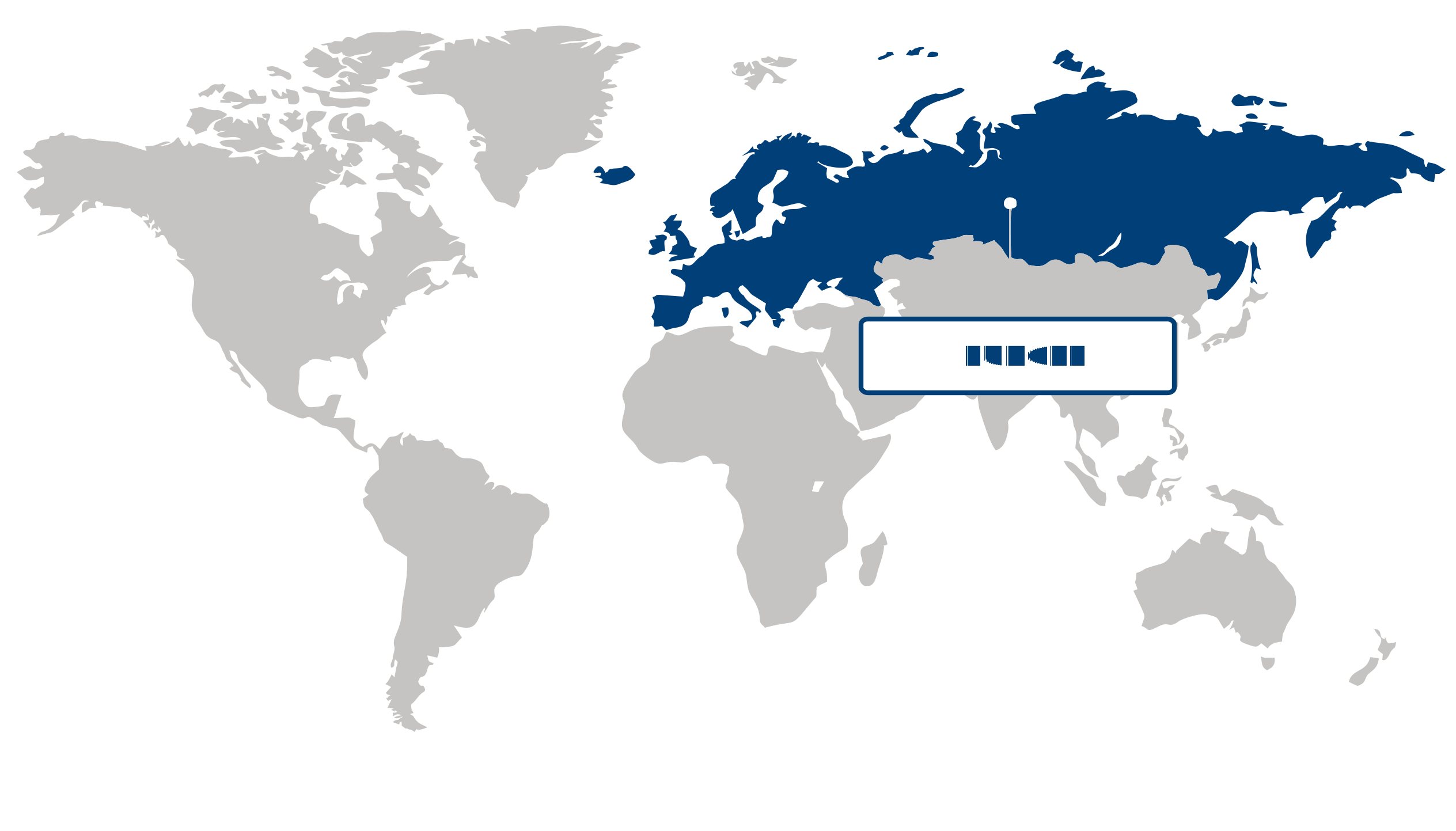
Europe (Largest Region)
Europe dominated the moscato wine market with a 45.69% share in 2026, reflecting the region's established wine culture, strong production heritage, and deep consumer familiarity with sweet and aromatic wine varieties. Moscato benefits from established consumption occasions spanning casual social gatherings, celebrations, and food pairing, while European wine-producing regions provide mature production expertise and distribution networks. Strong tourism activity and the cultural significance of wine also contribute to sustained demand, particularly where consumers value regional provenance and traditional production practices. Premiumization and growing interest in distinctive grape varieties are creating additional opportunities for producers to differentiate products through quality, origin, and flavor characteristics.
Asia Pacific (Fastest-Growing Region)
Asia Pacific is the fastest-growing region, driven by evolving consumer preferences, expanding urban middle-class populations, and increasing exposure to international wine culture. Rising interest in premium beverages is encouraging consumers to explore sweeter, fruit-forward, and approachable wine styles, creating favorable conditions for moscato. Expanding modern retail, hospitality, and e-commerce channels is also improving product accessibility, while wine education and greater exposure to international dining are supporting category awareness. The gradual development of wine consumption cultures across key asian markets provides a broader foundation for future demand, particularly as younger consumers increasingly seek new beverage experiences and premium lifestyle products.
| Parameter | North America | Asia Pacific | Europe | Latin America | MEA |
|---|---|---|---|---|---|
| Innovation Hub i Scale Nascent Developing Advanced | |||||
| Cost-Sensitive Region i Scale Low Medium High | |||||
| Regulatory Environment i Scale Restrictive Neutral Supportive | |||||
| Demand Drivers i Scale Weak Moderate Strong | |||||
| Development Stage i Scale Emerging Developing Developed | |||||
| Adoption Rate i Scale Low Medium High | |||||
| New Entrants / Startups i Scale Sparse Moderate Dense | |||||
| Macro Indicators i Scale Weak Stable Strong |
Key Country Insights
Germany 🇩🇪
Balanced Portfolio DemandGermany emphasizes moscato wines that complement established wine portfolios through quality-focused imports and regional distribution. Retailers in Germany increasingly highlight food pairing, low-alcohol selections, and curated wine assortments to address evolving consumer preferences.
France 🇫🇷
Selective Import PresenceFrance maintains a niche yet commercially relevant market for moscato wines, where consumers value authenticity and distinctive regional styles. Wine distributors in France emphasize curated selections that complement domestic offerings rather than compete directly with traditional categories.
Italy 🇮🇹
Regional Heritage FocusItaly benefits from established moscato production traditions while continuously refining premium product positioning across domestic and export channels. Italian producers focus on appellation identity, quality differentiation, and hospitality partnerships that reinforce long-term brand value.
Japan 🇯🇵
Refined Consumption TrendsJapan favors moscato wines positioned for casual dining and gift occasions, with strong attention to product presentation and consistent quality. Importers in Japan focus on premium packaging and smaller bottle formats that align with urban consumption patterns and specialty retail demand.
South Korea 🇰🇷
Lifestyle Beverage AppealSouth Korea continues to integrate moscato wines into modern dining and social occasions, supported by expanding wine culture. Importers prioritize convenient formats, digital retail engagement, and products that appeal to consumers seeking lighter, fruit-forward wine experiences.
United States 🇺🇸
Premium Retail ExpansionThe U.S. moscato wine market is shaped by demand for approachable premium wines, seasonal offerings, and innovative packaging. Producers continue to expand retail and direct-to-consumer channels while introducing new flavor profiles that appeal to younger adult consumers seeking versatile wine options.
Segment Leadership and Growth Trends
Moscato Wine Market Share (%), by Type, 2026
Go beyond the chart, access full insights & data tables
Request Free Sample ReportType Segment Analysis: Moscato Bianco (Largest Segment) vs Moscato Giallo (Fastest-Growing Segment)
Moscato bianco held the largest share of the moscato wine market, accounting for 39.11% in 2026. Its established consumer recognition and broad association with aromatic, sweet, and fruit-forward wine styles support its strong position within the market. Moscato bianco is particularly attractive to consumers seeking approachable wines with pronounced floral and fruity characteristics, helping sustain demand across both casual and social drinking occasions. The continued popularity of sweeter wine profiles, along with expanding interest in aromatic varietals, provides a favorable foundation for the segment. Its versatility across different consumption occasions further supports its established market presence.
Moscato giallo is emerging as the fastest-growing type segment as consumer interest expands toward distinctive grape varieties and differentiated flavor profiles. Its aromatic character provides opportunities for producers and retailers to appeal to consumers seeking alternatives to more familiar moscato offerings. Growing interest in varietal exploration and premium wine experiences is creating greater visibility for less conventional moscato styles. As consumers increasingly value uniqueness, provenance, and sensory differentiation in wine selection, moscato giallo is positioned to benefit from expanding interest in diversified moscato products.
Sales Channel Segment Analysis: Supermarkets & Hypermarkets (Largest Segment) vs Online Retail (Fastest-Growing Segment)
Supermarkets and hypermarkets represented the largest sales channel segment of the moscato wine market, holding a 23.65% share in 2026. These retail formats provide consumers with broad product selection and convenient access to wine across established grocery-shopping environments. Their extensive physical presence allows moscato products to reach a wide range of consumers while supporting product discovery through shelf visibility and in-store promotions. The continued importance of grocery-based alcohol purchasing and the convenience of combining wine purchases with routine shopping activities reinforce the segment's leading position.
Online retail is anticipated to be the fastest-growing sales channel as consumers increasingly embrace digital purchasing for alcoholic beverages. Online platforms provide greater product variety, convenient home delivery, and easier comparison of wine styles and prices, making them attractive to consumers seeking specific or less commonly stocked moscato varieties. Digital retail also enables producers and sellers to communicate product characteristics, origin, tasting profiles, and pairing information more effectively. As e-commerce adoption expands and consumers become more comfortable purchasing wine through digital channels, online retail is expected to gain increasing importance in the moscato wine market.
| Segment | Sub-Segment | Largest Segment | Fastest Growing |
|---|---|---|---|
| Type | Moscato Bianco, Moscato Rosa, Moscato Giallo, Others | Moscato Bianco | Moscato Giallo |
| Sales Channel | Restaurants & Bars, Winery, Liquor Stores, Online Retail, Supermarkets & Hypermarkets, Others | Supermarkets & Hypermarkets | Online Retail |
Competitive Landscape and Market Positioning
Prominent players in the moscato wine market:
1. COPPO S.R.L. (Italy)
2. Michele Chiarlo S.r.l. (Italy)
3. Barefoot Cellars (United States)
4. Azienda Agricola Saracco (Italy)
5. Casella Family Brands (Australia)
6. San Antonio Winery Inc. (United States)
7. Sutter Home Winery Inc. (United States)
8. Bartenura Wines (Italy)
9. Innocent Bystander (Australia)
10. La Spinetta (Italy)
The moscato wine market is influenced by growing consumer preference for sweeter and lighter alcoholic beverages. Producers are increasingly introducing flavor variations and premium variants to attract diverse consumer segments. Expanding distribution channels are supporting wider geographic reach, while differentiation through taste profiles and packaging innovation is becoming more prominent. These trends are strengthening growth in the moscato wine market.
| Company | Market Share | Company Revenue | Revenue CAGR (%) | Product Portfolio | Geographic Presence | Innovation / R&D Focus | Strategic Developments |
|---|---|---|---|---|---|---|---|
| COPPO S.R.L. (Italy) | |||||||
| Michele Chiarlo S.r.l. (Italy) | |||||||
| Barefoot Cellars (United States) | |||||||
| Azienda Agricola Saracco (Italy) | |||||||
| Casella Family Brands (Australia) | |||||||
| San Antonio Winery Inc. (United States) | |||||||
| Sutter Home Winery Inc. (United States) | |||||||
| Bartenura Wines (Italy) | |||||||
| Innocent Bystander (Australia) | |||||||
| La Spinetta (Italy). |
Industry Development/News
| Company Name | Date | Key Development |
|---|
Customize Your Report
Explore examples of how this report can be tailored to different research needs, including custom segments, additional topics or chapters, and related reports. Click a section of the wheel or its numbered marker to explore the available options.
Moscato Wine Market — Custom Segments
| Segment | Sub-Segment |
|---|---|
| Price Tier | Economy, Mid-Range, Premium, Luxury |
| Occasion | Casual & Everyday Consumption, Celebrations & Social Gatherings, Dining & Food Pairing, Gifting |
| Packaging Format | Bottles, Cans, Miniature & Single-Serve Bottles, Bag-in-Box |
Moscato Wine Market — Custom TOC
| Custom Chapter | Custom Details |
|---|---|
| Premium Wine Consumer Segmentation |
|
| Brand Differentiation Strategy Assessment |
|
| Wine Tourism and Experience Opportunities |
|
Need a different cut of the data?
Request Custom ResearchWhat is the current revenue of the moscato wine market?
How much is the moscato wine industry expected to grow by 2036?
How are shifting consumer preferences toward sweet, low-alcohol wines influencing Moscato consumption patterns?
How is the growth of online retail and direct-to-consumer channels affecting purchasing behavior in the Moscato wine market?
Why does Moscato Bianco lead the moscato wine market by type?
Which sales channel is growing the fastest in the moscato wine market?
Why is Europe the largest regional market for Moscato wine?
What is fueling Moscato wine market growth in Asia Pacific?
Which companies are driving growth in the moscato wine landscape?
Our Clients
"The report provided a thorough look at market trends, technological advancements, and the competitive landscape. The depth of insights was really valuable."
ITC Limited
"We would highly recommend Fundamental Business Insights & Consulting to anyone looking for reliable, detailed, and comprehensive market research in the Food industry."
Tyson Foods
"The clarity and presentation of the information were commendable. The report was delivered timely, which made the overall experience smooth and convenient."
Mondelēz International
Our Research Team & Methodology
Every Fundamental Business Insights report is built by a dedicated vertical research team, validated through a structured primary-and-secondary methodology, and reviewed for accuracy before it reaches you.
Research Team Overview
Prepared by the Food & Beverage Research Team
Delivery
Published
Demand
Available
Support
Trust & Compliance
Research Domains
10 coverage areasResearch Intelligence
| Source | Reference |
|---|---|
| Food and Agriculture Organization (FAO) | www.fao.org |
| World Health Organization (WHO) | www.who.int |
| U.S. Food & Drug Administration (FDA) | www.fda.gov |
| European Food Safety Authority (EFSA) | www.efsa.europa.eu |
| U.S. Department of Agriculture (USDA) | www.usda.gov |
| Codex Alimentarius Commission | www.fao.org/fao-who-codexalimentarius |
| International Organization for Standardization (ISO) | www.iso.org |
| AOAC INTERNATIONAL | www.aoac.org |
| Institute of Food Technologists (IFT) | www.ift.org |
| International Dairy Foods Association (IDFA) | www.idfa.org |
| International Sweeteners Association (ISA) | www.sweeteners.org |
| International Probiotics Association (IPA) | internationalprobiotics.org |
| Good Food Institute (GFI) | gfi.org |
| American Feed Industry Association (AFIA) | www.afia.org |
| International Feed Industry Federation (IFIF) | ifif.org |
| Specialty Food Association (SFA) | www.specialtyfood.com |
| Brewers Association | www.brewersassociation.org |
| International Bottled Water Association (IBWA) | bottledwater.org |
| International Alliance for Dietary/Food Supplement Associations (IADSA) | www.iadsa.org |
| OECD Agriculture & Food | www.oecd.org/agriculture |
Research Workflow & Quality Assurance
Data Collection
Verified information gathered through primary and secondary research.
Data Triangulation
Cross-validation using multiple independent data sources.
Forecast Modelling
Market estimates developed using historical trends and analytical models.
Analyst Validation
Findings reviewed by domain experts for accuracy and consistency.
Editorial & Quality Review
Final editorial, quality, and compliance checks before publication.
Final Publication
Released after successful completion of the internal review process.
Report Coverage
📊 Market Assessment
- Market Size & Forecast
- Market Segmentation
- Regional Analysis
- Growth Drivers & Challenges
- Market Dynamics
🏢 Competitive Intelligence
- Competitive Landscape
- Company Profiles
- Competitive Benchmarking
- Mergers & Acquisitions
- Market Share Analysis or Key Company Strategies
🔍 Strategic Analysis
- Value Chain Analysis
- Porter's Five Forces
- PESTLE Analysis
- Pricing Trends
- Supply-Demand Analysis
🚀 Future Outlook
- Technology Landscape
- Regulatory Landscape
- Investment & Funding Landscape
- Emerging Opportunities
- Future Market Outlook
Have a question about this report or need a custom scope?
Request Customization