Monocrystalline Germanium Market Size & Forecasts 2026-2035, By Segments (Type, Application), Growth Opportunities, Innovation Landscape, Regulatory Shifts, Strategic Regional Insights (U.S., Japan, China, South Korea, UK, Germany, France), and Competitive Dynamics (Umicore, 5N Plus, Shandong Xingzhi New Materials, Dowa Electronics Materials, American Elements)
Market Size and Growth Outlook
Monocrystalline Germanium Market size is anticipated to rise from USD 11.89 billion in 2025 to USD 31.4 billion by 2035, reflecting a CAGR surpassing 10.2% over the forecast horizon of 2026-2035. The estimated revenue for 2026 is USD 12.97 billion.
Get more details on this report
Request Free Sample ReportMonocrystalline Germanium Market Intelligence Snapshot
Regional Market Dynamics
Segment Momentum
Market Expansion Drivers
Leading Market Participants
Global Market Forecast Snapshot
Market Outlook
Regional and Segment Outlook
Market Growth Drivers and Industry Trends
Technological Improvements in Crystal Growth and Purity: Advances in melt-pulling, float-zone refinement, and contamination control demonstrated by Monocrystal production notes and research at Fraunhofer IOF are materially lowering defect densities and improving yield, enabling wider adoption of monocrystalline germanium in precision optics and photonic components. Equipment vendors such as Applied Materials and process R&D at Fraunhofer show that improved throughput and repeatability reduce unit costs and supply risk, presenting strategic openings for contract growers and for device manufacturers to integrate wafer sourcing. Continued capital investment in growth technology and published process improvements point to progressive quality gains that make higher-value applications commercially feasible.
Adoption in Advanced Electronics and Semiconductor Devices: Research breakthroughs at IMEC and IBM Research, alongside exploratory process work from Intel on SiGe and Ge channel integration, are driving use cases for germanium in high-mobility transistors and on-chip photodetectors; these demonstrations make the monocrystalline germanium market relevant to foundries and IDMs assessing next-generation nodes. As integration pilots move from labs to wafer fabs, opportunities arise for foundries to offer germanium-enabled process modules, for specialty wafer suppliers to capture upstream value, and for startups focused on Ge photonics to secure co-development partnerships. Publicized lab-to-fab milestones at IMEC, IBM Research, and Intel signal a measured transition from research to pilot manufacturing rather than immediate mass-market adoption.
Industry Restraints:
Concentrated, Byproduct-Dependent Supply Base
Monocrystalline germanium supply is tightly coupled to zinc smelting and coal fly‑ash recovery, creating a geographically concentrated and volatile feedstock base that constrains scale-up. The U.S. Geological Survey documents germanium as largely a byproduct stream, and the International Energy Agency’s analysis of declining coal use underscores shrinking fly‑ash volumes that historically contributed recoverable germanium. This linkage amplifies cyclical exposure and sourcing volatility, pressuring manufacturers that require reliable high‑purity feedstock. Strategically, incumbents can secure advantage via long‑term offtakes or vertical integration, while new entrants face elevated sourcing risk and bargaining weakness. Near term, as energy and base‑metal market dynamics evolve, byproduct concentration will remain a key bottleneck to predictable market expansion.
High‑Purity Processing and Environmental Compliance Costs
Producing monocrystalline germanium wafers requires capital‑intensive purification and crystal‑growth technologies and strict impurity control, raising unit costs and permitting burdens that slow market adoption. II‑VI Incorporated and other precision‑optics suppliers emphasize demanding specifications for infrared and semiconductor applications, while the U.S. Environmental Protection Agency and European Commission REACH frameworks increase compliance and waste‑management obligations for refining and chemical intermediates. These technical and regulatory cost layers favor established, well‑capitalized producers and specialized suppliers and deter lightly funded entrants that cannot absorb long lead times or compliance capex. Over the near‑to‑medium term, regulatory and purity requirements will continue to insulate incumbents, even as recycling and process efficiency gains gradually lower but do not eliminate the barrier.
| Growth Driver | Impact on CAGR | Regulatory Influence | Geographic Relevance | Adoption Rate | Impact Timeline |
|---|---|---|---|---|---|
| Growing use in infrared optics and detectors | 4.00% | Short term (≤ 2 yrs) | North America, Europe | Low | Fast |
| Technological improvements in crystal growth and purity | 3.00% | Medium term (2–5 yrs) | Asia Pacific, North America | Medium | Moderate |
| Adoption in advanced electronics and semiconductor devices | 3.20% | Long term (5+ yrs) | Europe, Asia Pacific; Spillover: North America | Low | Slow |
Unlock insights tailored to your business with our bespoke market research solutions.
Click to get your customized report now.
Regional Demand Dynamics
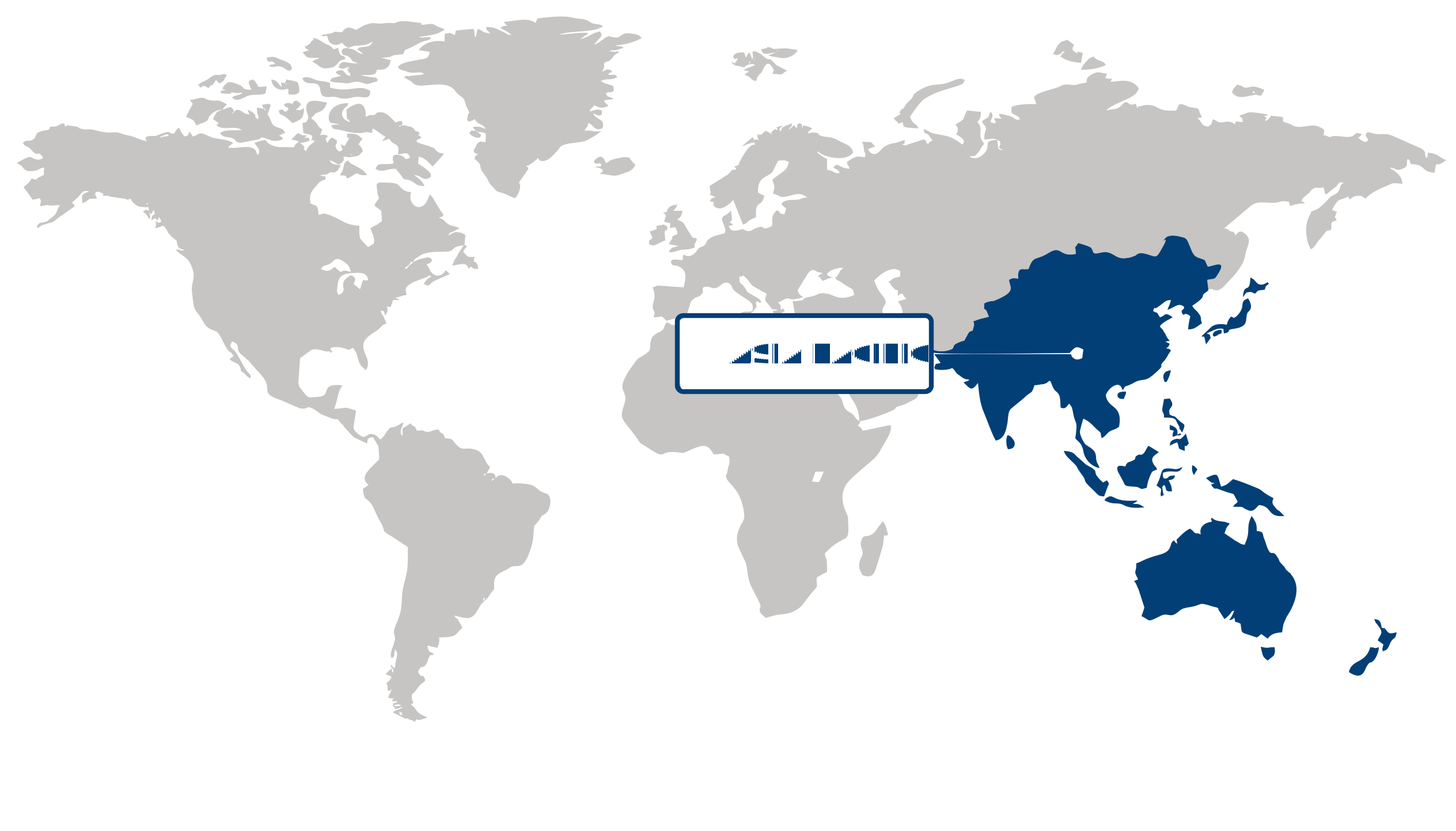
Asia Pacific captured over 50.00% of the monocrystalline germanium market in 2025, emerging as the largest regional hub driven by accelerating optoelectronics adoption and expanding semiconductor substrate manufacturing across APAC. Government programs and industry alliances—illustrated by Japan’s Ministry of Economy, Trade and Industry (METI) support for advanced materials and China’s Ministry of Industry and Information Technology (MIIT) IC capacity initiatives—are reinforcing downstream demand; trade and investment notes from the Japan Electronics and Information Technology Industries Association (JEITA) and the China Semiconductor Industry Association (CSIA) further document shifting supply chains. Combined with private-sector signals from Sony and Hamamatsu Photonics, the region offers scalable demand and integration advantages for upstream germanium suppliers and substrate fabricators.
Japan is positioned as a pivotal hub in Asia Pacific and the monocrystalline germanium market through its concentration of precision optoelectronics firms and specialty-materials expertise. Policy backing from METI, commercial expansion by Sony’s imaging business and Hamamatsu Photonics’ photonics portfolio create stable, high-value domestic consumption that favors specialty germanium grades for sensors and optical components. For investors, Japan’s ecosystem supports premium-margin applications and collaboration models that strengthen regional supply chains.
China serves as the production powerhouse in Asia Pacific and the monocrystalline germanium market, where scale, state-led capacity building and supply-chain integration accelerate uptake. MIIT’s semiconductor capacity plans, the China Semiconductor Industry Association’s industry coordination and large players such as SMIC and Huawei expanding optical and substrate capabilities signal strong manufacturing pull-through. Strategically, China’s volume-driven trajectory complements Japan’s premium demand, creating a two-tier regional opportunity for suppliers targeting both high-volume substrates and high-performance optoelectronics components.
North America Market Analysis:
North America emerged as the fastest-growing region in the monocrystalline germanium market, posting a CAGR of 12%, driven largely by defense, aerospace optics and high-end semiconductor demand in North America. Demand from U.S. Department of Defense programs and NASA missions for high-performance infrared optics, combined with requirements from defense contractors such as Lockheed Martin and Raytheon Technologies, has elevated specifications and qualification barriers, pushing suppliers toward tighter process controls and traceable supply chains. Simultaneously, advanced photonics and semiconductor applications pursued by firms like Intel Corporation are increasing demand for high-purity germanium substrates. These dynamics—heightened technical standards, procurement-driven volume, and concentrated OEM partnerships—create near-term entry points for specialized manufacturers and testing vendors and underscore strong long-term procurement pipelines across commercial and defense programs.
The U.S. serves as the primary demand engine for the monocrystalline germanium market, where defense procurement and domestic semiconductor incentives concentrate demand. Federal initiatives such as the CHIPS and Science Act, coupled with R&D funding from DARPA and procurement cycles led by the U.S. Department of Defense and NASA, are compelling domestic sourcing, qualification labs, and collaborative development with primes like Lockheed Martin and Raytheon Technologies. Intel Corporation’s wafer and advanced packaging investments further tighten requirements for substrate performance and supplier reliability. For suppliers and investors, the implication is clear: align capabilities with U.S. defense and semiconductor qualification pathways, invest in domestic qualification and traceability, and pursue partnerships with prime contractors and fabs to capture high-value contracts that reinforce North America’s leadership.
Europe Market Trends:
Held a commanding share in the monocrystalline germanium market, Europe combines strategic material policy, concentrated photonics demand and targeted R&D investment that sustain regional significance. The European Commission’s Critical Raw Materials list and related Critical Raw Materials Act underscore germanium’s strategic status, while Photonics21 roadmaps and Fraunhofer research programs (Fraunhofer Gesellschaft, Fraunhofer IOF) document growing demand for infrared optics and sensors. Horizon Europe projects and EU industrial funding further support processing and recycling pilots, creating pathways for higher domestic value capture and competitive supplier development across the bloc.
Germany functions as a manufacturing and systems‑integration leader in the monocrystalline germanium market, leveraging precision‑optics supply chains and established industrial players. German firms such as Carl Zeiss and Jenoptik, alongside Fraunhofer institutes, demonstrate vertically integrated capabilities for thermal imaging and sensor optics; national policy signals from the Federal Ministry for Economic Affairs and Climate Action (BMWK) emphasize photonics industrialization. This manufacturing depth makes Germany a regional anchor for scale‑up, quality control and downstream component sourcing, attracting investment into European processing capacity.
France plays a strategic role in the monocrystalline germanium market, driven by R&D intensity and defense procurement that accelerate specialty applications. Research centers such as CEA‑Leti and CNRS focus on germanium integration for photonics and semiconductor platforms, while prime contractors like Safran and Thales sustain demand through avionics and infrared systems; France 2030 industrial initiatives provide targeted funding. France’s combination of laboratory innovation and procurement pull offers collaboration opportunities for suppliers and supports Europe‑wide technology leadership in high‑value germanium components.
| Parameter | North America | Asia Pacific | Europe | Latin America | MEA |
|---|---|---|---|---|---|
| Innovation Hub i Scale Nascent Developing Advanced | |||||
| Cost-Sensitive Region i Scale Low Medium High | |||||
| Regulatory Environment i Scale Restrictive Neutral Supportive | |||||
| Demand Drivers i Scale Weak Moderate Strong | |||||
| Development Stage i Scale Emerging Developing Developed | |||||
| Adoption Rate i Scale Low Medium High | |||||
| New Entrants / Startups i Scale Sparse Moderate Dense | |||||
| Macro Indicators i Scale Weak Stable Strong |
Segment Leadership and Growth Trends
Monocrystalline Germanium Market Share (%), by Type, 2026
Go beyond the chart, access full insights & data tables
Request Free Sample ReportInfrared grade dominated the monocrystalline germanium market in 2025 within the Type segment, driven by rising demand for high-purity germanium in infrared imaging and defense applications. Leadership reflects the material’s superior long-wave infrared transmission and defense-sector procurement preferences—cited needs from the U.S. Department of Defense and product roadmaps at Teledyne Technologies illustrate sustained orders for high-purity detector substrates—while supplier specialization noted by Heraeus and supply considerations reported by the U.S. Geological Survey reinforce processing and sourcing barriers. That strengthens scale advantages for incumbents and creates niches for specialty refiners; ongoing defense modernization and satellite sensor deployments support continued near-term relevance.
Analysis by Application
Infrared lenses represented largest share in the monocrystalline germanium market in 2025 within the Application segment, propelled by increasing adoption of infrared optics in surveillance, thermal imaging, and aerospace. The segment’s lead is rooted in germanium’s enabling properties for compact, high-performance LWIR lens assemblies used by suppliers and systems integrators—examples include product lines from Teledyne Technologies and sensor systems from Raytheon Technologies—and mission requirements from NASA and the European Space Agency that favor proven optical materials. Advances in precision polishing and anti-reflection coatings by suppliers such as Heraeus, plus growing UAV and security deployments, create opportunities for established optical houses and agile contract manufacturers, keeping the segment strategically important through the near to medium term.
| Segment | Sub-Segment | Largest Segment | Fastest Growing |
|---|---|---|---|
| Type | Solar Grade, Infrared Grade | ||
| Application | Transistors & Solar Cells, Infrared Lenses, Optical Components |
Competitive Landscape and Market Positioning
The competitive landscape is shaped by active capability consolidation and targeted capability expansion among the top players. Some have combined complementary operations and formalized supply arrangements with downstream OEMs, while others have increased internal development capacity and pilot manufacturing to raise purity and wafer uniformity. Product portfolios have broadened to include specialized wafer grades and integrated traceability, and supply-chain tightening has been addressed through closer feedstock alignment. These moves deepen technical differentiation, accelerate customer qualification, and raise barriers for new entrants, shifting competition toward solution breadth and end-market integration.
Strategic / Actionable Recommendations for Regional Players
Prioritize expedited alignment with aerospace, defense, and specialty optics customers by offering flexible production runs and certification-ready documentation; reinforce local analytical partnerships to shorten qualification timelines and emphasize aftermarket support to capture premium segments.
Leverage domestic feedstock and fabrication scale by expanding downstream wafer processing, co-developing application-specific grades with large fab or sensor integrators, and accelerating automation to serve fast-growing optics and infrared detector demand.
Build on stringent regulatory and sustainability expectations by highlighting material traceability and low-carbon processing credentials, deepen R&D linkages with technical institutes to advance high-purity processes, and pursue selective supply partnerships to secure premium, compliance-sensitive contracts.
| Company | Market Share | Company Revenue | Revenue CAGR (%) | Product Portfolio | Geographic Presence | Innovation / R&D Focus | Strategic Developments |
|---|---|---|---|---|---|---|---|
| No companies available. | |||||||
Industry Development/News
| Company Name | Date | Key Development |
|---|
Customize Your Report
Explore examples of how this report can be tailored to different research needs, including custom segments, additional topics or chapters, and related reports. Click a section of the wheel or its numbered marker to explore the available options.
Monocrystalline Germanium Market — Custom Segments
| Segment | Sub-Segment |
|---|---|
| No segment data available. | |
Monocrystalline Germanium Market — Custom TOC
| Custom Chapter | Custom Details | ||
|---|---|---|---|
| No custom TOC data available. | |||
Need a different cut of the data?
Request Custom ResearchHow big is the monocrystalline germanium market?
What is the anticipated CAGR of the monocrystalline germanium industry?
Which part of the world represents the largest segment of the monocrystalline germanium market?
Which region shows the most rapid acceleration in the monocrystalline germanium sector?
What share does infrared grade segment hold in the monocrystalline germanium sector as of 2025?
Where is the infrared lenses segment seeing the strongest adoption within the monocrystalline germanium industry?
Who are the major participants shaping the monocrystalline germanium landscape?
Our Clients
"Working with FBI has been a good experience. The market report provided a holistic view, covering everything from emerging trends to potential risks."
Semtech Corporation
"The experience was highly positive. The team showcased remarkable flexibility in adapting to our specific needs and delivered report that perfectly aligned with all our requirements."
TSMC
"What really stood out to me was how clearly and promptly the Fundamental Business Insights team communicated throughout. It made the collaboration feel effortless."
NXP Semiconductors
Our Research Team & Methodology
Every Fundamental Business Insights report is built by a dedicated vertical research team, validated through a structured primary-and-secondary methodology, and reviewed for accuracy before it reaches you.
Research Team Overview
Prepared by the Electronics & Semiconductors Research Team
Delivery
Published
Demand
Available
Support
Trust & Compliance
Research Domains
10 coverage areasResearch Intelligence
| Source | Reference |
|---|---|
| Semiconductor Industry Association (SIA) | www.semiconductors.org |
| SEMI | www.semi.org |
| JEDEC Solid State Technology Association | www.jedec.org |
| IEEE | www.ieee.org |
| IPC – Association Connecting Electronics Industries | www.ipc.org |
| International Electrotechnical Commission (IEC) | www.iec.ch |
| International Organization for Standardization (ISO) | www.iso.org |
| U.S. Bureau of Industry and Security (BIS) | www.bis.gov |
| U.S. Patent and Trademark Office (USPTO) | www.uspto.gov |
| European Patent Office (EPO) | www.epo.org |
| Taiwan Semiconductor Industry Association (TSIA) | www.tsia.org.tw |
| World Semiconductor Trade Statistics (WSTS) | www.wsts.org |
| International Energy Agency (IEA) | www.iea.org |
| GSMA | www.gsma.com |
| 3GPP | www.3gpp.org |
| ITU (International Telecommunication Union) | www.itu.int |
| Omdia (public insights) | omdia.tech.informa.com |
| Display Supply Chain Consultants (DSCC) | www.displaysupplychain.com |
| U.S. Department of Energy (DOE) | www.energy.gov |
| NIST (National Institute of Standards and Technology) | www.nist.gov |
Research Workflow & Quality Assurance
Data Collection
Verified information gathered through primary and secondary research.
Data Triangulation
Cross-validation using multiple independent data sources.
Forecast Modelling
Market estimates developed using historical trends and analytical models.
Analyst Validation
Findings reviewed by domain experts for accuracy and consistency.
Editorial & Quality Review
Final editorial, quality, and compliance checks before publication.
Final Publication
Released after successful completion of the internal review process.
Report Coverage
📊 Market Assessment
- Market Size & Forecast
- Market Segmentation
- Regional Analysis
- Growth Drivers & Challenges
- Market Dynamics
🏢 Competitive Intelligence
- Competitive Landscape
- Company Profiles
- Competitive Benchmarking
- Mergers & Acquisitions
- Market Share Analysis or Key Company Strategies
🔍 Strategic Analysis
- Value Chain Analysis
- Porter's Five Forces
- PESTLE Analysis
- Pricing Trends
- Supply-Demand Analysis
🚀 Future Outlook
- Technology Landscape
- Regulatory Landscape
- Investment & Funding Landscape
- Emerging Opportunities
- Future Market Outlook
Have a question about this report or need a custom scope?
Request Customization