Molluscs Market Size & Growth Forecast 2027–2036, By Segments (Form, Species, Distribution Channel), Regional Demand Trends (North America, Asia Pacific, Europe), Key Country Insights (U.S., Japan, South Korea, Germany, France, Italy), and Competitive Landscape
Market Size and Growth Outlook
Molluscs Market size was worth USD 73.32 billion in 2026 and is expected to grow at a 4.28% CAGR between 2027 and 2036, surpassing USD 111.49 billion by 2036. The industry revenue for 2027 is calculated at USD 75.96 billion.
Get more details on this report
Request Free Sample ReportMolluscs Market Intelligence Snapshot
Regional Market Dynamics
- Asia Pacific captured 63.00% of the market in 2026, supported by extensive aquaculture, established seafood supply chains, and strong consumption across retail, wholesale, and foodservice channels.
- Europe is projected to grow at a 5.24% CAGR, driven by structured seafood distribution, strong retail and hospitality demand, and emphasis on quality, traceability, and regulated sourcing practices.
Segment Momentum
- Frozen accounted for a 57.75% share in 2026 because it offers longer shelf life, easier inventory management, and dependable distribution across retail, foodservice, and export markets.
- Scallops are the fastest-growing species segment as demand rises for premium, versatile seafood options across retail and foodservice channels.
Market Expansion Drivers
- Rising consumer preference for protein-rich and low-fat seafood boosting molluscs consumption globally.
- Growth in aquaculture production and processed seafood supply chains improving availability and affordability.
- Increasing demand for sustainable and farm-raised seafood supporting eco-certified aquaculture expansion.
Leading Market Participants
- Leading companies in the molluscs market include Maruha Nichiro Corporation (Japan), Cooke Aquaculture Inc. (Canada), Eastern Fish Company (United States), Blue Ridge Aquaculture, Inc. (United States), Ulka Seafoods Pvt. Ltd. (India), Avla Nettos Exports (India), Taylor Shellfish Company (United States), Pacific Seafood Group (United States), Wellfleet Shellfish Co. (United States).
Global Market Forecast Snapshot
Market Outlook
- 2026 Market Size: USD 73.32 billion
- 2027 Estimated Market Size: USD 75.96 billion.
- Projected Market Size: USD 111.49 billion by 2036
- Growth Forecast: 4.28% CAGR (2027-2036)
Regional and Segment Outlook
- Leading Regional Market: Asia Pacific
- High-Growth Regional Hub: Europe
- Core Revenue Segment: Frozen (Form) | Crassostrea (Species) | Hypermarkets and Supermarkets (Distribution Channel)
- Emerging Opportunity Segment: Canned (Form) | Scallops (Species) | Online (Distribution Channel)
Market Growth Drivers and Industry Trends
Rising consumer preference for protein-rich and low-fat seafood boosting molluscs consumption globally
Changing dietary preferences are supporting the molluscs market as consumers increasingly seek seafood options that provide protein while fitting lower-fat eating patterns. Molluscs such as shellfish can serve as versatile sources of animal protein across household meals and foodservice applications, while their positioning within seafood-based diets can appeal to health-conscious consumers. Greater interest in nutritious food choices is encouraging broader incorporation of molluscs into everyday consumption and diversified seafood offerings.
Growth in aquaculture production and processed seafood supply chains improving availability and affordability
The expansion of aquaculture and processed seafood distribution is strengthening the molluscs market by improving the consistency with which products reach consumers across different sales channels. Higher aquaculture production can support more reliable supply, while processing and distribution capabilities enable products to be handled, packaged, and transported efficiently. These developments can also improve affordability by supporting larger-scale supply and reducing constraints associated with limited or irregular availability of molluscs.
Increasing demand for sustainable and farm-raised seafood supporting eco-certified aquaculture expansion
Sustainability considerations are increasingly influencing the molluscs market as consumers and seafood buyers show greater interest in responsibly produced, farm-raised products. Eco-certified aquaculture can provide producers with a way to demonstrate adherence to recognized sustainability practices while responding to changing purchasing preferences. Greater emphasis on sustainable sourcing is encouraging aquaculture operators to expand certified production and incorporate responsible cultivation practices into their seafood supply strategies.
| Growth Driver | Impact on CAGR | Regulatory Influence | Geographic Relevance | Adoption Rate | Impact Timeline |
|---|---|---|---|---|---|
| Rising consumer preference for protein-rich and low-fat seafood boosting molluscs consumption globally | 1.90% | Low | Asia Pacific, North America, Europe | High | Near Term |
| Growth in aquaculture production and processed seafood supply chains improving availability and affordability | 1.60% | Moderate | Asia Pacific, Latin America | High | Mid Term |
| Increasing demand for sustainable and farm-raised seafood supporting eco-certified aquaculture expansion | 1.30% | Moderate | Asia Pacific, Europe | Medium | Mid Term |
Unlock insights tailored to your business with our bespoke market research solutions.
Click to get your customized report now.
Regional Demand Dynamics
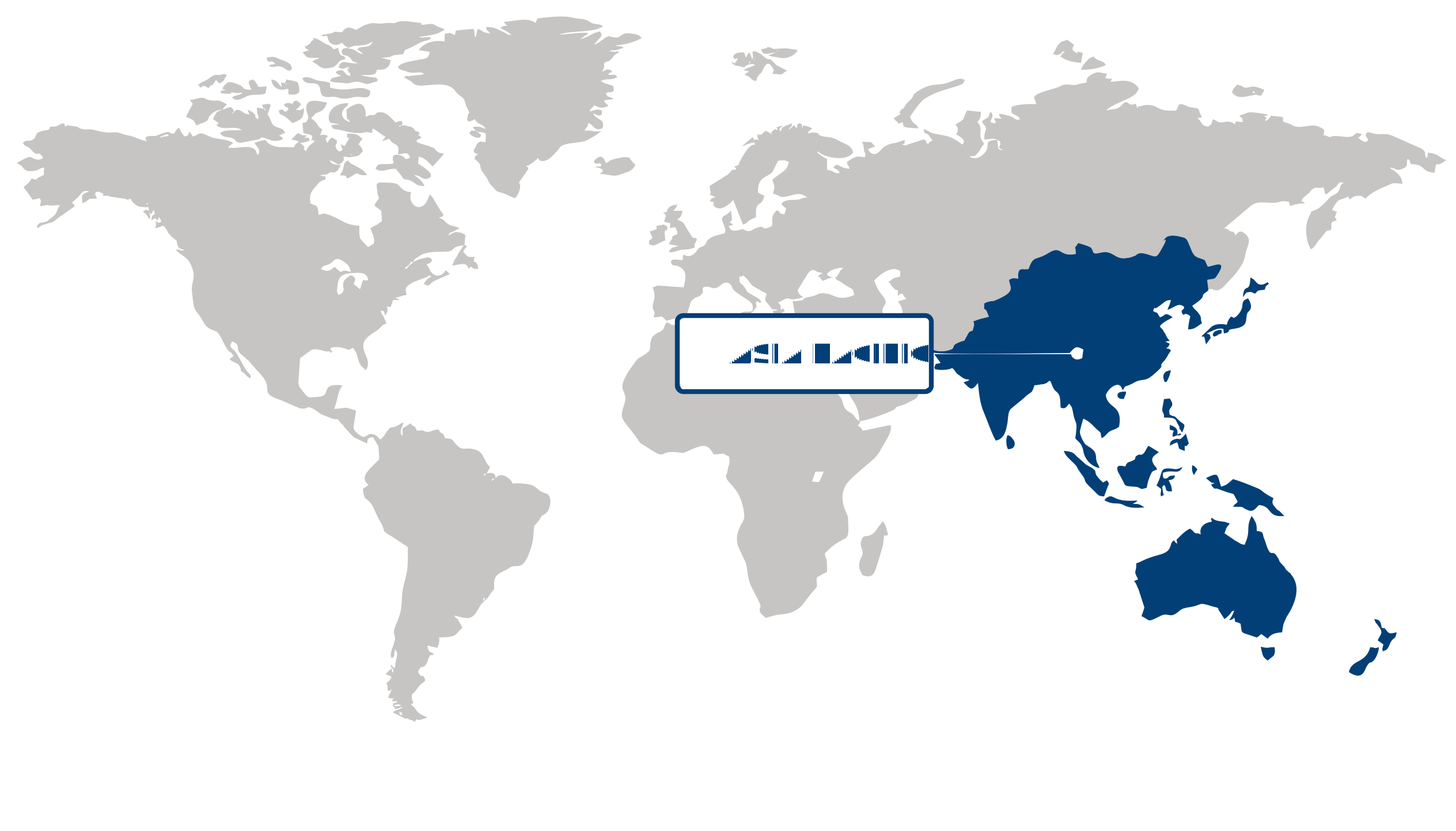
Asia Pacific (Largest Region)
The molluscs market in Asia Pacific held the largest share of 63.00% in 2026, supported by strong seafood consumption, extensive aquaculture activity, and established coastal harvesting and processing industries. Molluscs such as oysters, mussels, clams, and scallops form an important part of regional food cultures, while expanding urban populations and rising demand for protein-rich seafood continue to support consumption. The region also benefits from well-developed seafood supply chains, favorable coastal resources, and significant aquaculture capabilities that help maintain product availability for both domestic consumption and international trade. Improvements in cold-chain infrastructure, processing facilities, and seafood distribution are further strengthening market development, while growing consumer interest in nutritious and sustainably sourced seafood is encouraging producers to improve cultivation and handling practices.
Europe (Fastest-Growing Region)
Europe represents the fastest-growing regional market, driven by increasing consumer interest in seafood as part of healthier and more sustainable diets. Demand for responsibly sourced aquatic foods is encouraging greater attention to traceability, quality, and environmentally conscious production practices across the molluscs supply chain. The expansion of modern aquaculture, improvements in shellfish farming technologies, and greater adoption of efficient processing and distribution systems are creating favorable conditions for market development. In addition, growing demand from foodservice and premium retail channels is supporting consumption of higher-value mollusc products, while efforts to strengthen sustainable marine resource management are encouraging producers to adopt more efficient and environmentally responsible cultivation methods.
| Parameter | North America | Asia Pacific | Europe | Latin America | MEA |
|---|---|---|---|---|---|
| Innovation Hub i Scale Nascent Developing Advanced | |||||
| Cost-Sensitive Region i Scale Low Medium High | |||||
| Regulatory Environment i Scale Restrictive Neutral Supportive | |||||
| Demand Drivers i Scale Weak Moderate Strong | |||||
| Development Stage i Scale Emerging Developing Developed | |||||
| Adoption Rate i Scale Low Medium High | |||||
| New Entrants / Startups i Scale Sparse Moderate Dense | |||||
| Macro Indicators i Scale Weak Stable Strong |
Key Country Insights
Germany 🇩🇪
Sustainable Seafood ProcurementGermany prioritizes responsibly sourced molluscs that meet quality and traceability expectations within retail and hospitality sectors. Importers and distributors continue strengthening certified supply chains to satisfy demand for sustainable seafood products.
France 🇫🇷
Culinary Seafood DemandFrance emphasizes high-quality molluscs for retail and foodservice applications where culinary heritage supports consistent demand. French distributors increasingly prioritize traceable sourcing and premium product presentation to strengthen consumer confidence.
Italy 🇮🇹
Coastal Seafood SpecializationItaly's molluscs market benefits from established coastal harvesting and seafood consumption traditions. Italian producers continue investing in sustainable cultivation practices and processing improvements to maintain product quality across domestic and export markets.
Japan 🇯🇵
Premium Seafood ConsumptionJapan maintains strong demand for premium molluscs across retail, foodservice, and traditional cuisine. Japanese suppliers focus on freshness, processing quality, and reliable sourcing to support consistent availability for domestic consumption.
South Korea 🇰🇷
Aquaculture Supply DevelopmentSouth Korea strengthens its molluscs market through aquaculture investment and improvements in seafood processing capabilities. Producers continue enhancing product quality and cold-chain logistics to support domestic consumption and export opportunities.
United States 🇺🇸
Seafood Supply DiversificationThe U.S. molluscs market emphasizes consistent sourcing, product quality, and value-added seafood offerings across retail and foodservice channels. Processors continue expanding frozen and ready-to-cook formats to meet changing consumer purchasing preferences.
Segment Leadership and Growth Trends
Molluscs Market Share (%), by Form, 2026
Go beyond the chart, access full insights & data tables
Request Free Sample ReportForm Segment Analysis: Frozen (Largest Segment) vs Canned (Fastest-Growing Segment)
Frozen molluscs represented the largest share of the molluscs market in 2026, accounting for 57.75% of the market. The segment benefits from the ability of freezing technologies to preserve product quality while extending shelf life and enabling distribution across geographically dispersed markets. Frozen products also offer greater flexibility for foodservice operators, retailers, and consumers by supporting convenient storage and preparation. Expanding demand for seafood products, together with improvements in cold-chain infrastructure and broader availability through organized retail channels, continues to support the strong position of frozen molluscs.
The canned form segment is gaining traction as consumers and foodservice buyers seek convenient seafood products with extended storage potential. Canning reduces dependence on continuous refrigeration and supports distribution across markets where cold-chain infrastructure may be less developed. Its suitability for ready-to-use meal preparation, ease of storage, and convenience-oriented consumption patterns are contributing to increased interest in canned molluscs.
Species Segment Analysis: Crassostrea (Largest Segment) vs Scallops (Fastest-Growing Segment)
In the molluscs market, the crassostrea species segment held the largest share of 32.4% in 2026. Its market position is supported by established consumption patterns, broad culinary applications, and strong demand for oyster products across foodservice and retail channels. The species is valued for its versatility in fresh and processed seafood offerings, while established cultivation and distribution practices help maintain consistent market availability. Growing consumer interest in seafood as a source of high-quality protein further supports demand for commercially important oyster species.
Scallops are emerging as the fastest-growing species segment, supported by their premium positioning and increasing popularity across restaurant and specialty seafood channels. Their distinctive taste and texture make them attractive for diverse culinary preparations, while rising consumer interest in premium seafood is creating additional opportunities. Expansion of cold-chain distribution and wider availability through modern retail and foodservice outlets are also improving access to scallop products and supporting segment momentum.
| Segment | Sub-Segment | Largest Segment | Fastest Growing |
|---|---|---|---|
| Form | Frozen, Canned | Frozen | Canned |
| Species | Crassostrea, Ruditapes Philippinarum, Scallops, Others | Crassostrea | Scallops |
| Distribution Channel | Hypermarkets and Supermarkets, Convenience Store, Online, Others | Hypermarkets and Supermarkets | Online |
Competitive Landscape and Market Positioning
Major players in the molluscs market:
1. Maruha Nichiro Corporation (Japan)
2. Cooke Aquaculture Inc. (Canada)
3. Eastern Fish Company (United States)
4. Blue Ridge Aquaculture Inc. (United States)
5. Ulka Seafoods Pvt. Ltd. (India)
6. Avla Nettos Exports (India)
7. Taylor Shellfish Company (United States)
8. Pacific Seafood Group (United States)
9. Wellfleet Shellfish Co. (United States)
In the molluscs market, rising global seafood consumption is driving demand for sustainable aquaculture practices. Farming innovations are improving yield quality and environmental balance. The molluscs market is also expanding through integrated supply chain and aquaculture ecosystem development. Continuous improvements are strengthening production efficiency and resource management.
| Company | Market Share | Company Revenue | Revenue CAGR (%) | Product Portfolio | Geographic Presence | Innovation / R&D Focus | Strategic Developments |
|---|---|---|---|---|---|---|---|
| Maruha Nichiro Corporation (Japan) | |||||||
| Cooke Aquaculture Inc. (Canada) | |||||||
| Eastern Fish Company (United States) | |||||||
| Blue Ridge Aquaculture Inc. (United States) | |||||||
| Ulka Seafoods Pvt. Ltd. (India) | |||||||
| Avla Nettos Exports (India) | |||||||
| Taylor Shellfish Company (United States) | |||||||
| Pacific Seafood Group (United States) | |||||||
| Wellfleet Shellfish Co. (United States). |
Industry Development/News
| Company Name | Date | Key Development |
|---|---|---|
| Maruha Nichiro Corporation | Feb-26 | Maruha Nichiro Corporation implemented a corporate rebranding to Umios, signaling a strategic shift in its operational focus. This transition aligns with broader initiatives to consolidate its seafood processing and distribution capabilities, enhancing its competitive positioning within the global market for processed and frozen mollusc products. |
| Maruha Nichiro | Sep-25 | Maruha Nichiro expanded its frozen oyster processing capacity in Japan to address rising export demand across East Asian and North American markets. This capacity increase supports the company's objective to provide consistent product availability and high-quality standards for premium foodservice and retail sectors. |
| Cermaq ASA | Mar-25 | Cermaq ASA achieved Aquaculture Stewardship Council (ASC) certification for its expanded mollusc farming operations in Norway and Chile. This validation strengthens the company’s market position by meeting increasing global demand for sustainably sourced, traceable, and certified seafood products, directly appealing to environment-conscious retail and foodservice consumers. |
Customize Your Report
Explore examples of how this report can be tailored to different research needs, including custom segments, additional topics or chapters, and related reports. Click a section of the wheel or its numbered marker to explore the available options.
Molluscs Market — Custom Segments
| Segment | Sub-Segment |
|---|---|
| End Use | Household Consumption, Foodservice & Hospitality, Food Processing Industry |
| Source | Wild-Caught, Aquaculture-Farmed |
| Cultivation Method | Bottom Culture, Off-Bottom Culture, Raft & Longline Culture, Integrated Multi-Trophic Aquaculture (IMTA) |
Molluscs Market — Custom TOC
| Custom Chapter | Custom Details |
|---|---|
| Seafood Trade and Export Competitiveness |
|
| Foodservice and Retail Consumption Opportunities |
|
| Sustainability Certification and Traceability Benchmarking |
|
Need a different cut of the data?
Request Custom ResearchWhat is the current revenue of the molluscs market?
How much is the molluscs industry expected to grow by 2036?
How is rising demand for protein-rich seafood influencing consumption patterns in the molluscs market?
What impact are aquaculture growth and sustainability expectations having on molluscs supply chains?
Why is frozen the dominant form in the molluscs market?
Which species segment is growing fastest in the molluscs market?
Why is Asia Pacific the largest regional market for molluscs?
What is supporting growth in the European molluscs market?
Which companies are driving growth in the molluscs landscape?
Our Clients
"The report provided a thorough look at market trends, technological advancements, and the competitive landscape. The depth of insights was really valuable."
ITC Limited
"We would highly recommend Fundamental Business Insights & Consulting to anyone looking for reliable, detailed, and comprehensive market research in the Food industry."
Tyson Foods
"The clarity and presentation of the information were commendable. The report was delivered timely, which made the overall experience smooth and convenient."
Mondelēz International
Our Research Team & Methodology
Every Fundamental Business Insights report is built by a dedicated vertical research team, validated through a structured primary-and-secondary methodology, and reviewed for accuracy before it reaches you.
Research Team Overview
Prepared by the Food & Beverage Research Team
Delivery
Published
Demand
Available
Support
Trust & Compliance
Research Domains
10 coverage areasResearch Intelligence
| Source | Reference |
|---|---|
| Food and Agriculture Organization (FAO) | www.fao.org |
| World Health Organization (WHO) | www.who.int |
| U.S. Food & Drug Administration (FDA) | www.fda.gov |
| European Food Safety Authority (EFSA) | www.efsa.europa.eu |
| U.S. Department of Agriculture (USDA) | www.usda.gov |
| Codex Alimentarius Commission | www.fao.org/fao-who-codexalimentarius |
| International Organization for Standardization (ISO) | www.iso.org |
| AOAC INTERNATIONAL | www.aoac.org |
| Institute of Food Technologists (IFT) | www.ift.org |
| International Dairy Foods Association (IDFA) | www.idfa.org |
| International Sweeteners Association (ISA) | www.sweeteners.org |
| International Probiotics Association (IPA) | internationalprobiotics.org |
| Good Food Institute (GFI) | gfi.org |
| American Feed Industry Association (AFIA) | www.afia.org |
| International Feed Industry Federation (IFIF) | ifif.org |
| Specialty Food Association (SFA) | www.specialtyfood.com |
| Brewers Association | www.brewersassociation.org |
| International Bottled Water Association (IBWA) | bottledwater.org |
| International Alliance for Dietary/Food Supplement Associations (IADSA) | www.iadsa.org |
| OECD Agriculture & Food | www.oecd.org/agriculture |
Research Workflow & Quality Assurance
Data Collection
Verified information gathered through primary and secondary research.
Data Triangulation
Cross-validation using multiple independent data sources.
Forecast Modelling
Market estimates developed using historical trends and analytical models.
Analyst Validation
Findings reviewed by domain experts for accuracy and consistency.
Editorial & Quality Review
Final editorial, quality, and compliance checks before publication.
Final Publication
Released after successful completion of the internal review process.
Report Coverage
📊 Market Assessment
- Market Size & Forecast
- Market Segmentation
- Regional Analysis
- Growth Drivers & Challenges
- Market Dynamics
🏢 Competitive Intelligence
- Competitive Landscape
- Company Profiles
- Competitive Benchmarking
- Mergers & Acquisitions
- Market Share Analysis or Key Company Strategies
🔍 Strategic Analysis
- Value Chain Analysis
- Porter's Five Forces
- PESTLE Analysis
- Pricing Trends
- Supply-Demand Analysis
🚀 Future Outlook
- Technology Landscape
- Regulatory Landscape
- Investment & Funding Landscape
- Emerging Opportunities
- Future Market Outlook
Have a question about this report or need a custom scope?
Request Customization