Modular Kitchen Market Size & Growth Forecast 2027–2036, By Segments (Application, Distribution, Product, Layout), Regional Demand Trends (North America, Asia Pacific, Europe), Key Country Insights (U.S., Japan, South Korea, Germany, France, Italy), and Competitive Landscape
Market Size and Growth Outlook
Modular Kitchen Market size was estimated at USD 28.04 billion in 2026 and is projected to grow at a 4.66% CAGR from 2027 to 2036, crossing USD 44.22 billion by 2036. The industry revenue for 2027 is assessed at USD 29.14 billion.
Get more details on this report
Request Free Sample ReportModular Kitchen Market Intelligence Snapshot
Regional Market Dynamics
- Europe captured a 35.33% market share in 2026, supported by a mature renovation market, strong demand for customized kitchens, established installation networks, and premium interior preferences.
- Asia Pacific is projected to grow at a 5.7% CAGR, driven by urban housing expansion, rising middle-class spending, developer-led residential projects, and increasing adoption of branded modular kitchen solutions.
Segment Momentum
- Residential held a 76.1% share in 2026 because demand is closely tied to home renovations, apartment fit-outs, and new housing projects that prioritize space efficiency and design flexibility.
- Online is the fastest-growing distribution channel as buyers increasingly use digital platforms to compare designs, explore configurations, and access remote consultations before making purchase decisions.
Market Expansion Drivers
- Rising residential construction and income growth boosting modular kitchen installations.
- Increasing smart kitchen adoption with IoT-enabled automation and open-plan designs.
- Urban compact living trends driving demand for space-optimized kitchen configurations.
Leading Market Participants
- Prominent players in the modular kitchen market include IKEA Group (Netherlands), nobilia-Werke J. Stickling GmbH & Co. KG (Germany), Häcker Küchen GmbH & Co. KG (Germany), Poggenpohl Möbelwerke GmbH (Germany), SieMatic Möbelwerke GmbH & Co. KG (Germany), Bulthaup GmbH & Co KG (Germany), Snaidero Rino S.p.A. (Italy), Hettich Holding GmbH & Co. oHG (Germany), Pedini S.p.A. (Italy), Lineadecor Mobilya Sanayi ve Ticaret A.Ş. (Turkey).
Global Market Forecast Snapshot
Market Outlook
- 2026 Market Size: USD 28.04 billion
- 2027 Estimated Market Size: USD 29.14 billion.
- Projected Market Size: USD 44.22 billion by 2036
- Growth Forecast: 4.66% CAGR (2027-2036)
Regional and Segment Outlook
- Leading Regional Market: Europe
- High-Growth Regional Hub: Asia Pacific
- Core Revenue Segment: Residential (Application) | Offline (Distribution) | Floor Cabinet (Product) | L-Shape (Layout)
- Emerging Opportunity Segment: Commercial (Application) | Online (Distribution) | Tall Storage Cabinets (Product) | Parallel (Layout)
Market Growth Drivers and Industry Trends
Rising residential construction and income growth boosting modular kitchen installations
Increasing residential development combined with improving household purchasing capacity is creating favorable conditions for kitchen modernization, supporting the modular kitchen market. New homeowners and property developers are increasingly considering professionally designed kitchen systems that combine storage, functionality, and coordinated aesthetics within residential interiors. Modular kitchens can be configured according to available floor space and household requirements, while standardized components allow cabinets, countertops, storage units, and accessories to be integrated into a cohesive layout. Higher disposable income also enables consumers to allocate greater spending toward customized interiors and upgraded kitchen fixtures, strengthening demand for organized and professionally designed kitchen installations.
Increasing smart kitchen adoption with IoT-enabled automation and open-plan designs
The integration of connected appliances and automated kitchen functions is adding a technology-oriented dimension to modern kitchen design, creating new opportunities for the modular kitchen market. IoT-enabled appliances can support functions such as remote monitoring, automated controls, energy management, and coordinated operation, while modular layouts provide a suitable framework for incorporating these technologies into residential spaces. At the same time, open-plan home designs are encouraging kitchens to function as integrated living and social areas rather than isolated utility spaces. This shift is increasing consumer attention toward layouts that combine efficient storage and appliance placement with contemporary visual design and connected functionality.
Urban compact living trends driving demand for space-optimized kitchen configurations
Limited residential floor space in urban environments is increasing the importance of efficient kitchen planning, making compact and adaptable configurations increasingly relevant to the modular kitchen market. Smaller apartments and densely developed residential areas require kitchen layouts that maximize storage and usability without occupying excessive floor area. Modular systems can incorporate features such as vertical storage, multifunctional cabinets, integrated appliances, pull-out units, and customized layouts to make better use of constrained spaces. The ability to tailor individual components to the dimensions and functional requirements of an apartment allows consumers to maintain practical cooking and storage areas while accommodating the spatial limitations common in urban housing.
| Growth Driver | Impact on CAGR | Regulatory Influence | Geographic Relevance | Adoption Rate | Impact Timeline |
|---|---|---|---|---|---|
| Rising residential construction and income growth boosting modular kitchen installations | 2.00% | Low | Asia Pacific, Europe | High | Near Term |
| Increasing smart kitchen adoption with IoT-enabled automation and open-plan designs | 1.80% | Low | Europe, North America | Emerging | Mid Term |
| Urban compact living trends driving demand for space-optimized kitchen configurations | 1.50% | Low | Asia Pacific | Medium | Mid Term |
Unlock insights tailored to your business with our bespoke market research solutions.
Click to get your customized report now.
Regional Demand Dynamics
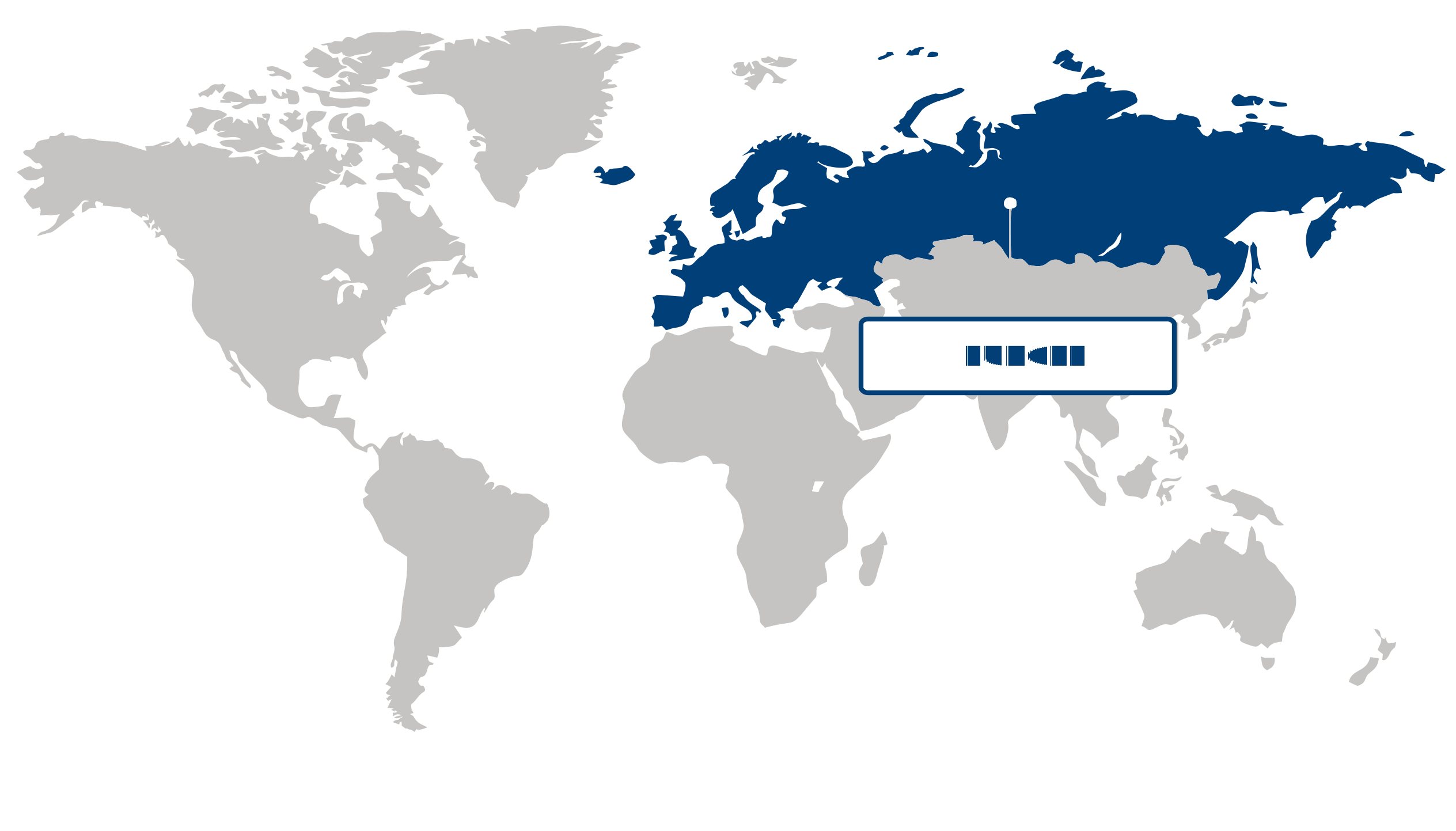
Europe (Largest Region)
Europe accounted for the largest share of the modular kitchen market, representing 35.33% in 2026, supported by strong demand for space-efficient, functional, and aesthetically coordinated residential interiors. Well-established housing and renovation markets, consumer preference for customized kitchen layouts, and growing interest in premium fixtures and integrated storage solutions continue to support adoption. The region’s emphasis on efficient use of residential space, contemporary interior design, and durable materials also encourages consumers to replace conventional kitchen configurations with modular systems. Increasing renovation activity and demand for kitchens that combine design, organization, and practical functionality further strengthen Europe’s established market position.
Asia Pacific (Fastest-Growing Region)
Asia Pacific is the fastest-growing regional market, driven by rapid urbanization, expanding residential construction, changing household lifestyles, and rising consumer spending on modern home interiors. Smaller urban living spaces are increasing the appeal of modular designs that provide efficient storage and flexible layouts, while a growing middle-class population is becoming more receptive to organized and contemporary kitchen solutions. Expanding real estate development and renovation activity are creating additional demand, supported by the wider availability of customizable products through organized retail and digital sales channels. Increasing exposure to modern interior trends and improvements in manufacturing and installation capabilities are also encouraging broader adoption of modular kitchens across the region.
| Parameter | North America | Asia Pacific | Europe | Latin America | MEA |
|---|---|---|---|---|---|
| Innovation Hub i Scale Nascent Developing Advanced | |||||
| Cost-Sensitive Region i Scale Low Medium High | |||||
| Regulatory Environment i Scale Restrictive Neutral Supportive | |||||
| Demand Drivers i Scale Weak Moderate Strong | |||||
| Development Stage i Scale Emerging Developing Developed | |||||
| Adoption Rate i Scale Low Medium High | |||||
| New Entrants / Startups i Scale Sparse Moderate Dense | |||||
| Macro Indicators i Scale Weak Stable Strong |
Key Country Insights
Germany 🇩🇪
Functional Space PlanningGermany prioritizes modular kitchen solutions that combine ergonomic layouts, precision engineering, and long-lasting materials. German consumers increasingly value efficient storage systems and sustainable product designs suited to modern residential spaces.
France 🇫🇷
Premium Lifestyle KitchensFrance favors modular kitchens that blend sophisticated design with durable materials and tailored storage solutions. Suppliers in France increasingly introduce customizable collections that reflect changing consumer preferences for aesthetics and efficient home organization.
Italy 🇮🇹
Design-Centric CraftsmanshipItaly's modular kitchen market combines contemporary styling with established furniture manufacturing expertise. Italian producers invest in premium finishes, innovative layouts, and high-quality materials that support both domestic demand and international design appeal.
Japan 🇯🇵
Compact Urban SolutionsJapan emphasizes modular kitchens designed for compact homes where efficient space utilization is essential. Manufacturers in Japan develop multifunctional cabinetry and streamlined layouts that maximize usability while maintaining premium aesthetics.
South Korea 🇰🇷
Contemporary Interior AppealSouth Korea's modular kitchen market benefits from strong demand for modern interiors and premium residential developments. Kitchen manufacturers in South Korea focus on minimalist designs, integrated appliances, and customized configurations that enhance everyday functionality.
United States 🇺🇸
Smart Living DesignsThe U.S. modular kitchen market is shaped by demand for customized layouts, premium finishes, and integrated smart appliances. Manufacturers in the U.S. continue expanding flexible design solutions that address renovation activity and evolving residential lifestyles.
Segment Leadership and Growth Trends
Modular Kitchen Market Share (%), by Application, 2026
Go beyond the chart, access full insights & data tables
Request Free Sample ReportApplication Segment Analysis: Residential (Largest Segment) vs Commercial (Fastest-Growing Segment)
The residential segment dominated the modular kitchen market, accounting for a 76.1% share in 2026, supported by growing consumer preference for organized, space-efficient, and aesthetically coordinated kitchen environments. Modular designs offer flexibility in layout, storage optimization, and customization, making them well suited to modern residential spaces. Increasing urbanization, changing housing preferences, and greater attention to interior design are encouraging households to invest in professionally designed kitchen solutions. The ability to integrate appliances, storage systems, and functional work areas within a structured design further strengthens demand across residential applications.
Commercial applications are expected to expand at the fastest pace as hospitality, foodservice, corporate, and other commercial establishments increasingly prioritize efficient kitchen layouts and streamlined operations. Modular kitchen systems can facilitate standardized installation, effective space utilization, and easier maintenance, supporting operational efficiency in commercial environments. Growing investment in hospitality and foodservice infrastructure is creating additional demand for flexible kitchen configurations. The need for durable and functional kitchen systems that can accommodate intensive usage is further supporting adoption in commercial settings.
Distribution Segment Analysis: Offline (Largest Segment) vs Online (Fastest-Growing Segment)
The offline segment held the largest share of the modular kitchen market at 80.56% in 2026, reflecting the importance of physical consultation and direct evaluation in kitchen purchasing decisions. Consumers often prefer to inspect materials, finishes, storage configurations, and fittings before committing to a customized kitchen solution. Offline channels also allow customers to interact with designers and receive personalized recommendations based on available space and functional requirements. Established showroom networks and the consultative nature of modular kitchen purchases continue to reinforce the segment's leading position.
The online segment is projected to witness the fastest growth as digital platforms increasingly simplify product discovery, design visualization, customization, and customer engagement. Online channels allow consumers to explore multiple design options and compare materials, configurations, and pricing before initiating a purchase. Digital visualization tools can also help buyers assess how modular layouts may fit within their available space. Growing digital adoption and increasing consumer comfort with researching high-value home improvement products online are supporting the expansion of this distribution channel.
| Segment | Sub-Segment | Largest Segment | Fastest Growing |
|---|---|---|---|
| Application | Residential, Commercial | Residential | Commercial |
| Distribution | Offline, Online | Offline | Online |
| Product | Floor Cabinet, Water Cabinet, Tall Storage Cabinets | Floor Cabinet | Tall Storage Cabinets |
| Layout | L-Shape, U-Shape, Parallel, Straight, Island, Others | L-Shape | Parallel |
Competitive Landscape and Market Positioning
Leading companies in the modular kitchen market:
1. IKEA Group (Netherlands)
2. nobilia-Werke J. Stickling GmbH & Co. KG (Germany)
3. Häcker Küchen GmbH & Co. KG (Germany)
4. Poggenpohl Möbelwerke GmbH (Germany)
5. SieMatic Möbelwerke GmbH & Co. KG (Germany)
6. Bulthaup GmbH & Co KG (Germany)
7. Snaidero Rino S.p.A. (Italy)
8. Hettich Holding GmbH & Co. oHG (Germany)
9. Pedini S.p.A. (Italy)
10. Lineadecor Mobilya Sanayi ve Ticaret A.Åž. (Turkey)
In the modular kitchen market, design preferences are increasingly shaped by evolving urban living patterns and demand for space optimization. The rise of smart manufacturing tools and digital design integration is influencing customization levels, while new modular kitchen market offerings continue to emphasize functionality and aesthetics. Collaborative design ecosystems between manufacturers and design specialists are also supporting faster innovation cycles and more personalized layouts.
| Company | Market Share | Company Revenue | Revenue CAGR (%) | Product Portfolio | Geographic Presence | Innovation / R&D Focus | Strategic Developments |
|---|---|---|---|---|---|---|---|
| IKEA Group (Netherlands) | |||||||
| nobilia-Werke J. Stickling GmbH & Co. KG (Germany) | |||||||
| Häcker Küchen GmbH & Co. KG (Germany) | |||||||
| Poggenpohl Möbelwerke GmbH (Germany) | |||||||
| SieMatic Möbelwerke GmbH & Co. KG (Germany) | |||||||
| Bulthaup GmbH & Co KG (Germany) | |||||||
| Snaidero Rino S.p.A. (Italy) | |||||||
| Hettich Holding GmbH & Co. oHG (Germany) | |||||||
| Pedini S.p.A. (Italy) | |||||||
| Lineadecor Mobilya Sanayi ve Ticaret A.Ş. (Turkey). |
Industry Development/News
| Company Name | Date | Key Development |
|---|---|---|
| Blum | Mar-26 | Blum inaugurated an exclusive Solution Centre in Gorakhpur, India, in partnership with Kitchen Pro. This facility serves as a dedicated hub for demonstrating high-end furniture fittings and modular kitchen hardware, significantly expanding the company's regional retail and partner network while improving consumer access to integrated, design-led kitchen interior systems. |
| Interio by Godrej | Jan-26 | Interio by Godrej announced a strategic growth initiative targeting a 10% CAGR in the modular kitchen segment through fiscal year 2030. The company is prioritizing expansion into tier 2 and tier 3 cities, backed by increased investment in technology-enabled customization to capture rising demand for modular interiors in India’s residential market. |
| Liebherr | Jul-25 | Liebherr commenced local manufacturing of fully integrated refrigerators in India, engineered to meet specific regional climatic requirements. This move enhances the company’s kitchen appliance portfolio by delivering increased durability and energy efficiency, supporting its ability to provide integrated kitchen solutions and strengthening its competitive standing through localized production capabilities. |
| Nolte Küchen | Mar-25 | Nolte Küchen committed $2 million to accelerate its market penetration in India. The investment focuses on the development of flagship showrooms, expansion of its distribution network, and local workforce training. This structured approach aims to establish the firm as a leading European modular kitchen brand within the Indian premium residential interior ecosystem. |
| BSH Home Appliances | Dec-24 | BSH Home Appliances opened a new Siemens Experience Centre in Bengaluru to showcase its premium integrated kitchen and home appliances. This interactive retail space is designed to facilitate deeper consumer engagement with built-in appliance ecosystems, reinforcing the Siemens brand’s positioning within the high-end modular kitchen and smart home segment in India. |
Customize Your Report
Explore examples of how this report can be tailored to different research needs, including custom segments, additional topics or chapters, and related reports. Click a section of the wheel or its numbered marker to explore the available options.
Modular Kitchen Market — Custom Segments
| Segment | Sub-Segment |
|---|---|
| Material | Wood-Based Materials, Metal, Glass, Acrylic, Other Materials |
| Price Tier | Economy, Mid-Range, Premium |
| Project Type | New Construction, Kitchen Renovation, Replacement and Remodeling |
Modular Kitchen Market — Custom TOC
| Custom Chapter | Custom Details |
|---|---|
| Consumer Lifestyle and Kitchen Design Evolution |
|
| Smart Kitchen Integration Opportunity Assessment |
|
| Premiumization and Customization Trends Analysis |
|
Need a different cut of the data?
Request Custom ResearchWhat is the market size of modular kitchen?
What is the anticipated CAGR of the modular kitchen industry?
How is rising residential construction and income growth influencing modular kitchen adoption?
How are smart kitchens and open-plan designs reshaping modular kitchen demand?
Why does the residential segment dominate the modular kitchen market?
Which distribution channel is growing the fastest in the modular kitchen market?
Why does Europe hold the largest share of the modular kitchen market?
Why is Asia Pacific the fastest-growing modular kitchen market?
Which organizations are considered leaders in the modular kitchen landscape?
Our Clients
"The report provided us with a clear direction, and the level of detail was beyond what we expected. I would definitely recommend their services to others."
Haier Appliances
"The collaboration with Fundamental Business Insights has added significant value to our decision-making process, and we look forward to continuing this partnership for our future market research requirements."
Luxottica Group S.p.A.
"The team at FBI delivered an exceptional research report. The insights on industry innovations were particularly impressive and added a lot of value to the overall report."
Nike
Our Research Team & Methodology
Every Fundamental Business Insights report is built by a dedicated vertical research team, validated through a structured primary-and-secondary methodology, and reviewed for accuracy before it reaches you.
Research Team Overview
Prepared by the Consumer Goods & Services Research Team
Delivery
Published
Demand
Available
Support
Trust & Compliance
Research Domains
10 coverage areasResearch Intelligence
| Source | Reference |
|---|---|
| International Organization for Standardization (ISO) | www.iso.org |
| ASTM International | www.astm.org |
| U.S. Consumer Product Safety Commission (CPSC) | www.cpsc.gov |
| European Commission – Consumer Safety | ec.europa.eu/safety-gate |
| Consumer Technology Association (CTA) | www.cta.tech |
| National Retail Federation (NRF) | nrf.com |
| World Retail Congress | www.worldretailcongress.com |
| World Travel & Tourism Council (WTTC) | wttc.org |
| UN Tourism | www.unwto.org |
| Personal Care Products Council (PCPC) | www.personalcarecouncil.org |
| Cosmetics Europe | cosmeticseurope.eu |
| International Housewares Association (IHA) | www.housewares.org |
| American Apparel & Footwear Association (AAFA) | www.aafaglobal.org |
| World Federation of the Sporting Goods Industry (WFSGI) | wfsgi.org |
| Juvenile Products Manufacturers Association (JPMA) | www.jpma.org |
| Pet Industry Joint Advisory Council (PIJAC) | pijac.org |
| International Council of Toy Industries (ICTI) | www.toy-icti.org |
| International Association of Amusement Parks and Attractions (IAAPA) | iaapa.org |
| Organisation for Economic Co-operation and Development (OECD) | www.oecd.org |
| World Bank Data | data.worldbank.org |
Research Workflow & Quality Assurance
Data Collection
Verified information gathered through primary and secondary research.
Data Triangulation
Cross-validation using multiple independent data sources.
Forecast Modelling
Market estimates developed using historical trends and analytical models.
Analyst Validation
Findings reviewed by domain experts for accuracy and consistency.
Editorial & Quality Review
Final editorial, quality, and compliance checks before publication.
Final Publication
Released after successful completion of the internal review process.
Report Coverage
📊 Market Assessment
- Market Size & Forecast
- Market Segmentation
- Regional Analysis
- Growth Drivers & Challenges
- Market Dynamics
🏢 Competitive Intelligence
- Competitive Landscape
- Company Profiles
- Competitive Benchmarking
- Mergers & Acquisitions
- Market Share Analysis or Key Company Strategies
🔍 Strategic Analysis
- Value Chain Analysis
- Porter's Five Forces
- PESTLE Analysis
- Pricing Trends
- Supply-Demand Analysis
🚀 Future Outlook
- Technology Landscape
- Regulatory Landscape
- Investment & Funding Landscape
- Emerging Opportunities
- Future Market Outlook
Have a question about this report or need a custom scope?
Request Customization