Mild Hybrid Electric Vehicle (MHEV) Market Size & Growth Forecast 2027–2036, By Segments (Capacity, Vehicle, Battery), Regional Demand Trends (North America, Asia Pacific, Europe), Key Country Insights (U.S., Japan, South Korea, Germany, France, Italy), and Competitive Landscape
Market Size and Growth Outlook
Mild Hybrid Electric Vehicle Market size was valued at USD 156.9 Billion in 2026 and is projected to grow at 18.2% CAGR from 2027 to 2036, crossing USD 835.21 Billion by 2036. The industry revenue for 2027 is estimated at USD 181.61 Billion.
Get more details on this report
Request Free Sample ReportMild Hybrid Electric Vehicle (MHEV) Market Intelligence Snapshot
Regional Market Dynamics
- Asia Pacific accounted for 50.88% in 2026, supported by its large automotive manufacturing base, expanding vehicle demand, and focus on fuel efficiency and electrification.
- Europe is projected to grow fastest as stringent emissions requirements, environmental priorities, and investments in powertrain electrification encourage wider MHEV integration.
Segment Momentum
- The 48 V and above segment held 60.42% share in 2026 due to improved fuel efficiency, regenerative braking, and emissions reduction benefits without full hybrid complexity.
- Passenger cars accounted for 83.3% share in 2026 and remain fastest-growing as consumers and automakers prioritize fuel efficiency, lower emissions, and efficient mobility solutions.
Market Expansion Drivers
- Rising eco-friendly vehicle demand accelerating mild hybrid powertrain adoption globally
- Regulatory incentives and emissions mandates driving hybrid vehicle transition programs
- Rising fuel price volatility increasing consumer shift toward hybrid mobility solutions
Leading Market Participants
- Top players in the mild hybrid electric vehicle market include Toyota Motor Corporation (Japan), Volkswagen AG (Germany), BMW AG (Germany), Mercedes-Benz Group AG (Germany), Ford Motor Company (United States), General Motors Company (United States), Hyundai Motor Company (South Korea), Honda Motor Co., Ltd. (Japan), Robert Bosch GmbH (Germany), BorgWarner Inc. (United States)
Global Market Forecast Snapshot
Market Outlook
- 2026 Market Size: USD 156.9 Billion
- 2027 Estimated Market Size: USD 181.61 Billion
- Projected Market Size: USD 835.21 Billion by 2036
- Growth Forecast: 18.2% CAGR (2027-2036)
Regional and Segment Outlook
- Leading Regional Market: Asia Pacific
- High-Growth Regional Hub: Europe
- Core Revenue Segment: 48 V and Above (Capacity) | Passenger Cars (Vehicle) | Lithium-ion (Battery)
- Emerging Opportunity Segment: 48 V and Above (Capacity) | Passenger Cars (Vehicle) | Lithium-ion (Battery)
Market Growth Drivers and Industry Trends
Rising eco-friendly vehicle demand accelerating mild hybrid powertrain adoption globally
Growing consumer and fleet interest in lower-emission mobility is supporting the mild hybrid electric vehicle market as buyers seek more efficient alternatives without the cost and charging requirements associated with fully electric powertrains. Mild hybrid systems combine an internal combustion engine with electrical assistance to support functions such as acceleration, regenerative braking, engine start-stop, and auxiliary power management. This configuration can improve fuel efficiency while allowing manufacturers to retain familiar refueling infrastructure and established engine platforms. The technology is particularly attractive in markets where consumers want incremental reductions in fuel consumption and emissions but remain hesitant to transition directly to battery-electric vehicles. Automakers can also integrate mild hybrid systems across existing vehicle architectures with comparatively limited changes to established manufacturing processes, making the technology relevant across multiple passenger and commercial vehicle segments.
Regulatory incentives and emissions mandates driving hybrid vehicle transition programs
Government policies focused on reducing vehicle emissions are encouraging automakers to incorporate electrification technologies into their product portfolios, creating favorable conditions for the mild hybrid electric vehicle market. Emissions requirements place pressure on manufacturers to improve fleet-level efficiency, while incentives and transition programs can reduce the commercial barriers associated with introducing hybridized powertrains. Mild hybrid systems provide manufacturers with a practical pathway for improving vehicle efficiency while continuing to use internal combustion engines, enabling gradual progression toward more electrified fleets. Regulatory pressure can also encourage investment in common electrical architectures, regenerative braking systems, and energy-management technologies that support broader hybrid deployment. As automakers balance compliance requirements with consumer demand, mild hybrid platforms can serve as an intermediate technology within multi-stage vehicle electrification strategies.
Rising fuel price volatility increasing consumer shift toward hybrid mobility solutions
Uncertainty surrounding fuel costs is making operating efficiency a more important consideration for vehicle buyers and commercial operators, strengthening demand for the mild hybrid electric vehicle market. Mild hybrid powertrains can reduce fuel consumption through regenerative energy recovery, engine assistance, and automated engine shutdown during suitable driving conditions, helping users manage exposure to fuel-cost fluctuations. For high-mileage drivers and fleets, even incremental improvements in fuel utilization can influence vehicle ownership economics and operating budgets. The technology also provides an accessible efficiency upgrade for consumers who may not have convenient access to charging infrastructure or who prefer the flexibility of conventional refueling. As fuel expenditure remains a significant component of vehicle operating costs, efficiency-focused powertrain features are becoming increasingly important in purchasing and fleet replacement decisions.
| Growth Driver | Impact on CAGR | Regulatory Influence | Geographic Relevance | Adoption Rate | Impact Timeline |
|---|---|---|---|---|---|
| Rising eco-friendly vehicle demand accelerating mild hybrid powertrain adoption globally | 2% | High | Europe, Asia Pacific | High | Near Term |
| Regulatory incentives and emissions mandates driving hybrid vehicle transition programs | 1.9% | High | Europe, North America | High | Near Term |
| Rising fuel price volatility increasing consumer shift toward hybrid mobility solutions | 1.7% | Moderate | Asia Pacific, Latin America | High | Mid Term |
Unlock insights tailored to your business with our bespoke market research solutions.
Click to get your customized report now.
Regional Demand Dynamics
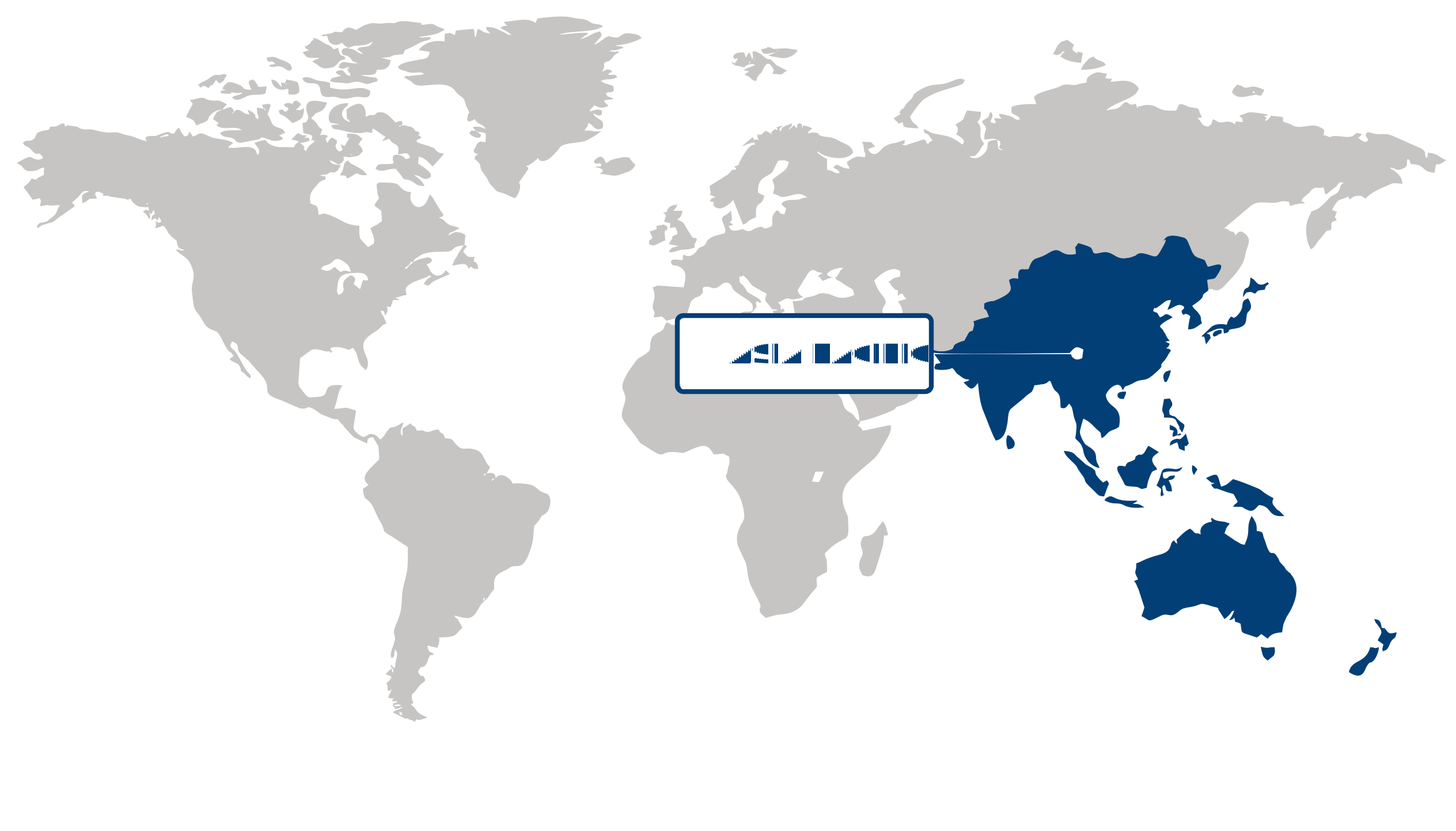
Asia Pacific (Largest Region)
Asia Pacific represented the largest share of 50.88% in the mild hybrid electric vehicle (MHEV) market in 2026, supported by its large automotive manufacturing base, expanding vehicle demand, and increasing focus on improving fuel efficiency. Automakers and consumers are showing greater interest in technologies that can reduce fuel consumption and emissions while requiring less extensive changes to conventional powertrain architectures. The region's growing automotive production capabilities, rising environmental awareness, and increasing adoption of vehicle electrification technologies are strengthening demand for mild hybrid systems. Regulatory efforts to improve vehicle efficiency and reduce emissions are also encouraging manufacturers to incorporate electrified powertrain components into a broader range of vehicles.
Europe (Fastest-Growing Region)
Europe is projected to experience the fastest growth, driven by stringent emissions-reduction requirements, strong environmental priorities, and the automotive industry's accelerating transition toward electrified mobility. Mild hybrid systems provide manufacturers with a practical pathway to improve vehicle efficiency and reduce emissions while supporting continued development of internal combustion engine platforms. Growing consumer interest in fuel-efficient vehicles, combined with investments in advanced automotive technologies and powertrain electrification, is creating favorable market conditions. The region's established automotive engineering capabilities and regulatory emphasis on cleaner transportation are expected to further encourage the integration of MHEV technology across vehicle segments.
| Parameter | North America | Asia Pacific | Europe | Latin America | MEA |
|---|---|---|---|---|---|
| Innovation Hub i Scale Nascent Developing Advanced | |||||
| Cost-Sensitive Region i Scale Low Medium High | |||||
| Regulatory Environment i Scale Restrictive Neutral Supportive | |||||
| Demand Drivers i Scale Weak Moderate Strong | |||||
| Development Stage i Scale Emerging Developing Developed | |||||
| Adoption Rate i Scale Low Medium High | |||||
| New Entrants / Startups i Scale Sparse Moderate Dense | |||||
| Macro Indicators i Scale Weak Stable Strong |
Key Country Insights
United States 🇺🇸
Fleet Efficiency FocusThe U.S. market emphasizes mild hybrid electric vehicles as automakers balance fuel efficiency improvements with affordability across passenger vehicles and light trucks. Demand is supported by fleet operators and manufacturers seeking practical electrification without major charging infrastructure dependence.
Germany 🇩🇪
Premium Powertrain IntegrationGermany prioritizes MHEV technology within premium vehicle portfolios to enhance efficiency while maintaining driving performance. Domestic manufacturers continue integrating 48-volt systems across multiple vehicle segments to meet evolving emissions and product development objectives.
Japan 🇯🇵
Compact Mobility InnovationJapan incorporates MHEV systems into compact and mid-sized vehicles where fuel economy and urban usability remain important purchasing factors. Local automakers focus on refining lightweight hybrid architectures that complement existing electrification strategies.
South Korea 🇰🇷
Technology Platform ExpansionSouth Korea continues expanding MHEV adoption through advanced vehicle platforms that combine digital electronics with efficient powertrain technologies. Domestic manufacturers emphasize scalable electrification solutions suitable for both domestic sales and export markets.
France 🇫🇷
Emissions Compliance StrategyFrance supports MHEV deployment as manufacturers adapt product portfolios to stricter vehicle emissions expectations while preserving affordability. Automotive suppliers and OEMs increasingly integrate efficient hybrid components into mainstream passenger vehicle offerings.
Italy 🇮🇹
Performance Efficiency BalanceItaly applies MHEV technology across passenger vehicles where efficiency improvements are combined with responsive driving characteristics. Vehicle manufacturers are incorporating compact hybrid systems that align with consumer demand for practical electrified mobility solutions.
Segment Leadership and Growth Trends
Mild Hybrid Electric Vehicle (MHEV) Market Share (%), by Capacity, 2026
Go beyond the chart, access full insights & data tables
Request Free Sample ReportCapacity Segment Analysis: 48 V and Above (Largest & Fastest-Growing Segment)
The 48 V and above capacity segment accounted for 60.42% of the mild hybrid electric vehicle market in 2026 and also emerged as the fastest-growing segment. The widespread adoption of 48V architectures is driven by their ability to deliver improved fuel efficiency, enhanced start-stop functionality, regenerative braking capabilities, and better power assistance without the complexity associated with full hybrid systems. Automakers increasingly favor these systems as they provide a practical pathway to reduce vehicle emissions while maintaining affordability and performance. Growing regulatory pressure for lower emissions and increasing consumer demand for fuel-efficient vehicles continue to strengthen the adoption of 48V and above mild hybrid technologies across global automotive markets.
Vehicle Segment Analysis: Passenger Cars (Largest & Fastest-Growing Segment)
Passenger cars dominated the mild hybrid electric vehicle market with a share of 83.3% in 2026 and continue to represent the fastest-growing vehicle segment. The dominance of passenger cars is supported by the high volume of personal vehicle ownership and the increasing integration of mild hybrid systems into mainstream vehicle models. Consumers are increasingly seeking vehicles that offer improved fuel economy and reduced environmental impact without significant changes to driving habits. In addition, manufacturers are expanding their mild hybrid passenger car portfolios to comply with evolving emissions standards and meet growing demand for efficient mobility solutions, reinforcing the segment’s leading position and growth trajectory.
Battery Segment Analysis: Lithium-ion (Largest & Fastest-Growing Segment)
In the mild hybrid electric vehicle market, the lithium-ion battery segment held the largest share in 2026 and is also the fastest-growing battery category. Lithium-ion batteries are widely preferred due to their high energy efficiency, lightweight design, fast charging characteristics, and long operational lifespan. These attributes make them particularly suitable for supporting functions such as energy recuperation, electric boosting, and advanced vehicle electrification features. Continuous advancements in battery technology, coupled with increasing investments in vehicle electrification, are further enhancing the performance and cost-effectiveness of lithium-ion batteries, driving their widespread adoption in mild hybrid vehicle platforms.
| Segment | Sub-Segment | Largest Segment | Fastest Growing |
|---|---|---|---|
| Capacity | Less Than 48V, 48 V and Above | 48 V and Above | 48 V and Above |
| Vehicle | Passenger Cars, Commercial Vehicles | Passenger Cars | Passenger Cars |
| Battery | Lithium-ion, Lead Acid, Others | Lithium-ion | Lithium-ion |
Competitive Landscape and Market Positioning
Leading companies in the mild hybrid electric vehicle (MHEV) market:
- Toyota Motor Corporation (Japan)
- Volkswagen AG (Germany)
- BMW AG (Germany)
- Mercedes-Benz Group AG (Germany)
- Ford Motor Company (United States)
- General Motors Company (United States)
- Hyundai Motor Company (South Korea)
- Honda Motor Co., Ltd. (Japan)
- Robert Bosch GmbH (Germany)
- BorgWarner, Inc. (United States)
The mild hybrid electric vehicle market is evolving as automakers compete to deliver improved efficiency while navigating the transition between conventional and fully electrified mobility solutions. Competitive strategies are increasingly centered on optimizing hybrid architectures, reducing fuel consumption, and integrating electrification technologies without significantly increasing vehicle complexity or cost. Manufacturers with established powertrain expertise are refining system performance, while newer mobility players are contributing through specialized electrification components and software-driven improvements. The market’s competitive direction is being shaped by the ability to provide practical electrified solutions that align with regulatory requirements, consumer expectations, and broader vehicle modernization trends.
| Company | Market Share | Company Revenue | Revenue CAGR (%) | Product Portfolio | Geographic Presence | Innovation / R&D Focus | Strategic Developments |
|---|---|---|---|---|---|---|---|
| Toyota Motor Corporation (Japan) | |||||||
| Volkswagen AG (Germany) | |||||||
| BMW AG (Germany) | |||||||
| Mercedes-Benz Group AG (Germany) | |||||||
| Ford Motor Company (United States) | |||||||
| General Motors Company (United States) | |||||||
| Hyundai Motor Company (South Korea) | |||||||
| Honda Motor Co. Ltd. (Japan) | |||||||
| Robert Bosch GmbH (Germany) | |||||||
| BorgWarner Inc. (United States) |
Industry Development/News
| Company Name | Date | Key Development |
|---|---|---|
| Jaguar Land Rover (JLR) | Jun-26 | Jaguar Land Rover announced an £18 billion investment strategy focusing on flexible powertrain architectures, including mild hybrid options. The company reversed its previous all-electric mandate to address shifting market demands, driving long-term operational shifts and revenue targets in North America. |
| Audi | Jun-26 | Audi expanded its large SUV portfolio by introducing the third-generation Q7 equipped with an MHEV Plus diesel powertrain. The launch integrates advanced mild-hybrid technical capabilities to sustain its internal combustion engine segments while optimizing overall fleet emissions. |
| Bermaz Auto Bhd | Jun-26 | Bermaz Auto expanded its product portfolio through the commercial launch of the Mazda CX-60 3.3L MHEV, capturing rising consumer demand within the hybrid SUV segment and intensifying localized market competition. |
| Audi | Nov-25 | Audi advanced its component technology infrastructure by launching a new V6 diesel powertrain featuring an integrated belt alternator starter, electric compressor, and powertrain generator. The architectural rollout improves fuel optimization across core vehicle lines. |
| Toyota | Jun-25 | Toyota commercialized its 48V mild hybrid architecture globally via the Land Cruiser Prado, incorporating an integrated motor-generator, battery, and DC-DC converter. The rollout expands the company's electrified utility portfolio to address regulatory efficiency mandates. |
| Audi | Apr-25 | Audi initiated localized assembly of the Q7 SUV at the DRB-Hicom facility in Pekan, Malaysia, establishing its initial manufacturing footprint in Southeast Asia. The supply chain project scales regional production capacity up to 5,000 units annually. |
| Jeep | Mar-25 | Jeep finalized structural changes for the South American market by integrating a new MHEV powertrain system into its upcoming Renegade vehicle update, scaling regional product availability and localized technology options. |
| Land Rover | Aug-24 | Land Rover expanded its high-performance SUV segment by introducing the Range Rover Sport SV Edition Two, deploying integrated mild-hybrid technology to reinforce its premium electrified portfolio. |
| Maruti Suzuki | Jan-24 | Maruti Suzuki modified its product architecture by reintroducing its 1.5-liter K15C mild-hybrid engine technology exclusively into the higher-spec manual variants of the Brezza SUV, reversing a previous technology discontinuation to alter its competitive positioning. |
Customize Your Report
Explore examples of how this report can be tailored to different research needs, including custom segments, additional topics or chapters, and related reports. Click a section of the wheel or its numbered marker to explore the available options.
Mild Hybrid Electric Vehicle (MHEV) Market — Custom Segments
| Segment | Sub-Segment |
|---|---|
| Powertrain Configuration | Belt-driven Starter Generator (BSG), Integrated Starter Generator (ISG), Crankshaft-mounted Starter Generator |
| Engine Configuration | Gasoline, Diesel |
| Vehicle Price Category | Economy, Mid-range, Premium |
Mild Hybrid Electric Vehicle (MHEV) Market — Custom TOC
| Custom Chapter | Custom Details |
|---|---|
| Powertrain Electrification Roadmap Assessment |
|
| OEM Platform Migration Strategy |
|
| Component Sourcing and Localization Outlook |
|
Need a different cut of the data?
Request Custom ResearchHow much is the mild hybrid electric vehicle (MHEV) market worth?
How is the mild hybrid electric vehicle industry expected to grow over the next 10 years?
Why are mild hybrid systems gaining traction as a transitional electrification technology?
How are fuel costs and emissions policies influencing MHEV purchasing and investment?
Why is the 48 V and above capacity segment leading MHEV adoption?
How are passenger cars shaping growth in the MHEV market?
What makes Asia Pacific the leading MHEV market?
Why is Europe expected to see the fastest MHEV growth?
What are the key competitors in the mild hybrid electric vehicle landscape?
Our Clients
"The team surpassed our expectations with the report depth. The actionable insights provided proved crucial in navigating market challenges."
Tata Motors
"We found the report to be very informative. The expertise and attention to market nuances significantly influenced our business direction."
DENSO Corporation
"The consumer survey findings were quite good. We now have a clearer picture of the customer churning and retention strategy."
HL Mando
Our Research Team & Methodology
Every Fundamental Business Insights report is built by a dedicated vertical research team, validated through a structured primary-and-secondary methodology, and reviewed for accuracy before it reaches you.
Research Team Overview
Prepared by the Automotive & Transportation Research Team
Delivery
Published
Demand
Available
Support
Trust & Compliance
Research Domains
10 coverage areasResearch Intelligence
| Source | Reference |
|---|---|
| International Organization of Motor Vehicle Manufacturers (OICA) | www.oica.net |
| SAE International | www.sae.org |
| International Energy Agency (IEA) | www.iea.org |
| International Transport Forum (ITF) | www.itf-oecd.org |
| International Road Federation (IRF) | www.irf.global |
| International Organization for Standardization (ISO) | www.iso.org |
| United Nations Economic Commission for Europe (UNECE) | unece.org |
| National Highway Traffic Safety Administration (NHTSA) | www.nhtsa.gov |
| U.S. Department of Transportation (USDOT) | www.transportation.gov |
| European Automobile Manufacturers' Association (ACEA) | www.acea.auto |
| Society of Indian Automobile Manufacturers (SIAM) | www.siam.in |
| International Air Transport Association (IATA) | www.iata.org |
| International Civil Aviation Organization (ICAO) | www.icao.int |
| International Maritime Organization (IMO) | www.imo.org |
| International Union of Railways (UIC) | uic.org |
| American Public Transportation Association (APTA) | www.apta.com |
| International Federation of Robotics (IFR) | ifr.org |
| CharIN | www.charin.global |
| World Shipping Council | www.worldshipping.org |
| International Federation of Freight Forwarders Associations (FIATA) | fiata.org |
Research Workflow & Quality Assurance
Data Collection
Verified information gathered through primary and secondary research.
Data Triangulation
Cross-validation using multiple independent data sources.
Forecast Modelling
Market estimates developed using historical trends and analytical models.
Analyst Validation
Findings reviewed by domain experts for accuracy and consistency.
Editorial & Quality Review
Final editorial, quality, and compliance checks before publication.
Final Publication
Released after successful completion of the internal review process.
Report Coverage
📊 Market Assessment
- Market Size & Forecast
- Market Segmentation
- Regional Analysis
- Growth Drivers & Challenges
- Market Dynamics
🏢 Competitive Intelligence
- Competitive Landscape
- Company Profiles
- Competitive Benchmarking
- Mergers & Acquisitions
- Market Share Analysis or Key Company Strategies
🔍 Strategic Analysis
- Value Chain Analysis
- Porter's Five Forces
- PESTLE Analysis
- Pricing Trends
- Supply-Demand Analysis
🚀 Future Outlook
- Technology Landscape
- Regulatory Landscape
- Investment & Funding Landscape
- Emerging Opportunities
- Future Market Outlook
Have a question about this report or need a custom scope?
Request Customization