Microwave Equipment Market Size & Forecasts 2026-2035, By Segments (Technology, Vertical), Growth Opportunities, Innovation Landscape, Regulatory Shifts, Strategic Regional Insights (U.S., Japan, China, South Korea, UK, Germany, France), and Competitive Dynamics (Keysight Technologies, Pentek, Anritsu, Rohde & Schwarz, National Instruments)
Market Size and Growth Outlook
Microwave Equipment Market size is anticipated to rise from USD 8.68 billion in 2025 to USD 15.99 billion by 2035, reflecting a CAGR surpassing 6.3% over the forecast horizon of 2026-2035. The estimated revenue for 2026 is USD 9.16 billion.
Get more details on this report
Request Free Sample ReportMicrowave Equipment Market Intelligence Snapshot
Regional Market Dynamics
Segment Momentum
Market Expansion Drivers
Leading Market Participants
Global Market Forecast Snapshot
Market Outlook
Regional and Segment Outlook
Market Growth Drivers and Industry Trends
Rapid rollout of 5G infrastructure, renewed defense procurements, and constellations of low‑earth‑orbit satellites are expanding demand for RF front ends and hardened transceivers, directly lifting the microwave equipment market. Ericsson and Nokia public roadmaps for 5G mid‑ and high‑band radio access networks, SpaceX’s Starlink deployments, and modernization programs at Lockheed Martin and the U.S. Department of Defense illustrate explicit, mission‑critical demand for higher‑frequency, reliable microwave subsystems. Incumbents can scale production and offer integrated RF modules tied to system vendors, while newcomers can specialize in niche high‑frequency components or ruggedized solutions. Given ongoing commercial 5G rollouts and defense recapitalization programs, procurement pipelines and multi‑vendor satellite projects will sustain demand for differentiated microwave capabilities.
Advances in Microwave Amplification and Component Technologies
Breakthroughs in GaN power amplifiers, MMIC integration, and compact passive components are improving efficiency and frequency reach, reshaping the microwave equipment market. Product announcements and technical briefs from Qorvo, Analog Devices, and MACOM demonstrate higher power density and thermal performance in GaN‑based amplifiers, while Keysight Technologies’ test solutions enable faster design cycles. These technology lifts reduce system size, cost, and power consumption, creating opportunities for established suppliers to upsell platform‑level RF modules and for startups to introduce focused GaN‑based subsystems. As component roadmaps and test‑and‑measurement support continue to mature, system integrators will increasingly adopt solid‑state, higher‑frequency architectures.
Cross‑sector Expansion in Automotive, Aerospace, and Industrial Applications
Adoption of radar, connectivity, and sensing solutions beyond telecom is driving diversified end‑market pull into the microwave equipment market. Bosch’s automotive radar programs, Airbus and Honeywell avionics upgrades, and Siemens’ industrial sensor initiatives show that mobility, aerospace communication, and process automation are integrating microwave technologies. Large OEMs and Tier‑1 suppliers can leverage scale to bundle microwave subsystems into broader platforms, while agile entrants can target application‑specific modules for ADAS, UAV links, or industrial level sensing. With vehicle electrification, urban air mobility prototypes, and factory digitization visible across announcements, cross‑sector procurement will broaden supplier footprints and accelerate application‑driven product specialization.
Industry Restraints:
Supply Chain Vulnerabilities
Persistent shortages of RF semiconductors, magnetrons, specialized connectors and PCB substrates materially constrain production cadence and cost predictability across microwave equipment segments. The Semiconductor Industry Association (SIA) and multiple vendor disclosures, including Ericsson and Nokia earnings commentary, have documented lead-time expansions and allocation-driven procurement that force prioritization of large OEM contracts over smaller buyers. That dynamic raises working-capital needs and increases time-to-revenue for new product introductions, disadvantaging startups without long-term supply agreements while compressing margins for incumbents who must absorb premium component costs. Expect procurement-driven product sequencing and inventory strategies to remain a central operating lever in the near term as firms pursue dual-sourcing, localized assembly and strategic partnerships to mitigate ongoing bottlenecks.
Export Controls and Regulatory Compliance Burdens
Tighter export controls and equipment authorization regimes are reshaping which vendors can participate in certain national deployments and how quickly products reach markets. The U.S. Bureau of Industry and Security (BIS) Entity List actions affecting Huawei, ongoing Federal Communications Commission (FCC) equipment authorization requirements, and the European Commission’s Radio Equipment Directive (RED) impose testing, documentation and licensing overhead that lengthen time-to-market and increase compliance costs. Large suppliers with global compliance teams can absorb certification timelines and navigate license processes, but smaller suppliers face disproportionate barriers to entry and delayed contracts. These regulatory constraints are likely to sustain vendor consolidation and favor companies that can demonstrate secure supply chains and certified interoperability in the near to medium term.
| Growth Driver | Impact on CAGR | Regulatory Influence | Geographic Relevance | Adoption Rate | Impact Timeline |
|---|---|---|---|---|---|
| Adoption in 5G, defense, and satellite communication networks | 2.50% | Short term (≤ 2 yrs) | North America, Asia Pacific | Medium | Fast |
| Technological advancements in microwave amplification and components | 2.00% | Medium term (2–5 yrs) | Europe, North America | Medium | Moderate |
| Expansion in automotive, aerospace, and industrial applications | 1.80% | Long term (5+ yrs) | Asia Pacific, Europe; Spillover: North America | Low | Slow |
Unlock insights tailored to your business with our bespoke market research solutions.
Click to get your customized report now.
Regional Demand Dynamics
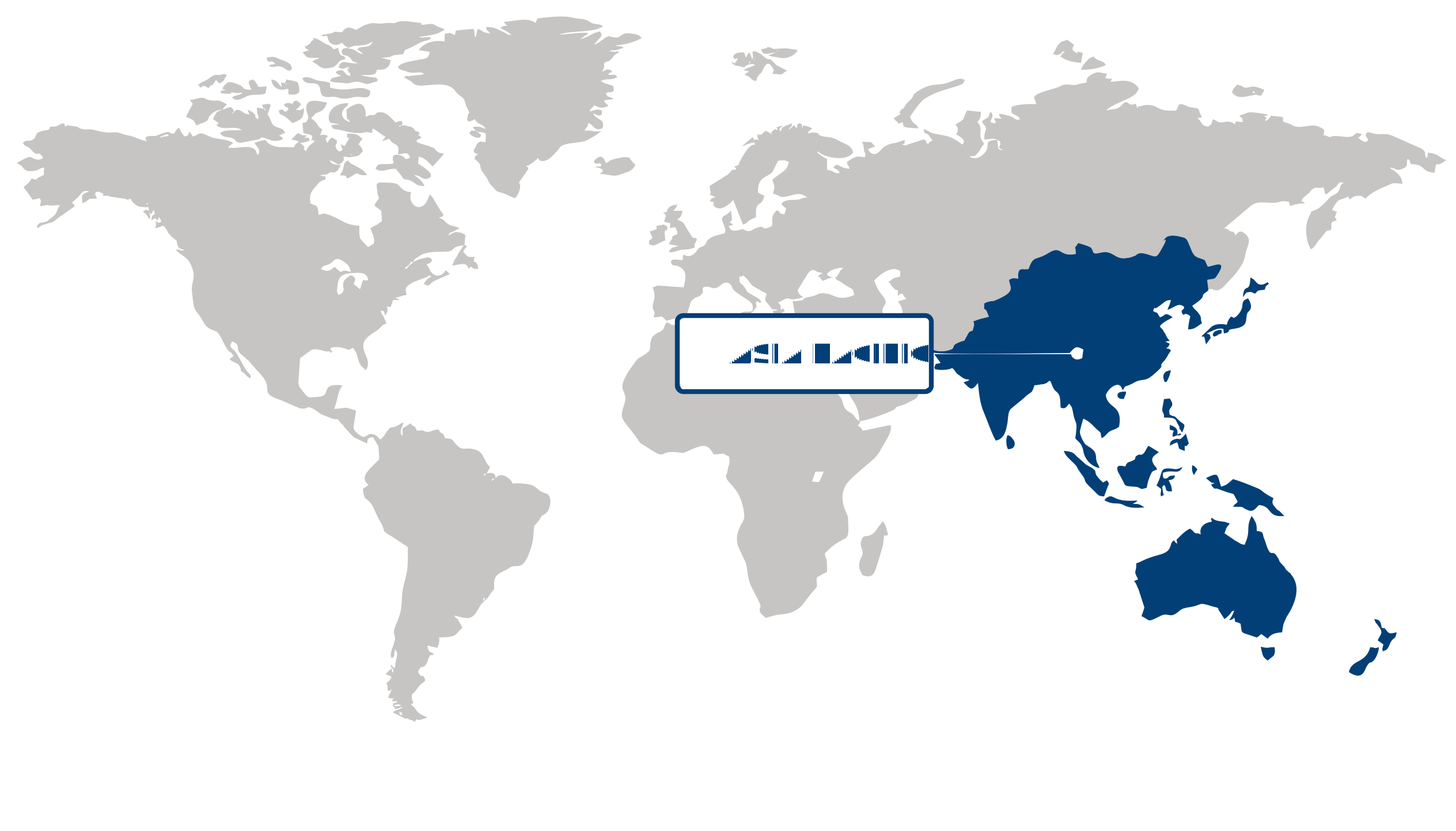
Asia Pacific captured approximately 42% of the global microwave equipment market in 2025 and, with a 7.2% CAGR, is the largest and fastest-growing region. This leadership reflects rapid expansion of mobile networks and targeted rural connectivity initiatives—GSMA Intelligence documents sustained subscriber and mobile broadband growth across APAC, while the Asian Development Bank has financed cross-border and rural digital access projects that require robust backhaul. National programs such as China’s Ministry of Industry and Information Technology scaling 5G infrastructure and Japan’s Ministry of Internal Affairs and Communications supporting rural broadband further accelerate demand. Vendor investments and operator contracts from Huawei, Nokia, and Ericsson for transport and microwave links provide additional commercial proof points. Taken together, continued public funding and operator capex make APAC a high-opportunity market for microwave equipment suppliers focused on backhaul, rural links, and densification.
Japan is positioned as a pivotal hub in Asia Pacific, with the microwave equipment market supported by targeted national programs and premium network upgrades. The Ministry of Internal Affairs and Communications (MIC) has prioritized rural broadband resilience and spectrum policy that favors high-performance backhaul, while operators such as NTT DOCOMO and KDDI are pursuing densification and enterprise 5G use cases that demand microwave transport solutions. NEC Corporation and Fujitsu have recent press releases highlighting microwave/backhaul deployments and integration work with local operators. For suppliers, Japan offers a market for higher-margin, technology-differentiated equipment and trials that can de-risk advanced product introductions for the wider region.
China anchors deployment scale across Asia Pacific, and the microwave equipment market is driven by massive base-station rollouts and state-led connectivity initiatives. The Ministry of Industry and Information Technology (MIIT) has set aggressive targets for 5G coverage and rural connectivity, while China Mobile and China Telecom disclose continued investment in mobile backhaul; Huawei and ZTE remain major suppliers in large commercial contracts. That combination of scale, operator-led demand, and manufacturing capacity creates volume-driven opportunities and pricing pressure—making China a strategic source of production, large-scale deployment projects, and partnerships that reinforce APAC’s regional leadership in microwave equipment.
North America Market Analysis:
North America held a commanding share of the microwave equipment market, driven by large-scale foodservice demand, dense industrial processing activity, and significant defense and telecom procurement that concentrate buying power and innovation in the region. Strong chains and commercial kitchens—underscored by data-led demand trends cited by the National Restaurant Association—fuel demand for reliable commercial microwaves, while advanced manufacturers reported by the U.S. Census Bureau sustain industrial adoption of microwave heating and drying systems. Spectrum policy actions by the Federal Communications Commission and procurement priorities from the U.S. Department of Defense further elevate demand for high-performance microwave components. These combined dynamics, alongside regulatory oversight from the U.S. Food and Drug Administration on medical and consumer devices, create a resilient market environment with clear upgrade and retrofit opportunities for suppliers and integrators.
The U.S. serves as the regional innovation and procurement hub for the microwave equipment market, with diverse end-use pull from quick-service restaurants to defense primes and health labs. Large buyers and specification-driven contracts—observable in Department of Defense procurement notices and procurement-led partnerships by firms such as Raytheon Technologies—accelerate adoption of higher-spec microwave subsystems, while consumer and commercial appliance leaders like Panasonic Corporation of North America and Whirlpool Corporation illustrate scale-driven product rollouts. Regulatory guidance from the U.S. Food and Drug Administration shapes product compliance in medical and food-contact applications, and Federal Communications Commission actions influence backhaul and telecom microwave demand. For investors and strategists, the U.S. position amplifies regional growth potential by concentrating demand, technical expertise, and procurement channels that suppliers can target to scale across North America.
Europe Market Trends:
Maintained a notable presence, the microwave equipment market in North America is experiencing moderate growth driven by concurrent defense modernization, phased 5G infrastructure upgrades, and industrial electrification that increase demand for RF components and thermal-processing systems. Evidence includes Federal Communications Commission (FCC) spectrum policies enabling mmWave deployments, U.S. Department of Energy (DOE) programs encouraging energy-efficient industrial equipment, and vendor contract announcements such as Lockheed Martin and L3Harris press releases on radar and microwave subsystems. Supply-chain resilience actions by manufacturers and coverage in Microwave Journal further underline commercial traction. Continued network upgrades and sustained defense procurements position the region for steady, diversified opportunities in components, test gear, and systems integration.
The United States remains the dominant adopter, and the microwave equipment market in the U.S. is shaped by large-scale defense buys, test-and-measurement demand, and carrier-led 5G densification. U.S. Department of Defense procurement notices and Federal Communications Commission (FCC) rulemaking create predictable procurement corridors, while company disclosures from Keysight Technologies and Qualcomm illustrate rising orders for test equipment and RF front-end technologies. Strong aerospace manufacturing clusters and venture activity support rapid productization, implying that U.S. procurement cycles and supplier networks will drive regional supplier scale and innovation.
Canada plays a strategic niche role, and the microwave equipment market in Canada grows around specialized industrial heating, remote sensing, and space/defense subsystems. References include Defence Research and Development Canada (DRDC) projects, National Research Council Canada collaborations on radar and sensing, and corporate activity from Canadian suppliers such as MDA in space-related microwave payloads. Smaller manufacturing footprints and targeted government R&D support favor high-value subsystems and OEM partnerships, offering complementary opportunities for North American supply chains to source innovation and scale across adjacent markets.
| Parameter | North America | Asia Pacific | Europe | Latin America | MEA |
|---|---|---|---|---|---|
| Innovation Hub i Scale Nascent Developing Advanced | |||||
| Cost-Sensitive Region i Scale Low Medium High | |||||
| Regulatory Environment i Scale Restrictive Neutral Supportive | |||||
| Demand Drivers i Scale Weak Moderate Strong | |||||
| Development Stage i Scale Emerging Developing Developed | |||||
| Adoption Rate i Scale Low Medium High | |||||
| New Entrants / Startups i Scale Sparse Moderate Dense | |||||
| Macro Indicators i Scale Weak Stable Strong |
Segment Leadership and Growth Trends
Microwave Equipment Market Share (%), by Technology, 2026
Go beyond the chart, access full insights & data tables
Request Free Sample ReportLTE held largest share in the microwave equipment market in 2025, driven by global deployment of LTE networks for high-capacity wireless backhaul. Leadership reflects operator rollouts and vendor investment—Ericsson Mobility Report and GSMA note broad LTE backhaul upgrades—while Nokia and Huawei product announcements emphasize microwave links for dense urban and rural backhaul. Growing customer demand for fixed wireless access, operator emphasis on energy-efficient nodes, and scaled supply chains favor incumbents, while software-defined microwave and open interfaces lower barriers for entrants. Strategic opportunities include bundled radio-microwave solutions for established vendors and cloud-managed, green microwave platforms for challengers. Continued densification and ITU-aligned regulatory pathways toward 5G keep LTE-focused microwave solutions relevant near to medium term.
Analysis by Vertical
IT & Telecom represented largest share in the microwave equipment market in 2025, reflecting the sector’s lead in broadband expansion and infrastructure investment. This is reinforced by mobile operator programs—AT&T, Vodafone, and China Mobile public statements and GSMA analysis highlight microwave backhaul as critical to broadband and rural coverage—while Cisco reporting on traffic growth underscores demand patterns. Preference for resilient, low-latency links, regulatory incentives for rural connectivity, and vendor–operator partnerships shape procurement and competitive dynamics. Opportunities exist for system integrators, neutral-host providers, and startups offering cloud-managed or energy-efficient microwave systems. With ongoing national broadband initiatives and digital transformation, IT & Telecom will remain a primary demand driver in the near to medium term.
| Segment | Sub-Segment | Largest Segment | Fastest Growing |
|---|---|---|---|
| Technology | LTE, HSPA/HSPA+, WiMAX, Satellite, Wireless Broadband | ||
| Vertical | Banking, Financial Services, Insurance (BFSI), IT & Telecom, Media & Entertainment, Public Sector, Retail, Manufacturing, Healthcare, Other Verticals |
Competitive Landscape and Market Positioning
The competitive environment is marked by an emphasis on combining hardware and software into platform offerings, deepening ties with ecosystem participants, and accelerating introductions of higher‑frequency, system‑level test capabilities. Selective portfolio expansions and tighter integration of measurement, analytics, and automation are shifting competitive advantage toward vendors that can deliver end‑to‑end workflows, while investments in advanced RF and mmWave capabilities are redefining differentiation around solution completeness and customer integration.
Strategic / Actionable Recommendations for Regional Players
Leverage proximity to major OEMs and semiconductor customers by broadening software‑defined instrument suites, partnering with cloud and automation providers, and prioritizing modular, programmable platforms that address over‑the‑air and mmWave verification needs.
Deepen co‑development and localized support with device and module manufacturers, emphasize cost‑competitive high‑frequency platforms, and align R&D with regional manufacturing and test ecosystems to capture handset and IoT test demand.
Target high‑reliability segments such as automotive and defense through collaborations with standards stakeholders and OEMs, pair precision measurement with lifecycle services, and incorporate sustainability practices to strengthen commercial differentiation.
| Company | Market Share | Company Revenue | Revenue CAGR (%) | Product Portfolio | Geographic Presence | Innovation / R&D Focus | Strategic Developments |
|---|---|---|---|---|---|---|---|
| No companies available. | |||||||
Industry Development/News
| Company Name | Date | Key Development |
|---|
Customize Your Report
Explore examples of how this report can be tailored to different research needs, including custom segments, additional topics or chapters, and related reports. Click a section of the wheel or its numbered marker to explore the available options.
Microwave Equipment Market — Custom Segments
| Segment | Sub-Segment |
|---|---|
| No segment data available. | |
Microwave Equipment Market — Custom TOC
| Custom Chapter | Custom Details | ||
|---|---|---|---|
| No custom TOC data available. | |||
Need a different cut of the data?
Request Custom ResearchHow much is the microwave equipment market worth?
What is the anticipated CAGR of the microwave equipment industry?
Which part of the world represents the largest segment of the microwave equipment market?
Which geography represents the strongest growth trajectory for the microwave equipment sector?
Which is the largest sub-segment within the technology segment for microwave equipment industry?
Why does IT & telecom sub-segment dominate the vertical segment of microwave equipment sector?
What are the key competitors in the microwave equipment landscape?
Our Clients
"Working with FBI has been a good experience. The market report provided a holistic view, covering everything from emerging trends to potential risks."
Semtech Corporation
"The experience was highly positive. The team showcased remarkable flexibility in adapting to our specific needs and delivered report that perfectly aligned with all our requirements."
TSMC
"What really stood out to me was how clearly and promptly the Fundamental Business Insights team communicated throughout. It made the collaboration feel effortless."
NXP Semiconductors
Our Research Team & Methodology
Every Fundamental Business Insights report is built by a dedicated vertical research team, validated through a structured primary-and-secondary methodology, and reviewed for accuracy before it reaches you.
Research Team Overview
Prepared by the Electronics & Semiconductors Research Team
Delivery
Published
Demand
Available
Support
Trust & Compliance
Research Domains
10 coverage areasResearch Intelligence
| Source | Reference |
|---|---|
| Semiconductor Industry Association (SIA) | www.semiconductors.org |
| SEMI | www.semi.org |
| JEDEC Solid State Technology Association | www.jedec.org |
| IEEE | www.ieee.org |
| IPC – Association Connecting Electronics Industries | www.ipc.org |
| International Electrotechnical Commission (IEC) | www.iec.ch |
| International Organization for Standardization (ISO) | www.iso.org |
| U.S. Bureau of Industry and Security (BIS) | www.bis.gov |
| U.S. Patent and Trademark Office (USPTO) | www.uspto.gov |
| European Patent Office (EPO) | www.epo.org |
| Taiwan Semiconductor Industry Association (TSIA) | www.tsia.org.tw |
| World Semiconductor Trade Statistics (WSTS) | www.wsts.org |
| International Energy Agency (IEA) | www.iea.org |
| GSMA | www.gsma.com |
| 3GPP | www.3gpp.org |
| ITU (International Telecommunication Union) | www.itu.int |
| Omdia (public insights) | omdia.tech.informa.com |
| Display Supply Chain Consultants (DSCC) | www.displaysupplychain.com |
| U.S. Department of Energy (DOE) | www.energy.gov |
| NIST (National Institute of Standards and Technology) | www.nist.gov |
Research Workflow & Quality Assurance
Data Collection
Verified information gathered through primary and secondary research.
Data Triangulation
Cross-validation using multiple independent data sources.
Forecast Modelling
Market estimates developed using historical trends and analytical models.
Analyst Validation
Findings reviewed by domain experts for accuracy and consistency.
Editorial & Quality Review
Final editorial, quality, and compliance checks before publication.
Final Publication
Released after successful completion of the internal review process.
Report Coverage
📊 Market Assessment
- Market Size & Forecast
- Market Segmentation
- Regional Analysis
- Growth Drivers & Challenges
- Market Dynamics
🏢 Competitive Intelligence
- Competitive Landscape
- Company Profiles
- Competitive Benchmarking
- Mergers & Acquisitions
- Market Share Analysis or Key Company Strategies
🔍 Strategic Analysis
- Value Chain Analysis
- Porter's Five Forces
- PESTLE Analysis
- Pricing Trends
- Supply-Demand Analysis
🚀 Future Outlook
- Technology Landscape
- Regulatory Landscape
- Investment & Funding Landscape
- Emerging Opportunities
- Future Market Outlook
Have a question about this report or need a custom scope?
Request Customization