Micro-LED Display Market Size & Forecasts 2026-2035, By Segments (Panel Size, Vertical, Application), Growth Opportunities, Innovation Landscape, Regulatory Shifts, Strategic Regional Insights (U.S., Japan, China, South Korea, UK, Germany, France), and Competitive Dynamics (Samsung, LG Display, Sony, Apple, PlayNitride)
Market Size and Growth Outlook
Micro-LED Display Market size is forecasted to reach USD 182.63 billion by 2035, rising from USD 1.6 billion in 2025, at a CAGR of more than 60.6% between 2026 and 2035. In 2026, revenue is projected at USD 2.49 billion.
Get more details on this report
Request Free Sample ReportMicro-LED Display Market Intelligence Snapshot
Regional Market Dynamics
Segment Momentum
Market Expansion Drivers
Leading Market Participants
Global Market Forecast Snapshot
Market Outlook
Regional and Segment Outlook
Market Growth Drivers and Industry Trends
Samsung Electronics’ commercial rollouts such as The Wall and Sony’s Crystal LED demonstrations, together with Apple’s earlier acquisition of LuxVue, underscore shifting consumer preferences toward higher brightness, longevity, and energy efficiency; these signals are reshaping the micro-led display market by validating premium large-format use cases and driving OEM product roadmaps. Established panel makers can deepen vertical integration and premium pricing, while new entrants can win niche segments (gaming, luxury home theater) or supply adjacent services (module assembly, calibration). Continued trade-show deployments and mainstream brand endorsements point to steady expansion of product roadmaps across tiers.
Integration into AR/VR and Wearable Devices
Investments by Meta Platforms (Reality Labs) and Apple’s sustained AR initiatives are increasing demand for compact, high-brightness panels that meet headset ergonomics, which accelerates adoption pathways within the micro-led display market for near-eye systems. Suppliers such as Plessey Semiconductor and transfer specialists like X-Celeprint are positioning to solve size, power, and optical-integration challenges, creating openings for optics integrators, semiconductor foundries, and system-level startups. Observable R&D partnerships and prototype disclosures at developer conferences indicate integration into next-generation AR/VR form factors will continue to drive targeted commercial deployments.
Technological Innovation in High-Efficiency Micro-LED Fabrication
Advances in epitaxy and mass-transfer—driven by equipment vendors such as Aixtron and Veeco Instruments and transfer innovators like X-Celeprint—are reducing defect rates and improving yield, which materially addresses cost and scalability constraints in the micro-led display market. IP owners and capital equipment suppliers can capture value through licensing and tool sales, while new entrants focused on process-specialization or foundry services can undercut barriers to entry for system integrators. Ongoing announcements from toolmakers and foundries about pilot lines and process improvements signal a tangible path toward more manufacturable supply chains and broader commercialization.
Industry Restraints:
Manufacturing Complexity and Low Transfer Yields
Micro‑LED commercialization is constrained by extremely complex fabrication and low mass‑transfer yields, meaning many devices remain uneconomic outside premium niches. Evidence from Samsung Electronics’ The Wall and Sony’s Crystal LED lines shows these products have been positioned as ultra‑high‑end solutions rather than volume consumer displays, and analysis by Yole Développement highlights persistent yield losses during pick‑and‑place and repair steps. Plessey Semiconductor’s press releases noting efforts to simplify GaN‑on‑Si processes implicitly confirm current process fragility. Strategically, incumbents with deep fabs can slowly absorb yield costs while new entrants face prohibitive scaling risks; contract manufacturers must prioritize yield engineering. Near‑term, incremental tool and process innovations will lower but not eliminate transfer‑yield drag, preserving a two‑tier market structure of niche premium deployments and tentative broader adoption.
Capital‑Intensive Equipment and Materials Supply Constraints
The micro‑LED value chain depends on scarce, expensive equipment and specialized materials, creating bottlenecks that delay throughput and raise unit costs. Veeco Instruments has documented growing demand for MOCVD capacity for GaN epitaxy, and Applied Materials has promoted tool roadmaps targeting micro‑LED assembly, underscoring equipment concentration. Epistar and Plessey Semiconductor statements about supply‑side R&D emphasize limited alternative sources for high‑quality LED epiwafers and backplane integration. This favors large OEMs and capitalized suppliers who can secure tool time and materials, while startups face long lead times and supplier risk. Going forward, capacity additions and vertical partnerships will ease constraints gradually, but equipment and high‑quality epi supply will remain a gating factor for medium‑term scale‑up.
| Growth Driver | Impact on CAGR | Regulatory Influence | Geographic Relevance | Adoption Rate | Impact Timeline |
|---|---|---|---|---|---|
| Rising adoption of micro-LEDs in consumer displays | 20.00% | Short term (≤ 2 yrs) | Asia Pacific, North America | Medium | Fast |
| Integration into AR/VR and wearable devices | 18.00% | Medium term (2–5 yrs) | North America, Europe | Medium | Moderate |
| Technological innovation in high-efficiency micro-LED fabrication | 12.00% | Long term (5+ yrs) | Asia Pacific, Europe | Low | Slow |
Unlock insights tailored to your business with our bespoke market research solutions.
Click to get your customized report now.
Regional Demand Dynamics
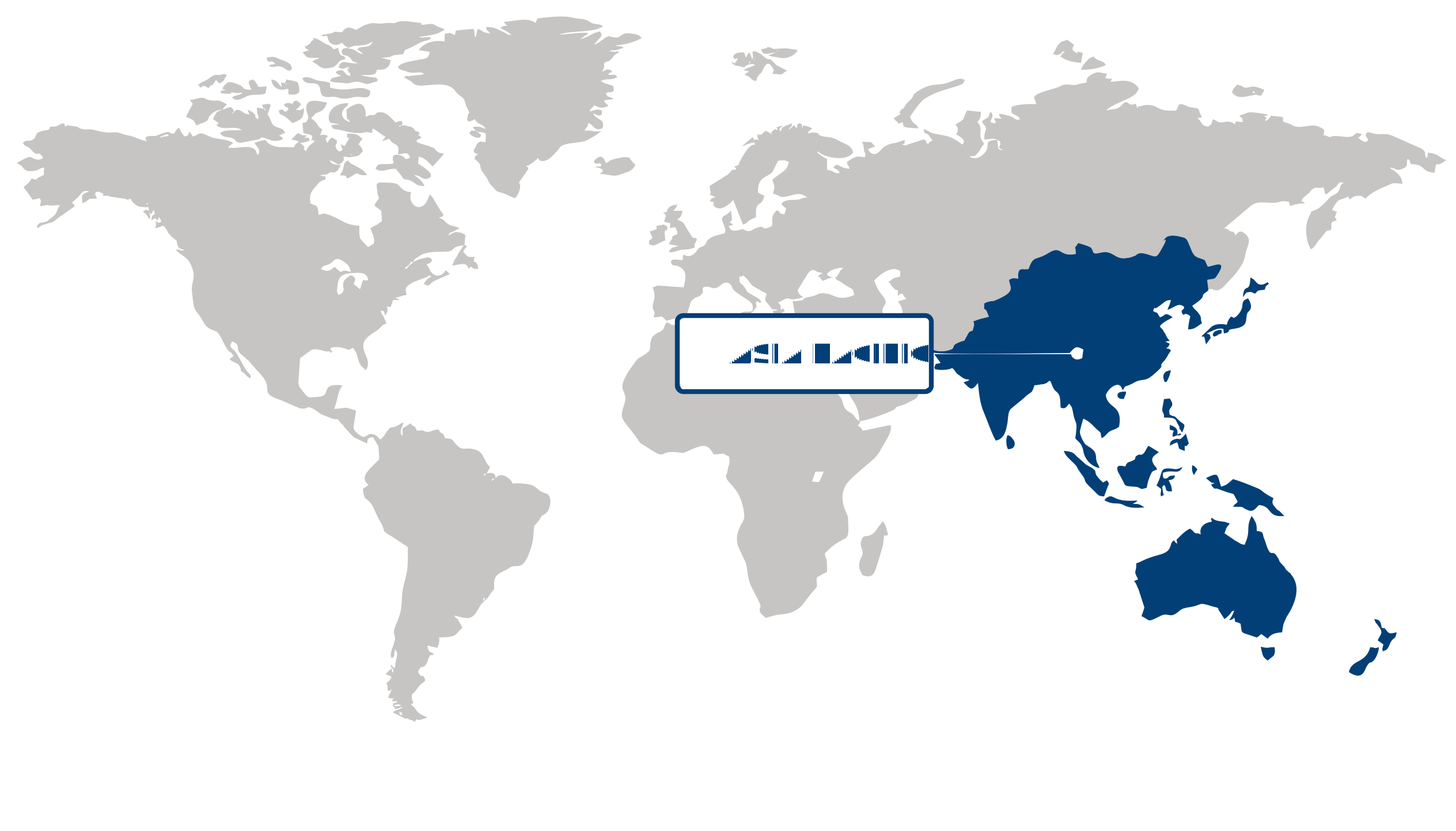
The micro-led display market in Asia Pacific captured 52.4% of the global market in 2025 and is the largest and fastest-growing region with a 71.51% CAGR, led by a high concentration of consumer electronic manufacturing sites and leading display producers. Major suppliers such as Samsung Electronics (The Wall demonstrations) and BOE Technology Group, combined with policy support from China’s Ministry of Industry and Information Technology (MIIT) and Japan’s Ministry of Economy, Trade and Industry (METI), create a dense ecosystem that accelerates commercialization; SEMI’s manufacturing-location analyses further validate the region’s production scale. These dynamics—from deep supply chains to targeted R&D funding—position Asia Pacific as the primary opportunity zone for scale-driven adoption and premium R&D partnerships.
The micro-led display market in Japan is positioned as a pivotal hub in Asia Pacific, anchored by advanced materials, precision equipment makers and focused R&D. Japan’s New Energy and Industrial Technology Development Organization (NEDO) collaborations and suppliers such as Tokyo Electron and Nippon Electric Glass enable high-yield pilot lines and specialty substrates, while Sony’s display expertise supports premium content and use cases; domestic regulatory and industrial programs sustain skilled talent pipelines. Strategically, Japan offers partners high-value components and prototyping capabilities that complement regional mass production, making it a natural collaborator for scaling microLED innovations.
The micro-led display market in China anchors the region’s manufacturing scale and price-competitive supply, driven by large panel makers and integrated device assembly. Firms such as BOE Technology Group and TCL CSOT, together with industrial policy signals from China’s MIIT and the concentration of consumer electronics OEMs, enable rapid capacity expansion and cost reduction; corporate press activity from these vendors highlights factory investments and pilot production. As a result, China is the execution engine that can convert regional R&D into volume products, reinforcing Asia Pacific’s lead while offering investors access to scale economics and accelerated time-to-market.
North America Market Analysis:
North America maintained a substantial share of the micro-led display market, driven by a dense cluster of OEM demand, deep private R&D and targeted public support that together accelerate commercialization. The region’s ecosystem—anchored by large consumer-electronics customers and system integrators—has been reinforced by U.S. policy incentives such as the CHIPS and Science Act and related Department of Commerce initiatives that lower capital barriers for advanced packaging and LED fabs. Corporate commitments (for example, Apple Inc.’s acquisition of LuxVue) and research partnerships involving National Institute of Standards and Technology (NIST) Manufacturing USA institutes provide tangible examples of translational R&D. These structural advantages and diversified demand patterns position North America to convert early technical leadership into scalable supply and premium end-market deployments.
U.S. acts as the primary commercialization hub for the micro-led display market within North America, reflecting concentrated OEM purchasing power and venture-backed manufacturing pilots. Major U.S. players have combined strategic acquisitions, internal R&D and partnerships to de-risk production stages—Apple Inc.’s LuxVue integration exemplifies OEM-driven verticalization—while federal programs under the CHIPS and Science Act and Department of Commerce incentives support capacity building and workforce development. Equipment and materials suppliers headquartered in the U.S. also accelerate supply-chain localization through pilot fabs and testing partnerships with universities and national labs. This country-level alignment of demand, capital and policy reinforces North America’s broader opportunity to scale micro-led production for premium displays and specialty applications.
Europe Market Trends:
The micro-led display market in North America held a commanding share of early innovation and commercial pilots, driven by concentrated R&D, OEM prototype activity, and targeted public funding. Evidence includes Apple’s 2014 LuxVue acquisition and Samsung Electronics’ commercial microLED "The Wall" demonstrations, alongside U.S. Department of Commerce implementation of the CHIPS and Science Act enabling scale-up investments and startup financing such as Canadian firm VueReal’s disclosed technology partnerships. These dynamics have tightened supplier networks and accelerated integration into premium consumer electronics, AR/VR, and defense niches noted by DARPA-sponsored projects. Given this depth of capability, the region offers significant opportunities to capture upstream manufacturing and high-margin system integration contracts.
The micro-led display market in the United States plays a leading role as a commercialization and manufacturing acceleration hub, propelled by government incentives and large OEM demand. The CHIPS and Science Act administered by the U.S. Department of Commerce has unlocked funding for domestic fabs and encouraged investments by firms like Intel; concurrently the U.S. Department of Defense and DARPA have funded micro-scale display programs for tactical and augmented-vision systems. Corporate activity from Apple and display suppliers signaling product roadmaps amplifies demand for scaleable transfer and testing capabilities. Strategic implication: U.S. capacity investments and defense procurement pathways make the country the primary locus for downstream assembly and high-volume microLED supply-chain consolidation in North America.
The micro-led display market in Canada functions as an innovation-rich incubator focused on pixel-engineering, pilot production, and cross-sector partnerships. Startups such as VueReal, together with the National Research Council Canada (NRC) and provincial innovation programs, have emphasized tooling for micro-LED transfer, testing, and smart-manufacturing techniques, attracting collaboration from international OEMs. Canada’s smaller domestic consumer base shifts emphasis to IP, equipment exports, and sustainable manufacturing processes supported by Innovation, Science and Economic Development Canada funding streams. Strategic implication: Canada’s specialist capabilities and public research collaboration position it as a partner for scaling prototypes into regional supply contracts that feed U.S. manufacturing ambitions.
| Parameter | North America | Asia Pacific | Europe | Latin America | MEA |
|---|---|---|---|---|---|
| Innovation Hub i Scale Nascent Developing Advanced | |||||
| Cost-Sensitive Region i Scale Low Medium High | |||||
| Regulatory Environment i Scale Restrictive Neutral Supportive | |||||
| Demand Drivers i Scale Weak Moderate Strong | |||||
| Development Stage i Scale Emerging Developing Developed | |||||
| Adoption Rate i Scale Low Medium High | |||||
| New Entrants / Startups i Scale Sparse Moderate Dense | |||||
| Macro Indicators i Scale Weak Stable Strong |
Segment Leadership and Growth Trends
Micro-LED Display Market Share (%), by Panel Size, 2026
Go beyond the chart, access full insights & data tables
Request Free Sample ReportLarge dominated the micro-led display market in 2025 within the Panel Size segment, driven by rising demand for large-format screens in premium TV and home-cinema applications seeking ultra-high brightness and expansive immersive viewing. Leadership stems from supplier focus on scale and optical performance, evidenced by Samsung Electronics’ The Wall and Sony’s Crystal LED demonstrations, and reflects consumer preference for cinematic home experiences, upgraded content ecosystems, and retail showroom strategies. This creates opportunities for established OEMs to monetize premium channels and for newcomers to specialize in modular assembly, while continued improvements in manufacturing yield and installer ecosystems suggest the large-panel preference will persist near term.
Analysis by Vertical
Consumer Electronics represented largest share of the micro-led display market in 2025 as rapid adoption in TVs, smartphones, and wearables prioritized high brightness and energy efficiency. Adoption is reinforced by Apple’s long‑reported micro‑LED initiatives and Samsung Electronics’ product showcases, signaling device makers’ push for premium visual performance and battery gains; supply‑chain partnerships and ecosystem integration are increasingly strategic. Opportunities include differentiated device tiers for incumbents and niche component suppliers for entrants, and ongoing miniaturization and manufacturing scale point to sustained relevance over the next several years.
Analysis by Application
TV held largest share of the micro-led display market in 2025 driven by strong uptake of Micro‑LED TVs and launches of large‑format premium models that deliver superior contrast and brightness. Manufacturer examples such as Samsung Electronics’ The Wall and Sony’s Crystal LED underscore industry validation and retailer demand for demonstrator units; shifting consumer viewing habits, HDR streaming, and premium home‑installation services amplify uptake. Strategic advantages arise for legacy TV brands to defend margins and for specialized integrators to capture bespoke installations, and continued content and display‑technology alignment supports near‑to‑medium‑term relevance.
| Segment | Sub-Segment | Largest Segment | Fastest Growing |
|---|---|---|---|
| Panel Size | Small, Medium, Large | ||
| Vertical | Automotive, Consumer Electronics, Aerospace & Defense, Advertisement, Others | ||
| Application | VR Headsets, AR Headsets, Smartphone, Smartwatches, Tablet, TV, Laptop, HUD, Digital Signage |
Competitive Landscape and Market Positioning
Competition is shaped by coordinated moves across technology, supply, and channel relationships among these firms. Alliances and targeted asset acquisitions are tightening access to epitaxy, mass-transfer and color-conversion capabilities while product introductions and pilot lines are raising performance benchmarks. Established panel integrators are aligning upstream with compound-semiconductor specialists, and specialist foundries are deepening ties to OEMs, compressing time-to-sample and reinforcing IP moats. The result is faster iteration on reliability and manufacturability, sharper segmentation by performance and cost, and clear advantage for players who secure contiguous steps of the stack.
Strategic / Actionable Recommendations for Regional Players
North America: Accelerate collaboration between device innovators and systems integrators to capture AR/VR, defense and pro-AV demand; combine advanced packaging and software/system expertise to differentiate and monetize subsystem performance while leveraging local foundries and design partners to protect IP and shorten development cycles.
Asia Pacific: Consolidate proximity to large panel and epitaxy capacity by co-investing with regional manufacturers, prioritize process yield and transfer tooling to exploit high-volume consumer and premium-TV pathways, and form interoperable supply consortia to reduce time-to-production risk.
Europe: Target high-reliability verticals such as automotive, medical and industrial displays by pairing compound-semiconductor optics expertise with Tier-1 OEM relationships; emphasize certification, sustainability of processes and niche premium offerings where manufacturing scale is less decisive.
| Company | Market Share | Company Revenue | Revenue CAGR (%) | Product Portfolio | Geographic Presence | Innovation / R&D Focus | Strategic Developments |
|---|---|---|---|---|---|---|---|
| No companies available. | |||||||
Industry Development/News
| Company Name | Date | Key Development |
|---|
Customize Your Report
Explore examples of how this report can be tailored to different research needs, including custom segments, additional topics or chapters, and related reports. Click a section of the wheel or its numbered marker to explore the available options.
Micro-LED Display Market — Custom Segments
| Segment | Sub-Segment |
|---|---|
| No segment data available. | |
Micro-LED Display Market — Custom TOC
| Custom Chapter | Custom Details | ||
|---|---|---|---|
| No custom TOC data available. | |||
Need a different cut of the data?
Request Custom ResearchHow much revenue does the micro-LED display market generate?
How is the micro-LED display industry size expected to evolve during the forecast period?
Which part of the world shows the greatest dominance in the micro-LED display market?
Which region shows the most rapid acceleration in the micro-LED display sector?
Why does large sub-segment dominate the panel size segment of micro-LED display sector?
How does consumer electronics segment fare in the micro-LED display industry?
What share does TV segment hold in the micro-LED display sector as of 2025?
What are the prominent companies operating in the micro-LED display landscape?
Our Clients
"Working with FBI has been a good experience. The market report provided a holistic view, covering everything from emerging trends to potential risks."
Semtech Corporation
"The experience was highly positive. The team showcased remarkable flexibility in adapting to our specific needs and delivered report that perfectly aligned with all our requirements."
TSMC
"What really stood out to me was how clearly and promptly the Fundamental Business Insights team communicated throughout. It made the collaboration feel effortless."
NXP Semiconductors
Our Research Team & Methodology
Every Fundamental Business Insights report is built by a dedicated vertical research team, validated through a structured primary-and-secondary methodology, and reviewed for accuracy before it reaches you.
Research Team Overview
Prepared by the Electronics & Semiconductors Research Team
Delivery
Published
Demand
Available
Support
Trust & Compliance
Research Domains
10 coverage areasResearch Intelligence
| Source | Reference |
|---|---|
| Semiconductor Industry Association (SIA) | www.semiconductors.org |
| SEMI | www.semi.org |
| JEDEC Solid State Technology Association | www.jedec.org |
| IEEE | www.ieee.org |
| IPC – Association Connecting Electronics Industries | www.ipc.org |
| International Electrotechnical Commission (IEC) | www.iec.ch |
| International Organization for Standardization (ISO) | www.iso.org |
| U.S. Bureau of Industry and Security (BIS) | www.bis.gov |
| U.S. Patent and Trademark Office (USPTO) | www.uspto.gov |
| European Patent Office (EPO) | www.epo.org |
| Taiwan Semiconductor Industry Association (TSIA) | www.tsia.org.tw |
| World Semiconductor Trade Statistics (WSTS) | www.wsts.org |
| International Energy Agency (IEA) | www.iea.org |
| GSMA | www.gsma.com |
| 3GPP | www.3gpp.org |
| ITU (International Telecommunication Union) | www.itu.int |
| Omdia (public insights) | omdia.tech.informa.com |
| Display Supply Chain Consultants (DSCC) | www.displaysupplychain.com |
| U.S. Department of Energy (DOE) | www.energy.gov |
| NIST (National Institute of Standards and Technology) | www.nist.gov |
Research Workflow & Quality Assurance
Data Collection
Verified information gathered through primary and secondary research.
Data Triangulation
Cross-validation using multiple independent data sources.
Forecast Modelling
Market estimates developed using historical trends and analytical models.
Analyst Validation
Findings reviewed by domain experts for accuracy and consistency.
Editorial & Quality Review
Final editorial, quality, and compliance checks before publication.
Final Publication
Released after successful completion of the internal review process.
Report Coverage
📊 Market Assessment
- Market Size & Forecast
- Market Segmentation
- Regional Analysis
- Growth Drivers & Challenges
- Market Dynamics
🏢 Competitive Intelligence
- Competitive Landscape
- Company Profiles
- Competitive Benchmarking
- Mergers & Acquisitions
- Market Share Analysis or Key Company Strategies
🔍 Strategic Analysis
- Value Chain Analysis
- Porter's Five Forces
- PESTLE Analysis
- Pricing Trends
- Supply-Demand Analysis
🚀 Future Outlook
- Technology Landscape
- Regulatory Landscape
- Investment & Funding Landscape
- Emerging Opportunities
- Future Market Outlook
Have a question about this report or need a custom scope?
Request Customization