Micro Irrigation Systems Market Size & Growth Forecast 2027–2036, By Segments (Product, Crop, Application), Regional Demand Trends (North America, Asia Pacific, Europe), Key Country Insights (U.S., Japan, South Korea, Germany, France, Italy), and Competitive Landscape
Market Size and Growth Outlook
Micro Irrigation Systems Market size stood at USD 15.93 billion in 2026 and is predicted to grow at a 7.89% CAGR from 2027 to 2036, surpassing USD 34.04 billion by 2036. The industry revenue for 2027 is assessed at USD 16.99 billion.
Get more details on this report
Request Free Sample ReportMicro Irrigation Systems Market Intelligence Snapshot
Regional Market Dynamics
- Asia Pacific leads due to its large agricultural base and strong demand for efficient water management systems that improve crop yield and farm productivity.
- Growth is supported by increasing adoption of drip and sprinkler systems to address water scarcity and improve irrigation efficiency across diverse agricultural regions.
Segment Momentum
- Drip systems held a 45.05% share in 2026 by delivering water directly to root zones, improving irrigation efficiency while reducing water loss across a wide range of cultivation settings.
- Plantation crops are growing fastest as large-scale cultivation increasingly adopts efficient irrigation methods that improve water management, input control, and consistent watering across organized plantation operations.
Market Expansion Drivers
- Growing water scarcity concerns accelerating adoption of precision irrigation technologies in agriculture.
- Government subsidies and awareness programs supporting micro irrigation deployment in drought-prone regions.
- Increasing integration of AI-enabled farm monitoring improving irrigation efficiency and crop productivity.
Leading Market Participants
- Top players in the micro irrigation systems market include Netafim Ltd. (Israel), The Toro Company (United States), Jain Irrigation Systems Ltd. (India), Valmont Industries, Inc. (United States), Rain Bird Corporation (United States), Lindsay Corporation (United States), Rivulis Irrigation Ltd. (Israel), Mahindra & Mahindra Ltd. (India), Nelson Irrigation Corporation (United States), T-L Irrigation Co. (United States).
Global Market Forecast Snapshot
Market Outlook
- 2026 Market Size: USD 15.93 billion
- 2027 Estimated Market Size: USD 16.99 billion.
- Projected Market Size: USD 34.04 billion by 2036
- Growth Forecast: 7.89% CAGR (2027-2036)
Regional and Segment Outlook
- Leading Regional Market: Asia Pacific
- High-Growth Regional Hub: Asia Pacific
- Core Revenue Segment: Drip (Product) | Orchard Crops (Crop) | Agriculture (Application)
- Emerging Opportunity Segment: Sprinkler (Product) | Plantation Crops (Crop) | Green House (Application)
Market Growth Drivers and Industry Trends
Growing water scarcity concerns accelerating adoption of precision irrigation technologies in agriculture
Increasing water scarcity is encouraging farmers to adopt technologies that deliver irrigation more precisely to crop root zones while limiting unnecessary water losses. The micro irrigation systems market is therefore benefiting from heightened pressure to improve agricultural water-use efficiency in regions affected by declining water availability, irregular rainfall, and competing demands for freshwater resources. Drip and other localized irrigation methods can regulate water delivery according to crop requirements, reducing the dependence on broad-area irrigation practices and supporting more controlled application of moisture. This approach is particularly valuable for water-intensive agricultural activities where improving the efficiency of each irrigation cycle can help maintain crop cultivation under constrained water conditions.
Government subsidies and awareness programs supporting micro irrigation deployment in drought-prone regions
Government support is helping expand the micro irrigation systems market by reducing adoption barriers for farmers and increasing awareness of efficient irrigation practices. Subsidies and financial assistance can lower the initial investment associated with installing irrigation infrastructure, making precision water-delivery technologies more accessible to agricultural producers with limited capital. Awareness programs further contribute by educating farmers about water conservation, appropriate system selection, installation practices, and the potential agronomic benefits of controlled irrigation. In drought-prone regions, where water availability directly affects cultivation decisions, coordinated policy support and farmer outreach can encourage wider deployment of micro irrigation equipment across different types of agricultural operations.
Increasing integration of AI-enabled farm monitoring improving irrigation efficiency and crop productivity
The integration of artificial intelligence and connected farm-monitoring technologies is creating new opportunities for the micro irrigation systems market by enabling irrigation decisions to become more responsive to field conditions. AI-enabled platforms can analyze information from soil sensors, weather observations, crop conditions, and other farm inputs to help determine when and where irrigation is required. Combining these insights with automated or remotely controlled irrigation equipment allows farmers to adjust water application more precisely rather than relying solely on fixed schedules. Such data-driven management can help reduce unnecessary irrigation, maintain more suitable soil-moisture conditions, and support crop productivity through better alignment between water delivery and plant requirements.
| Growth Driver | Impact on CAGR | Regulatory Influence | Geographic Relevance | Adoption Rate | Impact Timeline |
|---|---|---|---|---|---|
| Growing water scarcity concerns accelerating adoption of precision irrigation technologies in agriculture | 2.10% | High | Asia Pacific, Middle East & Africa | High | Near Term |
| Government subsidies and awareness programs supporting micro irrigation deployment in drought-prone regions | 1.80% | High | Asia Pacific, Latin America | High | Mid Term |
| Increasing integration of AI-enabled farm monitoring improving irrigation efficiency and crop productivity | 1.50% | Moderate | North America, Europe | Emerging | Long Term |
Unlock insights tailored to your business with our bespoke market research solutions.
Click to get your customized report now.
Regional Demand Dynamics
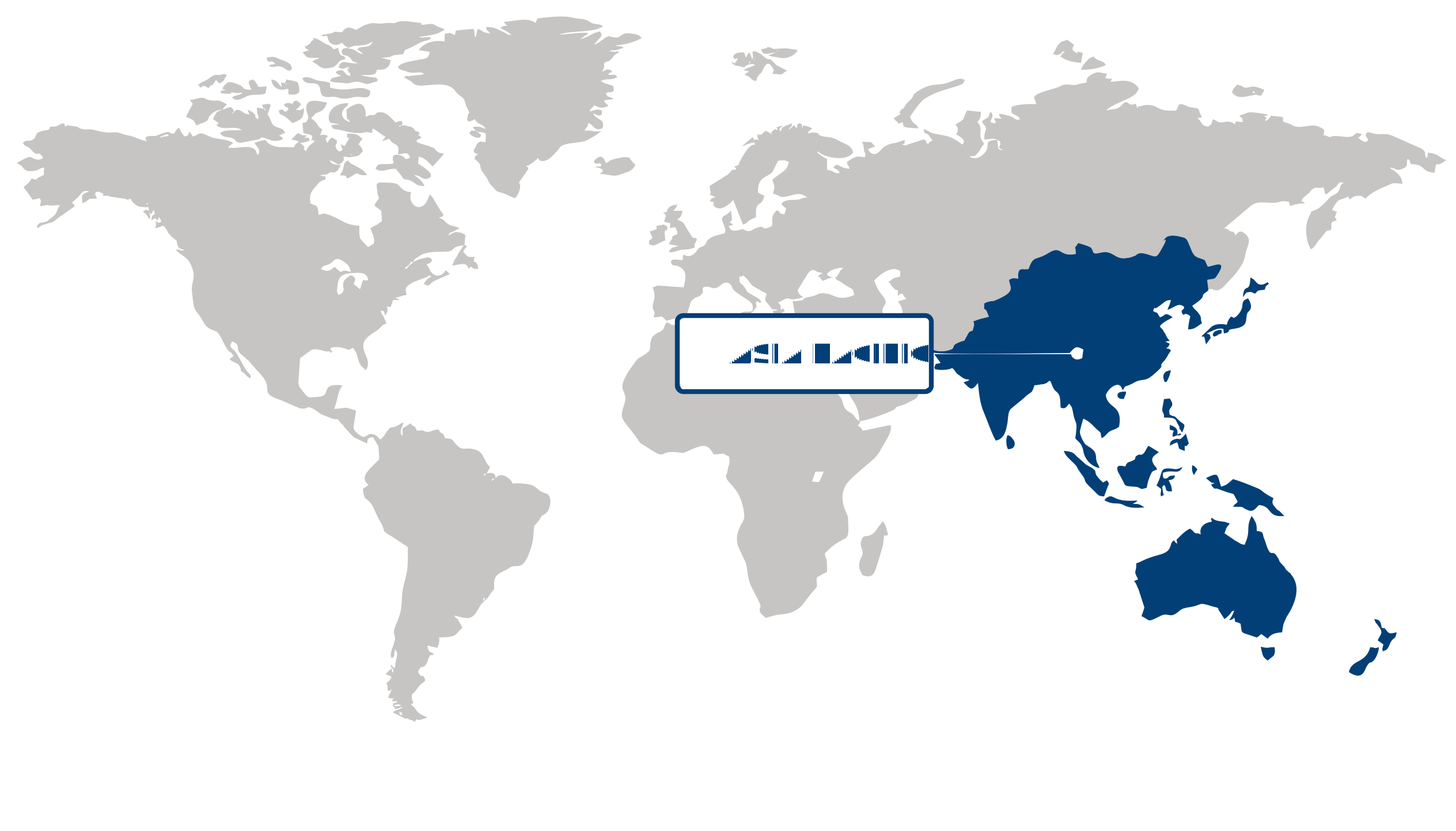
Asia Pacific (Largest & Fastest-Growing Region)
The Asia Pacific micro irrigation systems market held the largest share in 2026 and is also the fastest-growing regional market, underpinned by the region's substantial agricultural base and increasing pressure to improve water-use efficiency. Water scarcity, changing climatic conditions, and the need to enhance agricultural productivity are encouraging farmers and agricultural stakeholders to adopt drip and sprinkler-based irrigation technologies. Government initiatives supporting efficient irrigation, modernization of farming practices, and improved access to agricultural infrastructure are further strengthening regional adoption. Growing cultivation of high-value crops and increasing use of technology-enabled farming methods are expected to sustain demand for micro irrigation solutions across the region.
| Parameter | North America | Asia Pacific | Europe | Latin America | MEA |
|---|---|---|---|---|---|
| Innovation Hub i Scale Nascent Developing Advanced | |||||
| Cost-Sensitive Region i Scale Low Medium High | |||||
| Regulatory Environment i Scale Restrictive Neutral Supportive | |||||
| Demand Drivers i Scale Weak Moderate Strong | |||||
| Development Stage i Scale Emerging Developing Developed | |||||
| Adoption Rate i Scale Low Medium High | |||||
| New Entrants / Startups i Scale Sparse Moderate Dense | |||||
| Macro Indicators i Scale Weak Stable Strong |
Key Country Insights
Germany 🇩🇪
Sustainable Irrigation PlanningGermany promotes efficient irrigation technologies that complement sustainable agricultural practices and responsible water management. Farmers in Germany increasingly integrate micro irrigation systems with digital monitoring tools to optimize irrigation performance and operational efficiency.
France 🇫🇷
Water Efficiency ProgramsFrance encourages micro irrigation deployment in response to increasing focus on efficient water use and sustainable crop production. Agricultural operations across France continue modernizing irrigation infrastructure to support productivity while reducing unnecessary water consumption.
Italy 🇮🇹
High-Value Crop IrrigationItaly utilizes micro irrigation extensively in vineyards, orchards, and horticultural production where precise water delivery enhances crop quality. Italian growers continue upgrading irrigation systems that support efficient water management and consistent agricultural output.
Japan 🇯🇵
Controlled Cultivation SolutionsJapan supports micro irrigation adoption across high-value crops and controlled cultivation environments where water efficiency is essential. Agricultural producers in Japan prioritize compact, reliable irrigation technologies that fit intensive farming operations and limited arable land.
South Korea 🇰🇷
Smart Agriculture IntegrationSouth Korea advances the use of micro irrigation systems alongside smart farming technologies and automated crop management. Farmers in South Korea increasingly adopt connected irrigation solutions that improve water control and operational productivity across modern agricultural facilities.
United States 🇺🇸
Precision Farming InvestmentThe U.S. micro irrigation systems market benefits from increasing adoption of precision agriculture and water-efficient farming practices. Growers across the U.S. continue investing in automated irrigation solutions that improve resource utilization while supporting consistent crop performance.
Segment Leadership and Growth Trends
Micro Irrigation Systems Market Share (%), by Product, 2026
Go beyond the chart, access full insights & data tables
Request Free Sample ReportProduct Segment Analysis: Drip (Largest Segment) vs Sprinkler (Fastest-Growing Segment)
The drip segment dominated the micro irrigation systems market, accounting for a 45.05% share in 2026, supported by its ability to deliver water directly and efficiently to the root zones of crops. Drip systems are particularly valuable in regions facing water scarcity because they enable precise irrigation while limiting water loss through evaporation and runoff. Their suitability for diverse agricultural environments, including row crops, horticultural cultivation, and high-value crops, has strengthened adoption among growers seeking greater control over irrigation and input use. Increasing emphasis on water conservation, improved farm productivity, and efficient resource management is further reinforcing the position of drip irrigation as a leading micro irrigation solution.
The sprinkler segment is expected to register the fastest growth, driven by its flexibility in covering larger cultivated areas and its applicability across different crop and field conditions. Sprinkler systems can provide relatively uniform water distribution and are increasingly attractive where growers require adaptable irrigation methods that can support changing cultivation practices. The broader modernization of agricultural infrastructure, combined with growing awareness of efficient water application, is supporting demand for sprinkler-based micro irrigation. Increasing adoption of mechanized and technology-enabled farming practices is also encouraging producers to integrate irrigation systems that improve control over water delivery while reducing dependence on less efficient conventional methods.
Crop Segment Analysis: Orchard Crops (Largest Segment) vs Plantation Crops (Fastest-Growing Segment)
Orchard crops represented the largest crop segment of the micro irrigation systems market in 2026, reflecting the strong suitability of micro irrigation for perennial fruit cultivation. Orchard production requires consistent moisture management around established root systems, making controlled irrigation particularly important for maintaining plant health and supporting reliable crop development. Drip and other localized irrigation approaches can help growers apply water more precisely while reducing unnecessary losses between plants and across cultivated areas. Increasing focus on water-use efficiency, improved orchard management, and productivity optimization is supporting the adoption of micro irrigation across fruit-growing operations and sustaining the segment's leading position.
The plantation crops segment is projected to grow at the fastest pace as producers increasingly seek efficient irrigation approaches capable of supporting large-scale perennial cultivation. Plantation crops often require dependable water availability across extensive growing areas, creating opportunities for systems that provide controlled and targeted water application. Growing pressure to conserve agricultural water resources and improve farm-level efficiency is encouraging plantation growers to modernize irrigation infrastructure. The increasing integration of improved cultivation practices and resource-efficient agricultural technologies is expected to further strengthen demand for micro irrigation solutions within plantation crop production.
| Segment | Sub-Segment | Largest Segment | Fastest Growing |
|---|---|---|---|
| Product | Sprinkler, Drip, Central Pivot, Lateral Move | Drip | Sprinkler |
| Crop | Plantation Crops, Orchard Crops, Field Crops, Forage & Grass, Others | Orchard Crops | Plantation Crops |
| Application | Agriculture, Landscape, Green House, Nursery, Others | Agriculture | Green House |
Competitive Landscape and Market Positioning
Major players in the micro irrigation systems market:
1. Netafim Ltd. (Israel)
2. The Toro Company (United States)
3. Jain Irrigation Systems Ltd. (India)
4. Valmont Industries Inc. (United States)
5. Rain Bird Corporation (United States)
6. Lindsay Corporation (United States)
7. Rivulis Irrigation Ltd. (Israel)
8. Mahindra & Mahindra Ltd. (India)
9. Nelson Irrigation Corporation (United States)
10. T-L Irrigation Co. (United States)
The micro irrigation systems market is expanding due to rising need for water-efficient agricultural practices. The micro irrigation systems market is increasingly adopting smart irrigation technologies that optimize water usage and improve crop yield. Growing awareness of resource conservation is driving wider implementation across varied agricultural regions, supported by efficiency-focused innovations in irrigation design.
| Company | Market Share | Company Revenue | Revenue CAGR (%) | Product Portfolio | Geographic Presence | Innovation / R&D Focus | Strategic Developments |
|---|---|---|---|---|---|---|---|
| Netafim Ltd. (Israel) | |||||||
| The Toro Company (United States) | |||||||
| Jain Irrigation Systems Ltd. (India) | |||||||
| Valmont Industries Inc. (United States) | |||||||
| Rain Bird Corporation (United States) | |||||||
| Lindsay Corporation (United States) | |||||||
| Rivulis Irrigation Ltd. (Israel) | |||||||
| Mahindra & Mahindra Ltd. (India) | |||||||
| Nelson Irrigation Corporation (United States) | |||||||
| T-L Irrigation Co. (United States). |
Industry Development/News
| Company Name | Date | Key Development |
|---|---|---|
| Captain Polyplast Limited | May-26 | Captain Polyplast Limited commissioned a new manufacturing facility in Ahmedabad, Gujarat, to increase production capacity for micro irrigation solutions. This capital investment aligns with the company’s growth strategy by enhancing manufacturing capabilities to meet rising domestic and export demand, thereby strengthening its overall supply chain resilience and operational capacity in the region. |
| R M Drip & Sprinklers Systems Limited | Feb-26 | R M Drip & Sprinklers Systems Limited established a technology partnership to develop IoT-enabled irrigation and digital agriculture solutions. By integrating software, mobile applications, and data analytics with its core hardware, the company is diversifying its service offering and transitioning toward high-value, integrated farm automation platforms, significantly enhancing its competitive differentiation. |
| Mahindra EPC Irrigation | Feb-25 | Mahindra EPC Irrigation secured a project contract valued at approximately Rs 111 million for the deployment of micro irrigation infrastructure. This contract win highlights the company’s ability to secure large-scale commercial opportunities and reinforces its market position as a key infrastructure provider within the agricultural sector, supporting sustained revenue growth and project-based expansion. |
| Rain Bird Corporation | Aug-24 | Rain Bird Corporation acquired the assets of Adritec Group International, expanding its operational footprint across Africa, the Middle East, and Latin America. This acquisition serves as a strategic initiative to enhance regional market access and strengthen the company's competitive positioning in the global precision agriculture sector through an expanded portfolio of irrigation technologies. |
| Lindsay Corporation | Jan-24 | Lindsay Corporation launched 'FieldNET NextGen,' an upgraded interface for its remote monitoring and control platform. By incorporating enhanced mapping, visualization, and data-driven agronomic recommendations, this digital transformation initiative increases the commercial scalability of the company’s irrigation management software, providing farmers with advanced operational tools to optimize water usage and improve agricultural outcomes. |
Customize Your Report
Explore examples of how this report can be tailored to different research needs, including custom segments, additional topics or chapters, and related reports. Click a section of the wheel or its numbered marker to explore the available options.
Micro Irrigation Systems Market — Custom Segments
| Segment | Sub-Segment |
|---|---|
| Farm Size | Small Farms, Medium-Sized Farms, Large Farms, Plantation-Scale Farms |
| Water Source | Groundwater, Surface Water, Rainwater Harvesting, Recycled or Treated Water |
| Automation Level | Manual Systems, Semi-Automated Systems, Fully Automated Systems, Smart Irrigation Systems |
Micro Irrigation Systems Market — Custom TOC
| Custom Chapter | Custom Details |
|---|---|
| Crop-Wise Irrigation Adoption Potential |
|
| Water Stress and Irrigation Demand Hotspots |
|
| Farm Economics and Return on Investment Analysis |
|
Need a different cut of the data?
Request Custom ResearchHow much revenue does the micro irrigation systems market generate?
What is the projected value of the micro irrigation systems industry by 2036?
How is water scarcity influencing adoption in the micro irrigation systems market?
How are subsidies and digital farming tools accelerating deployment in the micro irrigation systems market?
Why do drip systems lead the micro irrigation systems market?
Why are plantation crops the fastest-growing crop segment in the micro irrigation systems market?
Why does Asia Pacific lead the micro irrigation systems market?
How is Asia Pacific driving growth in the micro irrigation systems market?
What are the prominent companies operating in the micro irrigation systems landscape?
Our Clients
"The team at Fundamental Business Insights & Consulting demonstrated a commitment to excellence, not only in the quality of the report but also in their client-centric approach."
FANUC
"The level of detail in the market segmentation provided were particularly noteworthy. The detailed country-level insights were also very helpful."
B&R Industrial Automation GmbH
"The consultant took the time to understand our specific business objectives, ensuring that the reports were tailored to address our unique challenges and opportunities."
KUKA SE & Co. KGaA
Our Research Team & Methodology
Every Fundamental Business Insights report is built by a dedicated vertical research team, validated through a structured primary-and-secondary methodology, and reviewed for accuracy before it reaches you.
Research Team Overview
Prepared by the Industrial Automation & Equipment Research Team
Delivery
Published
Demand
Available
Support
Trust & Compliance
Research Domains
10 coverage areasResearch Intelligence
| Source | Reference |
|---|---|
| International Society of Automation (ISA) | www.isa.org |
| International Organization for Standardization (ISO) | www.iso.org |
| National Institute of Standards and Technology (NIST) | www.nist.gov |
| IEEE | www.ieee.org |
| VDMA (German Mechanical Engineering Industry Association) | www.vdma.org |
| Association for Advancing Automation (A3) | www.automate.org |
| International Federation of Robotics (IFR) | ifr.org |
| ASME (American Society of Mechanical Engineers) | www.asme.org |
| ASHRAE | www.ashrae.org |
| American Society of Heating, Refrigerating and Air-Conditioning Engineers (ASHRAE) | www.ashrae.org |
| Material Handling Industry (MHI) | www.mhi.org |
| OSHA (Occupational Safety and Health Administration) | www.osha.gov |
| National Fire Protection Association (NFPA) | www.nfpa.org |
| ASTM International | www.astm.org |
| International Electrotechnical Commission (IEC) | www.iec.ch |
| Open Process Automation Forum (The Open Group) | www.opengroup.org/open-process-automation-forum |
| AGMA (American Gear Manufacturers Association) | www.agma.org |
| Association of Equipment Manufacturers (AEM) | www.aem.org |
| Food and Agriculture Organization (FAO) | www.fao.org |
| International Labour Organization (ILO) | www.ilo.org |
Research Workflow & Quality Assurance
Data Collection
Verified information gathered through primary and secondary research.
Data Triangulation
Cross-validation using multiple independent data sources.
Forecast Modelling
Market estimates developed using historical trends and analytical models.
Analyst Validation
Findings reviewed by domain experts for accuracy and consistency.
Editorial & Quality Review
Final editorial, quality, and compliance checks before publication.
Final Publication
Released after successful completion of the internal review process.
Report Coverage
📊 Market Assessment
- Market Size & Forecast
- Market Segmentation
- Regional Analysis
- Growth Drivers & Challenges
- Market Dynamics
🏢 Competitive Intelligence
- Competitive Landscape
- Company Profiles
- Competitive Benchmarking
- Mergers & Acquisitions
- Market Share Analysis or Key Company Strategies
🔍 Strategic Analysis
- Value Chain Analysis
- Porter's Five Forces
- PESTLE Analysis
- Pricing Trends
- Supply-Demand Analysis
🚀 Future Outlook
- Technology Landscape
- Regulatory Landscape
- Investment & Funding Landscape
- Emerging Opportunities
- Future Market Outlook
Have a question about this report or need a custom scope?
Request Customization