Metal Cutting Tools Market Size & Growth Forecast 2027–2036, By Segments (Tool, Material, Process, Distribution Channel, Application), Regional Demand Trends (North America, Asia Pacific, Europe), Key Country Insights (U.S., Japan, South Korea, Germany, France, Italy), and Competitive Landscape
Market Size and Growth Outlook
Metal Cutting Tools Market size was worth USD 51.04 Billion in 2026 and is expected to grow at 5.72% CAGR between 2027 and 2036, reaching USD 89.02 Billion by 2036. The industry revenue for 2027 is assessed at USD 53.52 Billion.
Get more details on this report
Request Free Sample ReportMetal Cutting Tools Market Intelligence Snapshot
Regional Market Dynamics
- Asia Pacific led in 2026 through extensive manufacturing, industrial production, and advanced machining investment across automotive, aerospace, machinery, and metalworking industries.
- North America is emerging as the fastest-growing region, driven by automated machining adoption, manufacturing infrastructure modernization, and demand for higher precision and efficiency.
Segment Momentum
- Indexable tools held a 63.65% market share in 2026 because replaceable inserts reduce operating costs and production downtime while delivering flexible, consistent machining performance across high-volume manufacturing environments.
- Ceramics is the fastest-growing material segment due to increasing demand for machining hard materials at higher cutting speeds. Their high-temperature resistance and continuous material innovations support advanced manufacturing applications.
Market Expansion Drivers
- Industrial automation and smart manufacturing increasing demand for precision machining tools
- Infrastructure and defense manufacturing growth boosting heavy-duty tooling demand
- Localization of manufacturing strengthening domestic machine tool consumption
Leading Market Participants
- Prominent companies in the metal cutting tools market include Sandvik AB (Sweden), ISCAR Ltd. (Israel), Kennametal Inc. (United States), Mitsubishi Materials Corporation (Japan), OSG Corporation (Japan), Seco Tools AB (Sweden), Walter AG (Germany), Guhring KG (Germany), Kyocera Corporation (Japan), Ceratizit Group (Luxembourg)
Global Market Forecast Snapshot
Market Outlook
- 2026 Market Size: USD 51.04 Billion
- 2027 Estimated Market Size: USD 53.52 Billion
- Projected Market Size: USD 89.02 Billion by 2036
- Growth Forecast: 5.72% CAGR (2027-2036)
Regional and Segment Outlook
- Leading Regional Market: Asia Pacific
- High-Growth Regional Hub: North America
- Core Revenue Segment: Indexable (Tool) | Carbide (Material) | Milling (Process) | Indirect (Distribution Channel) | Automotive (Application)
- Emerging Opportunity Segment: Solid (Tool) | Ceramics (Material) | Drilling (Process) | Direct (Distribution Channel) | Aerospace & Defence (Application)
Market Growth Drivers and Industry Trends
Industrial automation and smart manufacturing increasing demand for precision machining tools
The adoption of automated production systems and digitally connected manufacturing processes is increasing the need for highly accurate machining solutions. Industrial automation and smart manufacturing will drive the metal cutting tools market growth as manufacturers require precision tools that support advanced production lines, complex geometries, and consistent component quality. Integration of automated machining operations is encouraging demand for cutting tools with improved durability, accuracy, and compatibility with intelligent manufacturing environments.
Infrastructure and defense manufacturing growth boosting heavy-duty tooling demand
Expanding infrastructure development and increasing defense manufacturing activities are creating demand for robust machining solutions capable of handling high-strength materials. The metal cutting tools market growth is supported by rising requirements for heavy-duty tooling used in the production of structural components, machinery, and specialized defense equipment. Manufacturers are adopting advanced cutting technologies to improve machining efficiency, reduce production downtime, and support the fabrication of complex industrial components.
Localization of manufacturing strengthening domestic machine tool consumption
Efforts to strengthen domestic manufacturing capabilities are encouraging investments in local production ecosystems and machine tool infrastructure. Localization of manufacturing will propel the metal cutting tools market growth as regional industries increase their reliance on domestically available machining solutions for production expansion. The development of localized supply chains is supporting greater adoption of cutting tools across manufacturing sectors seeking improved production resilience and reduced dependence on external sources.
| Growth Driver | Impact on CAGR | Regulatory Influence | Geographic Relevance | Adoption Rate | Impact Timeline |
|---|---|---|---|---|---|
| Industrial automation and smart manufacturing increasing demand for precision machining tools | 1.9% | High | Asia Pacific, Europe | High | Near Term |
| Infrastructure and defense manufacturing growth boosting heavy-duty tooling demand | 1.7% | High | North America, Asia Pacific | High | Mid Term |
| Localization of manufacturing strengthening domestic machine tool consumption | 1.5% | Moderate | Asia Pacific, Europe | High | Mid Term |
Unlock insights tailored to your business with our bespoke market research solutions.
Click to get your customized report now.
Regional Demand Dynamics
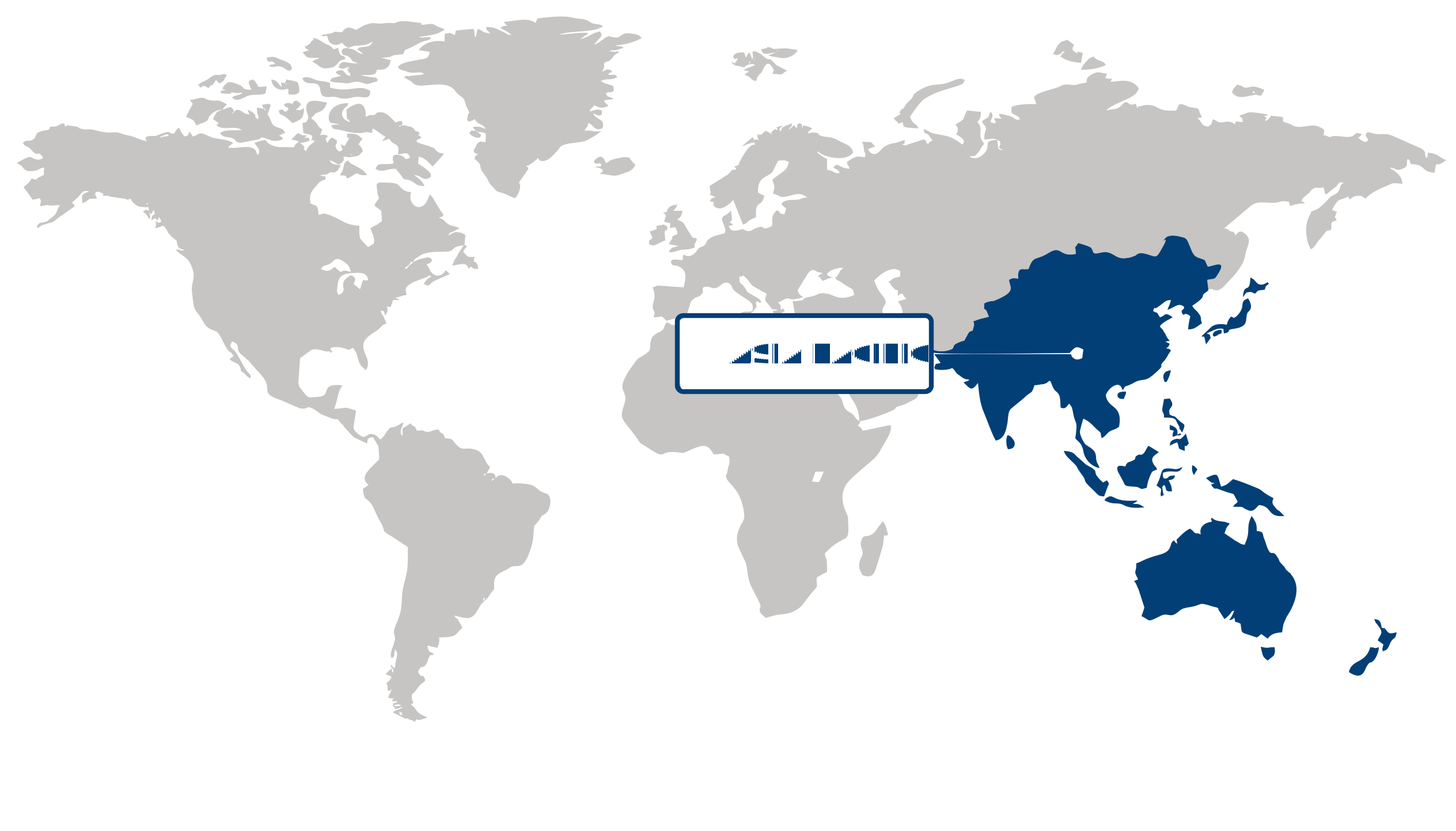
Asia Pacific (Largest Region)
The metal cutting tools market was led by Asia Pacific in 2026, supported by extensive manufacturing activity, expanding industrial production, and increasing investment in advanced machining capabilities. The region's strong automotive, aerospace, machinery, and metalworking industries are generating sustained demand for precision cutting solutions, while industrial automation and the modernization of production facilities are encouraging adoption of higher-performance tools.
North America (Fastest-Growing Region)
North America is emerging as the fastest-growing region, driven by increasing adoption of automated machining technologies, modernization of manufacturing infrastructure, and demand for greater production efficiency and precision. The expansion of advanced manufacturing activities and continued investment in high-performance machining equipment are creating favorable conditions for broader use of sophisticated metal cutting tools.
| Parameter | North America | Asia Pacific | Europe | Latin America | MEA |
|---|---|---|---|---|---|
| Innovation Hub i Scale Nascent Developing Advanced | |||||
| Cost-Sensitive Region i Scale Low Medium High | |||||
| Regulatory Environment i Scale Restrictive Neutral Supportive | |||||
| Demand Drivers i Scale Weak Moderate Strong | |||||
| Development Stage i Scale Emerging Developing Developed | |||||
| Adoption Rate i Scale Low Medium High | |||||
| New Entrants / Startups i Scale Sparse Moderate Dense | |||||
| Macro Indicators i Scale Weak Stable Strong |
Key Country Insights
United States 🇺🇸
Advanced Manufacturing SupportThe U.S. continues adopting high-performance metal cutting tools to support aerospace, automotive, and precision engineering applications. Manufacturers prioritize tool life, machining accuracy, and compatibility with advanced CNC production environments.
Germany 🇩🇪
Precision Machining ExpertiseGermany emphasizes premium metal cutting tools that deliver consistent performance for complex industrial manufacturing. German companies continue investing in tooling innovations that improve machining efficiency and component quality across precision production lines.
Japan 🇯🇵
High-Accuracy ToolingJapan focuses on precision metal cutting tools capable of supporting demanding manufacturing tolerances. Japanese manufacturers increasingly integrate advanced tool materials and coatings that extend service life and improve machining productivity.
South Korea 🇰🇷
Industrial Process OptimizationSouth Korea is strengthening its metal cutting tools market through investments in automated machining and advanced manufacturing. Tool suppliers are responding with products designed for higher productivity, reduced downtime, and efficient mass production.
France 🇫🇷
Aerospace Manufacturing DemandFrance supports steady demand for specialized metal cutting tools through its strong aerospace and industrial manufacturing base. French manufacturers prioritize tooling solutions that enhance machining precision and production reliability for complex components.
Italy 🇮🇹
Flexible Production SolutionsItaly is expanding the use of versatile metal cutting tools that serve diverse industrial and precision engineering applications. Italian manufacturers seek tooling systems that improve machining flexibility while supporting efficient small- and medium-scale production.
Segment Leadership and Growth Trends
Metal Cutting Tools Market Share (%), by Tool, 2026
Go beyond the chart, access full insights & data tables
Request Free Sample ReportTool Segment Analysis: Indexable (Largest Segment) vs Solid (Fastest-Growing Segment)
The indexable tool segment dominated the metal cutting tools market, accounting for 63.65% in 2026. Its leadership is driven by the ability to replace worn cutting inserts without changing the entire tool body, reducing operating costs and minimizing production downtime. These tools are widely adopted across high-volume manufacturing environments because they offer flexibility, consistent machining performance, and improved productivity. Continuous demand from automotive, aerospace, and industrial manufacturing applications further reinforces the segment's dominant market position.
The solid tool segment is expected to witness the fastest growth during the forecast period. Growing demand for high-precision machining and complex component manufacturing is encouraging wider adoption of solid cutting tools. Their ability to deliver superior rigidity, dimensional accuracy, and surface finish makes them well suited for advanced manufacturing processes. Ongoing advancements in tool materials and machining technologies are expected to further support the expansion of this segment.
Material Segment Analysis: Carbide (Largest Segment) vs Ceramics (Fastest-Growing Segment)
Carbide accounted for the largest share of the metal cutting tools market, holding 32.4% in 2026. The segment maintains its leading position because carbide tools offer an excellent balance of hardness, wear resistance, and cutting efficiency across a broad range of machining applications. Manufacturers continue to rely on carbide tooling to improve productivity, maintain dimensional accuracy, and extend tool life during high-speed machining operations. Its versatility across multiple industries continues to support widespread adoption.
The ceramics segment is projected to experience the fastest growth during the forecast period. Increasing demand for machining hard materials at higher cutting speeds is driving greater adoption of ceramic cutting tools. Their ability to withstand elevated temperatures while maintaining cutting performance makes them increasingly suitable for advanced manufacturing applications. Continuous innovation in ceramic materials and precision engineering is expected to strengthen the growth of this segment.
Process Segment Analysis: Milling (Largest Segment) vs Drilling (Fastest-Growing Segment)
Holding the largest share of the metal cutting tools market, the milling process accounted for 33.8% in 2026. Milling remains a fundamental machining operation for producing complex geometries, precision surfaces, and detailed components across diverse manufacturing industries. Ongoing investments in advanced machining centers and automated production systems continue to increase the adoption of milling tools for high-precision applications. The versatility and efficiency of milling operations further reinforce the segment's market leadership.
The drilling segment is anticipated to register the fastest growth over the forecast period. Rising demand for precision hole-making across automotive, aerospace, construction, and industrial manufacturing applications is supporting increased utilization of advanced drilling tools. Improvements in cutting tool design and manufacturing technologies are enabling greater productivity, enhanced accuracy, and longer tool life. These developments are expected to accelerate the expansion of drilling applications across modern production environments.
| Segment | Sub-Segment | Largest Segment | Fastest Growing |
|---|---|---|---|
| Tool | Indexable, Solid | Indexable | Solid |
| Material | Carbide, High Speed Steel, Stainless Steel, Ceramics, Others | Carbide | Ceramics |
| Process | Milling, Drilling, Boring, Turning, Grinding, Others | Milling | Drilling |
| Distribution Channel | Direct, Indirect | Indirect | Direct |
| Application | Automotive, Aerospace & Defence, Oil & Gas, General Machining, Medical, Electrical & Electronics, Other | Automotive | Aerospace & Defence |
Competitive Landscape and Market Positioning
Key companies in the metal cutting tools market:
- Sandvik AB (Sweden)
- ISCAR Ltd. (Israel)
- Kennametal, Inc. (United States)
- Mitsubishi Materials Corporation (Japan)
- OSG Corporation (Japan)
- Seco Tools AB (Sweden)
- Walter AG (Germany)
- Guhring KG (Germany)
- Kyocera Corporation (Japan)
- Ceratizit Group (Luxembourg)
The Metal Cutting Tools market is experiencing a shift toward higher-value solutions as manufacturers compete on tool performance, material innovation, and production efficiency rather than basic availability. Suppliers are advancing cutting technologies to address increasingly complex machining requirements, including harder materials, tighter tolerances, and automated manufacturing environments. Competitive strength is increasingly determined by the ability to provide application-specific tooling expertise, digital support capabilities, and solutions that extend tool life while improving overall machining productivity across industrial sectors.
| Company | Market Share | Company Revenue | Revenue CAGR (%) | Product Portfolio | Geographic Presence | Innovation / R&D Focus | Strategic Developments |
|---|---|---|---|---|---|---|---|
| Sandvik AB (Sweden) | |||||||
| ISCAR Ltd. (Israel) | |||||||
| Kennametal Inc. (United States) | |||||||
| Mitsubishi Materials Corporation (Japan) | |||||||
| OSG Corporation (Japan) | |||||||
| Seco Tools AB (Sweden) | |||||||
| Walter AG (Germany) | |||||||
| Guhring KG (Germany) | |||||||
| Kyocera Corporation (Japan) | |||||||
| Ceratizit Group (Luxembourg) |
Industry Development/News
| Company Name | Date | Key Development |
|---|---|---|
| Sandvik Coromant | Mar-26 | Sandvik Coromant commercialized its CoroTurn PI tool range, introducing specialized tooling engineering targeted at internal turning operations. Featuring advanced chip control mechanisms and dual insert capabilities, the product launch directly impacts machining efficiency and productivity metrics within high-precision metal cutting infrastructure. |
| YG-1 | Jun-25 | YG-1 supplied specialized metal cutting tools valued at $13 million, including advanced drills and milling cutters, to Russian defense enterprises during 2024. The commercial transaction highlights the company's active supply chain involvement in providing high-specification industrial cutting tools to heavy manufacturing operations requiring advanced drilling capabilities. |
| Walter AG | Jun-24 | Walter AG inaugurated a new precision tooling manufacturing plant in Vietnam to address rising demand from the electronics and automotive sectors within the ASEAN region. The facility will produce customized indexable inserts and solid carbide tools, reflecting an industry-wide push to localize production near high-growth manufacturing hubs to optimize supply chain agility. |
| OSG Corporation | May-24 | OSG Corporation inaugurated a specialized tooling technology center in Pune, India, featuring advanced tool grinding and application testing capabilities. The facility is strategically positioned to support precision machining requirements within the expanding Indian automotive and die-mold sectors, enhancing localized technical support and tool performance validation. |
| Sandvik | Apr-24 | Sandvik introduced its AI-powered Coromant Digital Hub, a smart tool management and monitoring platform designed to enhance real-time decision-making in precision machining. The platform integrates with CNC machinery to track tool wear and predict structural failures before occurrence, accelerating the digital transformation of automated manufacturing environments. |
Customize Your Report
Explore examples of how this report can be tailored to different research needs, including custom segments, additional topics or chapters, and related reports. Click a section of the wheel or its numbered marker to explore the available options.
Metal Cutting Tools Market — Custom Segments
| Segment | Sub-Segment |
|---|---|
| Coating Type | Uncoated, TiN-Based, TiAlN/AlTiN-Based, Diamond-Based, Other Advanced Coatings |
| Workpiece Material | Steel, Cast Iron, Aluminum & Other Nonferrous Metals, Superalloys, Composites |
| Machining Automation Level | Conventional Machining, CNC Machining, Automated/Robotic Machining |
Metal Cutting Tools Market — Custom TOC
| Custom Chapter | Custom Details |
|---|---|
| Precision Manufacturing Investment Outlook |
|
| Tool Lifecycle Cost Benchmarking |
|
| High-Performance Tool Material Adoption Landscape |
|
Need a different cut of the data?
Request Custom ResearchWhat is the current size of the metal cutting tools market?
How much is the metal cutting tools industry expected to grow by 2036?
How is smart manufacturing influencing purchasing priorities in the metal cutting tools market?
Why is manufacturing localization strengthening demand for metal cutting tools?
Why do indexable tools dominate the metal cutting tools market?
Why is the ceramics material segment expected to grow the fastest?
What supports Asia Pacific’s leadership in the metal cutting tools market?
Why is North America experiencing faster growth in metal cutting tools?
Who are the leading players in the metal cutting tools landscape?
Our Clients
"The team at Fundamental Business Insights & Consulting demonstrated a commitment to excellence, not only in the quality of the report but also in their client-centric approach."
FANUC
"The level of detail in the market segmentation provided were particularly noteworthy. The detailed country-level insights were also very helpful."
B&R Industrial Automation GmbH
"The consultant took the time to understand our specific business objectives, ensuring that the reports were tailored to address our unique challenges and opportunities."
KUKA SE & Co. KGaA
Our Research Team & Methodology
Every Fundamental Business Insights report is built by a dedicated vertical research team, validated through a structured primary-and-secondary methodology, and reviewed for accuracy before it reaches you.
Research Team Overview
Prepared by the Industrial Automation & Equipment Research Team
Delivery
Published
Demand
Available
Support
Trust & Compliance
Research Domains
10 coverage areasResearch Intelligence
| Source | Reference |
|---|---|
| International Society of Automation (ISA) | www.isa.org |
| International Organization for Standardization (ISO) | www.iso.org |
| National Institute of Standards and Technology (NIST) | www.nist.gov |
| IEEE | www.ieee.org |
| VDMA (German Mechanical Engineering Industry Association) | www.vdma.org |
| Association for Advancing Automation (A3) | www.automate.org |
| International Federation of Robotics (IFR) | ifr.org |
| ASME (American Society of Mechanical Engineers) | www.asme.org |
| ASHRAE | www.ashrae.org |
| American Society of Heating, Refrigerating and Air-Conditioning Engineers (ASHRAE) | www.ashrae.org |
| Material Handling Industry (MHI) | www.mhi.org |
| OSHA (Occupational Safety and Health Administration) | www.osha.gov |
| National Fire Protection Association (NFPA) | www.nfpa.org |
| ASTM International | www.astm.org |
| International Electrotechnical Commission (IEC) | www.iec.ch |
| Open Process Automation Forum (The Open Group) | www.opengroup.org/open-process-automation-forum |
| AGMA (American Gear Manufacturers Association) | www.agma.org |
| Association of Equipment Manufacturers (AEM) | www.aem.org |
| Food and Agriculture Organization (FAO) | www.fao.org |
| International Labour Organization (ILO) | www.ilo.org |
Research Workflow & Quality Assurance
Data Collection
Verified information gathered through primary and secondary research.
Data Triangulation
Cross-validation using multiple independent data sources.
Forecast Modelling
Market estimates developed using historical trends and analytical models.
Analyst Validation
Findings reviewed by domain experts for accuracy and consistency.
Editorial & Quality Review
Final editorial, quality, and compliance checks before publication.
Final Publication
Released after successful completion of the internal review process.
Report Coverage
📊 Market Assessment
- Market Size & Forecast
- Market Segmentation
- Regional Analysis
- Growth Drivers & Challenges
- Market Dynamics
🏢 Competitive Intelligence
- Competitive Landscape
- Company Profiles
- Competitive Benchmarking
- Mergers & Acquisitions
- Market Share Analysis or Key Company Strategies
🔍 Strategic Analysis
- Value Chain Analysis
- Porter's Five Forces
- PESTLE Analysis
- Pricing Trends
- Supply-Demand Analysis
🚀 Future Outlook
- Technology Landscape
- Regulatory Landscape
- Investment & Funding Landscape
- Emerging Opportunities
- Future Market Outlook
Have a question about this report or need a custom scope?
Request Customization