Membrane Electrode Assembly Market Size & Growth Forecast 2027–2036, By Segments (Product, Application), Regional Demand Trends (North America, Asia Pacific, Europe), Key Country Insights (U.S., Japan, South Korea, Germany, France, Italy), and Competitive Landscape
Market Size and Growth Outlook
Membrane Electrode Assembly Market size was around USD 17.4 billion in 2026 and is slated to grow at a 22.61% CAGR from 2027 to 2036, surpassing USD 133.6 billion by 2036. The industry revenue for 2027 is assessed at USD 20.71 billion.
Get more details on this report
Request Free Sample ReportMembrane Electrode Assembly Market Intelligence Snapshot
Regional Market Dynamics
- Asia Pacific held a 56.28% market share in 2026, supported by its strong fuel cell manufacturing base, integrated supply chains, and broad deployment across transport and stationary applications.
- Asia Pacific is projected to grow at a 25.41% CAGR, fueled by expanding hydrogen investments, fuel cell ecosystem development, local production capacity, and increasing commercialization of fuel cell technologies.
Segment Momentum
- 3-Layer Membrane Electrode Assemblies held a 51.23% market share in 2026 due to their proven manufacturing familiarity, streamlined structure, and reliable integration into established fuel cell production processes.
- 5-Layer Membrane Electrode Assemblies are expanding rapidly as fuel cell applications demand greater durability, structural integration, and optimized electrochemical performance under increasingly demanding operating conditions.
Market Expansion Drivers
- Rising global fuel cell adoption driven by clean energy transition policies and incentives.
- Government investments and carbon reduction mandates accelerating hydrogen energy ecosystem development.
- Expansion of fuel cell vehicles and hydrogen mobility infrastructure boosting MEA demand.
Leading Market Participants
- Top players in the membrane electrode assembly market include Ballard Power Systems Inc. (Canada), W. L. Gore & Associates, Inc. (United States), BASF SE (Germany), Plug Power Inc. (United States), Danish Power Systems A/S (Denmark), Giner Inc. (United States), FuelCellsEtc Inc. (United States), IRD Fuel Cells A/S (Denmark), HyPlat (South Africa), Johnson Matthey plc (United Kingdom).
Global Market Forecast Snapshot
Market Outlook
- 2026 Market Size: USD 17.4 billion
- 2027 Estimated Market Size: USD 20.71 billion.
- Projected Market Size: USD 133.6 billion by 2036
- Growth Forecast: 22.61% CAGR (2027-2036)
Regional and Segment Outlook
- Leading Regional Market: Asia Pacific
- High-Growth Regional Hub: Asia Pacific
- Core Revenue Segment: 3-Layer Membrane Electrode Assemblies (Product) | PEMFC (Application)
- Emerging Opportunity Segment: 5-Layer Membrane Electrode Assemblies (Product) | PEMFC (Application)
Market Growth Drivers and Industry Trends
Rising global fuel cell adoption driven by clean energy transition policies and incentives
Government policies supporting decarbonization and clean energy deployment are strengthening the adoption of hydrogen-based technologies across transportation, stationary power, and other energy applications. The membrane electrode assembly market will gain from expanding fuel cell deployment because the MEA is a critical functional component responsible for facilitating the electrochemical reactions required to generate electricity from hydrogen and oxygen. Policy support, clean energy incentives, and efforts to reduce emissions from hard-to-abate applications are encouraging investment in fuel cell technologies and associated supply chains. As fuel cell systems become more widely evaluated for low-emission power solutions, manufacturers are placing greater emphasis on MEA performance, durability, efficiency, and production consistency.
Government investments and carbon reduction mandates accelerating hydrogen energy ecosystem development
Public investment in hydrogen production, storage, distribution, and utilization infrastructure is helping establish the broader ecosystem required for fuel cell commercialization. Carbon reduction mandates will contribute to membrane electrode assembly market growth by encouraging industries and energy operators to consider hydrogen-based technologies as part of their decarbonization strategies. Development of hydrogen infrastructure also improves the practical feasibility of fuel cell applications by addressing supply and distribution requirements that can otherwise constrain deployment. Greater coordination between energy policy, infrastructure development, and industrial decarbonization initiatives is supporting demand for critical fuel cell components as hydrogen projects progress across multiple end-use sectors.
Expansion of fuel cell vehicles and hydrogen mobility infrastructure boosting MEA demand
Growing deployment of fuel cell vehicles is increasing the need for reliable and efficient electrochemical components capable of supporting automotive operating requirements. Expansion of hydrogen mobility infrastructure will boost the membrane electrode assembly market as greater availability of hydrogen refueling networks supports broader adoption of fuel cell buses, commercial vehicles, and passenger transportation applications. Automotive fuel cells require MEAs that can provide efficient power generation while maintaining durability under demanding temperature, pressure, cycling, and load conditions. Increasing attention to vehicle efficiency, system lifetime, and manufacturing scalability is consequently encouraging continued development of MEA materials, structures, and production processes for mobility applications.
| Growth Driver | Impact on CAGR | Regulatory Influence | Geographic Relevance | Adoption Rate | Impact Timeline |
|---|---|---|---|---|---|
| Rising global fuel cell adoption driven by clean energy transition policies and incentives | 2.80% | High | Asia Pacific, Europe, North America | High | Near Term |
| Government investments and carbon reduction mandates accelerating hydrogen energy ecosystem development | 2.60% | High | Europe, North America | High | Near Term |
| Expansion of fuel cell vehicles and hydrogen mobility infrastructure boosting MEA demand | 3.00% | High | Asia Pacific, Europe | High | Near Term |
Unlock insights tailored to your business with our bespoke market research solutions.
Click to get your customized report now.
Regional Demand Dynamics
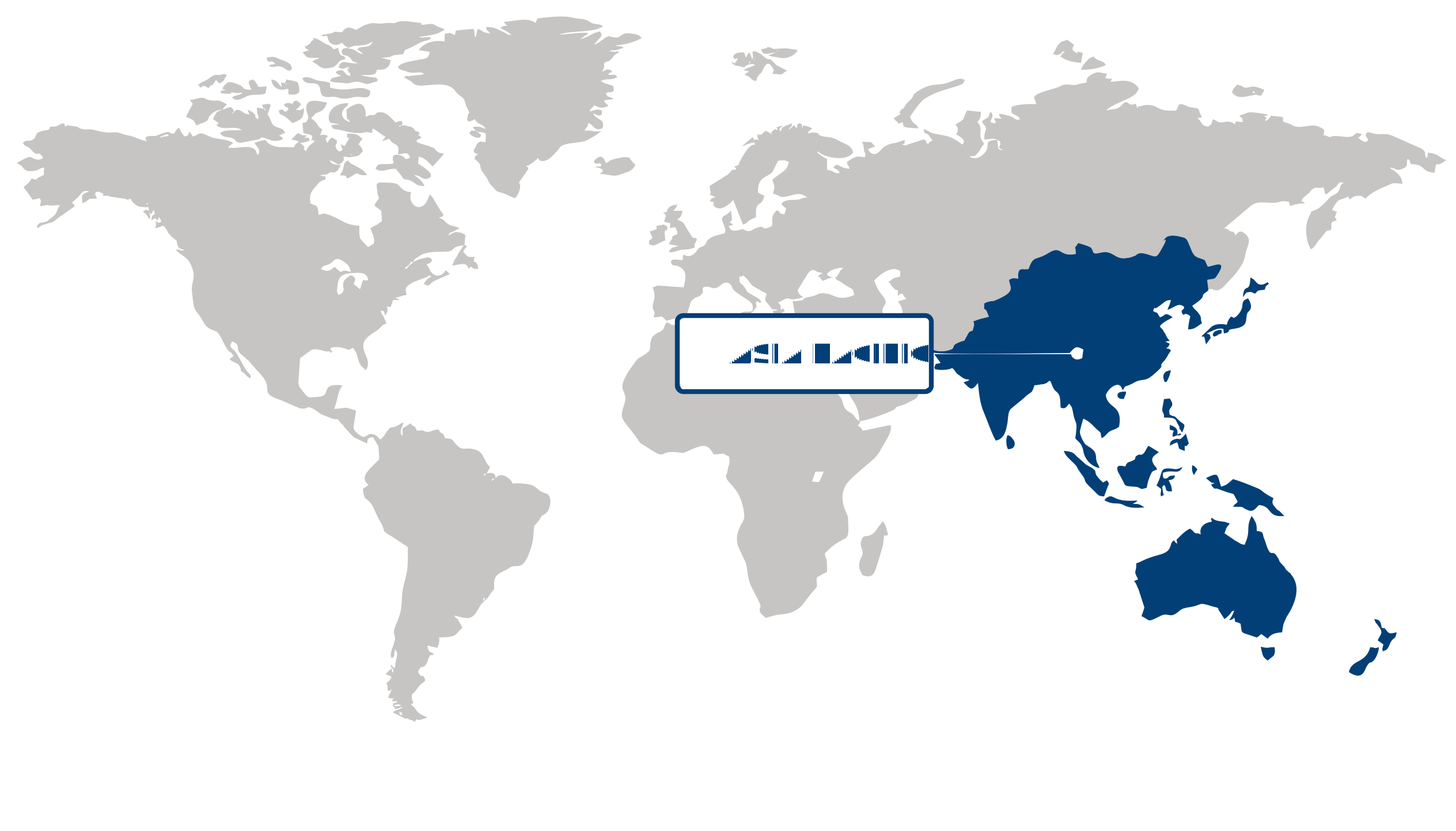
Asia Pacific (Largest & Fastest-Growing Region)
Asia Pacific dominated the membrane electrode assembly market in 2026, accounting for a 56.28% market share, and is also projected to be the fastest-growing regional market. Strong fuel cell manufacturing capabilities, increasing investment in clean energy technologies, and expanding production of advanced energy components are driving regional demand. Growing interest in hydrogen-based energy systems, alongside continued development of supporting manufacturing infrastructure, is further accelerating the adoption of membrane electrode assemblies and strengthening Asia Pacific’s position as the leading regional market.
| Parameter | North America | Asia Pacific | Europe | Latin America | MEA |
|---|---|---|---|---|---|
| Innovation Hub i Scale Nascent Developing Advanced | |||||
| Cost-Sensitive Region i Scale Low Medium High | |||||
| Regulatory Environment i Scale Restrictive Neutral Supportive | |||||
| Demand Drivers i Scale Weak Moderate Strong | |||||
| Development Stage i Scale Emerging Developing Developed | |||||
| Adoption Rate i Scale Low Medium High | |||||
| New Entrants / Startups i Scale Sparse Moderate Dense | |||||
| Macro Indicators i Scale Weak Stable Strong |
Key Country Insights
Germany 🇩🇪
Advanced Stack EngineeringGermany is refining membrane electrode assembly technologies to improve fuel cell efficiency for automotive and industrial applications. Strong collaboration between component suppliers and engineering firms is advancing manufacturing quality and product reliability.
France 🇫🇷
Clean Energy IntegrationFrance is promoting membrane electrode assembly innovation to support hydrogen-powered transport and clean energy infrastructure. Research organizations and manufacturers are collaborating to improve catalyst utilization and manufacturing efficiency.
Italy 🇮🇹
Industrial Technology AdoptionItaly is increasing interest in membrane electrode assemblies for industrial energy applications and specialized mobility projects. Companies are focusing on reliable component sourcing and technology partnerships to strengthen local fuel cell capabilities.
Japan 🇯🇵
Performance OptimizationJapan is concentrating on high-performance membrane electrode assemblies that enhance fuel cell longevity and operational efficiency. Companies are investing in material innovation and precision manufacturing to meet demanding commercial requirements.
South Korea 🇰🇷
Hydrogen Mobility SupportSouth Korea is expanding membrane electrode assembly production to reinforce its hydrogen mobility ecosystem. Manufacturers are increasing manufacturing capacity while improving component integration for next-generation fuel cell systems.
United States 🇺🇸
Fuel Cell CommercializationThe U.S. is accelerating membrane electrode assembly development to support fuel cell deployment across transportation and stationary power applications. Manufacturers are prioritizing durability improvements, scalable production, and domestic supply chain capabilities.
Segment Leadership and Growth Trends
Membrane Electrode Assembly Market Share (%), by Product, 2026
Go beyond the chart, access full insights & data tables
Request Free Sample ReportProduct Segment Analysis: 3-Layer Membrane Electrode Assemblies (Largest Segment) vs 5-Layer Membrane Electrode Assemblies (Fastest-Growing Segment)
Holding the largest share of the membrane electrode assembly market at 51.23% in 2026, 3-layer membrane electrode assemblies benefit from their established configuration, relatively straightforward construction, and suitability for a broad range of fuel cell applications. Their balanced combination of performance, manufacturing practicality, and cost considerations supports continued adoption across proton exchange membrane fuel cell systems. The established use of this configuration also contributes to its strong market position as fuel cell manufacturers focus on dependable assembly designs and scalable production.
The 5-layer membrane electrode assembly segment is expanding at the fastest pace, supported by increasing demand for enhanced fuel cell performance and more sophisticated electrode assembly architectures. The additional functional layers can support improved electrochemical performance, catalyst utilization, and overall cell efficiency, making the configuration attractive as fuel cell systems become more performance-oriented. Growing interest in advanced hydrogen-based energy technologies is further encouraging the adoption of higher-performance membrane electrode assemblies.
Application Segment Analysis: PEMFC (Largest & Fastest-Growing Segment)
The PEMFC segment led the membrane electrode assembly market with a 34.84% share in 2026 and is also the fastest-growing application segment, reflecting the strong role of proton exchange membrane fuel cells in the development of hydrogen-based power systems. PEMFC technology offers characteristics suited to applications requiring efficient and responsive power generation, supporting demand for specialized membrane electrode assemblies. Continued attention to hydrogen mobility, clean energy systems, and fuel cell efficiency is strengthening the need for reliable PEMFC components, while ongoing improvements in electrode and membrane technologies are supporting further adoption.
| Segment | Sub-Segment | Largest Segment | Fastest Growing |
|---|---|---|---|
| Product | 3-Layer Membrane Electrode Assemblies, 5-Layer Membrane Electrode Assemblies, Others | 3-Layer Membrane Electrode Assemblies | 5-Layer Membrane Electrode Assemblies |
| Application | PEMFC, DMFC, Electrolyzers, Hydrogen / Oxygen Fuel Cells, Others | PEMFC | PEMFC |
Competitive Landscape and Market Positioning
Major players in the membrane electrode assembly market:
1. Ballard Power Systems Inc. (Canada)
2. W. L. Gore & Associates Inc. (United States)
3. BASF SE (Germany)
4. Plug Power Inc. (United States)
5. Danish Power Systems A/S (Denmark)
6. Giner Inc. (United States)
7. FuelCellsEtc Inc. (United States)
8. IRD Fuel Cells A/S (Denmark)
9. HyPlat (South Africa)
10. Johnson Matthey plc (United Kingdom)
The membrane electrode assembly market is driven by advancements in fuel cell and clean energy technologies. R&D initiatives are focused on improving efficiency, durability, and performance stability. Product innovations are enhancing energy conversion effectiveness across applications. Collaborative development efforts are strengthening technological progress and commercialization pathways.
| Company | Market Share | Company Revenue | Revenue CAGR (%) | Product Portfolio | Geographic Presence | Innovation / R&D Focus | Strategic Developments |
|---|---|---|---|---|---|---|---|
| Ballard Power Systems Inc. (Canada) | |||||||
| W. L. Gore & Associates Inc. (United States) | |||||||
| BASF SE (Germany) | |||||||
| Plug Power Inc. (United States) | |||||||
| Danish Power Systems A/S (Denmark) | |||||||
| Giner Inc. (United States) | |||||||
| FuelCellsEtc Inc. (United States) | |||||||
| IRD Fuel Cells A/S (Denmark) | |||||||
| HyPlat (South Africa) | |||||||
| Johnson Matthey plc (United Kingdom). |
Industry Development/News
| Company Name | Date | Key Development |
|---|---|---|
| Johnson Matthey | Jul-25 | Johnson Matthey has finalized the structural expansion of its fuel cell membrane electrode assembly manufacturing facility in Jiading, Shanghai. This strategic capacity increase is designed to meet the rising demand for fuel cell components within the hydrogen energy sector, reinforcing the company's production footprint and supply chain reliability for high-performance membrane technologies. |
| Fuel Cell System Manufacturing (FCSM) | Jul-25 | The Fuel Cell System Manufacturing joint venture between General Motors and Honda has initiated production of hydrogen fuel cell systems at its Brownstown, Michigan facility. This development represents a critical milestone in the large-scale industrialization and commercialization of hydrogen fuel cell technologies specifically tailored for the transportation and automotive sectors. |
| Toshiba | Jul-25 | Toshiba has unveiled a high-efficiency PEM electrolysis device engineered to optimize hydrogen production while concurrently reducing reliance on iridium. This technology integration addresses key cost and supply chain challenges associated with precious metal consumption in electrolyzer manufacturing, facilitating more commercially viable deployment of large-scale hydrogen energy infrastructure. |
| Fraunhofer ISE | Jul-25 | Fraunhofer ISE has introduced a flexible production platform specifically designed for membrane electrode assemblies. By enhancing the scalability and efficiency of manufacturing processes, this innovation supports the transition from small-batch production to standardized industrial manufacturing, thereby reducing barriers to entry and improving operational efficiency for fuel cell technology producers. |
| Hyzon | Jul-25 | Hyzon has reached a manufacturing milestone with the commencement of 200kW fuel cell system production at its Bolingbrook facility. This operational expansion directly supports the commercial scaling of hydrogen-powered solutions, providing the necessary manufacturing capacity to address growing industrial requirements for heavy-duty transportation and high-output fuel cell applications. |
| Advent Technologies | Jul-25 | Advent Technologies is targeting the aerospace sector through the integration of its fuel cell systems into next-generation aviation platforms, including eVTOLs and fixed-wing aircraft. This expansion into specialized high-performance markets demonstrates the technical adaptability of the company's membrane electrode assembly solutions beyond traditional automotive applications, signaling a broader commercialization strategy for clean aviation. |
| Hyundai Motor, Kia, and W. L. Gore | Jun-25 | Hyundai Motor, Kia, and W. L. Gore have established a strategic partnership focused on the co-development of next-generation polymer electrolyte membrane (PEM) technology. By combining automotive application expertise with advanced material science, the collaboration aims to drive significant performance improvements and accelerate the adoption of hydrogen fuel cell systems in the clean mobility market. |
Customize Your Report
Explore examples of how this report can be tailored to different research needs, including custom segments, additional topics or chapters, and related reports. Click a section of the wheel or its numbered marker to explore the available options.
Membrane Electrode Assembly Market — Custom Segments
| Segment | Sub-Segment |
|---|---|
| Catalyst Type | Platinum-Based, Platinum-Alloy, Platinum-Free |
| Customer Type | Fuel Cell Manufacturers, Electrolyzer Manufacturers, System Integrators & OEMs, Research & Specialty Users |
| Manufacturing Technology | Catalyst-Coated Membrane, Gas Diffusion Electrode, Decal Transfer, Direct Coating |
Membrane Electrode Assembly Market — Custom TOC
| Custom Chapter | Custom Details |
|---|---|
| Hydrogen Economy Demand Impact Analysis |
|
| MEA Supply Chain Risk Assessment |
|
| Next-generation Fuel Cell Adoption Strategy |
|
Need a different cut of the data?
Request Custom ResearchHow much is the membrane electrode assembly market worth?
What is the expected industry size of membrane electrode assembly by 2036?
How are clean energy policies and incentives accelerating demand for membrane electrode assemblies in fuel cell deployments?
Why is hydrogen infrastructure investment critical to scaling membrane electrode assembly demand?
Which product segment dominated the membrane electrode assembly market in 2026?
Why are 5-Layer Membrane Electrode Assemblies the fastest-growing product segment?
Why does Asia Pacific lead the membrane electrode assembly market?
What is driving the rapid growth of the membrane electrode assembly market in Asia Pacific?
What are the key competitors in the membrane electrode assembly landscape?
Our Clients
"The information presented in the report was genuinely insightful. The data was clear and easy to understand, which made it much easier to interpret the findings."
Amara Raja Group
"The responsiveness and professionalism exhibited by the team were exemplary. They were readily available to address queries, provide clarifications, and offer additional insights."
ONGC
"The reports offered a comprehensive analysis of various segments within the market. The detailed insights into market trends, and regulatory landscapes were excellent."
TotalEnergies
Our Research Team & Methodology
Every Fundamental Business Insights report is built by a dedicated vertical research team, validated through a structured primary-and-secondary methodology, and reviewed for accuracy before it reaches you.
Research Team Overview
Prepared by the Energy & Power Research Team
Delivery
Published
Demand
Available
Support
Trust & Compliance
Research Domains
10 coverage areasResearch Intelligence
| Source | Reference |
|---|---|
| International Energy Agency (IEA) | www.iea.org |
| U.S. Energy Information Administration (EIA) | www.eia.gov |
| International Renewable Energy Agency (IRENA) | www.irena.org |
| International Electrotechnical Commission (IEC) | www.iec.ch |
| International Organization for Standardization (ISO) | www.iso.org |
| IEEE | www.ieee.org |
| CIGRE (International Council on Large Electric Systems) | www.cigre.org |
| World Energy Council (WEC) | www.worldenergy.org |
| U.S. Department of Energy (DOE) | www.energy.gov |
| International Atomic Energy Agency (IAEA) | www.iaea.org |
| American Petroleum Institute (API) | www.api.org |
| Society of Petroleum Engineers (SPE) | www.spe.org |
| Hydrogen Council | hydrogencouncil.com |
| Battery Council International (BCI) | batterycouncil.org |
| Global Wind Energy Council (GWEC) | gwec.net |
| SolarPower Europe | www.solarpowereurope.org |
| World Bioenergy Association (WBA) | worldbioenergy.org |
| International Hydropower Association (IHA) | www.hydropower.org |
| Edison Electric Institute (EEI) | www.eei.org |
| National Renewable Energy Laboratory (NREL) | www.nrel.gov |
Research Workflow & Quality Assurance
Data Collection
Verified information gathered through primary and secondary research.
Data Triangulation
Cross-validation using multiple independent data sources.
Forecast Modelling
Market estimates developed using historical trends and analytical models.
Analyst Validation
Findings reviewed by domain experts for accuracy and consistency.
Editorial & Quality Review
Final editorial, quality, and compliance checks before publication.
Final Publication
Released after successful completion of the internal review process.
Report Coverage
📊 Market Assessment
- Market Size & Forecast
- Market Segmentation
- Regional Analysis
- Growth Drivers & Challenges
- Market Dynamics
🏢 Competitive Intelligence
- Competitive Landscape
- Company Profiles
- Competitive Benchmarking
- Mergers & Acquisitions
- Market Share Analysis or Key Company Strategies
🔍 Strategic Analysis
- Value Chain Analysis
- Porter's Five Forces
- PESTLE Analysis
- Pricing Trends
- Supply-Demand Analysis
🚀 Future Outlook
- Technology Landscape
- Regulatory Landscape
- Investment & Funding Landscape
- Emerging Opportunities
- Future Market Outlook
Have a question about this report or need a custom scope?
Request Customization