Massive MIMO Market Size & Growth Forecast 2027–2036, By Segments (Technology, Spectrum, Antenna Array Type), Regional Demand Trends (North America, Asia Pacific, Europe), Key Country Insights (U.S., Japan, South Korea, Germany, France, Italy), and Competitive Landscape
Market Size and Growth Outlook
Massive MIMO Market size was over USD 8.15 Billion in 2026 and is likely to grow at 40.09% CAGR between 2027 and 2036, exceeding USD 237.26 Billion by 2036. The industry revenue for 2027 is estimated at USD 11.03 Billion.
Get more details on this report
Request Free Sample ReportMassive MIMO Market Intelligence Snapshot
Regional Market Dynamics
- Asia Pacific led in 2026, supported by advanced wireless deployments, high mobile data consumption, 5G expansion, and continued telecommunications infrastructure investment.
- North America is projected to grow fastest as 5G expansion, rising data traffic, network modernization, and demand for high-capacity connectivity accelerate adoption.
Segment Momentum
- LTE Advance accounted for 42.9% of the market in 2026, supported by established LTE deployments and its ability to improve network capacity, spectral efficiency, coverage, and data throughput across existing mobile networks.
- 128T128R & Above is projected to be the fastest-growing antenna array type as operators seek greater network capacity, enhanced beamforming, and improved support for dense, high-traffic wireless environments.
Market Expansion Drivers
- Accelerated global 5G standalone deployments driving large-scale Massive MIMO infrastructure expansion
- Mid-band spectrum adoption enabling higher capacity and improved 5G network performance
- Network densification in urban zones increasing demand for advanced antenna array systems
Leading Market Participants
- Prominent companies in the massive MIMO market include Ericsson (Sweden), Huawei Technologies Co., Ltd. (China), Nokia Corporation (Finland), Samsung Electronics Co., Ltd. (South Korea), Qualcomm Technologies, Inc. (United States), ZTE Corporation (China), Cisco Systems, Inc. (United States), NEC Corporation (Japan), Fujitsu Limited (Japan), Marvell Technology, Inc. (United States)
Global Market Forecast Snapshot
Market Outlook
- 2026 Market Size: USD 8.15 Billion
- 2027 Estimated Market Size: USD 11.03 Billion
- Projected Market Size: USD 237.26 Billion by 2036
- Growth Forecast: 40.09% CAGR (2027-2036)
Regional and Segment Outlook
- Leading Regional Market: Asia Pacific
- High-Growth Regional Hub: North America
- Core Revenue Segment: LTE Advance (Technology) | TDD (Spectrum) | 64T64R (Antenna Array Type)
- Emerging Opportunity Segment: 5G (Technology) | TDD (Spectrum) | 128T128R & Above (Antenna Array Type)
Market Growth Drivers and Industry Trends
Accelerated global 5G standalone deployments driving large-scale Massive MIMO infrastructure expansion
The transition toward standalone 5G architectures is accelerating investments in advanced radio access infrastructure capable of supporting higher network efficiency and improved service capabilities. This shift will drive the massive MIMO market growth as network operators deploy sophisticated antenna technologies that maximize spectral efficiency and deliver enhanced capacity for data-intensive applications. Standalone networks require more intelligent radio performance to support low-latency communications, network slicing, and expanding connected-device ecosystems, making large-scale massive MIMO deployments an integral component of modernization strategies. Infrastructure upgrades across urban and suburban environments are also increasing demand for advanced base station configurations designed to improve coverage and user experience.
Mid-band spectrum adoption enabling higher capacity and improved 5G network performance
The growing allocation and commercialization of mid-band spectrum are reshaping 5G deployment strategies by offering an effective balance between coverage and network capacity. Adoption of these frequencies will propel the massive MIMO market growth because advanced antenna arrays significantly improve spectrum utilization, allowing operators to serve greater numbers of simultaneous users with enhanced throughput. Beamforming capabilities associated with massive MIMO systems help optimize signal quality across densely populated service areas while reducing interference and improving overall network reliability. These technical advantages encourage broader implementation in both existing infrastructure upgrades and new network rollouts where efficient spectrum usage remains a strategic priority.
Network densification in urban zones increasing demand for advanced antenna array systems
As metropolitan regions experience rising mobile data consumption and growing concentrations of connected devices, telecommunications providers are expanding network density to maintain consistent service quality. In response to these requirements, the massive MIMO market will boost demand through widespread adoption of advanced antenna array systems that improve coverage, capacity, and spectral efficiency within space-constrained urban environments. Densified network architectures rely on intelligent radio technologies capable of managing overlapping cells, mitigating interference, and supporting high traffic volumes across commercial districts, residential areas, transportation hubs, and public venues where uninterrupted connectivity has become increasingly important.
| Growth Driver | Impact on CAGR | Regulatory Influence | Geographic Relevance | Adoption Rate | Impact Timeline |
|---|---|---|---|---|---|
| Accelerated global 5G standalone deployments driving large-scale Massive MIMO infrastructure expansion | 6.8% | High | Asia Pacific, North America, Europe | High | Near Term |
| Mid-band spectrum adoption enabling higher capacity and improved 5G network performance | 6.2% | High | North America, Europe, Asia Pacific | High | Near Term |
| Network densification in urban zones increasing demand for advanced antenna array systems | 5.4% | High | Asia Pacific, Europe, North America | High | Near Term |
Unlock insights tailored to your business with our bespoke market research solutions.
Click to get your customized report now.
Regional Demand Dynamics
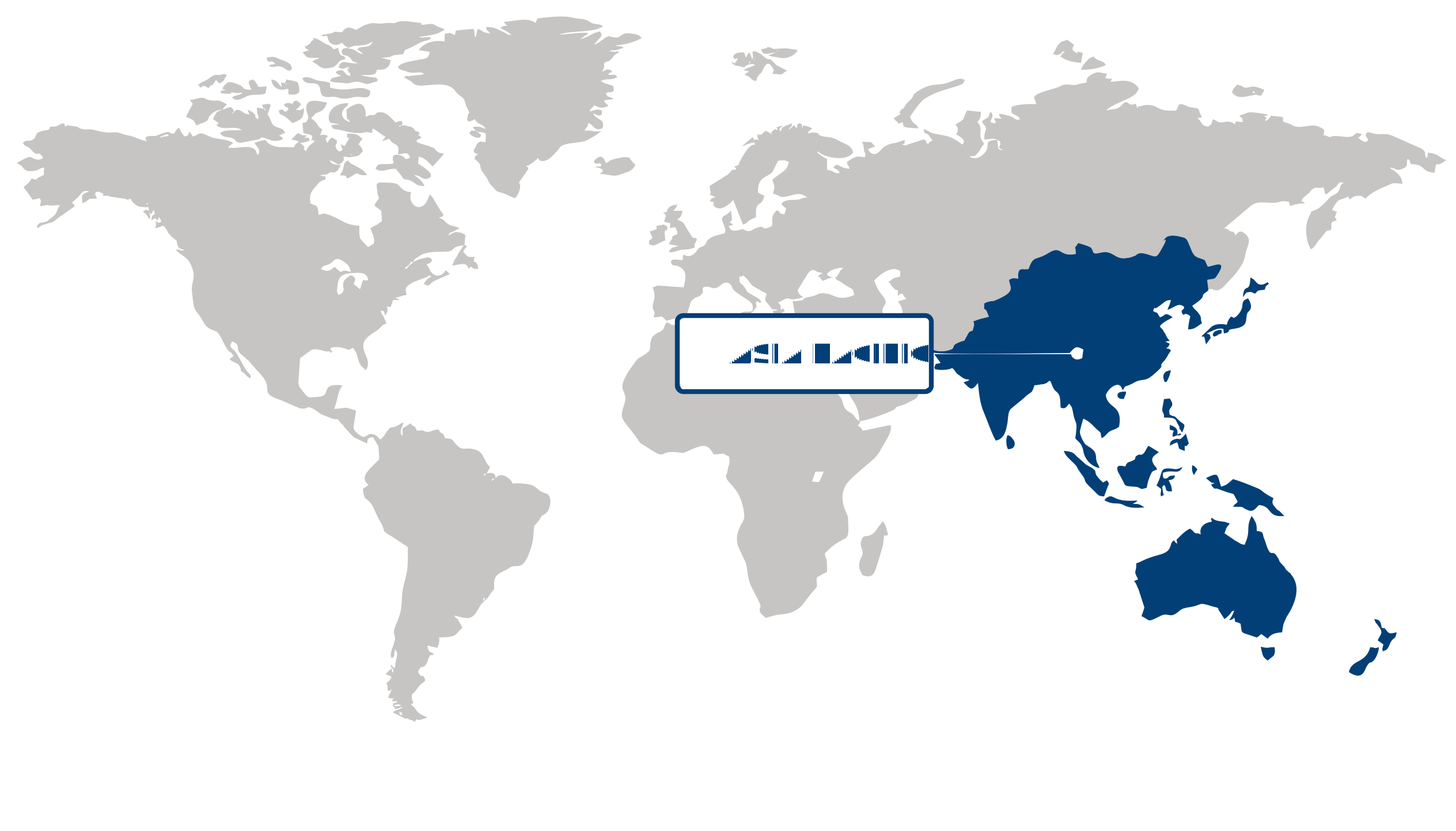
Asia Pacific (Largest Region)
The massive MIMO market was led by Asia Pacific in 2026, benefiting from rapid deployment of advanced wireless networks, high mobile data consumption, and continued investment in telecommunications infrastructure. The region's large and increasingly connected population is driving demand for greater network capacity, improved coverage, and higher data speeds. The expansion of 5G services and ongoing modernization of mobile networks are further supporting the integration of massive MIMO technologies into telecommunications infrastructure.
North America (Fastest-Growing Region)
North America is expected to witness the fastest growth, driven by continued 5G network expansion, increasing demand for high-capacity wireless connectivity, and investments in network modernization. Rising data traffic from connected devices, cloud-based services, and bandwidth-intensive applications is encouraging telecommunications providers to improve network efficiency and capacity. In addition, the growing adoption of advanced wireless technologies across enterprise, industrial, and consumer applications is expected to support the region's growth trajectory.
| Parameter | North America | Asia Pacific | Europe | Latin America | MEA |
|---|---|---|---|---|---|
| Innovation Hub i Scale Nascent Developing Advanced | |||||
| Cost-Sensitive Region i Scale Low Medium High | |||||
| Regulatory Environment i Scale Restrictive Neutral Supportive | |||||
| Demand Drivers i Scale Weak Moderate Strong | |||||
| Development Stage i Scale Emerging Developing Developed | |||||
| Adoption Rate i Scale Low Medium High | |||||
| New Entrants / Startups i Scale Sparse Moderate Dense | |||||
| Macro Indicators i Scale Weak Stable Strong |
Key Country Insights
United States 🇺🇸
Network Capacity ExpansionThe U.S. is deploying massive MIMO technologies to improve network capacity, spectral efficiency, and 5G service quality. Telecommunications providers are upgrading radio infrastructure to support increasing mobile data demand and enterprise connectivity applications.
Germany 🇩🇪
Industrial Connectivity EnablementGermany is adopting massive MIMO solutions to strengthen high-performance wireless connectivity for industrial automation and digital manufacturing. Network operators are integrating advanced antenna systems that improve coverage and support demanding enterprise communication environments.
Japan 🇯🇵
Advanced 5G PerformanceJapan is enhancing massive MIMO deployment to optimize high-density urban networks and next-generation wireless services. Equipment vendors and operators are focusing on energy-efficient antenna technologies, network optimization, and reliable user experiences.
South Korea 🇰🇷
Dense Network OptimizationSouth Korea continues to refine massive MIMO implementation across advanced mobile networks to improve capacity in densely populated environments. Telecom operators are emphasizing intelligent beamforming, efficient spectrum utilization, and seamless 5G service delivery.
France 🇫🇷
Urban Coverage EnhancementFrance is strengthening massive MIMO deployment to improve wireless coverage and network efficiency across urban and suburban areas. Service providers are investing in intelligent radio access technologies that support increasing mobile traffic and enterprise connectivity requirements.
Italy 🇮🇹
Radio Infrastructure ModernizationItaly is modernizing wireless infrastructure with massive MIMO technologies that improve network performance and operational efficiency. Operators are prioritizing scalable deployments, enhanced signal quality, and optimized spectrum utilization for expanding digital services.
Segment Leadership and Growth Trends
Massive MIMO Market Share (%), by Technology, 2026
Go beyond the chart, access full insights & data tables
Request Free Sample ReportTechnology Segment Analysis: LTE Advance (Largest Segment) vs 5G (Fastest-Growing Segment)
LTE advance held the largest share of the massive MIMO market at 42.9% in 2026. Its strong position is supported by the established deployment of LTE-based networks and the growing need to improve network capacity, spectral efficiency, and coverage in high-traffic environments. Massive MIMO technology enhances the performance of LTE networks by enabling more efficient use of available spectrum and supporting higher data throughput, making LTE advance a practical solution for operators seeking to strengthen existing network infrastructure. Its broad compatibility with established mobile ecosystems continues to support adoption across developed and emerging markets.
The 5G segment is expected to register the fastest growth, driven by the increasing deployment of next-generation wireless networks and the rising demand for high-capacity, low-latency connectivity. Massive MIMO is a core technology for 5G network performance, enabling operators to support dense user environments, improve spectral utilization, and deliver enhanced connectivity for advanced applications. The expansion of data-intensive services, connected devices, and emerging digital applications is further increasing the need for network architectures capable of handling growing traffic volumes, supporting strong momentum for 5G-based massive MIMO solutions.
Spectrum Segment Analysis: TDD (Largest & Fastest-Growing Segment)
The TDD segment accounted for the largest share of the massive MIMO market and is also expected to be the fastest-growing spectrum segment in 2026. TDD is well suited to massive MIMO deployments because it enables flexible allocation of uplink and downlink capacity according to changing traffic requirements. This characteristic is particularly valuable in high-density network environments where data demand can vary significantly between upload and download activities. The increasing deployment of advanced mobile networks and the need to improve spectrum efficiency are strengthening the role of TDD-based massive MIMO systems, supporting both its current market leadership and continued expansion.
Antenna Array Type Segment Analysis: 64T64R (Largest Segment) vs 128T128R & Above (Fastest-Growing Segment)
The 64T64R antenna array type represented the largest segment of the massive MIMO market in 2026. Its position reflects the balance it provides between high-capacity network performance and practical deployment requirements. The configuration supports enhanced beamforming and spatial multiplexing capabilities, helping network operators improve coverage and capacity in demanding environments. Its suitability for broad commercial network deployment and ability to support growing data traffic continue to make 64T64R a widely adopted configuration.
128T128R & above is projected to be the fastest-growing antenna array type segment, supported by the increasing demand for greater network capacity and more advanced beamforming capabilities. Higher-order antenna configurations can enable networks to serve more users simultaneously while improving spatial signal management in dense and high-traffic environments. As operators increasingly pursue higher performance from next-generation wireless infrastructure, the demand for advanced antenna arrays with greater spatial processing capabilities is expected to gain momentum.
| Segment | Sub-Segment | Largest Segment | Fastest Growing |
|---|---|---|---|
| Technology | LTE Advance, LTE Advance Pro, 5G | LTE Advance | 5G |
| Spectrum | TDD, FDD, Others | TDD | TDD |
| Antenna Array Type | 8T8R, 16T16R, 32T32R, 64T64R, 128T128R & Above | 64T64R | 128T128R & Above |
Competitive Landscape and Market Positioning
Leading companies in the massive MIMO market:
- Ericsson (Sweden)
- Huawei Technologies Co., Ltd. (China)
- Nokia Corporation (Finland)
- Samsung Electronics Co., Ltd. (South Korea)
- Qualcomm Technologies, Inc. (United States)
- ZTE Corporation (China)
- Cisco Systems, Inc. (United States)
- NEC Corporation (Japan)
- Fujitsu Limited (Japan)
- Marvell Technology, Inc. (United States)
Competitive momentum is increasingly centered on delivering higher network efficiency while reducing deployment complexity for communications infrastructure providers. Vendors are advancing antenna architectures, signal processing capabilities, and energy management techniques that enable operators to improve capacity without proportionally increasing network footprints or operating costs. As deployment environments become more diverse, differentiation is also emerging through flexible hardware designs and software-driven optimization that simplify integration with evolving network architectures. The market is further influenced by the convergence of radio intelligence and automation, prompting suppliers to strengthen capabilities that support dynamic resource allocation, remote optimization, and scalable network performance across increasingly demanding connectivity scenarios.
| Company | Market Share | Company Revenue | Revenue CAGR (%) | Product Portfolio | Geographic Presence | Innovation / R&D Focus | Strategic Developments |
|---|---|---|---|---|---|---|---|
| Ericsson (Sweden) | |||||||
| Huawei Technologies Co. Ltd. (China) | |||||||
| Nokia Corporation (Finland) | |||||||
| Samsung Electronics Co. Ltd. (South Korea) | |||||||
| Qualcomm Technologies Inc. (United States) | |||||||
| ZTE Corporation (China) | |||||||
| Cisco Systems Inc. (United States) | |||||||
| NEC Corporation (Japan) | |||||||
| Fujitsu Limited (Japan) | |||||||
| Marvell Technology Inc. (United States) |
Industry Development/News
| Company Name | Date | Key Development |
|---|---|---|
| rain South Africa | Jul-26 | rain South Africa and Huawei launched a multi-thousand-site sub-1 GHz Massive MIMO 5G network. This large-scale deployment utilizes wideband low-band technology to significantly expand 5G coverage and capacity, representing a major milestone in the commercial implementation of advanced Massive MIMO solutions for improved network performance in geographically diverse areas. |
| ZTE Corporation | Mar-26 | ZTE and China Mobile introduced the GigaMIMO solution, an AI-integrated evolution of Massive MIMO technology. By utilizing ultra-massive antenna arrays, the solution significantly enhances 5G-Advanced network capacity and user experience while establishing a technical foundation for future 6G service integration and intelligent network management. |
| Broadcom | Feb-26 | Broadcom launched the industry's first 6G digital front-end SoC specifically for Massive MIMO applications. Supporting a 0.4–8.5 GHz range, the CMOS-based solution delivers improved RF performance and power efficiency, addressing critical hardware requirements for the next generation of 5G-Advanced and 6G network infrastructure deployments. |
| Tejas Networks | Feb-26 | Tejas Networks secured a major contract to manufacture and supply 5G Massive MIMO radios for NEC Corporation's global telecommunications projects. This strategic partnership expands the company's manufacturing role in next-generation wireless infrastructure and validates its capability to deliver carrier-grade hardware for complex, multi-vendor international network deployments. |
| SoftBank Corp. | Jan-26 | SoftBank and Ericsson deployed an AI-powered control system to optimize Massive MIMO beamforming at major Japanese venues. Following successful trials, the system improved downlink throughput by approximately 24% by dynamically adjusting beam patterns in response to real-time traffic patterns, demonstrating the commercial scalability of intelligent, adaptive network infrastructure. |
| Tejas Networks | Oct-25 | Tejas Networks launched its indigenous 64T64R Massive MIMO radio, Ojas64, at India Mobile Congress 2025. This development highlights the company’s increasing domestic capability in designing high-capacity antenna systems and strengthens its competitive positioning as a specialized provider of advanced telecommunications equipment within the global market. |
| Ericsson | Jun-25 | Ericsson and Telstra introduced the industry's first triple-band FDD Massive MIMO radio (AIR 3284). By enabling simultaneous enhanced coverage and capacity across multiple spectrum bands, the programmable technology provides a high-performance architectural benchmark for 5G network transformation and creates a scalable pathway toward 5G-Advanced services. |
| Ericsson | Mar-25 | Ericsson announced an additional USD 50 million investment to expand its Texas-based 5G manufacturing facility. The capital injection is directed toward increasing production capacity for advanced network equipment, reinforcing the company's operational footprint in support of large-scale Open RAN adoption and the manufacturing of high-performance Massive MIMO radio portfolios. |
| Samsung Electronics | Mar-25 | Samsung and O2 Telefónica launched a commercial virtualized Open RAN network in Germany. The deployment validates the integration of Samsung’s Massive MIMO radio portfolio within virtualized, open network architectures, demonstrating the feasibility of large-scale interoperable network implementations and expanding the ecosystem for flexible, hardware-independent 5G infrastructure. |
| Ericsson | May-24 | Ericsson initiated domestic manufacturing of Massive MIMO radios at its Texas facility. This strategic capacity expansion strengthens the company's local supply chain for advanced wireless infrastructure, providing dedicated support for Open RAN deployments and next-generation network equipment requirements in the North American market. |
Customize Your Report
Explore examples of how this report can be tailored to different research needs, including custom segments, additional topics or chapters, and related reports. Click a section of the wheel or its numbered marker to explore the available options.
Massive MIMO Market — Custom Segments
| Segment | Sub-Segment |
|---|---|
| Deployment Type | Macro Base Stations, Small Cells, Distributed Antenna Systems |
| Network Operator Type | Mobile Network Operators, Private Network Operators, Neutral Host Operators |
| Use Case | Enhanced Mobile Broadband, Fixed Wireless Access, Massive IoT Connectivity, Private 5G Networks |
Massive MIMO Market — Custom TOC
| Custom Chapter | Custom Details |
|---|---|
| 5G Network Capacity Investment Priorities |
|
| Operator Deployment Economics |
|
| Open RAN Adoption Implications |
|
Need a different cut of the data?
Request Custom ResearchWhat is the market valuation of massive MIMO?
What is the projected value of the massive MIMO industry by 2036?
How are 5G standalone deployments influencing Massive MIMO infrastructure investments?
Why is network densification increasing demand for Massive MIMO solutions?
Why does LTE Advance hold the largest share of the massive MIMO market?
Which antenna array type is expected to grow the fastest in the massive MIMO market?
Why does Asia Pacific lead the massive MIMO market?
How is North America driving faster massive MIMO growth?
Which companies dominate the massive MIMO landscape?
Our Clients
"Working with FBI has been a good experience. The market report provided a holistic view, covering everything from emerging trends to potential risks."
Semtech Corporation
"The experience was highly positive. The team showcased remarkable flexibility in adapting to our specific needs and delivered report that perfectly aligned with all our requirements."
TSMC
"What really stood out to me was how clearly and promptly the Fundamental Business Insights team communicated throughout. It made the collaboration feel effortless."
NXP Semiconductors
Our Research Team & Methodology
Every Fundamental Business Insights report is built by a dedicated vertical research team, validated through a structured primary-and-secondary methodology, and reviewed for accuracy before it reaches you.
Research Team Overview
Prepared by the Electronics & Semiconductors Research Team
Delivery
Published
Demand
Available
Support
Trust & Compliance
Research Domains
10 coverage areasResearch Intelligence
| Source | Reference |
|---|---|
| Semiconductor Industry Association (SIA) | www.semiconductors.org |
| SEMI | www.semi.org |
| JEDEC Solid State Technology Association | www.jedec.org |
| IEEE | www.ieee.org |
| IPC – Association Connecting Electronics Industries | www.ipc.org |
| International Electrotechnical Commission (IEC) | www.iec.ch |
| International Organization for Standardization (ISO) | www.iso.org |
| U.S. Bureau of Industry and Security (BIS) | www.bis.gov |
| U.S. Patent and Trademark Office (USPTO) | www.uspto.gov |
| European Patent Office (EPO) | www.epo.org |
| Taiwan Semiconductor Industry Association (TSIA) | www.tsia.org.tw |
| World Semiconductor Trade Statistics (WSTS) | www.wsts.org |
| International Energy Agency (IEA) | www.iea.org |
| GSMA | www.gsma.com |
| 3GPP | www.3gpp.org |
| ITU (International Telecommunication Union) | www.itu.int |
| Omdia (public insights) | omdia.tech.informa.com |
| Display Supply Chain Consultants (DSCC) | www.displaysupplychain.com |
| U.S. Department of Energy (DOE) | www.energy.gov |
| NIST (National Institute of Standards and Technology) | www.nist.gov |
Research Workflow & Quality Assurance
Data Collection
Verified information gathered through primary and secondary research.
Data Triangulation
Cross-validation using multiple independent data sources.
Forecast Modelling
Market estimates developed using historical trends and analytical models.
Analyst Validation
Findings reviewed by domain experts for accuracy and consistency.
Editorial & Quality Review
Final editorial, quality, and compliance checks before publication.
Final Publication
Released after successful completion of the internal review process.
Report Coverage
📊 Market Assessment
- Market Size & Forecast
- Market Segmentation
- Regional Analysis
- Growth Drivers & Challenges
- Market Dynamics
🏢 Competitive Intelligence
- Competitive Landscape
- Company Profiles
- Competitive Benchmarking
- Mergers & Acquisitions
- Market Share Analysis or Key Company Strategies
🔍 Strategic Analysis
- Value Chain Analysis
- Porter's Five Forces
- PESTLE Analysis
- Pricing Trends
- Supply-Demand Analysis
🚀 Future Outlook
- Technology Landscape
- Regulatory Landscape
- Investment & Funding Landscape
- Emerging Opportunities
- Future Market Outlook
Have a question about this report or need a custom scope?
Request Customization