Manufacturing Logistics Market Size & Growth Forecast 2027–2036, By Segments (Services, Industry, Transportation Mode, Technology), Regional Demand Trends (North America, Asia Pacific, Europe), Key Country Insights (U.S., Japan, South Korea, Germany, France, Italy), and Competitive Landscape
Market Size and Growth Outlook
Manufacturing Logistics Market size was valued at USD 186.63 Billion in 2026 and is anticipated to grow at 9.54% CAGR from 2027 to 2036, surpassing USD 464.2 Billion by 2036. The industry revenue for 2027 is estimated at USD 201.75 Billion.
Get more details on this report
Request Free Sample ReportManufacturing Logistics Market Intelligence Snapshot
Regional Market Dynamics
- Asia Pacific held 36.72% in 2026, supported by its extensive manufacturing base, industrial supply chains, and growing demand for integrated logistics services.
- The region is also the fastest-growing, driven by industrialization, new production centers, automated warehouses, digital platforms, cross-border trade, and logistics infrastructure investment.
Segment Momentum
- Road transportation leads the market because it provides flexible, direct connectivity between manufacturing facilities, warehouses, and distribution centers while supporting efficient short- and long-distance deliveries.
- Warehousing is projected to grow the fastest as manufacturers increasingly invest in inventory optimization, automated storage systems, and advanced warehouse management to improve supply chain efficiency.
Market Expansion Drivers
- Global trade expansion driving demand for integrated manufacturing supply chain logistics
- E-commerce integration increasing complexity and speed requirements of manufacturing logistics systems
- Advanced logistics technologies improving end-to-end manufacturing visibility and coordination efficiency
Leading Market Participants
- Prominent players in the manufacturing logistics market include DHL Supply Chain (Germany), Kuehne + Nagel International AG (Switzerland), Deutsche Bahn AG (DB Schenker) (Germany), DSV A/S (Denmark), XPO, Inc. (United States), United Parcel Service, Inc. (United States), FedEx Corporation (United States), C.H. Robinson Worldwide, Inc. (United States), Nippon Express Holdings Co., Ltd. (Japan), GEODIS S.A. (France)
Global Market Forecast Snapshot
Market Outlook
- 2026 Market Size: USD 186.63 Billion
- 2027 Estimated Market Size: USD 201.75 Billion
- Projected Market Size: USD 464.2 Billion by 2036
- Growth Forecast: 9.54% CAGR (2027-2036)
Regional and Segment Outlook
- Leading Regional Market: Asia Pacific
- High-Growth Regional Hub: Asia Pacific
- Core Revenue Segment: Transportation (Services) | Automotive (Industry) | Road (Transportation Mode) | IoT (Technology)
- Emerging Opportunity Segment: Warehousing (Services) | Pharmaceuticals (Industry) | Air (Transportation Mode) | AI & ML (Technology)
Market Growth Drivers and Industry Trends
Global trade expansion driving demand for integrated manufacturing supply chain logistics
Growing international trade is increasing the movement of raw materials, intermediate goods, and finished products across geographically dispersed manufacturing networks. The manufacturing logistics market growth is driven by rising demand for integrated logistics solutions that coordinate transportation, warehousing, inventory management, and cross-border distribution within increasingly complex global supply chains. Manufacturers are strengthening collaboration with logistics partners to improve operational resilience, reduce transit disruptions, and maintain consistent product availability across multiple markets.
E-commerce integration increasing complexity and speed requirements of manufacturing logistics systems
The continued expansion of digital commerce has reshaped customer expectations regarding order fulfillment speed, inventory availability, and delivery reliability. Increasing integration with e-commerce channels will drive the manufacturing logistics market growth by requiring manufacturers to synchronize production schedules with agile logistics operations capable of handling frequent order fluctuations and accelerated fulfillment timelines. This shift is encouraging greater investment in flexible distribution networks, automated fulfillment processes, and responsive inventory management strategies that support both business and consumer demand.
Advanced logistics technologies improving end-to-end manufacturing visibility and coordination efficiency
Digital innovations are transforming manufacturing logistics by enabling continuous monitoring and coordination across every stage of the supply chain. Within the manufacturing logistics market, advanced logistics technologies enhance operational visibility through real-time tracking, predictive analytics, and connected data platforms that improve decision-making and resource allocation. Better information sharing among manufacturers, suppliers, logistics providers, and distributors also strengthens coordination, minimizes delays, and supports more efficient movement of goods throughout production and distribution networks.
| Growth Driver | Impact on CAGR | Regulatory Influence | Geographic Relevance | Adoption Rate | Impact Timeline |
|---|---|---|---|---|---|
| Global trade expansion driving demand for integrated manufacturing supply chain logistics | 2% | Moderate | Asia Pacific, Europe | High | Near Term |
| E-commerce integration increasing complexity and speed requirements of manufacturing logistics systems | 1.8% | Low | North America, Asia Pacific | High | Near Term |
| Advanced logistics technologies improving end-to-end manufacturing visibility and coordination efficiency | 1.5% | Moderate | Europe, North America | High | Mid Term |
Unlock insights tailored to your business with our bespoke market research solutions.
Click to get your customized report now.
Regional Demand Dynamics
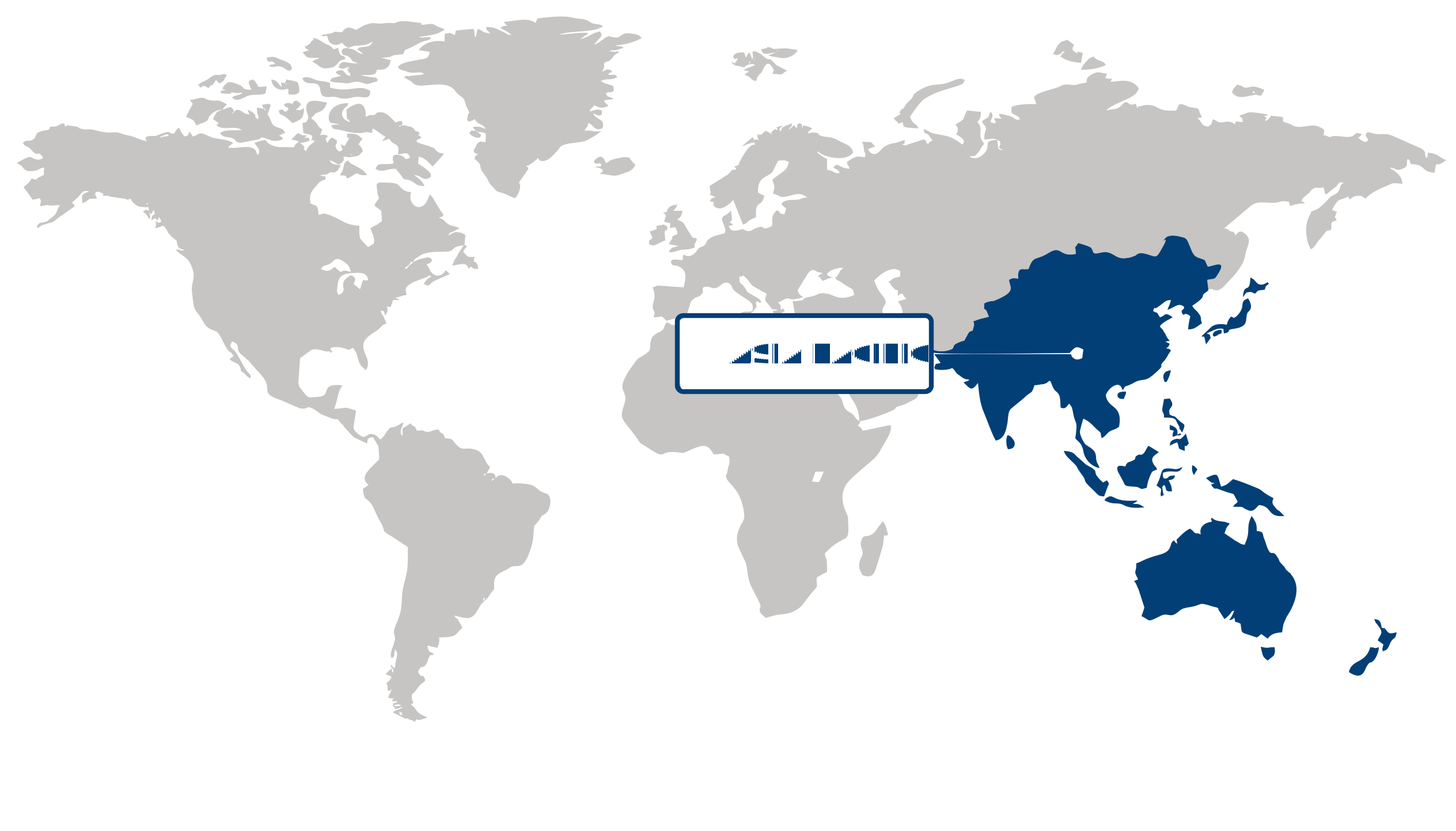
Asia Pacific (Largest & Fastest-Growing Region)
Asia Pacific held the largest share of the manufacturing logistics market at 36.72% in 2026 and is also expected to remain the fastest-growing regional market, reflecting the region's extensive manufacturing base and expanding industrial supply chains. The concentration of production facilities across automotive, electronics, machinery, consumer goods, and other industries generates substantial demand for efficient movement, storage, and coordination of raw materials, components, and finished products. Increasing adoption of automated warehouses, digital supply chain platforms, and real-time logistics monitoring is further improving manufacturing logistics capabilities. Rapid industrialization and the development of new production centers are creating additional demand for integrated logistics services that can support increasingly complex manufacturing networks. In parallel, expanding cross-border trade and investments in industrial infrastructure are encouraging manufacturers to modernize logistics operations, strengthen supply chain resilience, and improve the efficiency of material flows.
| Parameter | North America | Asia Pacific | Europe | Latin America | MEA |
|---|---|---|---|---|---|
| Innovation Hub i Scale Nascent Developing Advanced | |||||
| Cost-Sensitive Region i Scale Low Medium High | |||||
| Regulatory Environment i Scale Restrictive Neutral Supportive | |||||
| Demand Drivers i Scale Weak Moderate Strong | |||||
| Development Stage i Scale Emerging Developing Developed | |||||
| Adoption Rate i Scale Low Medium High | |||||
| New Entrants / Startups i Scale Sparse Moderate Dense | |||||
| Macro Indicators i Scale Weak Stable Strong |
Key Country Insights
United States 🇺🇸
Supply Chain OptimizationThe U.S. manufacturing logistics market is focused on improving resilience through warehouse automation, multimodal transportation, and digital supply chain visibility. Manufacturers invest in flexible logistics strategies that reduce operational disruptions and support complex production networks.
Germany 🇩🇪
Factory Logistics ExcellenceGermany prioritizes manufacturing logistics that integrate closely with advanced production systems and industrial automation. Companies enhance material flow, inventory synchronization, and supplier coordination to improve operational efficiency across manufacturing facilities.
Japan 🇯🇵
Lean Logistics CoordinationJapan strengthens manufacturing logistics by refining just-in-time delivery, inventory optimization, and supplier collaboration. Businesses continue improving logistics precision to support efficient production schedules and consistent product quality across manufacturing operations.
South Korea 🇰🇷
Export Supply AlignmentSouth Korea focuses on manufacturing logistics that efficiently connect production facilities with international distribution networks. Companies invest in digital logistics management and transportation optimization to support electronics, automotive, and industrial manufacturing sectors.
France 🇫🇷
Integrated Production SupportFrance is improving manufacturing logistics through stronger coordination between production facilities, suppliers, and distribution centers. Businesses prioritize digital planning tools and efficient transport management to enhance operational continuity and delivery performance.
Italy 🇮🇹
Flexible Industrial LogisticsItaly emphasizes manufacturing logistics solutions that support diverse industrial clusters and specialized production activities. Companies are modernizing warehouse operations, transportation planning, and supplier integration to improve responsiveness across manufacturing supply chains.
Segment Leadership and Growth Trends
Manufacturing Logistics Market Share (%), by Services, 2026
Go beyond the chart, access full insights & data tables
Request Free Sample ReportServices Segment Analysis: Transportation (Largest Segment) vs Warehousing (Fastest-Growing Segment)
The manufacturing logistics market was led by the transportation segment, which accounted for a share of 44.52% in 2026. Transportation services play a critical role in ensuring the seamless movement of raw materials, components, and finished goods across manufacturing supply chains. The increasing complexity of global production networks and the need for timely delivery have strengthened the demand for reliable transportation solutions. Manufacturers rely on efficient transportation networks to reduce supply chain disruptions, improve operational coordination, and maintain continuous production activities, supporting the dominance of this segment.
The warehousing segment is projected to experience the fastest growth within the services segment due to the rising focus on inventory optimization, supply chain visibility, and storage efficiency. Modern manufacturing operations require advanced warehousing solutions that enable better inventory control, faster order fulfillment, and improved handling of materials. The growing adoption of automated storage systems and technology-driven warehouse management practices is further enhancing the importance of warehousing services in supporting agile manufacturing supply chains.
Industry Segment Analysis: Automotive (Largest Segment) vs Pharmaceuticals (Fastest-Growing Segment)
The automotive segment dominated the manufacturing logistics market, capturing a share of 35.64% in 2026. Automotive manufacturing involves highly complex supply chains that require precise coordination of components, just-in-time deliveries, and efficient distribution networks. The extensive movement of parts, assemblies, and finished vehicles creates significant demand for specialized logistics services. Additionally, the expansion of automotive production activities and the increasing need for streamlined supply chain operations have reinforced the leading position of this segment.
The pharmaceuticals segment is anticipated to witness the fastest growth due to the increasing need for specialized logistics solutions that support sensitive product handling, regulatory compliance, and controlled transportation conditions. Pharmaceutical manufacturers require reliable supply chain systems to maintain product quality and ensure timely delivery of medicines and healthcare products. The rising emphasis on efficient distribution networks and enhanced supply chain management practices is driving greater adoption of logistics services within this industry.
Transportation Mode Segment Analysis: Road (Largest Segment) vs Air (Fastest-Growing Segment)
In the manufacturing logistics market, the road transportation segment held the largest share in 2026. Road-based logistics provides flexibility, extensive connectivity, and accessibility across manufacturing hubs, making it a preferred transportation mode for moving materials and finished products. Its ability to support short- and long-distance deliveries while enabling direct connectivity between production facilities, warehouses, and distribution centers contributes to its widespread adoption. These advantages have supported the continued importance of road transportation within manufacturing supply chains.
The air transportation segment is expected to register the fastest growth as manufacturers increasingly seek faster delivery solutions for time-sensitive goods and high-value components. Air logistics enables rapid movement across regions and supports industries where speed, reliability, and reduced transit times are critical. The growing requirement for responsive supply chains and efficient global connectivity is encouraging manufacturers to increasingly utilize air transportation services.
| Segment | Sub-Segment | Largest Segment | Fastest Growing |
|---|---|---|---|
| Services | Transportation, Warehousing, Distribution, Inventory Management | Transportation | Warehousing |
| Industry | Automotive, Aerospace, Electronics, Pharmaceuticals, Food & Beverage, Textiles, Others | Automotive | Pharmaceuticals |
| Transportation Mode | Road, Rail, Air, Sea | Road | Air |
| Technology | IoT, AI & ML, Robotics and Automation, Cloud Computing, Blockchain, Others | IoT | AI & ML |
Competitive Landscape and Market Positioning
Leading companies in the manufacturing logistics market:
- DHL Supply Chain (Germany)
- Kuehne + Nagel International AG (Switzerland)
- Deutsche Bahn AG (DB Schenker) (Germany)
- DSV A/S (Denmark)
- XPO, Inc. (United States)
- United Parcel Service, Inc. (United States)
- FedEx Corporation (United States)
- C.H. Robinson Worldwide, Inc. (United States)
- Nippon Express Holdings Co., Ltd. (Japan)
- GEODIS S.A. (France)
Manufacturing logistics providers are increasingly competing on their ability to synchronize material flows with production operations rather than simply moving goods between facilities. As manufacturers adopt more responsive production strategies, logistics capabilities that support real-time inventory visibility, adaptive scheduling, and seamless coordination across suppliers and distribution networks are becoming central to competitive positioning. Digital connectivity is reinforcing this shift by enabling continuous monitoring and faster operational adjustments, while greater supply chain complexity is encouraging providers to strengthen value-added services that improve resilience, reduce production interruptions, and enhance collaboration across manufacturing ecosystems.
| Company | Market Share | Company Revenue | Revenue CAGR (%) | Product Portfolio | Geographic Presence | Innovation / R&D Focus | Strategic Developments |
|---|---|---|---|---|---|---|---|
| DHL Supply Chain (Germany) | |||||||
| Kuehne + Nagel International AG (Switzerland) | |||||||
| Deutsche Bahn AG (DB Schenker) (Germany) | |||||||
| DSV A/S (Denmark) | |||||||
| XPO Inc. (United States) | |||||||
| United Parcel Service Inc. (United States) | |||||||
| FedEx Corporation (United States) | |||||||
| C.H. Robinson Worldwide Inc. (United States) | |||||||
| Nippon Express Holdings Co. Ltd. (Japan) | |||||||
| GEODIS S.A. (France) |
Industry Development/News
| Company Name | Date | Key Development |
|---|---|---|
| CEVA Logistics | Jun-26 | CEVA Logistics finalized a three-year Memorandum of Understanding with BYD to scale their global automotive logistics framework. The alliance enhances supply chain synchronization, finished vehicle transport, and component warehousing across international electric vehicle manufacturing networks. |
| James Group | Jun-26 | James Group acquired tire and wheel assembler EnovaPremier to scale its automotive logistics footprint. The acquisition expands specialized line-feed warehousing and sub-assembly transport capabilities for Tier-1 suppliers and OEMs, pushing corporate revenues past the $1 billion threshold. |
| DQS Solutions & Staffing | Apr-26 | DQS Solutions & Staffing acquired Comprehensive Logistics, Inc., merging corporate asset structures to form an integrated North American logistics provider. The transaction expands dedicated plant-support logistics, inbound-to-manufacturing freight management, and warehouse fulfillment capabilities. |
| mimic robotics | Nov-25 | mimic robotics secured a $16 million funding round to commercialize physical AI-powered robotic systems. The capital injection accelerates the deployment of automated systems capable of executing complex tactile tasks within demanding industrial manufacturing and plant logistics environments. |
| Toyota Motor Europe | Jun-25 | Toyota Motor Europe deployed heavy-duty hydrogen fuel cell trucks manufactured by VDL Groep into its active supply chain. The fuel-cell-powered vehicles operate on fixed logistics corridors connecting Toyota’s European Parts Centre with regional manufacturing hubs and commercial markets. |
| DHL | May-25 | DHL partnered with Cox Automotive to establish the United Kingdom’s largest electric vehicle battery service hub. The specialized facility integrates advanced diagnostics, technical remanufacturing capabilities, and complex reverse logistics framework required by automotive OEMs and major fleet operators. |
| NEURA Robotics | Jan-25 | NEURA Robotics raised €120 million in Series B financing, led by Lingotto Investment Management, to scale its cognitive and humanoid robotics platforms. The funding accelerates commercial deployment of advanced automation systems within industrial manufacturing and heavy logistics sectors. |
| Schaeffler | Nov-24 | Industrial supplier Schaeffler executed a minority investment in Agility Robotics and signed a purchase agreement for Digit humanoid robots. The integration of bipedal robotics aims to automate high-repetition material handling and intra-logistics workflows within Schaeffler's global manufacturing facilities. |
| Bastian Solutions | Jul-24 | Bastian Solutions announced a $165 million investment to construct a consolidated 435,000-square-foot corporate and manufacturing headquarters in Indiana. The facility expands domestic production capacity for advanced material handling machinery, automated storage systems, and industrial logistics hardware. |
| Flex | May-24 | Flex acquired FreeFlow to integrate its digital asset disposition and circular economy tracking software into its global manufacturing supply chain. The B2B marketplace platform optimizes secondary market sales for surplus electronics and returned components across data center and enterprise infrastructure verticals. |
Customize Your Report
Explore examples of how this report can be tailored to different research needs, including custom segments, additional topics or chapters, and related reports. Click a section of the wheel or its numbered marker to explore the available options.
Manufacturing Logistics Market — Custom Segments
| Segment | Sub-Segment |
|---|---|
| Supply Chain Stage | Inbound Logistics, In-Plant Logistics, Outbound Logistics, Reverse Logistics |
| Logistics Provider Type | In-House Logistics, Third-Party Logistics (3PL), Fourth-Party Logistics (4PL), Specialized Logistics Providers |
| Order Fulfillment Model | Make-to-Stock, Make-to-Order, Assemble-to-Order, Engineer-to-Order |
Manufacturing Logistics Market — Custom TOC
| Custom Chapter | Custom Details |
|---|---|
| Factory Logistics Transformation |
|
| Production Supply Synchronization |
|
| Resilient Factory Supply Networks |
|
Need a different cut of the data?
Request Custom ResearchHow big is the manufacturing logistics market?
How is the manufacturing logistics industry expected to grow over the next 10 years?
How is global trade influencing demand in the manufacturing logistics market?
Why are digital technologies becoming strategically important in the manufacturing logistics market?
Why does road transportation dominate the manufacturing logistics market?
Which service segment is expected to grow the fastest in the manufacturing logistics market?
Which region currently leads the manufacturing logistics market?
How is Asia Pacific sustaining growth in manufacturing logistics?
Who are the major participants shaping the manufacturing logistics landscape?
Our Clients
"The team surpassed our expectations with the report depth. The actionable insights provided proved crucial in navigating market challenges."
Tata Motors
"We found the report to be very informative. The expertise and attention to market nuances significantly influenced our business direction."
DENSO Corporation
"The consumer survey findings were quite good. We now have a clearer picture of the customer churning and retention strategy."
HL Mando
Our Research Team & Methodology
Every Fundamental Business Insights report is built by a dedicated vertical research team, validated through a structured primary-and-secondary methodology, and reviewed for accuracy before it reaches you.
Research Team Overview
Prepared by the Automotive & Transportation Research Team
Delivery
Published
Demand
Available
Support
Trust & Compliance
Research Domains
10 coverage areasResearch Intelligence
| Source | Reference |
|---|---|
| International Organization of Motor Vehicle Manufacturers (OICA) | www.oica.net |
| SAE International | www.sae.org |
| International Energy Agency (IEA) | www.iea.org |
| International Transport Forum (ITF) | www.itf-oecd.org |
| International Road Federation (IRF) | www.irf.global |
| International Organization for Standardization (ISO) | www.iso.org |
| United Nations Economic Commission for Europe (UNECE) | unece.org |
| National Highway Traffic Safety Administration (NHTSA) | www.nhtsa.gov |
| U.S. Department of Transportation (USDOT) | www.transportation.gov |
| European Automobile Manufacturers' Association (ACEA) | www.acea.auto |
| Society of Indian Automobile Manufacturers (SIAM) | www.siam.in |
| International Air Transport Association (IATA) | www.iata.org |
| International Civil Aviation Organization (ICAO) | www.icao.int |
| International Maritime Organization (IMO) | www.imo.org |
| International Union of Railways (UIC) | uic.org |
| American Public Transportation Association (APTA) | www.apta.com |
| International Federation of Robotics (IFR) | ifr.org |
| CharIN | www.charin.global |
| World Shipping Council | www.worldshipping.org |
| International Federation of Freight Forwarders Associations (FIATA) | fiata.org |
Research Workflow & Quality Assurance
Data Collection
Verified information gathered through primary and secondary research.
Data Triangulation
Cross-validation using multiple independent data sources.
Forecast Modelling
Market estimates developed using historical trends and analytical models.
Analyst Validation
Findings reviewed by domain experts for accuracy and consistency.
Editorial & Quality Review
Final editorial, quality, and compliance checks before publication.
Final Publication
Released after successful completion of the internal review process.
Report Coverage
📊 Market Assessment
- Market Size & Forecast
- Market Segmentation
- Regional Analysis
- Growth Drivers & Challenges
- Market Dynamics
🏢 Competitive Intelligence
- Competitive Landscape
- Company Profiles
- Competitive Benchmarking
- Mergers & Acquisitions
- Market Share Analysis or Key Company Strategies
🔍 Strategic Analysis
- Value Chain Analysis
- Porter's Five Forces
- PESTLE Analysis
- Pricing Trends
- Supply-Demand Analysis
🚀 Future Outlook
- Technology Landscape
- Regulatory Landscape
- Investment & Funding Landscape
- Emerging Opportunities
- Future Market Outlook
Have a question about this report or need a custom scope?
Request Customization