Malic Acid Market Size & Growth Forecast 2027–2036, By Segments (Product, End Use), Regional Demand Trends (North America, Asia Pacific, Europe), Key Country Insights (U.S., Japan, South Korea, Germany, France, Italy), and Competitive Landscape
Market Size and Growth Outlook
Malic Acid Market size was worth USD 264.3 million in 2026 and is expected to grow at a 5.42% CAGR between 2027 and 2036, exceeding USD 448.05 million by 2036. The industry revenue for 2027 is calculated at USD 276.35 million.
Get more details on this report
Request Free Sample ReportMalic Acid Market Intelligence Snapshot
Regional Market Dynamics
- Asia Pacific captured a 45.79% market share in 2026, supported by its large food and beverage manufacturing base and sustained demand for flavor enhancement and formulation ingredients.
- Asia Pacific is forecast to grow at a 5.99% CAGR, driven by rising packaged food production, expanding processed food consumption, and strong ingredient procurement across regional manufacturing industries.
Segment Momentum
- L-Malic Acid held a 56.18% market share in 2026, supported by its established use in formulations requiring consistent performance, dependable acidulant functionality, and purchasing preferences that favor formulation continuity and familiar supply sources.
- Personal Care & Cosmetics is the fastest-growing end-use segment as formulators increasingly adopt multifunctional ingredients for exfoliation, texture refinement, and formulation enhancement, supported by ongoing product innovation and expanding ingredient applications.
Market Expansion Drivers
- Rising beverage and confectionery demand driving flavor-enhancing acidulant consumption growth.
- Expansion of processed food manufacturing in emerging economies accelerating acidulant usage.
- Increasing clean-label and natural ingredient demand boosting multifunctional acidulant adoption.
Leading Market Participants
- Key companies in the malic acid market include Bartek Ingredients Inc. (Canada), Fuso Chemical Co., Ltd. (Japan), Polynt S.p.A. (Italy), Thirumalai Chemicals Limited (India), Lonza Group AG (Switzerland), Prinova Group LLC (United States), Anhui Sealong Biotechnology Co., Ltd. (China), Yongsan Chemicals, Inc. (South Korea), ISEGEN South Africa (Pty) Ltd (South Africa), Nacalai Tesque, Inc. (Japan).
Global Market Forecast Snapshot
Market Outlook
- 2026 Market Size: USD 264.3 million
- 2027 Estimated Market Size: USD 276.35 million.
- Projected Market Size: USD 448.05 million by 2036
- Growth Forecast: 5.42% CAGR (2027-2036)
Regional and Segment Outlook
- Leading Regional Market: Asia Pacific
- High-Growth Regional Hub: Asia Pacific
- Core Revenue Segment: L-Malic Acid (Product) | Food & Beverage (End Use)
- Emerging Opportunity Segment: DL-Malic Acid (Product) | Personal Care & Cosmetics (End Use)
Market Growth Drivers and Industry Trends
Rising beverage and confectionery demand driving flavor-enhancing acidulant consumption growth
Growing consumption of carbonated beverages, fruit-based drinks, confectionery, and other flavored food products is strengthening demand for acidulants that can provide balanced taste and enhance flavor profiles, supporting the malic acid market growth. Malic acid is widely used to deliver a smooth, persistent sourness and can complement fruit flavors in beverages, candies, chewing gum, and other confectionery applications. Its flavor characteristics make it useful in formulations where manufacturers seek to adjust acidity while maintaining the sensory profile of the finished product. The continued introduction of flavored beverages and specialty confectionery products is also increasing formulation requirements for ingredients that provide consistent acidity and taste performance, particularly across products featuring fruit and sour flavor profiles.
Expansion of processed food manufacturing in emerging economies accelerating acidulant usage
Expansion of processed food production across emerging economies is increasing the use of functional ingredients required to maintain product quality, taste, and stability, which will propel the malic acid market growth. Rising investment in food processing infrastructure and broader availability of packaged foods are encouraging manufacturers to develop beverages, sauces, bakery products, confectionery, and other convenience-oriented products with consistent formulations. As local food industries become more sophisticated, manufacturers are adopting standardized acidulant systems to achieve predictable acidity and sensory characteristics across production batches. The growing presence of packaged and ready-to-consume food products is consequently widening the application base for malic acid among processors seeking reliable ingredients for large-scale formulation.
Increasing clean-label and natural ingredient demand boosting multifunctional acidulant adoption
Consumer preference for recognizable and naturally positioned ingredients is encouraging food and beverage manufacturers to reassess formulation choices, creating opportunities for multifunctional acidulants, and the malic acid market demand is benefiting from this shift. Malic acid can perform several formulation roles, including acidity regulation, flavor enhancement, and ph adjustment, allowing manufacturers to address multiple product requirements through a single ingredient. Clean-label positioning is particularly relevant in beverages, confectionery, and specialty foods, where consumers increasingly scrutinize ingredient lists and favor simpler formulation approaches. Manufacturers are therefore seeking acidulants that provide effective technical functionality while fitting product development strategies centered on natural or familiar ingredient profiles.
| Growth Driver | Impact on CAGR | Regulatory Influence | Geographic Relevance | Adoption Rate | Impact Timeline |
|---|---|---|---|---|---|
| Rising beverage and confectionery demand driving flavor-enhancing acidulant consumption growth | 2.10% | Moderate | Asia Pacific, North America | High | Near Term |
| Expansion of processed food manufacturing in emerging economies accelerating acidulant usage | 1.90% | Moderate | Asia Pacific, Latin America | High | Mid Term |
| Increasing clean-label and natural ingredient demand boosting multifunctional acidulant adoption | 1.70% | Low | Europe, North America | Emerging | Mid Term |
Unlock insights tailored to your business with our bespoke market research solutions.
Click to get your customized report now.
Regional Demand Dynamics
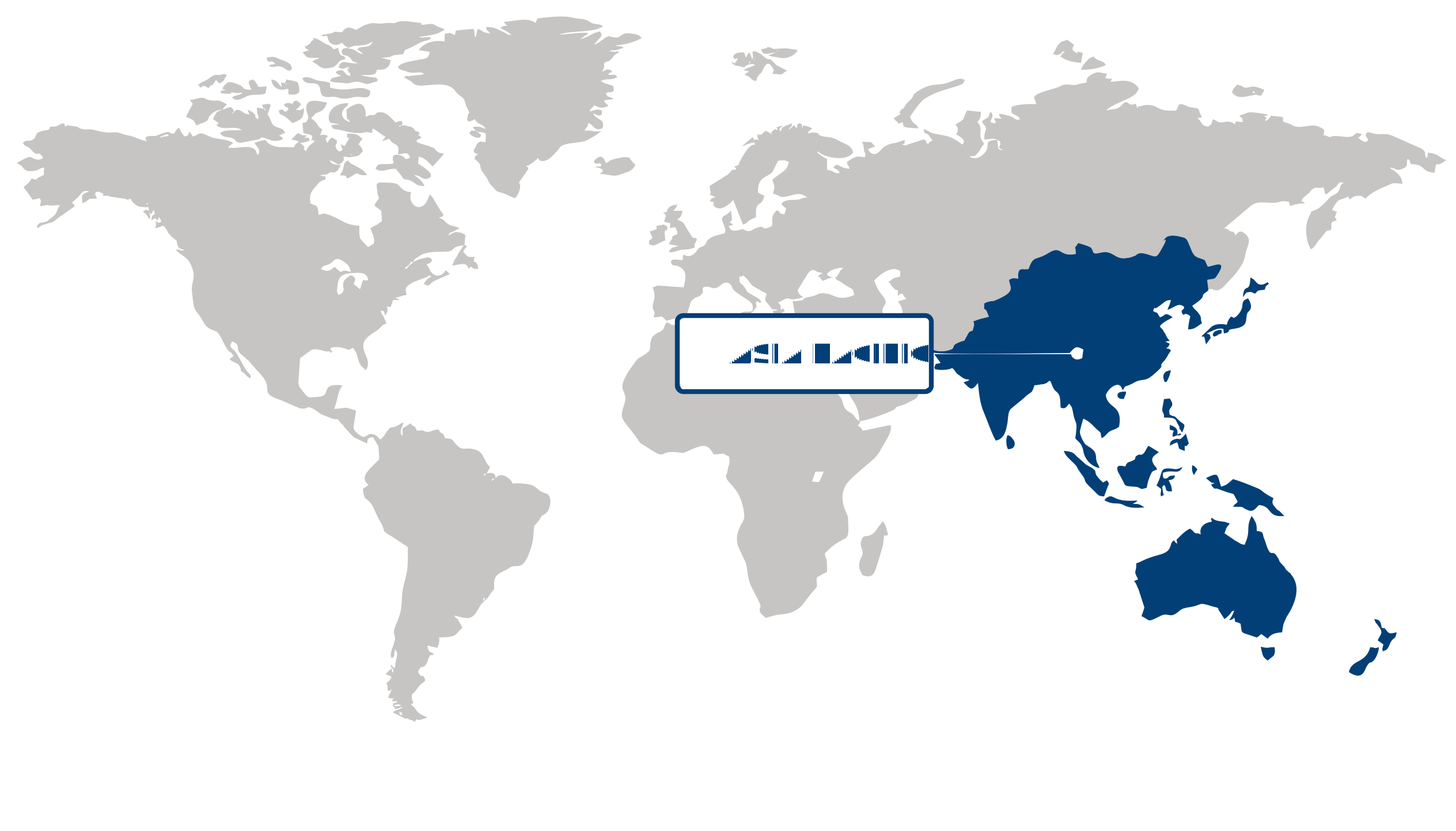
Asia Pacific (Largest & Fastest-Growing Region)
The Asia Pacific malic acid market accounted for a 45.79% share in 2026 and also represented the fastest-growing regional market, supported by expanding food and beverage production, increasing demand for processed foods, and broader use of malic acid as an acidulant, flavor enhancer, and preservative. The region’s large consumer base and evolving dietary preferences are encouraging manufacturers to develop products with appealing taste profiles and improved shelf stability. Malic acid also finds applications in confectionery, beverages, pharmaceuticals, and personal care products, providing a diversified demand base. Rapid development of food processing capabilities, growing consumption of packaged and convenience products, and expanding pharmaceutical manufacturing are further supporting regional demand. In addition, increasing interest in functional and specialty formulations is creating opportunities for malic acid suppliers across multiple end-use industries.
| Parameter | North America | Asia Pacific | Europe | Latin America | MEA |
|---|---|---|---|---|---|
| Innovation Hub i Scale Nascent Developing Advanced | |||||
| Cost-Sensitive Region i Scale Low Medium High | |||||
| Regulatory Environment i Scale Restrictive Neutral Supportive | |||||
| Demand Drivers i Scale Weak Moderate Strong | |||||
| Development Stage i Scale Emerging Developing Developed | |||||
| Adoption Rate i Scale Low Medium High | |||||
| New Entrants / Startups i Scale Sparse Moderate Dense | |||||
| Macro Indicators i Scale Weak Stable Strong |
Key Country Insights
Germany 🇩🇪
Process Quality FocusGermany is emphasizing high-purity malic acid for food processing, beverage production, and industrial applications. Manufacturers are optimizing production efficiency while meeting stringent quality and formulation requirements for value-added products.
France 🇫🇷
Specialty Food ApplicationsFrance is increasing the use of malic acid in specialty foods, beverages, and confectionery where balanced acidity enhances product quality. Manufacturers are focusing on ingredient consistency and formulation flexibility to meet evolving consumer expectations.
Italy 🇮🇹
Beverage Ingredient IntegrationItaly is strengthening malic acid demand through beverage production and processed food manufacturing requiring controlled acidity and flavor enhancement. Producers are prioritizing reliable ingredient sourcing and product consistency across diverse food applications.
Japan 🇯🇵
Premium Ingredient DevelopmentJapan is utilizing malic acid in premium beverages, confectionery, and health-oriented products where flavor consistency is essential. Domestic manufacturers are refining ingredient quality to support differentiated consumer product formulations.
South Korea 🇰🇷
Functional Beverage DemandSouth Korea is expanding malic acid usage across functional beverages and processed food products that emphasize taste and product stability. Ingredient suppliers are collaborating with food manufacturers to develop innovative formulations for changing consumer preferences.
United States 🇺🇸
Food Formulation InnovationThe U.S. malic acid market is supported by demand from food, beverage, and personal care manufacturers seeking effective acidity regulators. Producers are expanding application development for functional beverages and clean-label product formulations.
Segment Leadership and Growth Trends
Malic Acid Market Share (%), by Product, 2026
Go beyond the chart, access full insights & data tables
Request Free Sample ReportProduct Segment Analysis: L-Malic Acid (Largest Segment) vs DL-Malic Acid (Fastest-Growing Segment)
L-Malic acid held the largest position in the malic acid market, representing a 56.18% share in 2026, supported by its broad applicability as an acidity regulator, flavoring ingredient, and functional component across food, beverage, pharmaceutical, and other formulations. Its compatibility with a wide range of products and established use in applications requiring controlled acidity continue to sustain demand, while growing interest in formulation quality and functional ingredients reinforces its commercial relevance.
DL-Malic acid is expected to register the fastest growth as manufacturers seek versatile acidulants and formulation ingredients that can serve a wider range of industrial and consumer applications. Increasing experimentation with flavor profiles, processed foods, beverages, and personal care formulations is creating additional opportunities for DL-malic acid, particularly where manufacturers prioritize formulation flexibility and consistent functional performance.
End Use Segment Analysis: Food & Beverage (Largest Segment) vs Personal Care & Cosmetics (Fastest-Growing Segment)
Food & beverage represented the largest end-use segment of the malic acid market in 2026, reflecting the ingredient's established role in acidity regulation, flavor enhancement, and product formulation. Its use across beverages, confectionery, processed foods, and other products is supported by ongoing demand for balanced taste profiles and formulation consistency, while manufacturers continue to utilize malic acid to improve sensory characteristics and product functionality.
Personal care & cosmetics is anticipated to experience the fastest growth as formulators increasingly incorporate functional acids into skincare and cosmetic products. Demand for products emphasizing formulation performance, skin-conditioning properties, and carefully controlled ph levels is encouraging broader use of malic acid-based ingredients, while continued innovation in personal care formulations is widening the range of potential applications.
| Segment | Sub-Segment | Largest Segment | Fastest Growing |
|---|---|---|---|
| Product | L-Malic Acid, D-Malic Acid, DL-Malic Acid | L-Malic Acid | DL-Malic Acid |
| End Use | Food & Beverage, Pharmaceuticals, Personal Care & Cosmetics, Textiles, Metals, Others | Food & Beverage | Personal Care & Cosmetics |
Competitive Landscape and Market Positioning
Key companies in the malic acid market:
1. Bartek Ingredients Inc. (Canada)
2. Fuso Chemical Co. Ltd. (Japan)
3. Polynt S.p.A. (Italy)
4. Thirumalai Chemicals Limited (India)
5. Lonza Group AG (Switzerland)
6. Prinova Group LLC (United States)
7. Anhui Sealong Biotechnology Co. Ltd. (China)
8. Yongsan Chemicals Inc. (South Korea)
9. ISEGEN South Africa (Pty) Ltd (South Africa)
10. Nacalai Tesque Inc. (Japan)
The malic acid market is experiencing steady growth driven by its expanding use in food, beverage, and industrial applications. Production optimization efforts are enhancing cost efficiency and supply stability. The malic acid market reflects rising demand for multifunctional acidulants across global industries.
| Company | Market Share | Company Revenue | Revenue CAGR (%) | Product Portfolio | Geographic Presence | Innovation / R&D Focus | Strategic Developments |
|---|---|---|---|---|---|---|---|
| Bartek Ingredients Inc. (Canada) | |||||||
| Fuso Chemical Co. Ltd. (Japan) | |||||||
| Polynt S.p.A. (Italy) | |||||||
| Thirumalai Chemicals Limited (India) | |||||||
| Lonza Group AG (Switzerland) | |||||||
| Prinova Group LLC (United States) | |||||||
| Anhui Sealong Biotechnology Co. Ltd. (China) | |||||||
| Yongsan Chemicals Inc. (South Korea) | |||||||
| ISEGEN South Africa (Pty) Ltd (South Africa) | |||||||
| Nacalai Tesque Inc. (Japan). |
Industry Development/News
| Company Name | Date | Key Development |
|---|---|---|
| Thirumalai Chemicals | Sep-24 | Thirumalai Chemicals is advancing the pre-commissioning and startup of its West Virginia-based maleic anhydride facility. With partial unit operations expected by year-end and stabilization projected through H1 2026, this expansion strengthens the downstream chemical supply chain, specifically enhancing the availability of key intermediates essential for large-scale malic acid production. |
| Evodrop | Sep-24 | Evodrop has developed a specialized malic acid–based water treatment system engineered to remove limescale while retaining essential minerals such as calcium and magnesium. By eliminating the need for salt, synthetic resins, and electricity, this technology offers a sustainable alternative to traditional water softening, expanding the commercial application footprint of malic acid within residential and industrial infrastructure. |
| Dialog Group Bhd | Sep-23 | Dialog Group Bhd announced a strategic investment of approximately USD 88.1 million to construct a specialty chemical plant in Pahang, Malaysia. The facility is designed to produce 12,000 metric tons of malic acid annually, representing a significant addition to regional production capacity and signaling a long-term commitment to expanding supply-side infrastructure for the chemical intermediate market. |
| pH Plex | Jul-23 | pH Plex launched a malic acid–based shampoo and conditioner system designed to protect and repair hair keratin. By leveraging the specific pH-regulating and conditioning properties of malic acid, this product entry highlights the growing utilization of organic acids in high-performance personal care formulations, further integrating the compound into the value-added cosmetic and beauty segments. |
Customize Your Report
Explore examples of how this report can be tailored to different research needs, including custom segments, additional topics or chapters, and related reports. Click a section of the wheel or its numbered marker to explore the available options.
Malic Acid Market — Custom Segments
| Segment | Sub-Segment |
|---|---|
| Grade | Food Grade, Pharmaceutical Grade, Industrial Grade |
| Production Process | Chemical Synthesis, Fermentation-Based Production |
| Distribution Channel | Direct Sales, Chemical Distributors, Specialty Chemical Suppliers |
Malic Acid Market — Custom TOC
| Custom Chapter | Custom Details |
|---|---|
| Food and Beverage Formulation Opportunities |
|
| Bio-Based Ingredient Transition Analysis |
|
| Industrial Application Expansion Assessment |
|
Need a different cut of the data?
Request Custom ResearchHow much revenue does the malic acid market generate?
What are the growth projections for the malic acid industry?
How is the shift toward versatile DL-Malic Acid reshaping industrial formulation strategies in the malic acid market?
Why is the expansion of personal care and cosmetics accelerating demand dynamics in the malic acid market?
Why does L-Malic Acid lead the malic acid market?
What is driving the rapid growth of Personal Care & Cosmetics in the malic acid market?
Why does Asia Pacific dominate the malic acid market?
What is supporting continued malic acid market growth in Asia Pacific?
What are the prominent companies operating in the malic acid landscape?
Our Clients
"The report helped us understand emerging consumer trends in our product category. It clarified where to focus innovation for the next product launch."
LyondellBasell
"The regional forecast section was incredibly useful. We were able to identify two new potential partners in Europe thanks to the vendor mapping you included."
SABIC
"We appreciated how actionable the recommendations were. It guided us to improve supply chain resilience."
Olin Corporation
Our Research Team & Methodology
Every Fundamental Business Insights report is built by a dedicated vertical research team, validated through a structured primary-and-secondary methodology, and reviewed for accuracy before it reaches you.
Research Team Overview
Prepared by the Chemicals & Materials Research Team
Delivery
Published
Demand
Available
Support
Trust & Compliance
Research Domains
10 coverage areasResearch Intelligence
| Source | Reference |
|---|---|
| American Chemistry Council (ACC) | www.americanchemistry.com |
| European Chemical Industry Council (Cefic) | cefic.org |
| International Council of Chemical Associations (ICCA) | icca-chem.org |
| European Chemicals Agency (ECHA) | echa.europa.eu |
| U.S. Environmental Protection Agency (EPA) | www.epa.gov |
| ASTM International | www.astm.org |
| International Organization for Standardization (ISO) | www.iso.org |
| National Institute of Standards and Technology (NIST) | www.nist.gov |
| Plastics Industry Association (PLASTICS) | www.plasticsindustry.org |
| European Biplastics | www.european-bioplastics.org |
| The Adhesive and Sealant Council (ASC) | www.ascouncil.org |
| National Association of Corrosion Engineers (AMPP) | www.ampp.org |
| Society of Plastics Engineers (SPE) | www.4spe.org |
| International Fertilizer Association (IFA) | www.fertilizer.org |
| CropLife International | croplife.org |
| Packaging Europe | packagingeurope.com |
| Flexible Packaging Association (FPA) | www.flexpack.org |
| Battery Council International (BCI) | batterycouncil.org |
| International Copper Association (ICA) | internationalcopper.org |
| World Steel Association | worldsteel.org |
Research Workflow & Quality Assurance
Data Collection
Verified information gathered through primary and secondary research.
Data Triangulation
Cross-validation using multiple independent data sources.
Forecast Modelling
Market estimates developed using historical trends and analytical models.
Analyst Validation
Findings reviewed by domain experts for accuracy and consistency.
Editorial & Quality Review
Final editorial, quality, and compliance checks before publication.
Final Publication
Released after successful completion of the internal review process.
Report Coverage
📊 Market Assessment
- Market Size & Forecast
- Market Segmentation
- Regional Analysis
- Growth Drivers & Challenges
- Market Dynamics
🏢 Competitive Intelligence
- Competitive Landscape
- Company Profiles
- Competitive Benchmarking
- Mergers & Acquisitions
- Market Share Analysis or Key Company Strategies
🔍 Strategic Analysis
- Value Chain Analysis
- Porter's Five Forces
- PESTLE Analysis
- Pricing Trends
- Supply-Demand Analysis
🚀 Future Outlook
- Technology Landscape
- Regulatory Landscape
- Investment & Funding Landscape
- Emerging Opportunities
- Future Market Outlook
Have a question about this report or need a custom scope?
Request Customization