Magnetic Sensor Market Size & Forecasts 2026-2035, By Segments (Technology, Application, End-user), Growth Opportunities, Innovation Landscape, Regulatory Shifts, Strategic Regional Insights (U.S., Japan, China, South Korea, UK, Germany, France), and Competitive Dynamics (Honeywell, Allegro Microsystems, Infineon Technologies, TDK Corporation, NXP Semiconductors)
Market Size and Growth Outlook
Magnetic Sensor Market size is estimated to increase from USD 5.91 billion in 2025 to USD 13 billion by 2035, supported by a CAGR exceeding 8.2% during 2026-2035. In 2026, revenues are forecast to reach USD 6.33 billion.
Get more details on this report
Request Free Sample ReportMagnetic Sensor Market Intelligence Snapshot
Regional Market Dynamics
Segment Momentum
Market Expansion Drivers
Leading Market Participants
Global Market Forecast Snapshot
Market Outlook
Regional and Segment Outlook
Market Growth Drivers and Industry Trends
Widespread integration of position, wheel-speed and orientation sensing in vehicles and consumer devices is a primary growth driver: automotive OEMs and suppliers such as Bosch and NXP Semiconductors are embedding magnetic-based position and wheel sensors for ADAS and e‑powertrain functions, while Apple’s iPhone product line and various wearables include magnetometers for navigation and AR use. This trend directly expands the magnetic sensor market by increasing unit volumes and qualification requirements; incumbents can leverage automotive supply agreements and scale, while new entrants can pursue low-cost consumer niches or specialized automotive subsystems. Continued vehicle electrification and richer mobile AR features point to steady incremental demand grounded in current product roadmaps.
Advancements in MEMS and High-Precision Magnetic Sensing
Breakthroughs in MEMS fabrication, sensor fusion and high-resolution magnetics are enabling smaller, lower-power, more accurate devices—examples include STMicroelectronics’ MEMS magnetic sensor families and Analog Devices’ high-precision magnetic IC announcements. These technology improvements raise performance baselines across consumer electronics and industrial instrumentation, expanding applicability and driving differentiation within the magnetic sensor market; established players can integrate sensors into system-on-chip solutions, while startups can commercialize novel MEMS architectures or IP-licensed modules. As wafer-level packaging and foundry support mature, expect tighter integration of magnetic sensing into multi-sensor platforms already visible in recent product releases.
Regulatory Emphasis on Safety-Critical Magnetic Sensing
Heightened regulatory and safety standards for applications like steering, braking and vehicle controls—codified in ISO 26262 and guidance from bodies such as the International Organization for Standardization and the U.S. National Highway Traffic Safety Administration—are shaping supplier behavior and procurement choices. Automotive-qualified suppliers such as Infineon Technologies publicly emphasize functional-safety readiness for sensor products, driving the magnetic sensor market toward certified designs, traceability and diagnostic features; incumbents with established qualification processes gain competitive advantage, while new entrants can differentiate through build-to-safety offerings and compliance tooling. Observable enforcement of safety standards and OEM sourcing policies will continue to professionalize sensor supply chains and raise entry barriers for noncompliant actors.
Industry Restraints:
Supply Chain Vulnerabilities
Concentration of rare‑earth magnet production and periodic semiconductor shortages constrain magnetic sensor availability and cost stability. The U.S. Geological Survey highlights reliance on a narrow set of producers for rare‑earth elements, while the Semiconductor Industry Association and public statements from Infineon Technologies document chip supply tightness that impacts sensor IC delivery. Established suppliers with integrated sourcing or long‑term contracts can protect margins, whereas new entrants face longer lead times, elevated working capital needs, and difficulty scaling production. In the near to medium term, supplier diversification, strategic inventory practices, and recycling initiatives will reduce acute risk, but residual volatility will continue to favor vertically integrated firms and those with secured supply agreements.
Regulatory and Certification Complexity
Stringent functional‑safety, EMC and chemical compliance requirements slow product introduction and raise development costs for magnetic sensors. Automotive ISO 26262 mandates, UNECE WP.29 cybersecurity/OTA regulations (R155/R156), medical IEC 60601 standards, and REACH/RoHS enforcement by the European Chemicals Agency (ECHA) are repeatedly cited by manufacturers as gating factors. The result is longer validation cycles and higher certification expense that benefit incumbents holding approvals and penalize startups without certification infrastructure. Over the near to medium term, escalating regulatory scrutiny will drive adoption of certified reference platforms, strategic OEM partnerships, and greater reliance on third‑party test houses to accelerate compliant product launches.
| Growth Driver | Impact on CAGR | Regulatory Influence | Geographic Relevance | Adoption Rate | Impact Timeline |
|---|---|---|---|---|---|
| Adoption of magnetic sensors in automotive and consumer electronics | 3.00% | Short term (≤ 2 yrs) | North America, Europe | Medium | Fast |
| Advancements in MEMS and high-precision magnetic sensing | 2.50% | Medium term (2–5 yrs) | Asia Pacific, Europe | Low | Moderate |
| Regulatory guidelines for safety-critical magnetic sensing applications | 2.00% | Long term (5+ yrs) | North America, Europe | High | Slow |
Unlock insights tailored to your business with our bespoke market research solutions.
Click to get your customized report now.
Regional Demand Dynamics
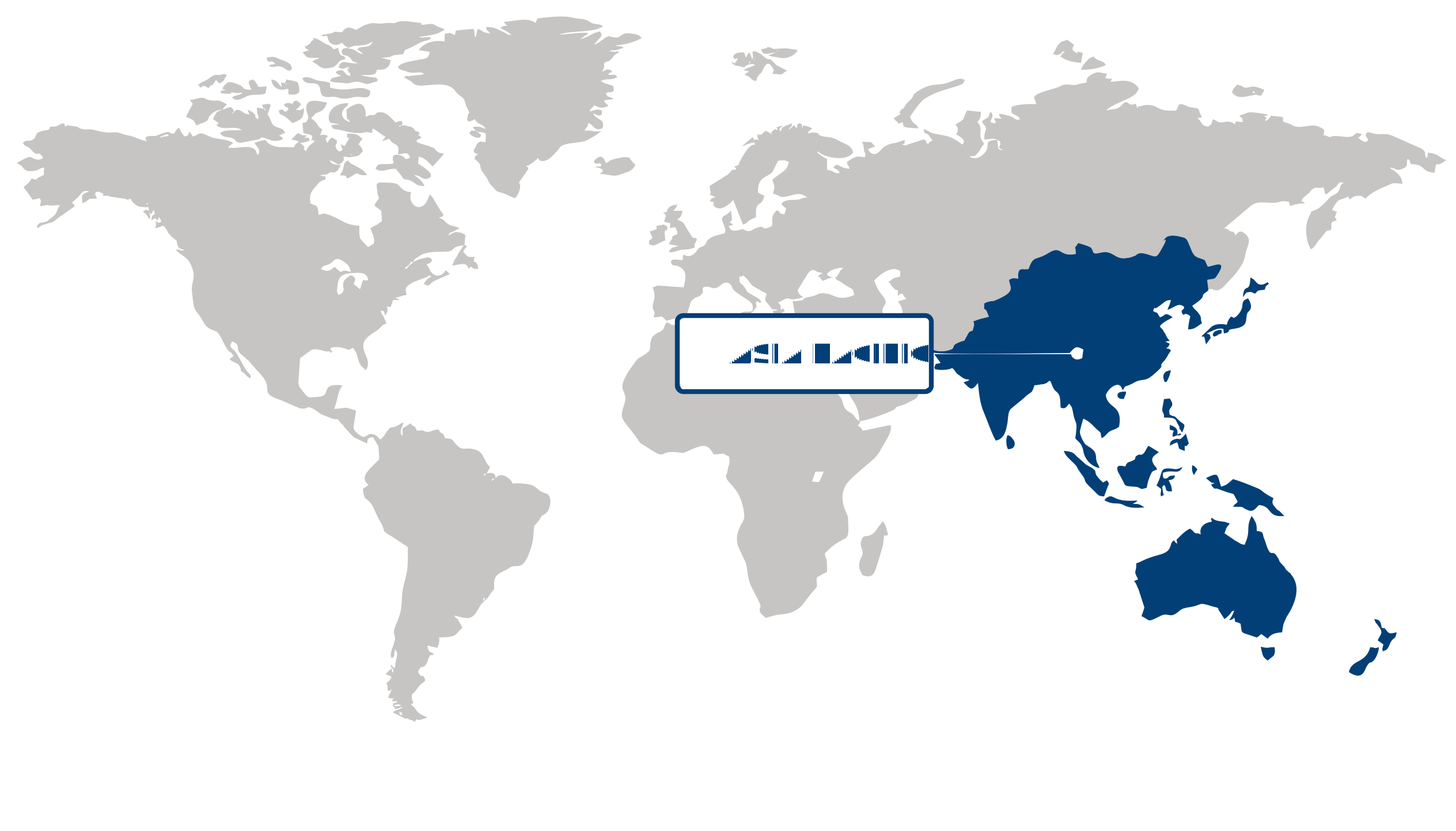
Asia Pacific captured more than 47% of the magnetic sensor market in 2025 and, at a 9.4% CAGR, stands as the largest and fastest-growing region. This leadership stems from APAC’s massive automotive and consumer-electronics manufacturing base, rising EV volumes and growing demand for sensors in industrial automation and smart devices; for example, the International Energy Agency’s EV outlook and China Association of Automobile Manufacturers (CAAM) data document the region’s EV surge, while Samsung Electronics and Foxconn signal sustained consumer-electronics investment. Policy backing from bodies such as the Ministry of Industry and Information Technology (MIIT) and supply-chain scaling by firms like BYD and CATL further reinforce capacity. These factors position APAC as a fertile market for sensor innovation, integration, and high-volume deployment.
Japan is positioned as a pivotal hub in Asia Pacific, leveraging a dense supplier ecosystem that elevates quality in the magnetic sensor market through precision automotive and industrial applications. Legacy OEMs and suppliers—Toyota Motor Corporation and Denso Corporation—drive demand for high-reliability sensors, while Ministry of Economy, Trade and Industry (METI) initiatives and New Energy and Industrial Technology Development Organization (NEDO) grants support sensor R&D and factory automation. Local strengths in miniaturization and quality control make Japan attractive for premium sensor suppliers and system integrators, reinforcing regional technology leadership and enabling cross-border scale-up.
China anchors Asia Pacific’s volume leadership and scale advantages, fueling the magnetic sensor market via mass EV production and vast consumer-device manufacturing. Large OEMs and battery makers—BYD and CATL—combined with CAAM production figures and MIIT industrial policy, create outsized demand for cost-effective, high-throughput sensor solutions; meanwhile, Huawei and Xiaomi’s device roadmaps sustain consumer-electronics pull. The combination of manufacturing scale, rapid domestic adoption, and supplier consolidation makes China the region’s execution engine, offering pathways for global suppliers to secure volume contracts and drive regional cost competitiveness.
North America Market Analysis:
North America held a commanding share in the magnetic sensor market, driven by concentrated demand across automotive electrification, industrial automation, aerospace and medical applications. The region’s entrenched analog-semiconductor ecosystem—exemplified by Analog Devices, Texas Instruments and Honeywell—continues to introduce application-specific sensors and integration partnerships that accelerate adoption. Federal policy support, including the CHIPS and Science Act and targeted investments by the U.S. Department of Energy to expand EV infrastructure and domestic manufacturing, has strengthened local supply chains, while measurement and standards work at the National Institute of Standards and Technology (NIST) improves reliability expectations. Combined with sustained defense procurement and advanced manufacturing clusters, North America presents meaningful near-term opportunities for suppliers focused on automotive-grade, industrial IoT and ruggedized sensor solutions.
The U.S. serves as the innovation and procurement anchor for the magnetic sensor market, with high uptake across EVs, aerospace, defense and healthcare segments. Major OEM electrification commitments from Ford and General Motors, together with incentives under the Inflation Reduction Act and supply-chain investments tied to the CHIPS and Science Act, are raising demand for high-precision, automotive-qualified magnetic sensors. Defense and space programs administered by the U.S. Department of Defense and NASA create specialized technical requirements that favor local suppliers such as Analog Devices and Texas Instruments, while medical device manufacturers push for miniaturized, low-power sensing. Strategic implication: U.S. policy and procurement priorities make the country a scalable launchpad for sensor firms targeting broader North American automotive and industrial channels.
Europe Market Trends:
Europe experienced moderate growth in the magnetic sensor market, driven by accelerating vehicle electrification, industrial digitalization, and policy-led decarbonization that have shifted procurement and investment patterns. The European Commission’s Green Deal and targeted mobility initiatives have increased demand signals for vehicle and infrastructure sensors, while the European Investment Bank’s financing of charging and industrial projects has supported deployment and supply-chain investments. Post‑pandemic resilience measures and localized sourcing priorities across EU member states have improved logistics reliability, and firms such as STMicroelectronics and Infineon Technologies AG remain active in product development. These dynamics create near-term demand stability and medium-term opportunities for component suppliers and integrators across Europe.
Germany acts as the industrial backbone in the magnetic sensor market in Europe, underpinned by deep automotive and automation clusters. Germany’s OEM and Tier‑1 ecosystem—including Robert Bosch GmbH and Continental—drives high-volume, high-reliability sensor specifications, while research institutions such as Fraunhofer‑Gesellschaft accelerate applied sensor innovation and test standards. Strong manufacturing capacity, skilled workforce availability, and supplier consolidation support cost-effective scaling and rapid iteration. Strategic implication: Germany’s manufacturing leadership anchors regional supply continuity and scale economics attractive to global suppliers and investors.
France functions as an innovation and systems‑integration hub in the magnetic sensor market in Europe, with strengths in mobility electronics and aerospace systems. Suppliers and system integrators such as Valeo and Safran collaborate with research organizations like CEA to advance sensor fusion and miniaturization for electric vehicles and avionics, and government industrial programs have prioritized domestic electronics capabilities. This combination of integrator expertise and public‑sector support favors higher‑value system designs and creates commercial pathways for startups and suppliers to scale across the European market.
| Parameter | North America | Asia Pacific | Europe | Latin America | MEA |
|---|---|---|---|---|---|
| Innovation Hub i Scale Nascent Developing Advanced | |||||
| Cost-Sensitive Region i Scale Low Medium High | |||||
| Regulatory Environment i Scale Restrictive Neutral Supportive | |||||
| Demand Drivers i Scale Weak Moderate Strong | |||||
| Development Stage i Scale Emerging Developing Developed | |||||
| Adoption Rate i Scale Low Medium High | |||||
| New Entrants / Startups i Scale Sparse Moderate Dense | |||||
| Macro Indicators i Scale Weak Stable Strong |
Segment Leadership and Growth Trends
Magnetic Sensor Market Share (%), by Technology, 2026
Go beyond the chart, access full insights & data tables
Request Free Sample ReportHall Effect represented largest share in 2025 of the magnetic sensor market as the leading technology segment, driven by low cost, reliability, and broad applicability across automotive, consumer electronics, and industrial systems. Its leadership reflects manufacturing scale and standardized IC designs—STMicroelectronics and Texas Instruments offer high-volume Hall-effect devices while Bosch demonstrates OEM integration in automotive platforms—alongside supply-chain maturity and preference for proven solutions. These segments create strategic advantages for established suppliers to bundle sensors with system software and for niche entrants to optimize MEMS or CMOS integration. With ongoing cost pressures and demand for dependable sensing, Hall-effect segments remain central in the near to medium term.
Analysis by Application
Position Sensing dominated the magnetic sensor market in 2025 as the largest application segment, propelled by rising demand for precise feedback in steering, motor control, and robotics. Leadership is rooted in field-proven performance and ease of integration into control loops; Bosch’s steering-angle products and Siemens’ automation offerings cite magnetic position feedback as standard practice. Customer preference for robustness, regulatory emphasis on functional safety (UNECE standards) and workforce automation trends reinforce adoption. These segments offer incumbents opportunities to deliver system-level modules and allow startups to differentiate via digital calibration and sensor fusion. Given continual automation and electrification, position-sensing segments will stay relevant.
Analysis by End-user
Automotive held largest share in 2025 of the magnetic sensor market as the dominant end-user segment, supported by accelerated ADAS deployment and vehicle electrification requiring precise current, position, and speed sensing. OEM roadmaps from Volkswagen and Tesla, plus Bosch’s supply commitments for EV and ADAS platforms, illustrate commercial pull; Euro NCAP safety protocols and UNECE regulations further drive sensor specification. Market and supply-chain consolidation favor tier-one suppliers, while new entrants can capture value in EV powertrain modules and sensor calibration services. As regulatory milestones, electrification roadmaps, and ADAS integration persist, automotive segments are set to remain a primary demand engine in the near to medium term.
| Segment | Sub-Segment | Largest Segment | Fastest Growing |
|---|---|---|---|
| Technology | Hall Effect, Tunnel Magnetoresistance (TMR), Anisotropic Magnetoresistance (AMR), Giant Magnetoresistance (GMR), Others | ||
| Application | Flow Rate Sensing, Speed Sensing, Detection/NDT, Navigation and Electronic Compass, Position Sensing, Others | ||
| End-user | Aerospace, Automotive, Banking, Financial Services, Insurance (BFSI), Consumer Electronics, Industrial, Others |
Competitive Landscape and Market Positioning
The competitive environment sees strategic tie-ups and selective portfolio consolidations alongside the rollout of next‑generation devices aimed at electrification, ADAS and industrial automation. Leaders are concurrently enhancing on‑chip signal processing, advanced packaging, and software toolchains to differentiate on system compatibility and ease of integration. These moves elevate technical thresholds for entrants, accelerate module adoption by OEMs, and shift competition toward ecosystem-led offers rather than standalone components.
Strategic / Actionable Recommendations for Regional Players
North America: Leverage strengths in analog and mixed‑signal design by deepening commercial links with automotive OEMs and foundries, expanding system‑level sensor integration, and pairing silicon IP with software stacks to capture EV and ADAS content.
Asia Pacific: Build scale and cost competitiveness through local manufacturing partnerships and supply‑chain collaborations, prioritize high‑volume consumer and industrial variants, and co-develop with regional OEMs to secure design wins.
Europe: Emphasize functional safety and automotive qualification, strengthen relationships with Tier‑1 integrators and industrial automation suppliers, and collaborate with research centers on advanced MEMS, materials and packaging to sustain differentiation.
| Company | Market Share | Company Revenue | Revenue CAGR (%) | Product Portfolio | Geographic Presence | Innovation / R&D Focus | Strategic Developments |
|---|---|---|---|---|---|---|---|
| No companies available. | |||||||
Industry Development/News
| Company Name | Date | Key Development |
|---|
Customize Your Report
Explore examples of how this report can be tailored to different research needs, including custom segments, additional topics or chapters, and related reports. Click a section of the wheel or its numbered marker to explore the available options.
Magnetic Sensor Market — Custom Segments
| Segment | Sub-Segment |
|---|---|
| No segment data available. | |
Magnetic Sensor Market — Custom TOC
| Custom Chapter | Custom Details | ||
|---|---|---|---|
| No custom TOC data available. | |||
Need a different cut of the data?
Request Custom ResearchHow large is the magnetic sensor market?
What is the expected industry size of magnetic sensor by 2035?
Which region holds the largest share of the magnetic sensor market?
Which geographical area is witnessing the highest growth rate in the magnetic sensor sector?
Why is the hall effect segment leading in the magnetic sensor industry?
Why does position sensing sub-segment dominate the application segment of magnetic sensor sector?
How much is the automotive segment expected to grow in the magnetic sensor industry beyond 2025?
Who holds a significant market share in the magnetic sensor landscape?
Our Clients
"Working with FBI has been a good experience. The market report provided a holistic view, covering everything from emerging trends to potential risks."
Semtech Corporation
"The experience was highly positive. The team showcased remarkable flexibility in adapting to our specific needs and delivered report that perfectly aligned with all our requirements."
TSMC
"What really stood out to me was how clearly and promptly the Fundamental Business Insights team communicated throughout. It made the collaboration feel effortless."
NXP Semiconductors
Our Research Team & Methodology
Every Fundamental Business Insights report is built by a dedicated vertical research team, validated through a structured primary-and-secondary methodology, and reviewed for accuracy before it reaches you.
Research Team Overview
Prepared by the Electronics & Semiconductors Research Team
Delivery
Published
Demand
Available
Support
Trust & Compliance
Research Domains
10 coverage areasResearch Intelligence
| Source | Reference |
|---|---|
| Semiconductor Industry Association (SIA) | www.semiconductors.org |
| SEMI | www.semi.org |
| JEDEC Solid State Technology Association | www.jedec.org |
| IEEE | www.ieee.org |
| IPC – Association Connecting Electronics Industries | www.ipc.org |
| International Electrotechnical Commission (IEC) | www.iec.ch |
| International Organization for Standardization (ISO) | www.iso.org |
| U.S. Bureau of Industry and Security (BIS) | www.bis.gov |
| U.S. Patent and Trademark Office (USPTO) | www.uspto.gov |
| European Patent Office (EPO) | www.epo.org |
| Taiwan Semiconductor Industry Association (TSIA) | www.tsia.org.tw |
| World Semiconductor Trade Statistics (WSTS) | www.wsts.org |
| International Energy Agency (IEA) | www.iea.org |
| GSMA | www.gsma.com |
| 3GPP | www.3gpp.org |
| ITU (International Telecommunication Union) | www.itu.int |
| Omdia (public insights) | omdia.tech.informa.com |
| Display Supply Chain Consultants (DSCC) | www.displaysupplychain.com |
| U.S. Department of Energy (DOE) | www.energy.gov |
| NIST (National Institute of Standards and Technology) | www.nist.gov |
Research Workflow & Quality Assurance
Data Collection
Verified information gathered through primary and secondary research.
Data Triangulation
Cross-validation using multiple independent data sources.
Forecast Modelling
Market estimates developed using historical trends and analytical models.
Analyst Validation
Findings reviewed by domain experts for accuracy and consistency.
Editorial & Quality Review
Final editorial, quality, and compliance checks before publication.
Final Publication
Released after successful completion of the internal review process.
Report Coverage
📊 Market Assessment
- Market Size & Forecast
- Market Segmentation
- Regional Analysis
- Growth Drivers & Challenges
- Market Dynamics
🏢 Competitive Intelligence
- Competitive Landscape
- Company Profiles
- Competitive Benchmarking
- Mergers & Acquisitions
- Market Share Analysis or Key Company Strategies
🔍 Strategic Analysis
- Value Chain Analysis
- Porter's Five Forces
- PESTLE Analysis
- Pricing Trends
- Supply-Demand Analysis
🚀 Future Outlook
- Technology Landscape
- Regulatory Landscape
- Investment & Funding Landscape
- Emerging Opportunities
- Future Market Outlook
Have a question about this report or need a custom scope?
Request Customization