Long-Term Evolution Base Station Market Size & Growth Forecast 2027–2036, By Segments (Component, Technology, Provision, End Use), Regional Demand Trends (North America, Asia Pacific, Europe), Key Country Insights (U.S., Japan, South Korea, Germany, France, Italy), and Competitive Landscape
Market Size and Growth Outlook
Long-Term Evolution Base Station Market size was more than USD 37.08 Billion in 2026 and is set to grow at 10.39% CAGR between 2027 and 2036, attaining USD 99.64 Billion by 2036. The industry revenue for 2027 is calculated at USD 40.35 Billion.
Get more details on this report
Request Free Sample ReportLong-Term Evolution Base Station Market Intelligence Snapshot
Regional Market Dynamics
- Asia Pacific accounted for 42.12% in 2026, supported by large mobile subscriber bases, expanding telecom infrastructure, rising data consumption, and continued network capacity investments.
- Europe is projected to grow fastest as operators modernize networks, improve mobile broadband coverage, and respond to rising demand from connected devices, enterprises, and digital services.
Segment Momentum
- Hardware captured a 62.4% market share in 2026 as antennas, radio units, baseband equipment, and power systems remain essential for LTE network deployment, expansion, and modernization.
- Small cells are the fastest-growing technology segment because they improve network capacity, strengthen indoor coverage, address rising mobile data traffic, and enhance service quality in densely populated urban environments.
Market Expansion Drivers
- Rising mobile data consumption driving large-scale LTE and 4G network expansion
- Expansion of IoT ecosystems increasing demand for dense and low-latency connectivity infrastructure
- Ongoing telecom infrastructure upgrades improving rural and underserved network coverage globally
Leading Market Participants
- Prominent players in the long-term evolution base station market include Huawei Technologies Co., Ltd. (China), Ericsson AB (Sweden), Nokia Corporation (Finland), Samsung Electronics Co., Ltd. (South Korea), ZTE Corporation (China), NEC Corporation (Japan), Fujitsu Limited (Japan), Cisco Systems, Inc. (United States), Qualcomm Incorporated (United States), CommScope Holding Company, Inc. (United States)
Global Market Forecast Snapshot
Market Outlook
- 2026 Market Size: USD 37.08 Billion
- 2027 Estimated Market Size: USD 40.35 Billion
- Projected Market Size: USD 99.64 Billion by 2036
- Growth Forecast: 10.39% CAGR (2027-2036)
Regional and Segment Outlook
- Leading Regional Market: Asia Pacific
- High-Growth Regional Hub: Europe
- Core Revenue Segment: Hardware (Component) | FDD-LTE (Technology) | Urban (Provision) | Telecom Operators (End Use)
- Emerging Opportunity Segment: Software (Component) | Small Cells (Technology) | Urban (Provision) | Enterprise (End Use)
Market Growth Drivers and Industry Trends
Rising mobile data consumption driving large-scale LTE and 4G network expansion
The rapid increase in mobile video streaming, digital communication, and data-intensive applications is encouraging telecom operators to expand and strengthen their LTE infrastructure. The long-term evolution base station market growth is driven by the need to accommodate rising network traffic while maintaining reliable coverage and consistent service quality. Operators are deploying additional base stations to increase network capacity, reduce congestion in high-demand locations, and improve user experience across both urban and suburban environments. Continuous investments in spectrum utilization and radio access infrastructure further support the deployment of advanced LTE networks capable of meeting evolving connectivity requirements.
Expansion of IoT ecosystems increasing demand for dense and low-latency connectivity infrastructure
The growing deployment of connected devices across industrial automation, smart cities, healthcare, logistics, and consumer applications is increasing the need for robust wireless communication infrastructure. This trend will propel the long-term evolution base station market growth as operators expand network density to deliver reliable connectivity, low latency, and broad coverage for diverse IoT applications. Supporting large numbers of simultaneously connected devices requires enhanced base station capabilities, efficient traffic management, and optimized network architectures that can sustain continuous machine-to-machine communication across multiple operating environments.
Ongoing telecom infrastructure upgrades improving rural and underserved network coverage globally
Governments and telecommunications providers are prioritizing network expansion programs that extend reliable mobile connectivity to rural and underserved regions. The long-term evolution base station market benefits from these infrastructure modernization initiatives, which involve deploying new base stations and upgrading existing installations to improve service availability and network quality. Broader geographic coverage supports digital inclusion, expands access to mobile broadband services, and enables businesses, public institutions, and communities in remote locations to participate more effectively in the digital economy through dependable wireless communication infrastructure.
| Growth Driver | Impact on CAGR | Regulatory Influence | Geographic Relevance | Adoption Rate | Impact Timeline |
|---|---|---|---|---|---|
| Rising mobile data consumption driving large-scale LTE and 4G network expansion | 2% | High | Asia Pacific, North America, Europe | High | Near Term |
| Expansion of IoT ecosystems increasing demand for dense and low-latency connectivity infrastructure | 1.8% | Moderate | Asia Pacific, Europe | High | Near Term |
| Ongoing telecom infrastructure upgrades improving rural and underserved network coverage globally | 1.6% | High | Asia Pacific, Latin America, Africa | High | Mid Term |
Unlock insights tailored to your business with our bespoke market research solutions.
Click to get your customized report now.
Regional Demand Dynamics
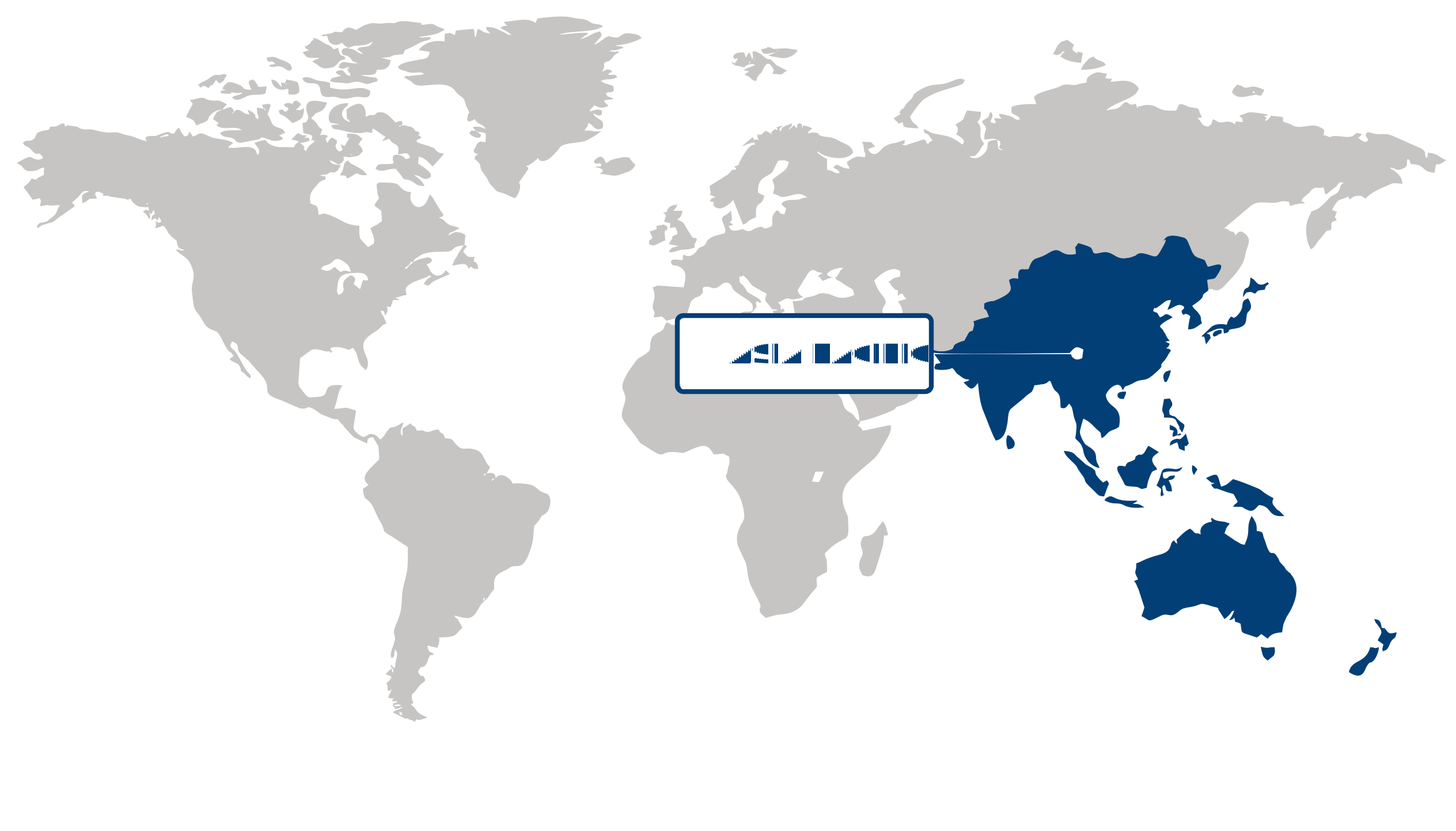
Asia Pacific (Largest Region)
The long-term evolution base station market was led by Asia Pacific, which represented 42.12% of the market in 2026. The region's leading position is closely associated with extensive mobile subscriber bases, expanding telecommunications infrastructure, and continued demand for reliable high-speed wireless connectivity. Growing data consumption from video streaming, connected devices, mobile applications, and enterprise services is encouraging operators to strengthen network capacity and coverage. Infrastructure development across emerging economies is further supporting deployment of LTE base stations, particularly as operators seek to improve connectivity in rapidly urbanizing and industrializing areas. Ongoing network upgrades and investments in telecommunications infrastructure are therefore sustaining demand across the region.
Europe (Fastest-Growing Region)
Europe is projected to register the fastest growth in the long-term evolution base station market, supported by ongoing network modernization and increasing demand for dependable mobile broadband services. Operators are upgrading wireless infrastructure to accommodate rising data traffic while improving network coverage and service quality. The expansion of connected devices, industrial connectivity, and digital services is creating additional requirements for robust LTE infrastructure. Regulatory emphasis on improving digital connectivity and continued investment in telecommunications networks are also supporting deployment activity. As enterprises and consumers increasingly depend on mobile data services, the need to enhance network performance is expected to provide further momentum to the regional market.
| Parameter | North America | Asia Pacific | Europe | Latin America | MEA |
|---|---|---|---|---|---|
| Innovation Hub i Scale Nascent Developing Advanced | |||||
| Cost-Sensitive Region i Scale Low Medium High | |||||
| Regulatory Environment i Scale Restrictive Neutral Supportive | |||||
| Demand Drivers i Scale Weak Moderate Strong | |||||
| Development Stage i Scale Emerging Developing Developed | |||||
| Adoption Rate i Scale Low Medium High | |||||
| New Entrants / Startups i Scale Sparse Moderate Dense | |||||
| Macro Indicators i Scale Weak Stable Strong |
Key Country Insights
United States 🇺🇸
Network Modernization FocusThe U.S. continues upgrading long-term evolution base station infrastructure to improve coverage, capacity, and interoperability with next-generation networks. Operators prioritize efficient modernization strategies that extend LTE performance while supporting evolving mobile traffic demands.
Germany 🇩🇪
Industrial Network ReliabilityGermany maintains investment in long-term evolution base stations supporting enterprise connectivity and industrial communications. Network operators emphasize dependable LTE infrastructure for private networks and mission-critical business applications.
Japan 🇯🇵
Dense Urban CoverageJapan enhances long-term evolution base station deployment to sustain reliable mobile connectivity in densely populated urban environments. Infrastructure optimization remains important for maintaining service quality alongside expanding digital applications.
South Korea 🇰🇷
Advanced Mobile InfrastructureSouth Korea continues optimizing long-term evolution base station networks to complement advanced wireless services. Operators focus on improving network efficiency, seamless coverage, and integration with broader mobile infrastructure investments.
France 🇫🇷
Broadband Coverage EnhancementFrance prioritizes long-term evolution base station upgrades that strengthen nationwide broadband access and enterprise connectivity. Infrastructure investments support stable mobile services while accommodating increasing data consumption across regional networks.
Italy 🇮🇹
Regional Network OptimizationItaly focuses on optimizing long-term evolution base station infrastructure to improve service consistency across urban and regional areas. Mobile operators continue modernizing network assets to enhance capacity and operational efficiency.
Segment Leadership and Growth Trends
Long-Term Evolution Base Station Market Share (%), by Component, 2026
Go beyond the chart, access full insights & data tables
Request Free Sample ReportComponent Segment Analysis: Hardware (Largest Segment) vs Software (Fastest-Growing Segment)
The hardware segment dominated the long-term evolution base station market with a 62.4% share in 2026. Hardware components such as antennas, radio units, baseband equipment, and power systems form the foundation of LTE network infrastructure, making them indispensable for network deployment and expansion. Continued investments in telecommunications infrastructure and network modernization have sustained strong demand for high-performance hardware solutions.
Software represents the fastest-growing component segment as network operators increasingly adopt software-driven capabilities to improve network management, optimize resource allocation, and support advanced operational features. The growing emphasis on virtualization, intelligent network optimization, and automated performance management is accelerating software adoption across LTE infrastructure.
Technology Segment Analysis: FDD-LTE (Largest Segment) vs Small Cells (Fastest-Growing Segment)
FDD-LTE accounted for a 47.7% share in 2026, making it the leading technology segment. Its broad commercial deployment, efficient spectrum utilization, and reliable coverage have made it the preferred technology for delivering consistent mobile broadband services across densely populated and geographically dispersed regions. Strong compatibility with existing telecommunications infrastructure has further reinforced its market leadership.
Small cells are projected to experience the fastest growth as operators seek to improve network capacity, strengthen indoor coverage, and address rising mobile data traffic. Their ability to enhance service quality in densely populated urban environments while supporting efficient spectrum utilization makes them increasingly important in evolving LTE network architectures.
Provision Segment Analysis: Urban (Largest & Fastest-Growing Segment)
The urban segment dominated the long-term evolution base station market in 2026 and also represents the fastest-growing provision segment. High population density, substantial mobile data consumption, and continuous investment in advanced telecommunications infrastructure have made urban areas the primary focus for LTE base station deployment. Ongoing smart city initiatives, expanding digital services, and increasing demand for high-speed wireless connectivity continue to accelerate infrastructure expansion across metropolitan regions, reinforcing the segment's leadership and growth trajectory.
| Segment | Sub-Segment | Largest Segment | Fastest Growing |
|---|---|---|---|
| Component | Hardware, Software | Hardware | Software |
| Technology | FDD-LTE, TDD-LTE, Small Cells | FDD-LTE | Small Cells |
| Provision | Urban, Suburban, Rural | Urban | Urban |
| End Use | Residential & SOHO, Enterprise, Telecom Operators, Government and Public Sector | Telecom Operators | Enterprise |
Competitive Landscape and Market Positioning
Major players in the long-term evolution base station market:
- Huawei Technologies Co., Ltd. (China)
- Ericsson AB (Sweden)
- Nokia Corporation (Finland)
- Samsung Electronics Co., Ltd. (South Korea)
- ZTE Corporation (China)
- NEC Corporation (Japan)
- Fujitsu Limited (Japan)
- Cisco Systems, Inc. (United States)
- Qualcomm Incorporated (United States)
- CommScope Holding Company, Inc. (United States)
Maturing network infrastructure is changing the competitive focus in the long-term evolution base station market from broad deployment expansion toward improving network efficiency, upgrade flexibility, and coexistence with newer wireless technologies. Suppliers are strengthening their positions by developing solutions that support evolving traffic demands, lower operational overhead, and enable smoother modernization without extensive infrastructure replacement. This shift is encouraging competition around software-driven optimization, energy-efficient operation, and adaptable network architectures that allow operators to maximize the value of existing assets while preparing for future network evolution.
| Company | Market Share | Company Revenue | Revenue CAGR (%) | Product Portfolio | Geographic Presence | Innovation / R&D Focus | Strategic Developments |
|---|---|---|---|---|---|---|---|
| Huawei Technologies Co. Ltd. (China) | |||||||
| Ericsson AB (Sweden) | |||||||
| Nokia Corporation (Finland) | |||||||
| Samsung Electronics Co. Ltd. (South Korea) | |||||||
| ZTE Corporation (China) | |||||||
| NEC Corporation (Japan) | |||||||
| Fujitsu Limited (Japan) | |||||||
| Cisco Systems Inc. (United States) | |||||||
| Qualcomm Incorporated (United States) | |||||||
| CommScope Holding Company Inc. (United States) |
Industry Development/News
| Company Name | Date | Key Development |
|---|---|---|
| Vodafone | Nov-24 | Vodafone and AMD partnered to co-develop next-generation mobile base stations focused on enhancing energy efficiency and integrating artificial intelligence (AI) workloads. This initiative aims to optimize LTE and 5G network performance while reducing the physical infrastructure footprint and energy consumption requirements of network operations. |
| Bharat Sanchar Nigam Limited (BSNL) | Aug-24 | BSNL announced a large-scale infrastructure expansion project involving the installation of 80,000 telecom towers across India to strengthen 4G service coverage. The initiative is part of a broader strategic roadmap to deploy a total of 100,000 towers, with 21,000 units scheduled for deployment by March 2025 to improve national connectivity and network reach. |
Customize Your Report
Explore examples of how this report can be tailored to different research needs, including custom segments, additional topics or chapters, and related reports. Click a section of the wheel or its numbered marker to explore the available options.
Long-Term Evolution Base Station Market — Custom Segments
| Segment | Sub-Segment |
|---|---|
| Frequency Band | Below 1 GHz, 1–3 GHz, 3–6 GHz |
| Backhaul Technology | Fiber Backhaul, Microwave Backhaul, Copper-Based Backhaul, Satellite Backhaul |
| Infrastructure Ownership | Operator-Owned Infrastructure, Neutral-Host Infrastructure, Shared Infrastructure, Private-Owned Infrastructure |
Long-Term Evolution Base Station Market — Custom TOC
| Custom Chapter | Custom Details |
|---|---|
| LTE Network Modernization Strategies |
|
| 4G Sunset & Network Migration Outlook |
|
| Private LTE Deployment Opportunities |
|
Need a different cut of the data?
Request Custom ResearchWhat is the current revenue of the long-term evolution base station market?
What is the forecasted size of the long-term evolution base station industry?
Why is rising mobile data consumption accelerating LTE base station deployment?
How are expanding IoT deployments influencing the long-term evolution base station market?
Why does the hardware segment lead the long-term evolution base station market?
Why are small cells gaining momentum in the long-term evolution base station market?
How does Asia Pacific maintain its leadership in the LTE base station market?
What is driving faster LTE base station growth in Europe?
Which companies are driving growth in the long-term evolution base station landscape?
Our Clients
"Working with FBI has been a good experience. The market report provided a holistic view, covering everything from emerging trends to potential risks."
Semtech Corporation
"The experience was highly positive. The team showcased remarkable flexibility in adapting to our specific needs and delivered report that perfectly aligned with all our requirements."
TSMC
"What really stood out to me was how clearly and promptly the Fundamental Business Insights team communicated throughout. It made the collaboration feel effortless."
NXP Semiconductors
Our Research Team & Methodology
Every Fundamental Business Insights report is built by a dedicated vertical research team, validated through a structured primary-and-secondary methodology, and reviewed for accuracy before it reaches you.
Research Team Overview
Prepared by the Electronics & Semiconductors Research Team
Delivery
Published
Demand
Available
Support
Trust & Compliance
Research Domains
10 coverage areasResearch Intelligence
| Source | Reference |
|---|---|
| Semiconductor Industry Association (SIA) | www.semiconductors.org |
| SEMI | www.semi.org |
| JEDEC Solid State Technology Association | www.jedec.org |
| IEEE | www.ieee.org |
| IPC – Association Connecting Electronics Industries | www.ipc.org |
| International Electrotechnical Commission (IEC) | www.iec.ch |
| International Organization for Standardization (ISO) | www.iso.org |
| U.S. Bureau of Industry and Security (BIS) | www.bis.gov |
| U.S. Patent and Trademark Office (USPTO) | www.uspto.gov |
| European Patent Office (EPO) | www.epo.org |
| Taiwan Semiconductor Industry Association (TSIA) | www.tsia.org.tw |
| World Semiconductor Trade Statistics (WSTS) | www.wsts.org |
| International Energy Agency (IEA) | www.iea.org |
| GSMA | www.gsma.com |
| 3GPP | www.3gpp.org |
| ITU (International Telecommunication Union) | www.itu.int |
| Omdia (public insights) | omdia.tech.informa.com |
| Display Supply Chain Consultants (DSCC) | www.displaysupplychain.com |
| U.S. Department of Energy (DOE) | www.energy.gov |
| NIST (National Institute of Standards and Technology) | www.nist.gov |
Research Workflow & Quality Assurance
Data Collection
Verified information gathered through primary and secondary research.
Data Triangulation
Cross-validation using multiple independent data sources.
Forecast Modelling
Market estimates developed using historical trends and analytical models.
Analyst Validation
Findings reviewed by domain experts for accuracy and consistency.
Editorial & Quality Review
Final editorial, quality, and compliance checks before publication.
Final Publication
Released after successful completion of the internal review process.
Report Coverage
📊 Market Assessment
- Market Size & Forecast
- Market Segmentation
- Regional Analysis
- Growth Drivers & Challenges
- Market Dynamics
🏢 Competitive Intelligence
- Competitive Landscape
- Company Profiles
- Competitive Benchmarking
- Mergers & Acquisitions
- Market Share Analysis or Key Company Strategies
🔍 Strategic Analysis
- Value Chain Analysis
- Porter's Five Forces
- PESTLE Analysis
- Pricing Trends
- Supply-Demand Analysis
🚀 Future Outlook
- Technology Landscape
- Regulatory Landscape
- Investment & Funding Landscape
- Emerging Opportunities
- Future Market Outlook
Have a question about this report or need a custom scope?
Request Customization