Liquid Filling Machines Market Size & Growth Forecast 2027–2036, By Segments (Automation Level, Machine Type, Sales Channel, Container, Fill Type, Industry), Regional Demand Trends (North America, Asia Pacific, Europe), Key Country Insights (U.S., Japan, South Korea, Germany, France, Italy), and Competitive Landscape
Market Size and Growth Outlook
Liquid Filling Machines Market size was assessed at USD 10.5 Billion in 2026 and is poised to grow at 8.06% CAGR between 2027 and 2036, crossing USD 22.79 Billion by 2036. The industry revenue for 2027 is estimated at USD 11.22 Billion.
Get more details on this report
Request Free Sample ReportLiquid Filling Machines Market Intelligence Snapshot
Regional Market Dynamics
- Asia Pacific led in 2026 through expanding pharmaceutical, food and beverage, cosmetics, and chemical manufacturing, driving demand for accurate automated filling processes.
- Rising production capacity, facility modernization, automated packaging adoption, and expanding consumer markets are increasing investment in high-throughput filling solutions.
Segment Momentum
- Fully automatic machines held 57.24% of the market in 2026 because they improve throughput, filling precision, and production consistency while reducing manual intervention and integrating efficiently with packaging lines.
- Aseptic fillers are projected to grow the fastest as manufacturers prioritize hygienic packaging, contamination control, extended shelf life, and compliance with stricter product safety and quality requirements.
Market Expansion Drivers
- Rising demand for packaged beverages and liquids driving automated filling equipment deployment
- Increasing regulatory quality and hygiene standards boosting precision filling automation adoption
- Expansion of pharmaceutical and nutraceutical production increasing sterile filling system demand
Leading Market Participants
- Key players in the liquid filling machines market include Krones AG (Germany), Sidel Group (France), KHS GmbH (Germany), Tetra Pak International S.A. (Switzerland), GEA Group AG (Germany), Coesia S.p.A. (Italy), ProMach Inc. (USA), JBT Corporation (USA), Serac Group (France), Syntegon Technology GmbH (Germany)
Global Market Forecast Snapshot
Market Outlook
- 2026 Market Size: USD 10.5 Billion
- 2027 Estimated Market Size: USD 11.22 Billion
- Projected Market Size: USD 22.79 Billion by 2036
- Growth Forecast: 8.06% CAGR (2027-2036)
Regional and Segment Outlook
- Leading Regional Market: Asia Pacific
- High-Growth Regional Hub: Asia Pacific
- Core Revenue Segment: Fully Automatic (Automation Level) | Volumetric Fillers (Machine Type) | Direct Sales (Sales Channel) | Plastic (Container) | Cold Fill (Fill Type) | Food & Beverage (Industry)
- Emerging Opportunity Segment: Fully Automatic (Automation Level) | Aseptic Fillers (Machine Type) | Indirect Sales (Sales Channel) | Metal (Container) | Asceptic Fill (Fill Type) | Pharmaceutical (Industry)
Market Growth Drivers and Industry Trends
Rising demand for packaged beverages and liquids driving automated filling equipment deployment
Growing consumer preference for packaged beverages, dairy products, edible oils, personal care liquids, and household chemicals is creating strong momentum that will drive the liquid filling machines market growth. Manufacturers are expanding production capacity while adopting automated filling solutions to achieve higher throughput, improve filling consistency, and reduce product wastage during packaging operations. Automated equipment also supports flexible production environments by accommodating multiple container sizes and liquid viscosities, enabling efficient manufacturing across diverse product categories.
Increasing regulatory quality and hygiene standards boosting precision filling automation adoption
Stricter manufacturing regulations governing product safety and sanitation are encouraging companies to modernize production facilities, strengthening the liquid filling machines market through wider adoption of precision filling technologies. Automated systems help maintain consistent fill volumes while minimizing contamination risks by reducing direct human interaction during production. Advanced monitoring capabilities, hygienic machine designs, and repeatable operational accuracy enable manufacturers to comply with evolving quality standards across food, beverage, pharmaceutical, and personal care industries.
Expansion of pharmaceutical and nutraceutical production increasing sterile filling system demand
The continued growth of pharmaceutical and nutraceutical manufacturing will boost the liquid filling machines market demand as producers require sterile and highly controlled filling environments for sensitive liquid formulations. These industries depend on advanced filling systems capable of maintaining product integrity, supporting contamination control, and ensuring accurate dosing throughout high-volume production processes. Automated sterile filling equipment also facilitates compliance with stringent manufacturing protocols while improving production efficiency for a broad range of medicinal and nutritional liquid products.
| Growth Driver | Impact on CAGR | Regulatory Influence | Geographic Relevance | Adoption Rate | Impact Timeline |
|---|---|---|---|---|---|
| Rising demand for packaged beverages and liquids driving automated filling equipment deployment | 2% | Moderate | Asia Pacific, North America | High | Near Term |
| Increasing regulatory quality and hygiene standards boosting precision filling automation adoption | 1.8% | High | Europe, North America | High | Near Term |
| Expansion of pharmaceutical and nutraceutical production increasing sterile filling system demand | 1.6% | High | Asia Pacific | Medium | Mid Term |
Unlock insights tailored to your business with our bespoke market research solutions.
Click to get your customized report now.
Regional Demand Dynamics
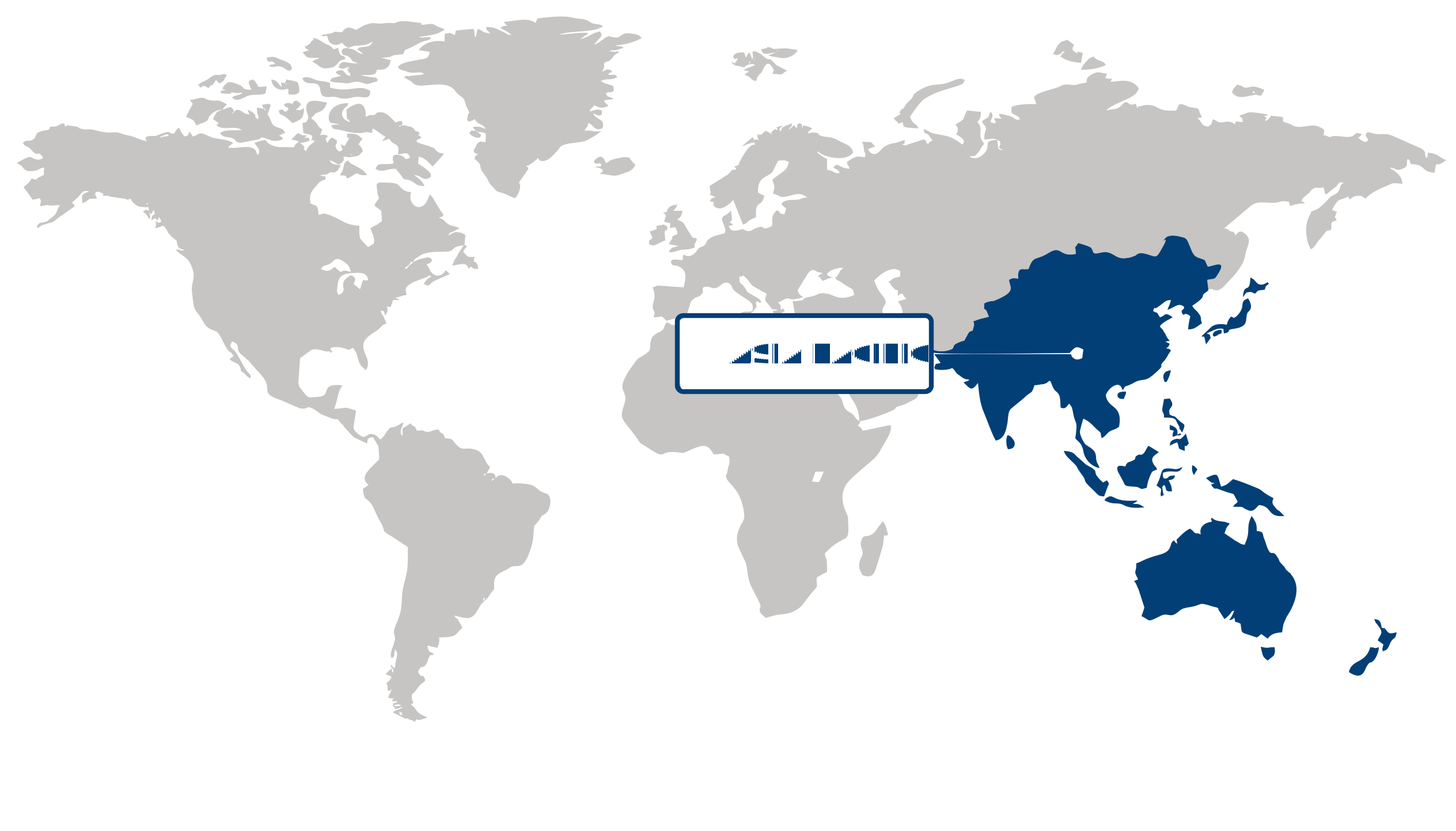
Asia Pacific (Largest & Fastest-Growing Region)
Asia Pacific accounted for the largest share of the liquid filling machines market in 2026 and is also expected to maintain the fastest growth trajectory. The region benefits from expanding pharmaceutical, food and beverage, cosmetics, and chemical manufacturing activities, which are increasing the need for accurate, efficient, and automated filling processes. Rising production capacity, modernization of manufacturing facilities, and growing adoption of automated packaging equipment are further supporting demand, while expanding consumer markets continue to encourage investments in high-throughput filling solutions.
| Parameter | North America | Asia Pacific | Europe | Latin America | MEA |
|---|---|---|---|---|---|
| Innovation Hub i Scale Nascent Developing Advanced | |||||
| Cost-Sensitive Region i Scale Low Medium High | |||||
| Regulatory Environment i Scale Restrictive Neutral Supportive | |||||
| Demand Drivers i Scale Weak Moderate Strong | |||||
| Development Stage i Scale Emerging Developing Developed | |||||
| Adoption Rate i Scale Low Medium High | |||||
| New Entrants / Startups i Scale Sparse Moderate Dense | |||||
| Macro Indicators i Scale Weak Stable Strong |
Key Country Insights
United States 🇺🇸
Automated Packaging SolutionsThe U.S. liquid filling machines market is driven by automation, flexible production lines, and demand for high-throughput packaging. Manufacturers increasingly adopt smart filling equipment with digital monitoring to improve operational efficiency and product consistency.
Germany 🇩🇪
Precision Filling SystemsGermany emphasizes precision-engineered liquid filling machines designed for pharmaceutical, food, and specialty manufacturing applications. German equipment suppliers focus on hygienic design, accurate dosing, and seamless integration with automated packaging lines.
Japan 🇯🇵
Compact Manufacturing EfficiencyJapan prioritizes compact, highly reliable liquid filling machines suited to space-efficient production facilities. Japanese manufacturers invest in automation, reduced maintenance requirements, and precise filling performance across multiple container formats.
South Korea 🇰🇷
Flexible Production EquipmentSouth Korea expands adoption of liquid filling machines that support rapidly changing consumer packaging requirements. Equipment suppliers develop flexible systems capable of handling diverse product viscosities while improving production efficiency and quality control.
France 🇫🇷
Hygienic Processing FocusFrance emphasizes liquid filling machines that meet stringent hygiene and traceability requirements in food, beverage, and cosmetics manufacturing. French producers prioritize efficient cleaning systems and adaptable equipment for premium packaged products.
Italy 🇮🇹
Specialty Packaging ExpertiseItaly focuses on liquid filling machines that support premium food, beverage, cosmetics, and personal care production. Italian machinery manufacturers emphasize customization, reliable filling accuracy, and integration with aesthetically driven packaging operations.
Segment Leadership and Growth Trends
Liquid Filling Machines Market Share (%), by Automation Level, 2026
Go beyond the chart, access full insights & data tables
Request Free Sample ReportAutomation Level Segment Analysis: Fully Automatic (Largest & Fastest-Growing Segment)
The fully automatic segment dominated the liquid filling machines market and accounted for a 57.24% market share in 2026. Its leading position is supported by the growing need for high-throughput, consistent, and efficient filling operations across industries such as food and beverages, pharmaceuticals, cosmetics, and chemicals. Fully automatic filling machines reduce the need for manual intervention while improving filling precision, minimizing product wastage, and supporting consistent production quality. Their ability to integrate with broader packaging lines and accommodate continuous manufacturing processes further enhances their appeal as manufacturers seek to improve operational efficiency, maintain stringent quality standards, and respond to rising production requirements. The same advantages are also driving the segment's rapid expansion, as businesses increasingly prioritize automation to reduce labor dependency and achieve more streamlined production workflows.
Machine Type Segment Analysis: Volumetric Fillers (Largest Segment) vs Aseptic Fillers (Fastest-Growing Segment)
The liquid filling machines market was led by the volumetric fillers segment, which held a 42.23% market share in 2026. Volumetric fillers are widely adopted because they provide controlled and consistent product dispensing, making them suitable for handling liquids with different viscosities across diverse manufacturing environments. Their versatility and ability to support accurate filling operations contribute to their strong demand in industries where product consistency and efficient material utilization are essential. The increasing focus on automated packaging processes and the need for reliable filling accuracy further support the continued prominence of volumetric filling equipment.
Aseptic fillers are expected to register the fastest growth, driven by rising demand for hygienic packaging and extended product shelf life, particularly in applications involving sensitive liquid products. Aseptic filling technology enables products and packaging materials to be handled under controlled conditions, helping minimize contamination risks and preserve product quality. Growing consumer preference for safe and convenient packaged products, together with stricter hygiene expectations across food, beverage, and pharmaceutical manufacturing, is encouraging manufacturers to adopt advanced aseptic filling solutions. The increasing emphasis on product safety and quality preservation is therefore creating favorable conditions for the expansion of this segment.
Sales Channel Segment Analysis: Direct Sales (Largest Segment) vs Indirect Sales (Fastest-Growing Segment)
The direct sales segment held the largest position in the liquid filling machines market in 2026, reflecting the importance of direct interactions between equipment manufacturers and industrial buyers. Direct sales enable manufacturers to provide customized machine configurations, technical consultations, installation support, and after-sales services based on specific production requirements. This approach is particularly valuable for complex filling equipment, where customers may require detailed guidance regarding machine selection, integration, commissioning, and maintenance. The need for tailored solutions and long-term technical support continues to make direct sales an important channel for purchasing specialized liquid filling machinery.
The indirect sales segment is anticipated to experience the fastest growth, supported by the expanding role of distributors, dealers, and specialized equipment resellers in broadening market access. Indirect channels can help manufacturers reach customers across geographically dispersed markets while providing localized sales support and service capabilities. This channel is particularly relevant for smaller and mid-sized manufacturers seeking access to filling equipment without engaging directly with machine producers. As demand for liquid filling machinery expands across diverse industrial markets and regions, the wider distribution reach and convenience offered by indirect sales are expected to support stronger adoption of this channel.
| Segment | Sub-Segment | Largest Segment | Fastest Growing |
|---|---|---|---|
| Automation Level | Manual, Semi-automatic, Fully Automatic | Fully Automatic | Fully Automatic |
| Machine Type | Rotary Fillers, Aseptic Fillers, Volumetric Fillers, Net Weight Fillers, Others | Volumetric Fillers | Aseptic Fillers |
| Sales Channel | Direct Sales, Indirect Sales | Direct Sales | Indirect Sales |
| Container | Plastic, Glass, Metal | Plastic | Metal |
| Fill Type | Hot Fill, Cold Fill, Asceptic Fill | Cold Fill | Asceptic Fill |
| Industry | Pharmaceutical, Food & Beverage, Chemical, Cosmetics and Personal Care, Others | Food & Beverage | Pharmaceutical |
Competitive Landscape and Market Positioning
Prominent players in the liquid filling machines market:
- Krones AG (Germany)
- Sidel Group (France)
- KHS GmbH (Germany)
- Tetra Pak International S.A. (Switzerland)
- GEA Group AG (Germany)
- Coesia S.p.A. (Italy)
- ProMach, Inc. (USA)
- JBT Corporation (USA)
- Serac Group (France)
- Syntegon Technology GmbH (Germany)
Manufacturers are increasingly competing by delivering filling systems that balance precision, production flexibility, and seamless integration with automated packaging environments. Development efforts are shifting toward modular machine platforms that accommodate frequent product changeovers, diverse container formats, and varying liquid characteristics without extensive reconfiguration. Digital monitoring, predictive maintenance capabilities, and hygienic equipment designs are further redefining competitive positioning, rewarding suppliers that can improve operational reliability while meeting evolving regulatory and manufacturing requirements across multiple end-use industries.
| Company | Market Share | Company Revenue | Revenue CAGR (%) | Product Portfolio | Geographic Presence | Innovation / R&D Focus | Strategic Developments |
|---|---|---|---|---|---|---|---|
| Krones AG (Germany) | |||||||
| Sidel Group (France) | |||||||
| KHS GmbH (Germany) | |||||||
| Tetra Pak International S.A. (Switzerland) | |||||||
| GEA Group AG (Germany) | |||||||
| Coesia S.p.A. (Italy) | |||||||
| ProMach Inc. (USA) | |||||||
| JBT Corporation (USA) | |||||||
| Serac Group (France) | |||||||
| Syntegon Technology GmbH (Germany) |
Industry Development/News
| Company Name | Date | Key Development |
|---|---|---|
| Elopak | Oct-25 | Elopak introduced the S-PM200, an integrated carton erecting, filling, and sealing machine tailored for school milk programs and institutional beverage applications. The system features servo-driven precision for splash-free filling, real-time monitoring, and an intuitive HMI, offering high-capacity, hygienic performance for mini-carton formats while streamlining maintenance requirements and operational monitoring for high-volume chilled product lines. |
| Acasi Machinery | Sep-24 | Acasi Machinery acquired Filling Equipment Corporation to bolster its market position in liquid filling solutions. This strategic acquisition enhances Acasi’s portfolio and technical capabilities across critical end-use sectors, including food and beverage, pharmaceuticals, and cosmetics, where there is rising demand for precise, high-speed, and flexible filling systems to accommodate diverse packaging formats and production requirements. |
| Ampack | Feb-24 | Ampack, a Syntegon subsidiary, launched the FBL aseptic liquid filling machine designed for preformed PP, HDPE, and PET bottles. Featuring a specialized neck-handling system for rapid format changeovers, the machine ensures sterility for sensitive products like baby food and dairy. Its innovative dosing process minimizes foaming, supporting high-speed production of up to 36,000 bottles per hour. |
Customize Your Report
Explore examples of how this report can be tailored to different research needs, including custom segments, additional topics or chapters, and related reports. Click a section of the wheel or its numbered marker to explore the available options.
Liquid Filling Machines Market — Custom Segments
| Segment | Sub-Segment |
|---|---|
| Dosing Principle | Volumetric Dosing, Time-Pressure Dosing, Mass-Flow Dosing, Net-Weight Dosing |
| Production Throughput | Low Throughput, Medium Throughput, High Throughput, Ultra-High Throughput |
| End-Use Product Viscosity | Low-Viscosity Liquids, Medium-Viscosity Liquids, High-Viscosity Liquids |
Liquid Filling Machines Market — Custom TOC
| Custom Chapter | Custom Details |
|---|---|
| Filling Line Investment Economics |
|
| Packaging Format Transition Outlook |
|
| Aftermarket Service Opportunity |
|
Need a different cut of the data?
Request Custom ResearchWhat is the current size of the liquid filling machines market?
What are the growth projections for the liquid filling machines industry?
How is growing demand for packaged liquid products shaping the liquid filling machines market?
Why are regulatory quality and hygiene requirements accelerating adoption of precision filling systems?
Why are fully automatic liquid filling machines the leading market segment?
Which machine type is growing the fastest in the liquid filling machines market?
Why does Asia Pacific lead the liquid filling machines market?
What is driving the fastest growth of liquid filling machines in Asia Pacific?
Who are the leading players in the liquid filling machines landscape?
Our Clients
"The team at Fundamental Business Insights & Consulting demonstrated a commitment to excellence, not only in the quality of the report but also in their client-centric approach."
FANUC
"The level of detail in the market segmentation provided were particularly noteworthy. The detailed country-level insights were also very helpful."
B&R Industrial Automation GmbH
"The consultant took the time to understand our specific business objectives, ensuring that the reports were tailored to address our unique challenges and opportunities."
KUKA SE & Co. KGaA
Our Research Team & Methodology
Every Fundamental Business Insights report is built by a dedicated vertical research team, validated through a structured primary-and-secondary methodology, and reviewed for accuracy before it reaches you.
Research Team Overview
Prepared by the Industrial Automation & Equipment Research Team
Delivery
Published
Demand
Available
Support
Trust & Compliance
Research Domains
10 coverage areasResearch Intelligence
| Source | Reference |
|---|---|
| International Society of Automation (ISA) | www.isa.org |
| International Organization for Standardization (ISO) | www.iso.org |
| National Institute of Standards and Technology (NIST) | www.nist.gov |
| IEEE | www.ieee.org |
| VDMA (German Mechanical Engineering Industry Association) | www.vdma.org |
| Association for Advancing Automation (A3) | www.automate.org |
| International Federation of Robotics (IFR) | ifr.org |
| ASME (American Society of Mechanical Engineers) | www.asme.org |
| ASHRAE | www.ashrae.org |
| American Society of Heating, Refrigerating and Air-Conditioning Engineers (ASHRAE) | www.ashrae.org |
| Material Handling Industry (MHI) | www.mhi.org |
| OSHA (Occupational Safety and Health Administration) | www.osha.gov |
| National Fire Protection Association (NFPA) | www.nfpa.org |
| ASTM International | www.astm.org |
| International Electrotechnical Commission (IEC) | www.iec.ch |
| Open Process Automation Forum (The Open Group) | www.opengroup.org/open-process-automation-forum |
| AGMA (American Gear Manufacturers Association) | www.agma.org |
| Association of Equipment Manufacturers (AEM) | www.aem.org |
| Food and Agriculture Organization (FAO) | www.fao.org |
| International Labour Organization (ILO) | www.ilo.org |
Research Workflow & Quality Assurance
Data Collection
Verified information gathered through primary and secondary research.
Data Triangulation
Cross-validation using multiple independent data sources.
Forecast Modelling
Market estimates developed using historical trends and analytical models.
Analyst Validation
Findings reviewed by domain experts for accuracy and consistency.
Editorial & Quality Review
Final editorial, quality, and compliance checks before publication.
Final Publication
Released after successful completion of the internal review process.
Report Coverage
📊 Market Assessment
- Market Size & Forecast
- Market Segmentation
- Regional Analysis
- Growth Drivers & Challenges
- Market Dynamics
🏢 Competitive Intelligence
- Competitive Landscape
- Company Profiles
- Competitive Benchmarking
- Mergers & Acquisitions
- Market Share Analysis or Key Company Strategies
🔍 Strategic Analysis
- Value Chain Analysis
- Porter's Five Forces
- PESTLE Analysis
- Pricing Trends
- Supply-Demand Analysis
🚀 Future Outlook
- Technology Landscape
- Regulatory Landscape
- Investment & Funding Landscape
- Emerging Opportunities
- Future Market Outlook
Have a question about this report or need a custom scope?
Request Customization