Liquid Analytical Instrument Market Size & Growth Forecast 2027–2036, By Segments (Application, Instrument, End-use), Regional Demand Trends (North America, Asia Pacific, Europe), Key Country Insights (U.S., Japan, South Korea, Germany, France, Italy), and Competitive Landscape
Market Size and Growth Outlook
Liquid Analytical Instrument Market size was more than USD 540.9 million in 2026 and is set to grow at a 5.8% CAGR between 2027 and 2036, attaining USD 950.55 million by 2036. The industry revenue for 2027 is calculated at USD 567.3 million.
Get more details on this report
Request Free Sample ReportLiquid Analytical Instrument Market Intelligence Snapshot
Regional Market Dynamics
- Europe leads the market with its mature industrial and laboratory base, where routine quality control, regulatory compliance, and process monitoring sustain steady instrument utilization and replacement demand.
- Asia Pacific is forecast to expand at a 6.44% CAGR as industrial production, laboratory capabilities, and regulated manufacturing increase demand for continuous liquid testing and monitoring solutions.
Segment Momentum
- Wastewater management held a 33.18% share in 2026 because treatment facilities require continuous liquid quality monitoring to maintain compliance, process stability, and reliable discharge control.
- Liquid chemistry monitoring is growing fastest as industries increasingly adopt continuous inline analysis to improve process control, maintain product consistency, and respond more quickly to process variations.
Market Expansion Drivers
- Stringent environmental compliance requirements increasing adoption of advanced liquid monitoring instruments.
- AI and IoT integration enabling real-time analytics and predictive maintenance capabilities.
- Rising demand for portable automated analytical systems expanding healthcare and field testing applications.
Leading Market Participants
- Prominent companies in the liquid analytical instrument market include ABB Ltd. (Switzerland), Endress+Hauser Group Services AG (Switzerland), Emerson Electric Co. (United States), Honeywell International Inc. (United States), Yokogawa Electric Corporation (Japan), Mettler-Toledo International Inc. (United States), Schneider Electric SE (France), Teledyne Technologies Incorporated (United States), Electro-Chemical Devices, Inc. (United States), Analytical Systems Keco, Inc. (United States).
Global Market Forecast Snapshot
Market Outlook
- 2026 Market Size: USD 540.9 million
- 2027 Estimated Market Size: USD 567.3 million.
- Projected Market Size: USD 950.55 million by 2036
- Growth Forecast: 5.8% CAGR (2027-2036)
Regional and Segment Outlook
- Leading Regional Market: Europe
- High-Growth Regional Hub: Asia Pacific
- Core Revenue Segment: Wastewater Management (Application) | pH/ORP Analyzers (Instrument) | Pharmaceutical (End-use)
- Emerging Opportunity Segment: Liquid Chemistry Monitoring (Application) | Infrared Analyzers (Instrument) | Pharmaceutical (End-use)
Market Growth Drivers and Industry Trends
Stringent environmental compliance requirements increasing adoption of advanced liquid monitoring instruments
Stringent environmental regulations and tighter monitoring requirements across industrial operations are increasing the need for accurate measurement of liquid quality and composition, which will drive the liquid analytical instrument market growth. Industries such as water and wastewater treatment, chemicals, pharmaceuticals, food processing, and manufacturing increasingly require reliable analytical capabilities to monitor contaminants, chemical parameters, and process conditions while maintaining compliance with environmental standards. Advanced instruments offer greater measurement accuracy, faster analysis, and improved process control, allowing operators to identify deviations and address potential compliance issues more efficiently. The need to document environmental performance and maintain consistent monitoring across treatment and production processes is also encouraging organizations to replace basic testing approaches with sophisticated analytical equipment capable of handling complex liquid samples and demanding operating environments.
AI and IoT integration enabling real-time analytics and predictive maintenance capabilities
Integration of artificial intelligence and the internet of things is transforming analytical workflows by connecting instruments with digital monitoring and data management systems, thereby propelling the liquid analytical instrument market growth. AI-enabled analytics can support automated interpretation of measurement data, anomaly detection, and identification of changing process conditions, while IoT connectivity enables continuous transmission of instrument readings to centralized platforms. These capabilities allow users to monitor liquid parameters remotely and respond more quickly to abnormal results without relying entirely on periodic manual testing. Predictive maintenance functionality can further analyze equipment performance and operating patterns to identify potential faults before they cause interruptions, helping laboratories and industrial facilities improve instrument utilization, reduce unplanned downtime, and streamline maintenance activities.
Rising demand for portable automated analytical systems expanding healthcare and field testing applications
The growing requirement for rapid testing outside conventional laboratory environments is creating new opportunities for portable and automated solutions, which will boost liquid analytical instrument market demand. Healthcare facilities, environmental monitoring teams, field laboratories, and industrial operators increasingly require compact systems that can deliver dependable analytical results close to the point of sampling. Portable instruments reduce the need to transport liquid samples over long distances and can support faster decision-making where immediate results are important. Automation also simplifies sample handling and measurement procedures, reducing operator dependency and improving consistency in testing workflows. Improvements in compact sensor technologies, battery-powered operation, connectivity, and user-friendly interfaces are making these systems more practical for mobile applications where space, time, and access to full laboratory infrastructure may be limited.
| Growth Driver | Impact on CAGR | Regulatory Influence | Geographic Relevance | Adoption Rate | Impact Timeline |
|---|---|---|---|---|---|
| Stringent environmental compliance requirements increasing adoption of advanced liquid monitoring instruments | 2.00% | High | North America, Europe | High | Near Term |
| AI and IoT integration enabling real-time analytics and predictive maintenance capabilities | 1.80% | Moderate | Asia Pacific, North America | High | Mid Term |
| Rising demand for portable automated analytical systems expanding healthcare and field testing applications | 1.40% | Moderate | Asia Pacific, Latin America | Medium | Long Term |
Unlock insights tailored to your business with our bespoke market research solutions.
Click to get your customized report now.
Regional Demand Dynamics
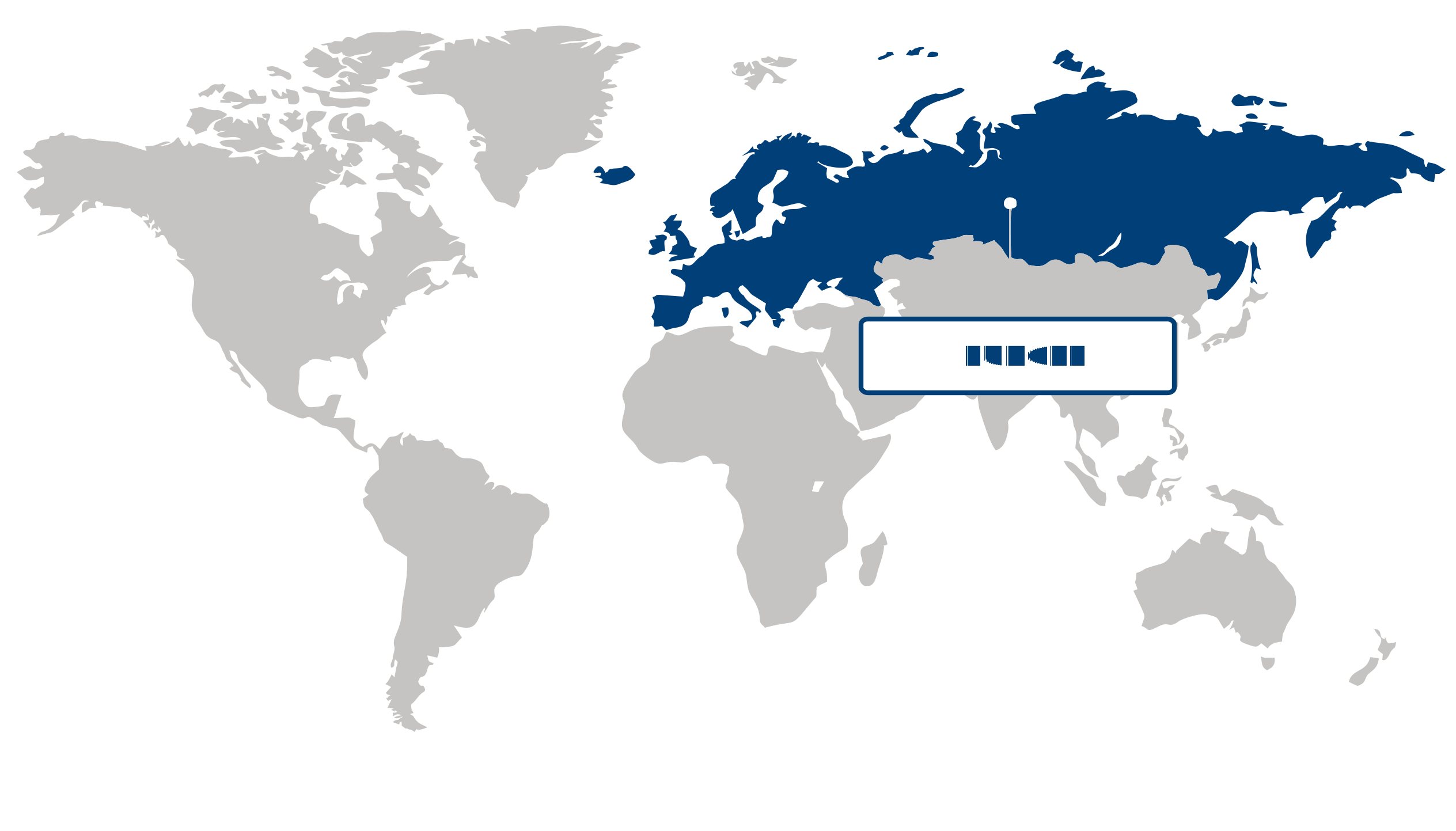
Europe (Largest Region)
The liquid analytical instrument market was led by Europe in 2026, supported by a mature analytical testing ecosystem, advanced laboratory infrastructure, and strong demand for precise chemical and biological analysis. The region's pharmaceutical, biotechnology, food and beverage, environmental testing, and research sectors rely extensively on liquid analytical technologies for quality control, compound identification, separation, and process monitoring. Increasing emphasis on product safety, regulatory compliance, and reproducible laboratory results is encouraging organizations to invest in sophisticated analytical equipment. In addition, established research institutions and expanding applications of advanced laboratory techniques are supporting continued demand for high-performance liquid analysis solutions across industrial and academic environments.
Asia Pacific (Fastest-Growing Region)
Asia Pacific is experiencing the fastest growth in the liquid analytical instrument market, driven by expanding pharmaceutical and biotechnology manufacturing, increasing laboratory investments, and rapid industrial development. Growing quality-control requirements across food processing, chemicals, environmental testing, and healthcare are broadening the need for reliable analytical technologies. The expansion of research capabilities and modernization of laboratory facilities are also encouraging adoption of advanced instruments with improved automation and sensitivity. Furthermore, increasing investment in domestic pharmaceutical production and scientific research is strengthening the regional analytical infrastructure, while rising regulatory expectations are prompting manufacturers and laboratories to improve testing capabilities.
| Parameter | North America | Asia Pacific | Europe | Latin America | MEA |
|---|---|---|---|---|---|
| Innovation Hub i Scale Nascent Developing Advanced | |||||
| Cost-Sensitive Region i Scale Low Medium High | |||||
| Regulatory Environment i Scale Restrictive Neutral Supportive | |||||
| Demand Drivers i Scale Weak Moderate Strong | |||||
| Development Stage i Scale Emerging Developing Developed | |||||
| Adoption Rate i Scale Low Medium High | |||||
| New Entrants / Startups i Scale Sparse Moderate Dense | |||||
| Macro Indicators i Scale Weak Stable Strong |
Key Country Insights
Germany 🇩🇪
Industrial Quality ControlGermany deploys liquid analytical instruments across chemical processing, environmental monitoring, and advanced manufacturing operations. Equipment suppliers are expanding digital connectivity and precision measurement capabilities to improve production efficiency and process control.
France 🇫🇷
Environmental Testing FocusFrance utilizes liquid analytical instruments for environmental compliance, water quality monitoring, and industrial process management. Organizations are adopting advanced analytical systems that improve data reliability while supporting evolving regulatory requirements.
Italy 🇮🇹
Laboratory Modernization DriveItaly is modernizing laboratory and industrial testing capabilities through wider deployment of liquid analytical instruments. Businesses are upgrading analytical infrastructure to improve measurement consistency, operational efficiency, and compliance across multiple end-use industries.
Japan 🇯🇵
Precision Laboratory SolutionsJapan emphasizes liquid analytical instruments that deliver reliable measurements for laboratories, pharmaceuticals, and electronics manufacturing. Manufacturers continue integrating advanced sensing technologies to enhance analytical performance and operational efficiency.
South Korea 🇰🇷
Smart Process AnalyticsSouth Korea is expanding the use of liquid analytical instruments within semiconductor, biotechnology, and industrial manufacturing facilities. Companies are integrating intelligent monitoring platforms to strengthen quality assurance and real-time process optimization.
United States 🇺🇸
Process Monitoring ExcellenceThe U.S. liquid analytical instrument market is driven by demand from pharmaceuticals, water treatment, food processing, and chemical manufacturing. Organizations are investing in automated monitoring solutions that improve measurement accuracy and regulatory compliance.
Segment Leadership and Growth Trends
Liquid Analytical Instrument Market Share (%), by Application, 2026
Go beyond the chart, access full insights & data tables
Request Free Sample ReportApplication Segment Analysis: Wastewater Management (Largest Segment) vs Liquid Chemistry Monitoring (Fastest-Growing Segment)
Wastewater management led the liquid analytical instrument market with a 33.18% share in 2026, reflecting the critical need for continuous monitoring of water quality and treatment processes. Liquid analytical instruments help treatment facilities measure parameters such as acidity, oxidation-reduction conditions, dissolved constituents, and other indicators required to maintain process efficiency and regulatory compliance. Increasing pressure to improve water quality, optimize treatment operations, and manage water resources efficiently is sustaining demand for analytical monitoring technologies. The expansion of wastewater treatment infrastructure and greater emphasis on environmental protection further reinforce the segment's market position.
Liquid chemistry monitoring is experiencing the fastest growth as industries increasingly require continuous visibility into chemical conditions across production and treatment processes. Real-time monitoring enables operators to detect changes in liquid composition, maintain process consistency, and respond quickly to deviations that could affect product quality or operational efficiency. Advances in sensor technologies and automated analytical systems are making continuous monitoring more accessible across industrial applications. Growing emphasis on process optimization, quality control, and efficient resource utilization is accelerating adoption of liquid chemistry monitoring solutions.
Instrument Segment Analysis: pH/ORP Analyzers (Largest Segment) vs Infrared Analyzers (Fastest-Growing Segment)
pH/ORP analyzers represented the largest instrument segment of the liquid analytical instrument market, accounting for 32.97% in 2026, owing to their widespread use in water treatment, chemical processing, food and beverage production, and other applications requiring routine measurement of liquid conditions. These analyzers provide essential information for controlling chemical reactions, maintaining treatment efficiency, and ensuring process stability. Their established role in continuous monitoring and compatibility with automated process-control systems support broad adoption across industrial environments. Increasing requirements for precise process control and reliable water-quality management continue to sustain demand.
Infrared analyzers are advancing at the fastest pace as industries increasingly seek rapid, non-destructive methods for identifying and quantifying chemical components in liquid streams. Infrared-based analysis can support real-time process monitoring while reducing dependence on conventional sampling and laboratory testing. Improvements in sensor performance, automation, and integration with digital process-management systems are expanding the usefulness of these instruments across diverse applications. The growing focus on faster quality assessment, process efficiency, and automated monitoring is supporting stronger adoption of infrared analytical technologies.
| Segment | Sub-Segment | Largest Segment | Fastest Growing |
|---|---|---|---|
| Application | Liquid Chemistry Monitoring, Drug Discovery, Wastewater Management, Water Purification, Others | Wastewater Management | Liquid Chemistry Monitoring |
| Instrument | Conductivity & Resistivity Analyzers, Infrared Analyzers, Oxygen Analyzers, pH/ORP Analyzers, Turbidity Analyzers, Others | pH/ORP Analyzers | Infrared Analyzers |
| End-use | Chemical, Energy, Healthcare & Biotechnology, Oil & Gas, Pharmaceutical, Food & Beverage, Others | Pharmaceutical | Pharmaceutical |
Competitive Landscape and Market Positioning
Prominent players in the liquid analytical instrument market:
1. ABB Ltd. (Switzerland)
2. Endress+Hauser Group Services AG (Switzerland)
3. Emerson Electric Co. (United States)
4. Honeywell International Inc. (United States)
5. Yokogawa Electric Corporation (Japan)
6. Mettler-Toledo International Inc. (United States)
7. Schneider Electric SE (France)
8. Teledyne Technologies Incorporated (United States)
9. Electro-Chemical Devices Inc. (United States)
10. Analytical Systems Keco Inc. (United States)
In the liquid analytical instrument market, rapid technological adoption is reshaping precision measurement and monitoring capabilities across applications. Continuous improvements in analytical accuracy and automation are being driven by sustained R&D investments focused on enhancing detection limits and operational reliability. New product developments emphasize user-centric design and application-specific adaptability, supporting broader adoption in complex environments. Competitive differentiation is increasingly defined by integrated smart functionalities and enhanced data interpretation capabilities.
| Company | Market Share | Company Revenue | Revenue CAGR (%) | Product Portfolio | Geographic Presence | Innovation / R&D Focus | Strategic Developments |
|---|---|---|---|---|---|---|---|
| ABB Ltd. (Switzerland) | |||||||
| Endress+Hauser Group Services AG (Switzerland) | |||||||
| Emerson Electric Co. (United States) | |||||||
| Honeywell International Inc. (United States) | |||||||
| Yokogawa Electric Corporation (Japan) | |||||||
| Mettler-Toledo International Inc. (United States) | |||||||
| Schneider Electric SE (France) | |||||||
| Teledyne Technologies Incorporated (United States) | |||||||
| Electro-Chemical Devices Inc. (United States) | |||||||
| Analytical Systems Keco Inc. (United States). |
Industry Development/News
| Company Name | Date | Key Development |
|---|---|---|
| Emerson | Feb-25 | Emerson agreed to acquire remaining AspenTech shares for USD 17 billion, strengthening its position in software-defined control and industrial automation solutions. The transaction enhances Emerson’s ability to integrate advanced process control capabilities with analytics software, reinforcing its broader industrial digitalization strategy across laboratory and process-intensive environments. |
| Thermo Fisher | Feb-25 | Thermo Fisher announced plans to acquire Solventum’s purification and filtration unit for USD 4.1 billion, expanding its bioprocessing and analytical workflow capabilities. The acquisition strengthens its downstream processing and liquid handling portfolio, supporting broader integration across analytical instrumentation and life sciences manufacturing applications. |
| SICK and Endress+Hauser | Feb-25 | SICK and Endress+Hauser formed a strategic joint venture, transferring approximately 800 employees to create an integrated gas and liquid analysis portfolio. The collaboration consolidates sensing and analytical capabilities, enhancing combined offerings in process instrumentation and strengthening their competitive position in industrial liquid analysis solutions. |
| ABB and Agilent Technologies | Jan-25 | ABB and Agilent Technologies initiated collaboration to develop automated laboratory solutions combining robotics with LC/GC instrumentation. The initiative focuses on integrating laboratory automation with analytical systems, improving workflow efficiency and enabling higher levels of digitalization in laboratory environments used for liquid and chromatographic analysis. |
| Agilent Technologies Inc. | Oct-24 | Agilent Technologies introduced the InfinityLab LC Series portfolio, including 1290 Infinity III LC and 1260 Infinity III LC systems, featuring biocompatible configurations. The systems integrate InfinityLab Assist Technology, a digital support layer that automates routine operations and provides built-in guidance, improving laboratory workflow efficiency and enabling greater focus on analytical accuracy and system performance. |
| Waters Corporation | Mar-23 | Waters launched the Alliance iS intelligent HPLC system with enhanced compliance capabilities, including proactive error detection and automated troubleshooting functions. When integrated with eConnect HPLC columns and Empower software, the platform reduces analytical errors by up to 40%, improving consistency in quality control laboratories and strengthening operational reliability in regulated testing environments. |
Customize Your Report
Explore examples of how this report can be tailored to different research needs, including custom segments, additional topics or chapters, and related reports. Click a section of the wheel or its numbered marker to explore the available options.
Liquid Analytical Instrument Market — Custom Segments
| Segment | Sub-Segment |
|---|---|
| Measurement Parameter | pH & ORP, Conductivity & Resistivity, Dissolved Oxygen, Turbidity, Total Organic Carbon, Other Parameters |
| Automation Level | Manual/Portable, Semi-Automated, Fully Automated/Online |
| Connectivity & Data Integration | Standalone, Network-Connected, Industrial IoT-Integrated |
Liquid Analytical Instrument Market — Custom TOC
| Custom Chapter | Custom Details |
|---|---|
| Digitalization and Smart Instrument Adoption Roadmap |
|
| Emerging Application Landscape Assessment |
|
| Laboratory Automation Integration Outlook |
|
Need a different cut of the data?
Request Custom ResearchWhat is the current revenue of the liquid analytical instrument market?
What is the projected value of the liquid analytical instrument industry by 2036?
How are regulatory compliance requirements driving adoption of continuous liquid monitoring systems?
Why is integration of AI, IoT, and portable analytical systems reshaping market demand patterns?
Why is wastewater management the largest application in the liquid analytical instrument market?
Why is liquid chemistry monitoring the fastest-growing application in the liquid analytical instrument market?
Why is Europe the leading market for liquid analytical instruments?
What is driving liquid analytical instrument market growth in Asia Pacific?
Which companies are driving growth in the liquid analytical instrument landscape?
Our Clients
"The team at Fundamental Business Insights & Consulting demonstrated a commitment to excellence, not only in the quality of the report but also in their client-centric approach."
FANUC
"The level of detail in the market segmentation provided were particularly noteworthy. The detailed country-level insights were also very helpful."
B&R Industrial Automation GmbH
"The consultant took the time to understand our specific business objectives, ensuring that the reports were tailored to address our unique challenges and opportunities."
KUKA SE & Co. KGaA
Our Research Team & Methodology
Every Fundamental Business Insights report is built by a dedicated vertical research team, validated through a structured primary-and-secondary methodology, and reviewed for accuracy before it reaches you.
Research Team Overview
Prepared by the Industrial Automation & Equipment Research Team
Delivery
Published
Demand
Available
Support
Trust & Compliance
Research Domains
10 coverage areasResearch Intelligence
| Source | Reference |
|---|---|
| International Society of Automation (ISA) | www.isa.org |
| International Organization for Standardization (ISO) | www.iso.org |
| National Institute of Standards and Technology (NIST) | www.nist.gov |
| IEEE | www.ieee.org |
| VDMA (German Mechanical Engineering Industry Association) | www.vdma.org |
| Association for Advancing Automation (A3) | www.automate.org |
| International Federation of Robotics (IFR) | ifr.org |
| ASME (American Society of Mechanical Engineers) | www.asme.org |
| ASHRAE | www.ashrae.org |
| American Society of Heating, Refrigerating and Air-Conditioning Engineers (ASHRAE) | www.ashrae.org |
| Material Handling Industry (MHI) | www.mhi.org |
| OSHA (Occupational Safety and Health Administration) | www.osha.gov |
| National Fire Protection Association (NFPA) | www.nfpa.org |
| ASTM International | www.astm.org |
| International Electrotechnical Commission (IEC) | www.iec.ch |
| Open Process Automation Forum (The Open Group) | www.opengroup.org/open-process-automation-forum |
| AGMA (American Gear Manufacturers Association) | www.agma.org |
| Association of Equipment Manufacturers (AEM) | www.aem.org |
| Food and Agriculture Organization (FAO) | www.fao.org |
| International Labour Organization (ILO) | www.ilo.org |
Research Workflow & Quality Assurance
Data Collection
Verified information gathered through primary and secondary research.
Data Triangulation
Cross-validation using multiple independent data sources.
Forecast Modelling
Market estimates developed using historical trends and analytical models.
Analyst Validation
Findings reviewed by domain experts for accuracy and consistency.
Editorial & Quality Review
Final editorial, quality, and compliance checks before publication.
Final Publication
Released after successful completion of the internal review process.
Report Coverage
📊 Market Assessment
- Market Size & Forecast
- Market Segmentation
- Regional Analysis
- Growth Drivers & Challenges
- Market Dynamics
🏢 Competitive Intelligence
- Competitive Landscape
- Company Profiles
- Competitive Benchmarking
- Mergers & Acquisitions
- Market Share Analysis or Key Company Strategies
🔍 Strategic Analysis
- Value Chain Analysis
- Porter's Five Forces
- PESTLE Analysis
- Pricing Trends
- Supply-Demand Analysis
🚀 Future Outlook
- Technology Landscape
- Regulatory Landscape
- Investment & Funding Landscape
- Emerging Opportunities
- Future Market Outlook
Have a question about this report or need a custom scope?
Request Customization