Limestone Market Size & Forecasts 2026-2035, By Segments (Type, Size, End-use Industry), Growth Opportunities, Innovation Landscape, Regulatory Shifts, Strategic Regional Insights (U.S., Japan, China, South Korea, UK, Germany, France), and Competitive Dynamics (Carmeuse, Graymont, Lhoist, Martin Marietta, Mississippi Lime Company)
Market Size and Growth Outlook
Limestone Market size is estimated to increase from USD 83.59 billion in 2025 to USD 178.8 billion by 2035, supported by a CAGR exceeding 7.9% during 2026-2035. In 2026, revenues are forecast to reach USD 89.38 billion.
Get more details on this report
Request Free Sample ReportLimestone Market Intelligence Snapshot
Regional Market Dynamics
Segment Momentum
Market Expansion Drivers
Leading Market Participants
Global Market Forecast Snapshot
Market Outlook
Regional and Segment Outlook
Market Growth Drivers and Industry Trends
The limestone market is increasingly driven by its fundamental role in construction, cement manufacturing, and diverse industrial applications. As infrastructure projects accelerate globally, cement producers like LafargeHolcim emphasize consistent limestone sourcing to ensure product quality and durability, reinforcing demand. This trend reflects evolving urbanization patterns and large-scale public works supported by government infrastructure programs, such as those highlighted by the U.S. Department of Transportation. The growing application of limestone in steel production and environmental uses also broadens market scope. For established players, optimizing supply chains to serve construction and industrial sectors reliably provides a competitive edge, while new entrants can focus on niche industrial uses. The limestone market’s trajectory aligns with expanding construction and heavy industry activities observable in global infrastructure investments, signaling sustained demand.
Innovation in High-Purity and Specialty Limestone Products
Advancements in producing high-purity and specialty limestone are transforming the limestone market by enabling penetration into more specialized and value-added segments. Companies like Carmeuse and Graymont are spearheading development of finely processed and chemically tailored limestone products suited for pharmaceuticals, food-grade applications, and advanced environmental technologies. Regulatory standards from agencies such as the U.S. Food and Drug Administration increasingly require precise material specifications, boosting demand for compliance-oriented limestone products. This specialization offers strategic opportunities for incumbents to differentiate their product portfolios and for niche entrants to address unmet needs in high-purity sectors. The industry’s pivot toward innovation reflects a broader trend of material refinement and customization, suggesting future growth rooted in tailored limestone solutions aligned with stringent regulatory and industrial demands.
Expansion of Limestone Demand in Emerging Markets’ Construction and Steel Sectors
Emerging economies' rapid urbanization and industrialization are intensifying limestone consumption within the construction and steel sectors, key pillars of the limestone market's expansion. Reports from the World Steel Association highlight surging steel production in countries like India and Vietnam, where limestone is essential as a fluxing agent. Concurrently, extensive residential and commercial building projects reported by agencies such as the China National Bureau of Statistics further amplify limestone requirements for cement and construction aggregates. This growing demand creates strategic openings for market players to establish supply bases closer to these high-growth regions while leveraging localized partnerships. As infrastructure development accelerates in emerging markets, the limestone market is positioned to capitalize on this structural shift toward increased material intensity and industrial capacity expansion documented in recent economic analyses.
Industry Restraints:
Environmental Regulatory Constraints
Stringent environmental regulations governing quarrying and processing activities significantly limit limestone market expansion. Compliance with emission controls and land reclamation mandates, as enforced by agencies such as the U.S. Environmental Protection Agency (EPA) and the European Environment Agency (EEA), increases operational costs and extends permitting timelines. For example, the EPA’s National Emission Standards for Hazardous Air Pollutants impose costly technological upgrades to curb dust and particulate matter from limestone plants. These regulatory overheads deter smaller operators from entering or expanding, while established players face elevated capital expenditures to maintain compliance. Consequently, market participants must allocate substantial resources toward sustainable practices and regulatory adherence, slowing capacity growth. Over the next few years, evolving policies aimed at reducing mining’s environmental footprint will sustain pressure on operational models, pushing firms to innovate in eco-friendly extraction and processing, though such transitions may slow the pace of new project developments.
Logistical and Infrastructure Bottlenecks
The limestone market is constrained by significant logistical challenges, particularly in regions lacking robust transportation infrastructure. Limestone’s bulk and weight make cost-efficient movement vital; however, inadequate rail and port facilities, especially in emerging markets, inflate distribution expenses and lead to delayed deliveries. For instance, data from India’s Central Electricity Authority highlights that infrastructure shortcomings add up to 15% in logistics costs for domestic limestone shipments used in power generation. These inefficiencies reduce market accessibility for both suppliers and end-users, complicate supply chain reliability, and hinder competitive pricing structures. Established producers must invest heavily in supply chain optimization, while new entrants often encounter high barriers to market penetration. Looking forward, unless improvements in transport infrastructure and integrated logistics solutions occur, these bottlenecks will continue to impede efficient limestone distribution and limit market flexibility globally.
| Growth Driver | Impact on CAGR | Regulatory Influence | Geographic Relevance | Adoption Rate | Impact Timeline |
|---|---|---|---|---|---|
| Rising use in construction, cement & industrial applications | 3.00% | Short term (≤ 2 yrs) | North America, Europe | Medium | Fast |
| Development of high-purity and specialty limestone products | 2.00% | Medium term (2–5 yrs) | Europe, Asia Pacific | Low | Moderate |
| Growth in emerging markets’ construction & steel sectors | 2.90% | Long term (5+ yrs) | Asia Pacific; Spillover: Latin America | Low | Moderate |
Unlock insights tailored to your business with our bespoke market research solutions.
Click to get your customized report now.
Regional Demand Dynamics
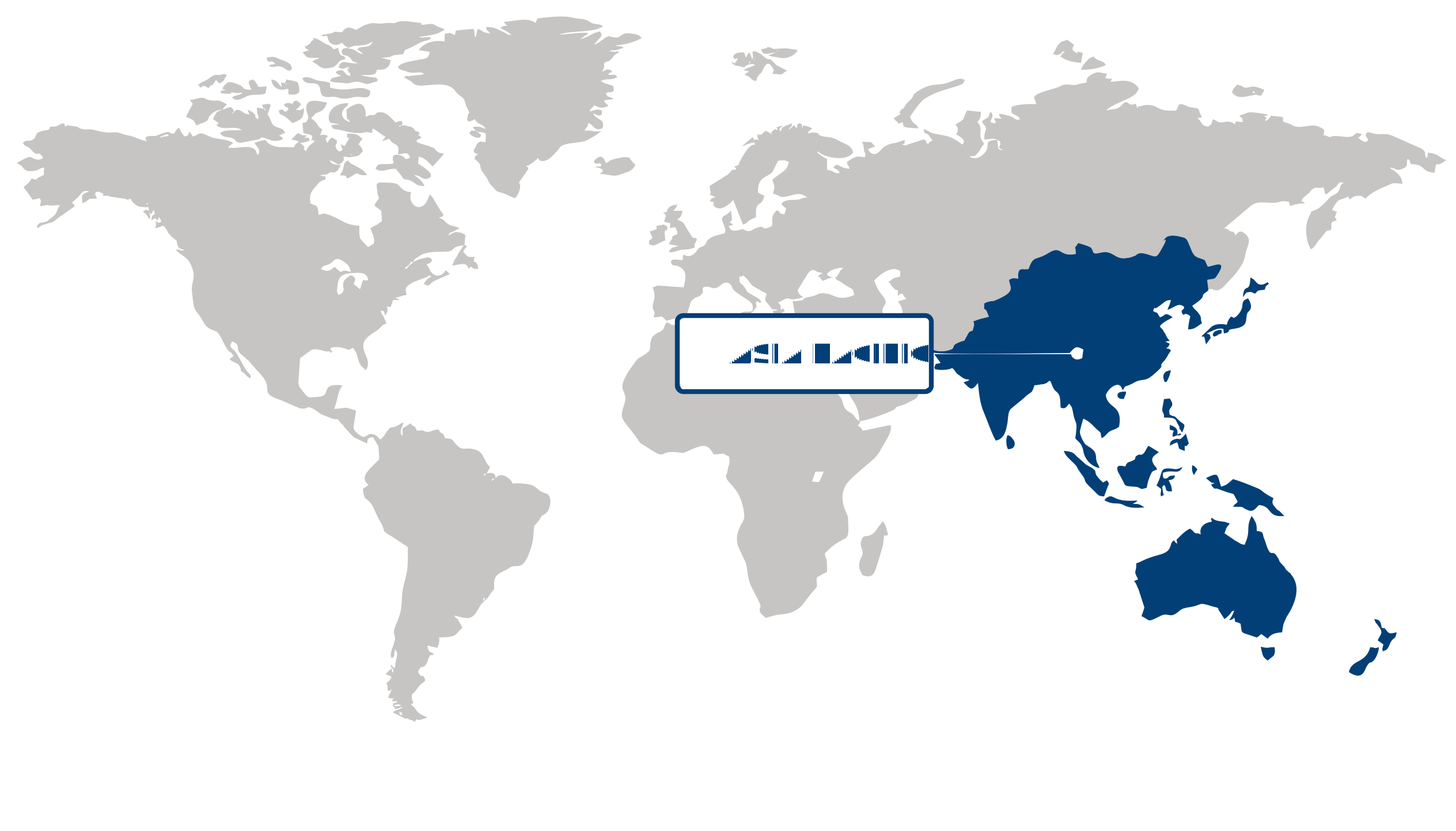
The Asia Pacific limestone market dominated with approximately 69% share of the global market in 2025, also exhibiting the fastest growth at a CAGR of 8.8%. As the largest and most rapidly expanding region, Asia Pacific’s limestone market benefits significantly from its booming construction sector and rapid urbanization trends. Countries like China and India are investing heavily in infrastructure, driven by expanding urban centers and industrial hubs, which create sustained demand for limestone in cement production and building materials. The region’s focus on enhancing infrastructure alongside evolving regulatory frameworks that encourage sustainable construction practices further reinforce market momentum. For instance, the Ministry of Housing and Urban-Rural Development of China has instated guidelines promoting eco-friendly building materials, fostering the use of limestone-based products. These multi-faceted dynamics offer robust opportunities for investment and strategic expansion across the limestone supply chain in Asia Pacific.
China anchors the Asia Pacific limestone market by leveraging its vast urbanization projects and large-scale infrastructure development, which substantially drive limestone consumption. The country’s regulatory emphasis on greener construction materials, as highlighted by recent policies from the Ministry of Ecology and Environment, aligns with growing environmental awareness among developers and consumers. Key players like China National Building Material Group Corporation have announced expansions to meet this sustained demand, signaling competitive intensity and innovation within the sector. China’s blend of high-volume consumption with evolving quality standards underscores its pivotal role, reinforcing the regional dominance of Asia Pacific’s limestone market and highlighting strategic avenues in advanced material solutions.
Japan plays a strategic role in the Asia Pacific limestone market with its focus on technologically advanced and sustainable construction solutions amidst urban renewal and disaster resilience initiatives. Despite a mature market, Japan’s stringent environmental regulations, exemplified by policies from the Ministry of the Environment, drive demand for higher-grade, eco-conscious limestone derivatives used in both infrastructure retrofitting and new development. Companies such as Taiheiyo Cement Corporation are pioneering innovations in limestone utilization aligned with carbon neutrality objectives. This enables Japan to serve as a niche market leader within the region, complementing mass consumption hubs by focusing on premium applications, thereby strengthening Asia Pacific’s overall market resilience and long-term growth prospects.
North America Market Analysis:
North America held a substantial share in the limestone market, driven by robust demand in construction and industrial applications across the region. The presence of extensive limestone reserves and advanced mining infrastructure supports steady supply, while increasing investments in sustainable construction materials are shaping product development. Regulatory frameworks, such as the U.S. Environmental Protection Agency’s guidelines on emissions from quarrying activities, have promoted more eco-friendly extraction practices, encouraging innovation in operational efficiency. Furthermore, the region’s resilient economy and diverse industrial base sustain consistent consumption patterns. For example, Vulcan Materials Company’s recent facility upgrades exemplify the integration of technology to enhance output and reduce environmental impact. Looking ahead, North America’s emphasis on infrastructure renewal and green building initiatives offers promising avenues for growth within the limestone market.
The U.S. serves as the cornerstone of North America’s limestone market, reflecting elevated infrastructure spending and a strong industrial sector. Driven by federal infrastructure bills emphasizing road construction and renovation, demand for crushed limestone and lime products remains robust. The country’s stringent environmental regulations have accelerated the adoption of cleaner production technologies, as demonstrated by Martin Marietta Materials’ investment in low-emission processing plants. Consumer preferences increasingly favor sustainable materials, influencing market offerings and procurement practices. Additionally, the integration of digital monitoring systems across quarry operations enhances supply chain efficacy. These country-specific dynamics underscore the U.S.’ pivotal role in reinforcing North America’s leadership in the limestone market, providing a strategic platform for expansion amid evolving industrial requirements.
Europe Market Trends:
Europe maintained a notable presence in the limestone market, commanding a significant share driven by its robust construction and manufacturing sectors. The region benefits from well-established industrial infrastructure and stringent environmental regulations that encourage the adoption of cleaner production technologies. For instance, the European Cement Association (CEMBUREAU) has highlighted ongoing shifts toward sustainable raw material sourcing, influencing limestone extraction and processing methods. Additionally, Europe’s diverse geological formations provide abundant limestone reserves, supporting stable supply chains despite evolving trade policies. Rising consumer focus on sustainable building materials and circular economy initiatives, as emphasized by the European Commission’s Green Deal, further underpin demand growth. With continuous investments in advanced mining equipment and digital transformation across operations, Europe is poised to leverage innovation-led efficiency gains, presenting substantial opportunities for stakeholders aiming to capitalize on the limestone market’s evolving landscape.
Germany plays a pivotal role in Europe’s limestone market, underpinned by its expansive automotive and construction industries that sustain steady material demand. The country’s progressive environmental standards, reinforced by the Federal Ministry for the Environment, Nature Conservation and Nuclear Safety (BMU), drive manufacturers toward adopting low-carbon limestone-based products, aligning with regional sustainability priorities. German firms like HeidelbergCement actively incorporate cutting-edge extraction technology, enhancing operational efficiency and reducing environmental footprint. Meanwhile, robust logistics networks facilitate streamlined distribution across Europe, ensuring market responsiveness. This strategic positioning strengthens Germany’s status as a critical limestone supplier and innovator, reinforcing broader European market resilience and growth prospects.
France constitutes another cornerstone in Europe’s limestone market landscape, fueled by substantial infrastructure development and industrial consumption. French regulatory frameworks, as outlined by the Ministry of Ecological Transition, promote sustainable quarry rehabilitation and emissions reduction, shaping extraction practices within the sector. Companies such as Vicat Group have publicly committed to leveraging eco-friendly limestone products, reflecting national trends toward green construction material adoption. Demographic trends favoring urban expansion coupled with government-driven renovations of public infrastructure amplify demand. Consequently, France’s active engagement in balancing environmental stewardship with industrial advancement enhances its competitive position, further energizing Europe’s limestone market opportunities.
| Parameter | North America | Asia Pacific | Europe | Latin America | MEA |
|---|---|---|---|---|---|
| Innovation Hub i Scale Nascent Developing Advanced | |||||
| Cost-Sensitive Region i Scale Low Medium High | |||||
| Regulatory Environment i Scale Restrictive Neutral Supportive | |||||
| Demand Drivers i Scale Weak Moderate Strong | |||||
| Development Stage i Scale Emerging Developing Developed | |||||
| Adoption Rate i Scale Low Medium High | |||||
| New Entrants / Startups i Scale Sparse Moderate Dense | |||||
| Macro Indicators i Scale Weak Stable Strong |
Segment Leadership and Growth Trends
Limestone Market Share (%), by Type, 2026
Go beyond the chart, access full insights & data tables
Request Free Sample ReportHigh-Calcium Limestone held largest share in the limestone market in 2025, driven primarily by robust demand from steel manufacturing and construction sectors. Its leadership is underpinned by the segment’s superior chemical properties, which make it indispensable as a flux in steel production and as a foundational material in cement and concrete formulations. Supply chain enhancements and sustainability initiatives emphasizing low-carbon footprint materials have further strengthened its position, as highlighted in recent reports from the World Steel Association. The segment offers strategic advantages by enabling firms to meet stringent environmental and quality standards while addressing growing infrastructure needs. Given ongoing industrial modernization and global urbanization trends, high-calcium limestone is poised to maintain its critical role in these vital heavy industries in the near to medium term.
Analysis by Size
Crushed Limestone represented the largest share of the limestone market in 2025, fueled by its extensive application in construction aggregates and infrastructure development projects worldwide. This segment leads due to consistent demand for durable, cost-effective base materials essential for roads, bridges, and urban expansion, supported by evolving construction methodologies that favor sustainable sourcing and recycling. The U.S. Geological Survey’s infrastructure statistics emphasize the centrality of crushed limestone in public works, reflecting demographic shifts and government stimulus programs. Opportunities abound for both established producers and emerging suppliers to leverage this segment’s steady demand and logistical efficiencies. Considering the persistent global push for infrastructure modernization and green building standards, crushed limestone’s relevance is expected to endure firmly.
Analysis by End-Use Industry
The construction segment dominated the limestone market in 2025, propelled by accelerating residential, commercial, and infrastructure construction worldwide. This leadership stems from limestone’s crucial role in cement production, aggregates, and soil stabilization, aligning with growing urban populations and government initiatives toward affordable housing and sustainable infrastructure. The International Federation of Red Cross and Red Crescent Societies underscores increasing urban resilience programs, indirectly boosting construction material demand. Competitive dynamics also favor firms that integrate innovative processing techniques and digital project tracking to optimize supply chains. The strategic importance of this segment lies in its ability to satisfy large-scale, environmentally conscious construction needs, ensuring it remains a linchpin for industry players amid evolving economic and regulatory landscapes.
| Segment | Sub-Segment | Largest Segment | Fastest Growing |
|---|---|---|---|
| Type | Magnesian Limestone, High-Calcium Limestone | ||
| Size | Crushed Limestone, Calcined Limestone (PCC), Ground Limestone (GCC) | ||
| End-use Industry | Metallurgy, Water & Wastewater Treatment, Construction, Agriculture, Paper & Pulp, Chemical, Others |
Competitive Landscape and Market Positioning
The competitive landscape of the limestone market is characterized by sustained efforts to enhance operational efficiency and broaden product lines among the leading companies. Strategic consolidation and selective acquisitions have augmented raw material reserves and optimized supply chains, evident in moves by Carmeuse and Lhoist. Holcim and CEMEX have deepened integration with cement and concrete offerings, enabling cross-segment synergies. Concurrently, investments in innovative processing techniques and environmental sustainability yield competitive differentiation, particularly for Graymont and Martin Marietta. Cooperative ventures and capacity expansions among Asian leaders such as Anhui Conch Cement and Taiwan Cement Corporation further reflect shifting centers of growth. These ongoing initiatives underscore a focus on resilience, responsiveness, and value-added solutions which intensify competition while fostering incremental innovation in the limestone sector.
Strategic / Actionable Recommendations for Regional Players
In North America, leveraging collaborative ventures with infrastructure and environmental technology firms could enhance the relevance and application scope of limestone products. Capitalizing on digital tools for resource optimization and predictive maintenance can improve margins amid fluctuating demand patterns. Players may also consider aligning with emerging sustainable construction trends by refining product lines tailored to green building standards.
Within the Asia Pacific region, forging alliances with downstream construction conglomerates and industrial users is likely to fortify market presence. Embracing advanced beneficiation and automated handling technologies can increase efficiency in the face of intensifying competition. Emphasis on specialized limestone grades to meet diverse industrial and agricultural applications could unlock niche growth opportunities.
European actors would benefit from integrating circular economy principles and collaborating with research institutions to propel sustainable extraction and processing innovations. Navigating stringent environmental policies requires agility, which can be supported through investment in cleaner technologies and enhanced product stewardship. Focusing on premium and specialty limestone segments may further differentiate offerings amid a mature market landscape.
| Company | Market Share | Company Revenue | Revenue CAGR (%) | Product Portfolio | Geographic Presence | Innovation / R&D Focus | Strategic Developments |
|---|---|---|---|---|---|---|---|
| No companies available. | |||||||
Industry Development/News
| Company Name | Date | Key Development |
|---|
Customize Your Report
Explore examples of how this report can be tailored to different research needs, including custom segments, additional topics or chapters, and related reports. Click a section of the wheel or its numbered marker to explore the available options.
Limestone Market — Custom Segments
| Segment | Sub-Segment |
|---|---|
| No segment data available. | |
Limestone Market — Custom TOC
| Custom Chapter | Custom Details | ||
|---|---|---|---|
| No custom TOC data available. | |||
Need a different cut of the data?
Request Custom ResearchHow much is the limestone market worth?
What is the expected industry size of limestone by 2035?
Which region holds the largest share of the limestone market?
Which geographical area is witnessing the highest growth rate in the limestone sector?
When did high-calcium limestone sub-segment emerge as the largest sub-segment in the type segment of limestone sector?
Why is the crushed limestone segment leading in the limestone industry?
Why does construction sub-segment dominate the end-use industry segment of limestone sector?
What are the key competitors in the limestone landscape?
Our Clients
"Your insights on workforce structures were spot-on. The analysis on mid-to-senior level roles validated some of our hiring decisions and highlighted gaps."
Ateliers De France
"The report gave us insights on competitors in the market. It helped our team refine our bidding strategy for upcoming contracts."
Clark Construction
"The reports provided a deep dive into market trends, and competitive landscape. The strategic insights and recommendations have been very helpful."
Rudolph and Sletten
Our Research Team & Methodology
Every Fundamental Business Insights report is built by a dedicated vertical research team, validated through a structured primary-and-secondary methodology, and reviewed for accuracy before it reaches you.
Research Team Overview
Prepared by the Construction & Manufacturing Research Team
Delivery
Published
Demand
Available
Support
Trust & Compliance
Research Domains
10 coverage areasResearch Intelligence
| Source | Reference |
|---|---|
| International Organization for Standardization (ISO) | www.iso.org |
| ASTM International | www.astm.org |
| National Institute of Standards and Technology (NIST) | www.nist.gov |
| International Code Council (ICC) | www.iccsafe.org |
| American Concrete Institute (ACI) | www.concrete.org |
| American Institute of Steel Construction (AISC) | www.aisc.org |
| Construction Industry Institute (CII) | www.construction-institute.org |
| Associated General Contractors of America (AGC) | www.agc.org |
| Association of Equipment Manufacturers (AEM) | www.aem.org |
| Building Owners and Managers Association (BOMA) | www.boma.org |
| American Society of Civil Engineers (ASCE) | www.asce.org |
| National Ready Mixed Concrete Association (NRMCA) | www.nrmca.org |
| International Facility Management Association (IFMA) | www.ifma.org |
| World Green Building Council (WorldGBC) | worldgbc.org |
| International Federation of Consulting Engineers (FIDIC) | fidic.org |
| International Labour Organization (ILO) | www.ilo.org |
| American Society of Mechanical Engineers (ASME) | www.asme.org |
| Society of Manufacturing Engineers (SME) | www.sme.org |
| National Association of Home Builders (NAHB) | www.nahb.org |
| European Construction Industry Federation (FIEC) | www.fiec.eu |
Research Workflow & Quality Assurance
Data Collection
Verified information gathered through primary and secondary research.
Data Triangulation
Cross-validation using multiple independent data sources.
Forecast Modelling
Market estimates developed using historical trends and analytical models.
Analyst Validation
Findings reviewed by domain experts for accuracy and consistency.
Editorial & Quality Review
Final editorial, quality, and compliance checks before publication.
Final Publication
Released after successful completion of the internal review process.
Report Coverage
📊 Market Assessment
- Market Size & Forecast
- Market Segmentation
- Regional Analysis
- Growth Drivers & Challenges
- Market Dynamics
🏢 Competitive Intelligence
- Competitive Landscape
- Company Profiles
- Competitive Benchmarking
- Mergers & Acquisitions
- Market Share Analysis or Key Company Strategies
🔍 Strategic Analysis
- Value Chain Analysis
- Porter's Five Forces
- PESTLE Analysis
- Pricing Trends
- Supply-Demand Analysis
🚀 Future Outlook
- Technology Landscape
- Regulatory Landscape
- Investment & Funding Landscape
- Emerging Opportunities
- Future Market Outlook
Have a question about this report or need a custom scope?
Request Customization