LGC and VLGC LPG Shipyard Carrier Market Size & Growth Forecast 2027–2036, By Segments (Refrigeration & Pressurization), Regional Demand Trends (North America, Asia Pacific, Europe), Key Country Insights (U.S., Japan, South Korea, Germany, France, Italy), and Competitive Landscape
Market Size and Growth Outlook
LGC and VLGC LPG Shipyard Carrier Market size was around USD 3.1 billion in 2026 and is slated to grow at a 9.69% CAGR from 2027 to 2036, attaining USD 7.82 billion by 2036. The industry revenue for 2027 is assessed at USD 3.35 billion.
Get more details on this report
Request Free Sample ReportLGC and VLGC LPG Shipyard Carrier Market Intelligence Snapshot
Regional Market Dynamics
- Asia Pacific led the market in 2026 and is projected to grow at an 11.31% CAGR, supported by extensive shipbuilding capacity, integrated yard infrastructure, and reliable execution of large carrier orders.
- Continued shipowner orders, strong technical capabilities, production scale, and dependable delivery performance are expanding the regional vessel construction pipeline and reinforcing long-term market growth.
Segment Momentum
- Full Pressurized led the market with a 68.4% share in 2026 due to its operational simplicity, proven vessel designs, and well-established cargo handling practices for LPG transportation.
- Semi Refrigerated is expanding fastest because it offers greater flexibility in balancing pressure and temperature management, making it increasingly suitable for evolving LPG transport requirements.
Market Expansion Drivers
- Rising shale gas production accelerating global LPG trade and driving demand for LPG carrier fleet expansion.
- Growing LNG-to-LPG substitution in heating and cooking applications increasing long-haul maritime transport needs.
- Expansion of cross-border energy trade agreements strengthening long-term LPG shipping capacity requirements.
Leading Market Participants
- Major players in the LGC and VLGC LPG shipyard carrier market include Hyundai Heavy Industries Co., Ltd. (South Korea), Kawasaki Heavy Industries, Ltd. (Japan), Mitsubishi Heavy Industries, Ltd. (Japan), Namura Shipbuilding Co., Ltd. (Japan), Dae Sun Shipbuilding & Engineering Co., Ltd. (South Korea), Hanwha Ocean Co., Ltd. (South Korea), China State Shipbuilding Corporation - CSSC (China), Samsung Heavy Industries Co., Ltd. (South Korea).
Global Market Forecast Snapshot
Market Outlook
- 2026 Market Size: USD 3.1 billion
- 2027 Estimated Market Size: USD 3.35 billion.
- Projected Market Size: USD 7.82 billion by 2036
- Growth Forecast: 9.69% CAGR (2027-2036)
Regional and Segment Outlook
- Leading Regional Market: Asia Pacific
- High-Growth Regional Hub: Asia Pacific
- Core Revenue Segment: Full Pressurized (Refrigeration & Pressurization)
- Emerging Opportunity Segment: Semi Refrigerated (Refrigeration & Pressurization)
Market Growth Drivers and Industry Trends
Rising shale gas production accelerating global LPG trade and driving demand for LPG carrier fleet expansion
Rising shale gas production will propel the LGC and VLGC LPG shipyard carrier market growth by increasing the availability of LPG for international trade and strengthening demand for large-scale maritime transportation capacity. Greater production of natural gas liquids associated with shale development can expand LPG export volumes, particularly from regions with substantial surplus production relative to domestic consumption. As these supplies reach distant international markets, the need for purpose-built carriers capable of transporting large LPG cargoes over extended routes becomes more important. Fleet expansion and replacement activity can therefore gain momentum as shipowners and energy traders seek vessels with suitable cargo capacity, operational efficiency, and flexibility to serve evolving global LPG trade flows.
Growing LNG-to-LPG substitution in heating and cooking applications increasing long-haul maritime transport needs
Growing substitution toward LPG in heating and cooking applications will boost the LGC and VLGC LPG shipyard carrier market demand as consumers and energy users seek practical gaseous-fuel alternatives across regions with changing energy supply conditions. Increased LPG consumption can create additional requirements for moving cargoes from major production and export centers to markets where domestic supply is insufficient. Longer transportation distances require reliable maritime capacity and vessels designed to handle substantial LPG volumes efficiently, supporting demand for both fleet expansion and new shipbuilding activity. The broader geographic distribution of LPG demand also increases the importance of carriers that can support regular deliveries across international trade routes while accommodating the logistical requirements associated with bulk gas transportation.
Expansion of cross-border energy trade agreements strengthening long-term LPG shipping capacity requirements
Expansion of cross-border energy trade agreements is strengthening the LGC and VLGC LPG shipyard carrier market growth by creating more structured and sustained flows of LPG between exporting and importing regions. Long-term trade arrangements can provide greater visibility into future cargo movements, encouraging energy companies and shipping operators to secure transportation capacity that aligns with established supply commitments. As trade relationships expand across regions, shipping networks must accommodate additional routes, larger cargo volumes, and more coordinated delivery schedules, increasing the need for suitable LPG carriers. This environment can also support fleet planning decisions as shipowners assess vessel availability, route requirements, and replacement needs in response to more interconnected international LPG supply chains.
| Growth Driver | Impact on CAGR | Regulatory Influence | Geographic Relevance | Adoption Rate | Impact Timeline |
|---|---|---|---|---|---|
| Rising shale gas production accelerating global LPG trade and driving demand for LPG carrier fleet expansion | 2.40% | Moderate | North America, Asia Pacific | High | Near Term |
| Growing LNG-to-LPG substitution in heating and cooking applications increasing long-haul maritime transport needs | 2.10% | Moderate | Asia Pacific, Europe | High | Near Term |
| Expansion of cross-border energy trade agreements strengthening long-term LPG shipping capacity requirements | 1.80% | Moderate | Middle East & Africa, Asia Pacific | Medium | Mid Term |
Unlock insights tailored to your business with our bespoke market research solutions.
Click to get your customized report now.
Regional Demand Dynamics
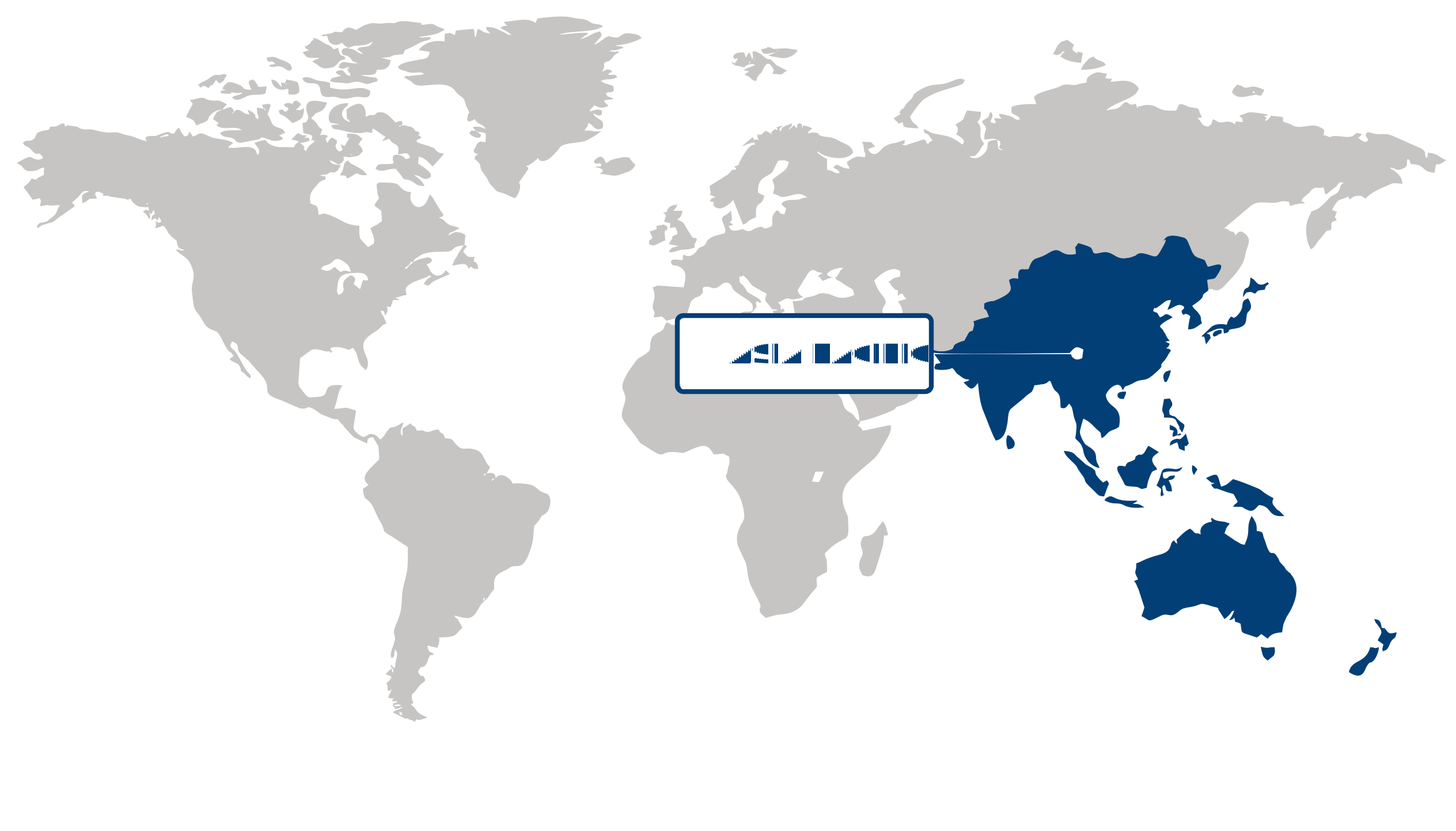
Asia Pacific (Largest & Fastest-Growing Region)
Asia Pacific dominated the LGC and VLGC LPG shipyard carrier market in 2026 and is also the fastest-growing region, underpinned by the region's strong shipbuilding ecosystem, expanding LPG trade, and extensive maritime infrastructure. Leading shipbuilding centers across the region possess established capabilities in designing and constructing large gas carriers, supported by specialized engineering expertise, component suppliers, fabrication facilities, and port infrastructure. Increasing movement of LPG through international maritime routes is supporting demand for dedicated carrier capacity, while growing gas processing and export activity is strengthening the need for efficient transportation vessels. Shipowners and energy market participants are also placing greater emphasis on vessel efficiency, cargo safety, operational reliability, and compliance with evolving environmental requirements, encouraging shipyards to adopt improved designs and technologies. The region's established maritime supply chain provides shipbuilders with access to skilled labor and specialized manufacturing capabilities, strengthening their competitiveness in large carrier construction. Continued development of LPG-related infrastructure and international energy trade is creating additional opportunities for new vessel orders. At the same time, advances in vessel design and propulsion technologies are enabling shipyards to respond to changing efficiency and emissions expectations, reinforcing Asia Pacific's position as both the largest and fastest-growing regional market.
| Parameter | North America | Asia Pacific | Europe | Latin America | MEA |
|---|---|---|---|---|---|
| Innovation Hub i Scale Nascent Developing Advanced | |||||
| Cost-Sensitive Region i Scale Low Medium High | |||||
| Regulatory Environment i Scale Restrictive Neutral Supportive | |||||
| Demand Drivers i Scale Weak Moderate Strong | |||||
| Development Stage i Scale Emerging Developing Developed | |||||
| Adoption Rate i Scale Low Medium High | |||||
| New Entrants / Startups i Scale Sparse Moderate Dense | |||||
| Macro Indicators i Scale Weak Stable Strong |
Key Country Insights
Germany 🇩🇪
Specialized Marine EngineeringGermany contributes advanced marine engineering and ship equipment expertise that supports construction of sophisticated LPG carriers. German companies emphasize vessel efficiency, digital navigation systems, and environmentally compliant ship technologies.
France 🇫🇷
Maritime Technology AdoptionFrance supports the LPG carrier market through maritime technology development, shipping operations, and environmental compliance initiatives. French stakeholders increasingly value vessels equipped with digital monitoring and lower-emission operating capabilities.
Italy 🇮🇹
Marine Equipment ExpertiseItaly contributes specialized marine equipment, engineering services, and ship design capabilities to the LGC and VLGC LPG carrier market. Italian suppliers increasingly focus on efficient onboard systems and compliance with evolving environmental standards.
Japan 🇯🇵
High-Specification ShipbuildingJapan maintains strong capabilities in constructing technologically advanced LGC and VLGC LPG carriers with emphasis on reliability and fuel-efficient performance. Japanese shipyards continue refining vessel designs that meet evolving international shipping requirements.
South Korea 🇰🇷
Export-Oriented ShipbuildingSouth Korea remains a preferred location for construction of large LPG carriers because of its advanced shipbuilding capacity and engineering expertise. Domestic shipyards continue focusing on efficient vessel production and next-generation propulsion technologies.
United States 🇺🇸
Fleet Modernization DemandThe U.S. supports demand for LGC and VLGC LPG carriers through active LPG exports and fleet renewal initiatives. Shipowners increasingly prioritize efficient vessel designs that improve cargo flexibility, fuel efficiency, and regulatory compliance.
Segment Leadership and Growth Trends
LGC and VLGC LPG Shipyard Carrier Market Share (%), by Refrigeration & Pressurization, 2026
Go beyond the chart, access full insights & data tables
Request Free Sample ReportRefrigeration & Pressurization Segment Analysis: Full Pressurized (Largest Segment) vs Semi Refrigerated (Fastest-Growing Segment)
Full pressurized vessels dominated the LGC and VLGC LPG shipyard carrier market, accounting for a 68.4% share in 2026, supported by their established suitability for transporting liquefied petroleum gas without relying on onboard refrigeration systems. Their comparatively straightforward cargo-handling configuration, operational flexibility, and suitability for short- to medium-distance LPG transportation make them an important choice for shipowners and operators. Continued demand for efficient LPG distribution, particularly across established regional trade routes, is sustaining the use of full pressurized systems, while shipyard capabilities and familiarity with their design further reinforce the segment's position.
Semi refrigerated vessels are emerging as the fastest-growing segment as LPG transportation requirements increasingly favor greater cargo-handling flexibility and improved operational efficiency. These carriers combine pressurization with refrigeration capabilities, allowing them to accommodate a broader range of cargo conditions and transportation requirements than fully pressurized designs. Growing LPG trade, diversification of shipping routes, and demand for versatile gas carriers are encouraging shipowners to consider semi refrigerated configurations, particularly where flexibility in cargo management is a key operational priority.
| Segment | Sub-Segment | Largest Segment | Fastest Growing |
|---|---|---|---|
| Refrigeration & Pressurization | Ethylene, Full Refrigerated, Semi Refrigerated, Full Pressurized | Full Pressurized | Semi Refrigerated |
Competitive Landscape and Market Positioning
Prominent players in the LGC and VLGC LPG shipyard carrier market:
1. Hyundai Heavy Industries Co. Ltd. (South Korea)
2. Kawasaki Heavy Industries Ltd. (Japan)
3. Mitsubishi Heavy Industries Ltd. (Japan)
4. Namura Shipbuilding Co. Ltd. (Japan)
5. Dae Sun Shipbuilding & Engineering Co. Ltd. (South Korea)
6. Hanwha Ocean Co. Ltd. (South Korea)
7. China State Shipbuilding Corporation - CSSC (China)
8. Samsung Heavy Industries Co. Ltd. (South Korea)
Efficiency optimization and emissions compliance pressures are reshaping vessel design priorities in the LGC and VLGC LPG shipyard carrier market. In the LGC and VLGC LPG shipyard carrier market, upgraded propulsion systems and design refinements are improving long-range transport performance.
| Company | Market Share | Company Revenue | Revenue CAGR (%) | Product Portfolio | Geographic Presence | Innovation / R&D Focus | Strategic Developments |
|---|---|---|---|---|---|---|---|
| Hyundai Heavy Industries Co. Ltd. (South Korea) | |||||||
| Kawasaki Heavy Industries Ltd. (Japan) | |||||||
| Mitsubishi Heavy Industries Ltd. (Japan) | |||||||
| Namura Shipbuilding Co. Ltd. (Japan) | |||||||
| Dae Sun Shipbuilding & Engineering Co. Ltd. (South Korea) | |||||||
| Hanwha Ocean Co. Ltd. (South Korea) | |||||||
| China State Shipbuilding Corporation - CSSC (China) | |||||||
| Samsung Heavy Industries Co. Ltd. (South Korea). |
Industry Development/News
| Company Name | Date | Key Development |
|---|---|---|
| Astomos Tankers / Maersk Tankers | Aug-23 | Astomos Tankers contracted Maersk Tankers to manage five VLGC carriers with potential fleet expansion. The agreement strengthens operational management capabilities and enhances efficiency in LPG shipping logistics through outsourced vessel management and potential scaling of carrier capacity across global trade routes. |
| NYK Line / Kawasaki Heavy Industries | Jul-23 | NYK ordered its sixth LPG dual-fuel VLGC from Kawasaki Heavy Industries, designed for LPG and ammonia fuel use. The development supports fleet modernization and alternative fuel adoption in gas shipping, enhancing operational efficiency and aligning with emerging decarbonization and fuel diversification trends in maritime transport. |
| ADNOC Logistics & Services / AW Shipping | Apr-23 | ADNOC Logistics & Services added five VLGC carriers to its fleet, manufactured at Jiangnan Shipyard in Shanghai and owned through joint venture AW Shipping with Wanhua Chemical Group. The expansion strengthens its shipping capacity in LPG transport and enhances its operational footprint in the global gas carrier market. |
Customize Your Report
Explore examples of how this report can be tailored to different research needs, including custom segments, additional topics or chapters, and related reports. Click a section of the wheel or its numbered marker to explore the available options.
LGC and VLGC LPG Shipyard Carrier Market — Custom Segments
| Segment | Sub-Segment |
|---|---|
| Vessel Capacity | Large Gas Carriers (LGCs), Very Large Gas Carriers (VLGCs) |
| Propulsion Technology | Conventional Fuel Propulsion, Dual-Fuel Propulsion, Alternative-Fuel Propulsion |
| Vessel Age Category | Newbuild Vessels, Mid-Life Vessels, Mature Vessels |
LGC and VLGC LPG Shipyard Carrier Market — Custom TOC
| Custom Chapter | Custom Details |
|---|---|
| Global LPG Fleet Renewal Outlook |
|
| LPG Trade Route Evolution Assessment |
|
| Shipyard Capacity and Orderbook Competitiveness |
|
Need a different cut of the data?
Request Custom ResearchWhat is the market valuation of LGC and VLGC LPG shipyard carrier?
How much is the LGC and VLGC LPG shipyard carrier industry expected to grow by 2036?
How is rising shale gas production influencing demand for LPG carriers?
How are cross-border energy trade agreements shaping LPG carrier fleet expansion?
Which refrigeration and pressurization segment leads the LGC and VLGC LPG shipyard carrier market?
Why is the Semi Refrigerated segment growing faster in the LGC and VLGC LPG shipyard carrier market?
Why does Asia Pacific lead the LGC and VLGC LPG shipyard carrier market?
How is Asia Pacific sustaining growth in the LGC and VLGC LPG shipyard carrier market?
Which companies dominate the LGC and VLGC LPG shipyard carrier landscape?
Our Clients
"The team surpassed our expectations with the report depth. The actionable insights provided proved crucial in navigating market challenges."
Tata Motors
"We found the report to be very informative. The expertise and attention to market nuances significantly influenced our business direction."
DENSO Corporation
"The consumer survey findings were quite good. We now have a clearer picture of the customer churning and retention strategy."
HL Mando
Our Research Team & Methodology
Every Fundamental Business Insights report is built by a dedicated vertical research team, validated through a structured primary-and-secondary methodology, and reviewed for accuracy before it reaches you.
Research Team Overview
Prepared by the Automotive & Transportation Research Team
Delivery
Published
Demand
Available
Support
Trust & Compliance
Research Domains
10 coverage areasResearch Intelligence
| Source | Reference |
|---|---|
| International Organization of Motor Vehicle Manufacturers (OICA) | www.oica.net |
| SAE International | www.sae.org |
| International Energy Agency (IEA) | www.iea.org |
| International Transport Forum (ITF) | www.itf-oecd.org |
| International Road Federation (IRF) | www.irf.global |
| International Organization for Standardization (ISO) | www.iso.org |
| United Nations Economic Commission for Europe (UNECE) | unece.org |
| National Highway Traffic Safety Administration (NHTSA) | www.nhtsa.gov |
| U.S. Department of Transportation (USDOT) | www.transportation.gov |
| European Automobile Manufacturers' Association (ACEA) | www.acea.auto |
| Society of Indian Automobile Manufacturers (SIAM) | www.siam.in |
| International Air Transport Association (IATA) | www.iata.org |
| International Civil Aviation Organization (ICAO) | www.icao.int |
| International Maritime Organization (IMO) | www.imo.org |
| International Union of Railways (UIC) | uic.org |
| American Public Transportation Association (APTA) | www.apta.com |
| International Federation of Robotics (IFR) | ifr.org |
| CharIN | www.charin.global |
| World Shipping Council | www.worldshipping.org |
| International Federation of Freight Forwarders Associations (FIATA) | fiata.org |
Research Workflow & Quality Assurance
Data Collection
Verified information gathered through primary and secondary research.
Data Triangulation
Cross-validation using multiple independent data sources.
Forecast Modelling
Market estimates developed using historical trends and analytical models.
Analyst Validation
Findings reviewed by domain experts for accuracy and consistency.
Editorial & Quality Review
Final editorial, quality, and compliance checks before publication.
Final Publication
Released after successful completion of the internal review process.
Report Coverage
📊 Market Assessment
- Market Size & Forecast
- Market Segmentation
- Regional Analysis
- Growth Drivers & Challenges
- Market Dynamics
🏢 Competitive Intelligence
- Competitive Landscape
- Company Profiles
- Competitive Benchmarking
- Mergers & Acquisitions
- Market Share Analysis or Key Company Strategies
🔍 Strategic Analysis
- Value Chain Analysis
- Porter's Five Forces
- PESTLE Analysis
- Pricing Trends
- Supply-Demand Analysis
🚀 Future Outlook
- Technology Landscape
- Regulatory Landscape
- Investment & Funding Landscape
- Emerging Opportunities
- Future Market Outlook
Have a question about this report or need a custom scope?
Request Customization