Leather Chemicals Market Size & Growth Forecast 2027–2036, By Segments (Process, Application, Product), Regional Demand Trends (North America, Asia Pacific, Europe), Key Country Insights (U.S., Japan, South Korea, Germany, France, Italy), and Competitive Landscape
Market Size and Growth Outlook
Leather Chemicals Market size was over USD 9.9 billion in 2026 and is likely to grow at a 6.75% CAGR between 2027 and 2036, exceeding USD 19.02 billion by 2036. The industry revenue for 2027 is assessed at USD 10.46 billion.
Get more details on this report
Request Free Sample ReportLeather Chemicals Market Intelligence Snapshot
Regional Market Dynamics
- Asia Pacific held a 53.00% market share in 2026, supported by extensive tannery operations, established leather manufacturing supply chains, and consistently high chemical consumption across processing stages.
- Europe is projected to grow at a 7.57% CAGR, driven by rising demand for specialized, high-performance processing chemicals that enhance product quality and support premium leather manufacturing.
Segment Momentum
- Tanning & Dyeing accounted for 50.88% of the market in 2026 because these stages determine leather durability, texture, and color, driving substantial chemical consumption across production processes.
- Upholstery is the fastest-growing application as manufacturers increasingly require leather treatments that enhance softness, durability, and surface quality for furniture and interior applications.
Market Expansion Drivers
- Rising demand from footwear and automotive industries driving leather chemical consumption globally.
- Growing regulatory push for eco-friendly tanning chemicals and sustainable leather processing solutions.
- Expanding furniture and upholstery manufacturing increasing demand for specialty leather finishing chemicals.
Leading Market Participants
- Key companies in the leather chemicals market include BASF SE (Germany), Stahl Holdings B.V. (Netherlands), TFL Ledertechnik GmbH (Germany), LANXESS AG (Germany), Clariant AG (Switzerland), Elementis plc (United Kingdom), Texapel Group (Spain), Chemtan Company, Inc. (United States), Lawrence Industries Limited (United Kingdom), Schill+Seilacher GmbH (Germany).
Global Market Forecast Snapshot
Market Outlook
- 2026 Market Size: USD 9.9 billion
- 2027 Estimated Market Size: USD 10.46 billion.
- Projected Market Size: USD 19.02 billion by 2036
- Growth Forecast: 6.75% CAGR (2027-2036)
Regional and Segment Outlook
- Leading Regional Market: Asia Pacific
- High-Growth Regional Hub: Europe
- Core Revenue Segment: Tanning & Dyeing (Process) | Footwear (Application) | Polyurethane Resins (Product)
- Emerging Opportunity Segment: Beamhouse (Process) | Upholstery (Application) | Surfactants (Product)
Market Growth Drivers and Industry Trends
Rising demand from footwear and automotive industries driving leather chemical consumption globally
Expansion of footwear and automotive applications is sustaining demand for leather processing inputs, while the leather chemicals market will benefit from the continued need for chemicals used to treat, process, and finish leather materials. Manufacturers in these industries rely on appropriate chemical formulations to achieve required material characteristics and surface performance across finished leather products.
Growing regulatory push for eco-friendly tanning chemicals and sustainable leather processing solutions
Increasing regulatory attention to environmental performance is encouraging leather processors to shift toward more sustainable chemical solutions. The leather chemicals market is therefore seeing greater emphasis on eco-friendly tanning and processing formulations that can support leather production while addressing evolving environmental requirements, influencing product development and purchasing priorities among processors.
Expanding furniture and upholstery manufacturing increasing demand for specialty leather finishing chemicals
Growth in furniture and upholstery manufacturing is creating additional requirements for specialized treatments that improve the appearance and performance of leather surfaces. As these applications expand, the leather chemicals market will see greater demand for finishing formulations tailored to the functional and aesthetic requirements of furniture and upholstery products.
| Growth Driver | Impact on CAGR | Regulatory Influence | Geographic Relevance | Adoption Rate | Impact Timeline |
|---|---|---|---|---|---|
| Rising demand from footwear and automotive industries driving leather chemical consumption globally | 2.30% | Moderate | Asia Pacific, Europe | High | Mid Term |
| Growing regulatory push for eco-friendly tanning chemicals and sustainable leather processing solutions | 2.10% | High | Europe, North America | High | Near Term |
| Expanding furniture and upholstery manufacturing increasing demand for specialty leather finishing chemicals | 1.70% | Moderate | Asia Pacific, North America | Medium | Mid Term |
Unlock insights tailored to your business with our bespoke market research solutions.
Click to get your customized report now.
Regional Demand Dynamics
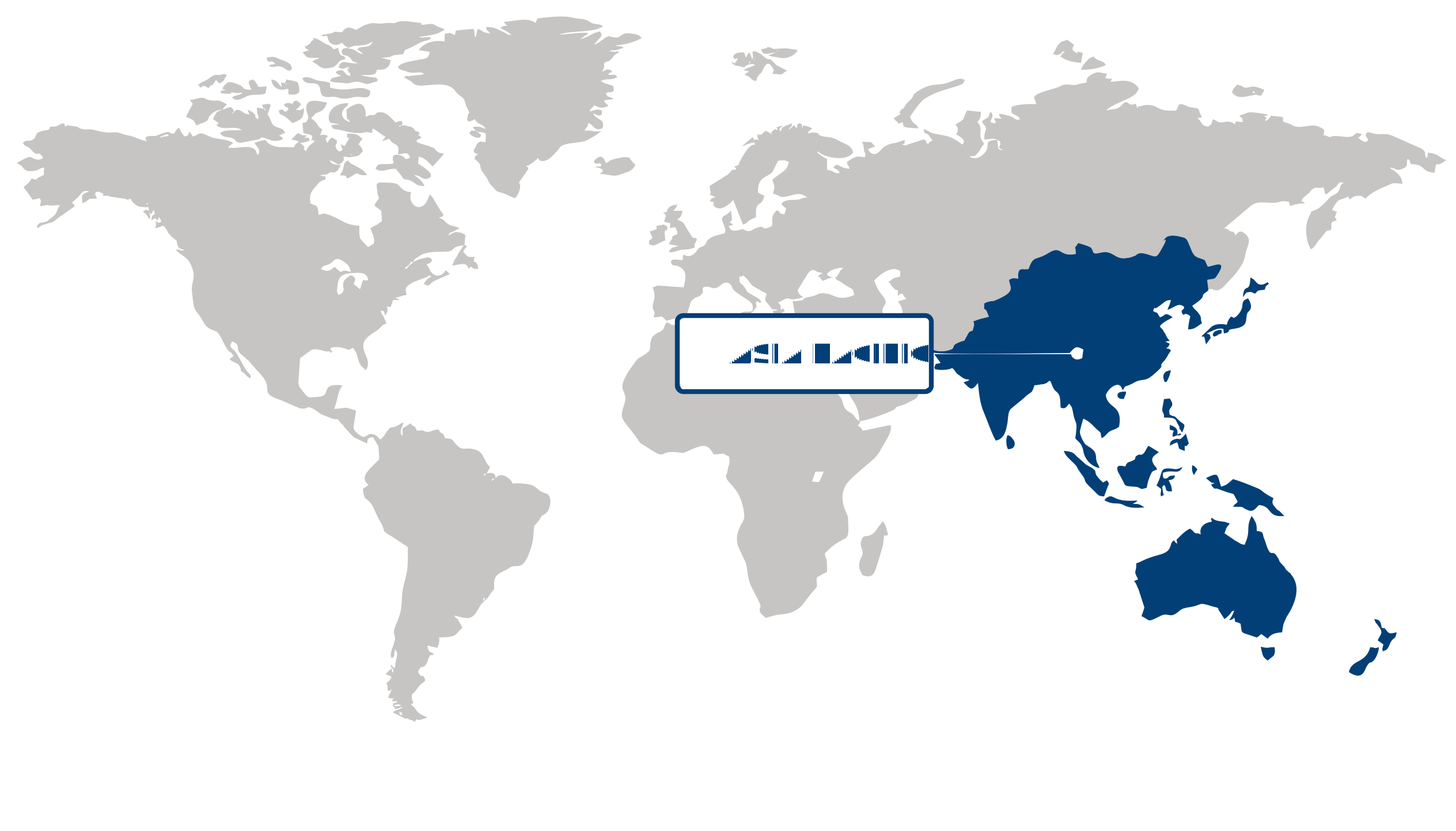
Asia Pacific (Largest Region)
Asia Pacific dominated the leather chemicals market with a 53.00% share in 2026, underpinned by the region’s extensive leather processing and footwear manufacturing base, established tanning infrastructure, and strong downstream demand for finished leather products. High levels of production across footwear, automotive interiors, furniture, apparel, and accessories sustain consumption of tanning agents, dyes, finishing chemicals, and other specialized formulations. The availability of established processing capabilities and integrated manufacturing ecosystems also supports efficient chemical utilization throughout the leather value chain. In addition, manufacturers are increasingly focused on improving leather quality, process efficiency, and environmental performance, encouraging demand for advanced formulations that support more consistent and sustainable processing.
Europe (Fastest-Growing Region)
Europe is the fastest-growing regional market, supported by stringent environmental expectations, technological advancement in leather processing, and continued demand for premium and performance-oriented leather products. Increasing emphasis on reducing chemical waste, water consumption, emissions, and hazardous substances is encouraging tanneries to adopt more efficient and environmentally responsible chemical solutions. The region’s strong automotive, luxury goods, footwear, and furniture industries also create demand for high-quality finished leather with specific durability, appearance, and performance characteristics. Innovation in bio-based, low-impact, and process-efficient formulations is further strengthening opportunities for leather chemical suppliers as manufacturers seek to align production practices with evolving sustainability requirements.
| Parameter | North America | Asia Pacific | Europe | Latin America | MEA |
|---|---|---|---|---|---|
| Innovation Hub i Scale Nascent Developing Advanced | |||||
| Cost-Sensitive Region i Scale Low Medium High | |||||
| Regulatory Environment i Scale Restrictive Neutral Supportive | |||||
| Demand Drivers i Scale Weak Moderate Strong | |||||
| Development Stage i Scale Emerging Developing Developed | |||||
| Adoption Rate i Scale Low Medium High | |||||
| New Entrants / Startups i Scale Sparse Moderate Dense | |||||
| Macro Indicators i Scale Weak Stable Strong |
Key Country Insights
Germany 🇩🇪
Advanced Leather FinishingGermany emphasizes high-performance leather chemicals that enhance durability, appearance, and process efficiency for premium leather applications. Manufacturers continue investing in low-impact formulations aligned with strict environmental and quality standards.
France 🇫🇷
Luxury Leather SupportFrance relies on advanced leather chemicals to maintain premium quality across luxury leather goods production. Producers increasingly seek specialty formulations that preserve craftsmanship while supporting cleaner and more efficient manufacturing processes.
Italy 🇮🇹
Heritage Manufacturing SupportItaly's leather chemicals market is driven by premium leather manufacturing that values high-quality finishing, softness, and durability. Suppliers continue introducing sustainable chemical technologies that complement traditional leather production while improving environmental performance.
Japan 🇯🇵
Precision Chemical FormulationsJapan is prioritizing leather chemicals that deliver consistent finishing quality and support premium manufacturing standards. Demand centers on innovative formulations that improve processing efficiency while minimizing environmental impact throughout production.
South Korea 🇰🇷
Premium Material EnhancementSouth Korea is adopting leather chemicals that support high-quality finishes for fashion, automotive, and consumer goods applications. Chemical suppliers are developing specialty solutions that improve aesthetics while addressing sustainability expectations from manufacturers.
United States 🇺🇸
Sustainable Processing SolutionsThe U.S. leather chemicals market is increasingly focused on environmentally responsible processing technologies that improve product quality while reducing emissions and resource consumption. Manufacturers are adopting advanced specialty chemicals to meet evolving sustainability requirements from downstream industries.
Segment Leadership and Growth Trends
Leather Chemicals Market Share (%), by Process, 2026
Go beyond the chart, access full insights & data tables
Request Free Sample ReportProcess Segment Analysis: Tanning & Dyeing (Largest Segment) vs Beamhouse (Fastest-Growing Segment)
The tanning & dyeing segment led the leather chemicals market with a 50.88% share in 2026, supported by its central role in converting hides and skins into finished leather with the desired durability, color, texture, and appearance. Tanning chemicals are essential for improving leather stability and resistance, while dyeing agents help manufacturers achieve consistent shades and surface characteristics across footwear, upholstery, automotive, and other applications. Growing demand for higher-quality finished leather, increasing emphasis on process efficiency, and the need for consistent product aesthetics continue to sustain chemical consumption throughout tanning and dyeing operations.
Beamhouse processing is emerging as the fastest-growing segment, driven by increasing attention to efficient hide preparation and improved utilization of raw materials before tanning. Beamhouse chemicals support critical activities such as soaking, liming, dehairing, and fleshing, helping remove unwanted materials and prepare hides for subsequent processing. The growing focus on reducing chemical waste, improving process consistency, and adopting more sustainable leather manufacturing practices is encouraging investment in improved beamhouse formulations and processing technologies.
Application Segment Analysis: Footwear (Largest Segment) vs Upholstery (Fastest-Growing Segment)
Footwear accounted for the largest share of the leather chemicals market, representing 52.89% in 2026, owing to the extensive use of leather across shoes, boots, and other footwear products. Leather chemicals are required throughout processing to achieve the flexibility, strength, color consistency, finish, and resistance properties demanded by footwear manufacturers. Continued consumer preference for durable and visually appealing footwear, together with ongoing product diversification and premium leather applications, supports sustained demand for specialized chemical formulations in this segment.
The upholstery segment is advancing at the fastest pace as leather continues to be used across automotive interiors, furniture, and other premium furnishing applications. Manufacturers increasingly require leather with consistent texture, enhanced durability, resistance to wear, and attractive surface finishes to meet demanding design and performance requirements. Rising interest in premium interior materials and greater emphasis on product quality are encouraging the use of advanced tanning, finishing, and surface-treatment chemicals, strengthening opportunities for leather chemical suppliers serving upholstery applications.
| Segment | Sub-Segment | Largest Segment | Fastest Growing |
|---|---|---|---|
| Process | Tanning & Dyeing, Beamhouse, Finishing Chemicals | Tanning & Dyeing | Beamhouse |
| Application | Footwear, Upholstery, Leather Goods, Garments | Footwear | Upholstery |
| Product | Biocides, Surfactants, Chromium Sulfate, Polyurethane Resins, Sodium Bicarbonate, Others | Polyurethane Resins | Surfactants |
Competitive Landscape and Market Positioning
Key companies in the leather chemicals market:
1. BASF SE (Germany)
2. Stahl Holdings B.V. (Netherlands)
3. TFL Ledertechnik GmbH (Germany)
4. LANXESS AG (Germany)
5. Clariant AG (Switzerland)
6. Elementis plc (United Kingdom)
7. Texapel Group (Spain)
8. Chemtan Company Inc. (United States)
9. Lawrence Industries Limited (United Kingdom)
10. Schill+Seilacher GmbH (Germany)
The leather chemicals market is shifting toward environmentally compliant and high-performance chemical formulations. In the leather chemicals market, innovation is increasingly driven by the need to reduce environmental impact while maintaining processing efficiency. Continuous research efforts are enabling the development of safer and more sustainable tanning and finishing solutions. Growing regulatory pressure is also accelerating the transition toward eco-friendly chemical alternatives.
| Company | Market Share | Company Revenue | Revenue CAGR (%) | Product Portfolio | Geographic Presence | Innovation / R&D Focus | Strategic Developments |
|---|---|---|---|---|---|---|---|
| BASF SE (Germany) | |||||||
| Stahl Holdings B.V. (Netherlands) | |||||||
| TFL Ledertechnik GmbH (Germany) | |||||||
| LANXESS AG (Germany) | |||||||
| Clariant AG (Switzerland) | |||||||
| Elementis plc (United Kingdom) | |||||||
| Texapel Group (Spain) | |||||||
| Chemtan Company Inc. (United States) | |||||||
| Lawrence Industries Limited (United Kingdom) | |||||||
| Schill+Seilacher GmbH (Germany). |
Industry Development/News
| Company Name | Date | Key Development |
|---|---|---|
| Stahl | Jan-26 | Stahl carved out its wet-end leather chemicals business into an independent entity operating as Muno, with majority ownership held by Wendel. The restructuring reflects portfolio specialization within leather chemical operations and is expected to streamline strategic focus on wet-end processing technologies, while reshaping competitive positioning within specialty leather treatment segments. |
| Nouryon / IMCD | Dec-25 | Nouryon entered a strategic distribution partnership with IMCD to expand leather and textile processing chemical solutions across the EMEA region. The collaboration enhances regional supply chain reach and improves customer access to specialty processing ingredients, strengthening downstream distribution efficiency and supporting broader adoption of advanced leather chemical formulations in key European and Middle Eastern markets. |
| Wendel SE / Stahl Holdings BV | Nov-24 | Wendel SE evaluated the potential divestment of its 68% stake in Stahl Holdings BV, a specialty coatings and surface treatment company active in leather chemical applications. The move reflects ongoing portfolio optimization within specialty chemicals and signals potential consolidation dynamics in leather processing-related chemical value chains, particularly in coating and finishing segments. |
| Syn-Bios / Pidilite Industries Limited | Jan-24 | Syn-Bios and Pidilite Industries Limited entered a strategic collaboration to expand leather chemical solutions across South Asia, with Pidilite handling distribution across India, Bangladesh, Nepal, Sri Lanka, and Vietnam. The partnership also focuses on joint development of binders, syntans, and polyurethane-based systems, strengthening regional formulation capabilities and improving product access across the leather tanning value chain. |
| Stahl | Mar-21 | Stahl introduced the Stahlite product line targeting retanning and fatliquoring stages in wet-end leather processing, replacing conventional chemicals with specialty polymers. The solution improves penetration into leather fiber structures and enables lighter-weight automotive leather, reportedly reducing material weight by up to 30%, with implications for vehicle efficiency and performance in both conventional and electric automotive applications. |
| LANXESS AG / Brother Enterprises | Jan-20 | LANXESS AG completed the divestment of its chrome chemicals business to Brother Enterprises, including transfer of the Newcastle plant in South Africa. The transaction involved production of sodium dichromate and chromic acid used in leather tanning processes, with LANXESS retaining limited contract manufacturing arrangements. The deal reflects restructuring in upstream leather chemical inputs and consolidation of chrome-based tanning supply chains. |
Customize Your Report
Explore examples of how this report can be tailored to different research needs, including custom segments, additional topics or chapters, and related reports. Click a section of the wheel or its numbered marker to explore the available options.
Leather Chemicals Market — Custom Segments
| Segment | Sub-Segment |
|---|---|
| Leather Type | Bovine Leather, Sheep & Goat Leather, Pig Leather, Exotic Leather |
| Buyer Type | Tanneries, Leather Goods Manufacturers, Chemical Distributors |
| Sustainability Profile | Conventional Chemicals, Low-Impact Chemicals, Bio-Based Chemicals, Recycled/Circular Chemicals |
Leather Chemicals Market — Custom TOC
| Custom Chapter | Custom Details |
|---|---|
| Sustainable Leather Processing Outlook |
|
| Bio-Based Chemical Adoption Assessment |
|
| Chemical Supply Chain Resilience |
|
Need a different cut of the data?
Request Custom ResearchWhat is the current size of the leather chemicals market?
What is the forecasted size of the leather chemicals industry?
How are sustainability regulations influencing purchasing decisions in the leather chemicals market?
Why is demand from footwear and automotive industries supporting market expansion?
Why does the Tanning & Dyeing process lead the leather chemicals market?
Which application segment is growing the fastest in the leather chemicals market?
Why does Asia Pacific lead the leather chemicals market?
What is driving the rapid growth of the leather chemicals market in Europe?
Who are the leading players in the leather chemicals landscape?
Our Clients
"The report helped us understand emerging consumer trends in our product category. It clarified where to focus innovation for the next product launch."
LyondellBasell
"The regional forecast section was incredibly useful. We were able to identify two new potential partners in Europe thanks to the vendor mapping you included."
SABIC
"We appreciated how actionable the recommendations were. It guided us to improve supply chain resilience."
Olin Corporation
Our Research Team & Methodology
Every Fundamental Business Insights report is built by a dedicated vertical research team, validated through a structured primary-and-secondary methodology, and reviewed for accuracy before it reaches you.
Research Team Overview
Prepared by the Chemicals & Materials Research Team
Delivery
Published
Demand
Available
Support
Trust & Compliance
Research Domains
10 coverage areasResearch Intelligence
| Source | Reference |
|---|---|
| American Chemistry Council (ACC) | www.americanchemistry.com |
| European Chemical Industry Council (Cefic) | cefic.org |
| International Council of Chemical Associations (ICCA) | icca-chem.org |
| European Chemicals Agency (ECHA) | echa.europa.eu |
| U.S. Environmental Protection Agency (EPA) | www.epa.gov |
| ASTM International | www.astm.org |
| International Organization for Standardization (ISO) | www.iso.org |
| National Institute of Standards and Technology (NIST) | www.nist.gov |
| Plastics Industry Association (PLASTICS) | www.plasticsindustry.org |
| European Biplastics | www.european-bioplastics.org |
| The Adhesive and Sealant Council (ASC) | www.ascouncil.org |
| National Association of Corrosion Engineers (AMPP) | www.ampp.org |
| Society of Plastics Engineers (SPE) | www.4spe.org |
| International Fertilizer Association (IFA) | www.fertilizer.org |
| CropLife International | croplife.org |
| Packaging Europe | packagingeurope.com |
| Flexible Packaging Association (FPA) | www.flexpack.org |
| Battery Council International (BCI) | batterycouncil.org |
| International Copper Association (ICA) | internationalcopper.org |
| World Steel Association | worldsteel.org |
Research Workflow & Quality Assurance
Data Collection
Verified information gathered through primary and secondary research.
Data Triangulation
Cross-validation using multiple independent data sources.
Forecast Modelling
Market estimates developed using historical trends and analytical models.
Analyst Validation
Findings reviewed by domain experts for accuracy and consistency.
Editorial & Quality Review
Final editorial, quality, and compliance checks before publication.
Final Publication
Released after successful completion of the internal review process.
Report Coverage
📊 Market Assessment
- Market Size & Forecast
- Market Segmentation
- Regional Analysis
- Growth Drivers & Challenges
- Market Dynamics
🏢 Competitive Intelligence
- Competitive Landscape
- Company Profiles
- Competitive Benchmarking
- Mergers & Acquisitions
- Market Share Analysis or Key Company Strategies
🔍 Strategic Analysis
- Value Chain Analysis
- Porter's Five Forces
- PESTLE Analysis
- Pricing Trends
- Supply-Demand Analysis
🚀 Future Outlook
- Technology Landscape
- Regulatory Landscape
- Investment & Funding Landscape
- Emerging Opportunities
- Future Market Outlook
Have a question about this report or need a custom scope?
Request Customization