Leaded Multi-layer Ceramic Capacitors Market Size & Forecasts 2026-2035, By Segments (Type, Voltage Rating, Application, End-Use Industry), Growth Opportunities, Innovation Landscape, Regulatory Shifts, Strategic Regional Insights (U.S., Japan, China, South Korea, UK, Germany, France), and Competitive Dynamics (Taiyo Yuden, Murata Manufacturing, Samsung Electro-Mechanics, TDK Corporation, Kyocera)
Market Size and Growth Outlook
Leaded Multi-layer Ceramic Capacitors Market size is anticipated to rise from USD 11.81 billion in 2025 to USD 20.17 billion by 2035, reflecting a CAGR surpassing 5.5% over the forecast horizon of 2026-2035. The estimated revenue for 2026 is USD 12.37 billion.
Get more details on this report
Request Free Sample ReportLeaded Multi-layer Ceramic Capacitors Market Intelligence Snapshot
Regional Market Dynamics
Segment Momentum
Market Expansion Drivers
Leading Market Participants
Global Market Forecast Snapshot
Market Outlook
Regional and Segment Outlook
Market Growth Drivers and Industry Trends
The increasing consumer preference for compact, multifunctional devices is accelerating demand for miniaturized components with higher capacitance. In the leaded multi-layer ceramic capacitors market, this trend is reshaping product design, pushing manufacturers to innovate on materials and layering technologies to maintain performance at smaller sizes. For example, Murata Manufacturing has announced advancements in capacitor miniaturization aligned with mobile and wearable electronics growth. This shift benefits both established firms with R&D capabilities and agile startups focused on niche applications. As device form factors continue shrinking, market participants who prioritize ultra-compact, high-capacitance solutions will find significant adoption potential without compromising reliability—a critical factor validated by electronics OEM feedback.
Expansion of Automotive Electronics and EV Applications
Automotive electrification, spanning EV powertrains to advanced driver-assistance systems, is fostering robust demand within the leaded multi-layer ceramic capacitors market. Industry leaders such as Panasonic Energy have highlighted the critical role of high-reliability capacitors in electric vehicles, particularly to support higher voltages and thermal endurance. This sector’s evolution involves more stringent durability requirements and integration with complex electronic architectures, creating opportunity for manufacturers that can meet automotive-grade qualifications. Both incumbent capacitor producers and new entrants specializing in automotive compliance stand to gain from this expansion, as evidenced by the Automotive Electronics Council’s emphasis on component standardization. The trajectory reflects continued emphasis on vehicle electrification and smart mobility ecosystems.
Stringent RoHS/REACH Compliance Driving Advanced Materials
Environmental regulations such as the European Union’s RoHS and REACH directives are compelling component suppliers in the leaded multi-layer ceramic capacitors market to adopt eco-friendly and compliant materials that eliminate hazardous substances without sacrificing performance. Companies like TDK Corporation have publicly detailed their initiatives toward lead-free terminations and alternative dielectric compounds to meet these legal frameworks. This regulatory environment incentivizes innovation in materials science and supply chain transparency, offering first-mover advantages to firms aligned with sustainable production. As global regulatory scrutiny intensifies, companies positioned to rapidly integrate compliant materials will enhance market access and appeal, particularly in regions prioritizing green electronics policies. Compliance-driven innovation continues to be a strong competitive differentiator.
Industry Restraints:
Environmental Regulatory Pressures
Increasingly stringent environmental regulations, such as the Restriction of Hazardous Substances (RoHS) directive enforced by the European Chemicals Agency, are limiting the use of leaded components in electronic manufacturing. This regulatory landscape restricts the leaded multi-layer ceramic capacitors (MLCCs) market by forcing manufacturers to either reformulate products with costly alternative materials or face market access challenges, as seen in cases like Murata Manufacturing’s compliance-driven pivot to lead-free designs. These pressures introduce operational inefficiencies, elevate production costs, and slow product development cycles, thereby deterring smaller firms from scaling leaded MLCC offerings. As governments worldwide intensify sustainability mandates, this restraint will sustain high compliance costs and regulatory complexity, compelling incumbents to accelerate innovation in lead-free alternatives, while new entrants may struggle to gain foothold without significant R&D investment.
Raw Material Supply Chain Constraints
Dependence on scarce raw materials such as high-purity lead oxide and specific ceramic powders exposes leaded MLCC manufacturers to supply chain disruptions and price volatility, as highlighted by recent supply shortages reported by industry players like AVX Corporation. Such supply constraints inhibit consistent production, delay order fulfillment, and reduce operational agility, impeding market expansion. For established companies, maintaining resilient supplier relationships and strategic inventories is crucial, while smaller competitors often face disproportionate risks due to limited procurement leverage. Given ongoing geopolitical tensions and fluctuating mining outputs, these supply chain vulnerabilities are expected to persist, forcing market participants to enhance sourcing diversification and invest in material substitution research, thereby shaping the competitive landscape for the foreseeable future.
| Growth Driver | Impact on CAGR | Regulatory Influence | Geographic Relevance | Adoption Rate | Impact Timeline |
|---|---|---|---|---|---|
| Miniaturization and higher capacitance demand in electronics | 2.00% | Short term (≤ 2 yrs) | Asia Pacific, North America | Medium | Fast |
| Expansion of automotive electronics and EV applications | 2.00% | Medium term (2–5 yrs) | Asia Pacific, Europe | Medium | Moderate |
| Stringent RoHS/REACH compliance driving advanced materials | 1.00% | Long term (5+ yrs) | Europe, North America | High | Slow |
Unlock insights tailored to your business with our bespoke market research solutions.
Click to get your customized report now.
Regional Demand Dynamics
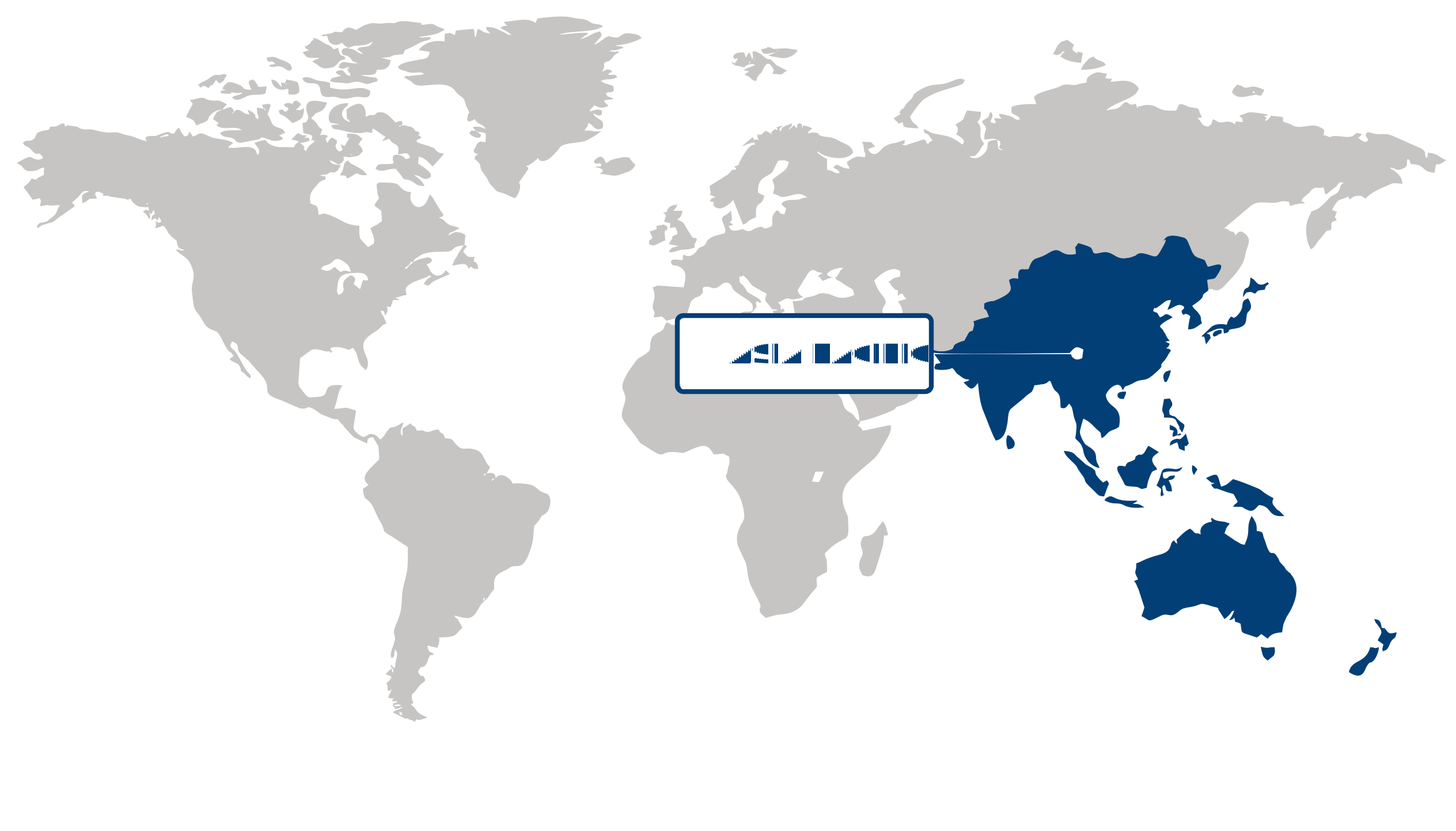
Asia Pacific dominated the leaded multi-layer ceramic capacitors market in 2025, representing approximately 62% of the global share and exhibiting the fastest growth with a 7.5% CAGR. This region’s leadership is primarily driven by the surging demand across massive electronics, electric vehicles (EVs), 5G deployment, and expanding industrial applications centered in key APAC hubs. For instance, the Japan Electronics and Information Technology Industries Association highlights Japan’s advanced manufacturing capabilities and increased adoption of multi-layer ceramic capacitors in EV battery management systems. Additionally, supply chain advancements and governmental incentives in countries like China, as reported by the Ministry of Industry and Information Technology of China, sustain competitive production conditions. Such dynamic interplay of technological innovation, robust manufacturing ecosystems, and policy support positions Asia Pacific for considerable expansion and sustained dominance in the coming years.
Japan is positioned as a pivotal hub in the Asia Pacific leaded multi-layer ceramic capacitors market, leveraging its technological expertise in electronics and advanced automotive sectors. The Japan External Trade Organization documented that Japanese manufacturers are enhancing capacitor performance for 5G network infrastructure and EV models to meet escalating domestic and international demand. Regulatory encouragement for clean energy technologies further accelerates capacitor integration in high-efficiency EV components. This strategic focus not only fortifies Japan’s market role but also strengthens regional supply chains, facilitating Asia Pacific’s overall market growth trajectory.
China anchors the regional leaded multi-layer ceramic capacitors market as a key production and consumption base driven by vast industrial expansion and 5G infrastructure rollout. The China Academy of Information and Communications Technology reports that domestic OEMs prioritize capacitors in EV design optimization and smart manufacturing, supported by government initiatives like “Made in China 2025.” Heightened consumer electronics consumption fosters continuous capacitor demand, while competitive manufacturing costs ensure China remains a preferred export hub. Consequently, China’s integrated ecosystem amplifies Asia Pacific’s strategic market advantages globally.
North America Market Analysis:
North America maintained a notable market presence in the leaded multi-layer ceramic capacitors market, driven by the region’s well-established electronics manufacturing base and robust adoption of advanced automotive and aerospace technologies. The demand for reliable, high-performance capacitors in safety-critical applications has intensified, reflecting a shift toward stronger quality and durability standards promoted by regulatory bodies such as the U.S. Department of Transportation and the Federal Aviation Administration. Furthermore, supply chain resilience efforts amid global disruptions pushed manufacturers, such as KEMET Corporation, to localize production and innovate in materials and design, reinforcing North America’s competitive position. Increasing investments in electric vehicles and smart grid infrastructure also elevate the regional demand, underscoring significant opportunities for expansion in quality-sensitive segments within the leaded multi-layer ceramic capacitors market.
The U.S. stands as a pivotal market within North America, benefiting from its leadership in automotive innovation and aerospace engineering. The stringent environmental and safety regulations imposed by agencies like the Environmental Protection Agency and the National Highway Traffic Safety Administration have escalated demand for capacitors with superior performance and reliability. Moreover, American manufacturers such as AVX Corporation emphasize product development tailored for electric vehicles and industrial automation, responding to evolving consumer preferences for sustainable and efficient technologies. This strategic focus not only drives domestic growth but also strengthens the U.S.’s position as a key hub for supply chain integration and technological advancement, reinforcing its influence on regional dynamics in the leaded multi-layer ceramic capacitors market.
Europe Market Trends:
Europe has held a substantial share in the leaded multi-layer ceramic capacitors market, driven by its robust industrial base and strong emphasis on innovation in electronics manufacturing. The region’s focus on enhancing energy efficiency and adherence to stringent environmental regulations, such as the European Union’s Restriction of Hazardous Substances Directive, has prompted manufacturers to optimize component quality and sustainability. Additionally, Europe’s integration of advanced manufacturing technologies and strategic supply chain frameworks, supported by entities like the European Semiconductor Industry Association, has bolstered the availability and reliability of key materials. These dynamics, combined with growing digitization and demand for high-performance electronic devices across automotive and industrial sectors, position Europe favorably for sustained growth and technological leadership in leaded multi-layer ceramic capacitors.
Germany plays a pivotal role in the leaded multi-layer ceramic capacitors market, underpinned by its status as Europe’s industrial powerhouse and leader in automotive and industrial automation sectors. The country’s commitment to Industry 4.0 and precision engineering fosters high demand for capacitors with enhanced reliability and miniaturization. Firms such as Wacker Chemie AG continue to invest in advanced ceramic materials production, reinforcing Germany’s supply chain resilience. Moreover, government-backed initiatives targeting digital infrastructure upgrade further drive capacitor utilization across electronics systems. Germany’s innovative ecosystem and industrial scale amplify the region’s market prospects by setting benchmarks in both quality and technological adoption.
France holds a distinctive position in the leaded multi-layer ceramic capacitors market, supported by its growing electronics manufacturing and aerospace industries, which prioritize component durability and performance under rigorous conditions. The French government’s investments in research and development, as evidenced by CNRS-backed projects focusing on advanced materials for capacitors, enhance the country’s technological edge. Additionally, evolving consumer electronics demand, coupled with tighter EU regulations on component safety and sustainability, are catalyzing innovation among French manufacturers. France’s strategic emphasis on high-value sectors complements regional dynamics, contributing to Europe’s sustained market presence and opening avenues for specialized leaded multi-layer ceramic capacitor applications.
| Parameter | North America | Asia Pacific | Europe | Latin America | MEA |
|---|---|---|---|---|---|
| Innovation Hub i Scale Nascent Developing Advanced | |||||
| Cost-Sensitive Region i Scale Low Medium High | |||||
| Regulatory Environment i Scale Restrictive Neutral Supportive | |||||
| Demand Drivers i Scale Weak Moderate Strong | |||||
| Development Stage i Scale Emerging Developing Developed | |||||
| Adoption Rate i Scale Low Medium High | |||||
| New Entrants / Startups i Scale Sparse Moderate Dense | |||||
| Macro Indicators i Scale Weak Stable Strong |
Segment Leadership and Growth Trends
Leaded Multi-layer Ceramic Capacitors Market Share (%), by Type, 2026
Go beyond the chart, access full insights & data tables
Request Free Sample ReportThe radial lead segment held the largest share in the leaded multi-layer ceramic capacitors market in 2025, driven primarily by the increasing demand for compact and reliable capacitors in consumer electronics and automotive applications. This leadership reflects consumer preferences for smaller, high-performance components that enhance device miniaturization and functionality, particularly in smartphones and electric vehicles. Industry examples such as Murata Manufacturing’s product innovations underscore the push for more efficient designs meeting stringent automotive quality standards. The radial lead segment offers strategic advantages for incumbent firms with established manufacturing expertise and emerging players focusing on niche, space-constrained applications. Given continuous advancements in device integration and the automotive sector’s electrification trajectory, the radial lead segment is poised to sustain its relevance amid ongoing digital transformation and stricter reliability requirements.
Analysis by Voltage Rating
Low voltage capacitors represented the largest share in the leaded multi-layer ceramic capacitors market, reflecting the dominant role of low-voltage electronics in consumer devices. The preference for low voltage ratings aligns with the proliferation of compact gadgets such as smartphones and wearables that demand energy-efficient, high-capacitance components operating at safe voltage thresholds. Regulatory emphasis on energy efficiency by agencies like the U.S. Department of Energy has incentivized manufacturers to optimize low voltage capacitor performance, which enhances supply chain resilience by reducing material waste. This segment provides ample opportunity for both established firms and startups to innovate in packaging and dielectric materials for improved durability. Considering ongoing trends in portable consumer electronics and smart home devices, low voltage capacitors will continue to underpin development, supported by evolving manufacturing technologies and regulatory frameworks.
Analysis by Application
The consumer electronics segment dominated the leaded multi-layer ceramic capacitors market, fueled by the rapid expansion of smartphone, laptop, and wearable device markets. This segment’s leadership is bolstered by consumer demand for lightweight, reliable, and long-lasting electronic components amid increasing device complexity and connectivity features. Companies like Samsung Electronics and Apple emphasize component miniaturization and energy efficiency, driving demand for advanced leaded multi-layer ceramic capacitors. Furthermore, sustainability pressures and electronic waste regulations in markets such as the European Union have nudged manufacturers toward capacitors with improved longevity and lower environmental impact. Consumer electronics offer robust strategic opportunities for market players through product diversification and innovation in response to digital lifestyle trends. Its continued dominance is reinforced by accelerating digital transformation and consumer expectations for higher performance electronics in daily life.
| Segment | Sub-Segment | Largest Segment | Fastest Growing |
|---|---|---|---|
| Type | Radial Lead, Axial Lead | ||
| Voltage Rating | Low Voltage, Medium Voltage, High Voltage | ||
| Application | Consumer Electronics, Industrial Machinery, Automotive, Defense | ||
| End-Use Industry | Electronics Manufacturing, Automotive, Industrial, Military and Aerospace |
Competitive Landscape and Market Positioning
The competitive landscape is marked by continuous endeavors to advance product portfolios and enhance production efficiency. These key players demonstrate dynamism through their focus on next-generation dielectric materials, which improve capacitor reliability and miniaturization. Strategic alignments and resource consolidation boost operational scale and technological depth, ensuring resilience against market fluctuations. Innovation is also propelled by investment in automation and digitalization of manufacturing processes, enabling rapid adaptation to evolving electronic component demands. Such initiatives not only solidify incumbents’ market foothold but foster differentiation in increasingly commoditized segments.
Strategic / Actionable Recommendations for Regional Players
North American firms would benefit from embedding close collaborations with automotive and aerospace sectors, capitalizing on the growing demand for high-reliability capacitors in electric vehicles and avionics. Leveraging advanced manufacturing technologies and tapping into expertise in high-frequency applications could yield advantageous positioning.
In the Asia Pacific, deepening partnerships with semiconductor and consumer electronics manufacturers can accelerate innovation cycles. Emphasizing sustainable production methods and targeting emerging IoT and 5G infrastructure segments can enhance market penetration and brand reputation.
European players should focus on integrating smart factory technologies and boosting R&D in ultra-low loss materials to address stringent environmental standards. Collaborations with research institutions to develop specialized capacitors for renewable energy systems and industrial automation could unlock new growth avenues.
| Company | Market Share | Company Revenue | Revenue CAGR (%) | Product Portfolio | Geographic Presence | Innovation / R&D Focus | Strategic Developments |
|---|---|---|---|---|---|---|---|
| No companies available. | |||||||
Industry Development/News
| Company Name | Date | Key Development |
|---|
Customize Your Report
Explore examples of how this report can be tailored to different research needs, including custom segments, additional topics or chapters, and related reports. Click a section of the wheel or its numbered marker to explore the available options.
Leaded Multi-layer Ceramic Capacitors Market — Custom Segments
| Segment | Sub-Segment |
|---|---|
| No segment data available. | |
Leaded Multi-layer Ceramic Capacitors Market — Custom TOC
| Custom Chapter | Custom Details | ||
|---|---|---|---|
| No custom TOC data available. | |||
Need a different cut of the data?
Request Custom ResearchWhat is the anticipated CAGR of the leaded multi-layer ceramic capacitors industry?
Which part of the world shows the greatest dominance in the leaded multi-layer ceramic capacitors market?
Who is driving the fastest regional growth in the leaded multi-layer ceramic capacitors sector?
What share does radial lead segment hold in the leaded multi-layer ceramic capacitors sector as of 2025?
Where is the low voltage segment seeing the strongest adoption within the leaded multi-layer ceramic capacitors industry?
When did consumer electronics sub-segment emerge as the largest sub-segment in the application segment of leaded multi-layer ceramic capacitors sector?
Why is the electronics manufacturing segment leading in the leaded multi-layer ceramic capacitors industry?
Who are the major participants shaping the leaded multi-layer ceramic capacitors landscape?
Our Clients
"Working with FBI has been a good experience. The market report provided a holistic view, covering everything from emerging trends to potential risks."
Semtech Corporation
"The experience was highly positive. The team showcased remarkable flexibility in adapting to our specific needs and delivered report that perfectly aligned with all our requirements."
TSMC
"What really stood out to me was how clearly and promptly the Fundamental Business Insights team communicated throughout. It made the collaboration feel effortless."
NXP Semiconductors
Our Research Team & Methodology
Every Fundamental Business Insights report is built by a dedicated vertical research team, validated through a structured primary-and-secondary methodology, and reviewed for accuracy before it reaches you.
Research Team Overview
Prepared by the Electronics & Semiconductors Research Team
Delivery
Published
Demand
Available
Support
Trust & Compliance
Research Domains
10 coverage areasResearch Intelligence
| Source | Reference |
|---|---|
| Semiconductor Industry Association (SIA) | www.semiconductors.org |
| SEMI | www.semi.org |
| JEDEC Solid State Technology Association | www.jedec.org |
| IEEE | www.ieee.org |
| IPC – Association Connecting Electronics Industries | www.ipc.org |
| International Electrotechnical Commission (IEC) | www.iec.ch |
| International Organization for Standardization (ISO) | www.iso.org |
| U.S. Bureau of Industry and Security (BIS) | www.bis.gov |
| U.S. Patent and Trademark Office (USPTO) | www.uspto.gov |
| European Patent Office (EPO) | www.epo.org |
| Taiwan Semiconductor Industry Association (TSIA) | www.tsia.org.tw |
| World Semiconductor Trade Statistics (WSTS) | www.wsts.org |
| International Energy Agency (IEA) | www.iea.org |
| GSMA | www.gsma.com |
| 3GPP | www.3gpp.org |
| ITU (International Telecommunication Union) | www.itu.int |
| Omdia (public insights) | omdia.tech.informa.com |
| Display Supply Chain Consultants (DSCC) | www.displaysupplychain.com |
| U.S. Department of Energy (DOE) | www.energy.gov |
| NIST (National Institute of Standards and Technology) | www.nist.gov |
Research Workflow & Quality Assurance
Data Collection
Verified information gathered through primary and secondary research.
Data Triangulation
Cross-validation using multiple independent data sources.
Forecast Modelling
Market estimates developed using historical trends and analytical models.
Analyst Validation
Findings reviewed by domain experts for accuracy and consistency.
Editorial & Quality Review
Final editorial, quality, and compliance checks before publication.
Final Publication
Released after successful completion of the internal review process.
Report Coverage
📊 Market Assessment
- Market Size & Forecast
- Market Segmentation
- Regional Analysis
- Growth Drivers & Challenges
- Market Dynamics
🏢 Competitive Intelligence
- Competitive Landscape
- Company Profiles
- Competitive Benchmarking
- Mergers & Acquisitions
- Market Share Analysis or Key Company Strategies
🔍 Strategic Analysis
- Value Chain Analysis
- Porter's Five Forces
- PESTLE Analysis
- Pricing Trends
- Supply-Demand Analysis
🚀 Future Outlook
- Technology Landscape
- Regulatory Landscape
- Investment & Funding Landscape
- Emerging Opportunities
- Future Market Outlook
Have a question about this report or need a custom scope?
Request Customization