IVF Time-lapse Imaging Devices Market Size & Growth Forecast 2027–2036, By Segments (End Use), Regional Demand Trends (North America, Asia Pacific, Europe), Key Country Insights (U.S., Japan, South Korea, Germany, France, Italy), and Competitive Landscape
Market Size and Growth Outlook
IVF Time-lapse Imaging Devices Market size was more than USD 747.3 million in 2026 and is set to grow at a 22.52% CAGR between 2027 and 2036, reaching USD 5.7 billion by 2036. The industry revenue for 2027 is calculated at USD 888.99 million.
Get more details on this report
Request Free Sample ReportIVF Time-lapse Imaging Devices Market Intelligence Snapshot
Regional Market Dynamics
- Europe accounted for 38.27% of the market in 2026, supported by established fertility care infrastructure, widespread use of embryo monitoring technologies, and routine integration into IVF laboratory workflows.
- Asia Pacific is expected to expand at a 25.3% CAGR as fertility clinics upgrade laboratory capabilities, adopt advanced embryo monitoring systems, and expand treatment capacity across growing clinic networks.
Segment Momentum
- Hospitals & Other Settings accounted for 73.92% of the market in 2026, supported by established embryology workflows, centralized laboratory resources, and broader procedural capacity for assisted reproductive services.
- Fertility Clinics are the fastest-growing segment because their specialized embryo monitoring and IVF treatment workflows enable quicker adoption of time-lapse imaging technologies that support core fertility services.
Market Expansion Drivers
- Rising infertility rates driven by lifestyle stress and delayed parenthood trends globally.
- AI-enabled embryo selection improving IVF success rates and clinical decision accuracy.
- Growing fertility preservation and delayed parenthood trends expanding IVF treatment demand.
Leading Market Participants
- Major companies in the IVF time-lapse imaging devices market include Vitrolife AB (Sweden), Esco Medical Technologies UAB (Lithuania), Genea Biomedx Pty Ltd. (Australia), ASTEC Co., Ltd. (Japan), Merck KGaA (Germany), FUJIFILM Irvine Scientific, Inc. (United States), CooperSurgical, Inc. (United States), Hamilton Thorne Ltd. (Canada).
Global Market Forecast Snapshot
Market Outlook
- 2026 Market Size: USD 747.3 million
- 2027 Estimated Market Size: USD 888.99 million.
- Projected Market Size: USD 5.7 billion by 2036
- Growth Forecast: 22.52% CAGR (2027-2036)
Regional and Segment Outlook
- Leading Regional Market: Europe
- High-Growth Regional Hub: Asia Pacific
- Core Revenue Segment: Hospitals & Other Settings (End Use)
- Emerging Opportunity Segment: Fertility Clinics (End Use)
Market Growth Drivers and Industry Trends
Rising infertility rates driven by lifestyle stress and delayed parenthood trends globally
The IVF time-lapse imaging devices market is benefiting from the growing number of couples seeking assisted reproductive treatments as infertility becomes increasingly associated with lifestyle-related stress and delayed family formation. Prolonged work-related pressures, changing social priorities, and postponement of childbearing can increase the likelihood of requiring fertility interventions, creating a broader patient pool for IVF clinics. As treatment volumes rise, fertility centers are placing greater emphasis on technologies that can support continuous embryo observation without repeatedly disturbing developing embryos. Time-lapse imaging enables clinicians to monitor embryo development within controlled incubator environments and assess developmental patterns that may assist in embryo selection, strengthening the role of advanced imaging systems in modern fertility laboratories.
AI-enabled embryo selection improving IVF success rates and clinical decision accuracy
Advances in artificial intelligence are enhancing the analytical capabilities available to fertility specialists, supporting the IVF time-lapse imaging devices market through more sophisticated interpretation of embryo development. AI-enabled systems can process sequential embryo images and identify developmental characteristics that may be difficult to assess consistently through conventional visual observation alone. By combining continuous imaging with algorithm-based analysis, fertility clinics can obtain more structured insights into embryo morphology and developmental timing, supporting clinical decisions during embryo selection. The integration of AI also helps standardize assessment processes across embryologists and may reduce reliance on subjective interpretation when evaluating large volumes of developmental observations.
Growing fertility preservation and delayed parenthood trends expanding IVF treatment demand
Increasing interest in fertility preservation and the continued trend toward later parenthood are expanding the need for assisted reproductive services, supporting demand for the IVF time-lapse imaging devices market. Individuals and couples who postpone childbearing may increasingly consider fertility preservation or IVF as part of longer-term family planning, creating sustained requirements for advanced laboratory technologies. As fertility centers manage more complex treatment pathways involving preserved reproductive material and repeated treatment cycles, continuous monitoring of embryo development becomes increasingly valuable for laboratory workflows. Time-lapse imaging systems provide a means of observing developmental progression under stable culture conditions, making them relevant to clinics seeking advanced monitoring capabilities alongside expanding fertility preservation services.
| Growth Driver | Impact on CAGR | Regulatory Influence | Geographic Relevance | Adoption Rate | Impact Timeline |
|---|---|---|---|---|---|
| Rising infertility rates driven by lifestyle stress and delayed parenthood trends globally | 2.30% | High | Global | High | Near Term |
| AI-enabled embryo selection improving IVF success rates and clinical decision accuracy | 2.00% | Moderate | North America, Europe | Medium | Mid Term |
| Growing fertility preservation and delayed parenthood trends expanding IVF treatment demand | 1.80% | Moderate | Asia Pacific, North America, Europe | Medium | Mid Term |
Unlock insights tailored to your business with our bespoke market research solutions.
Click to get your customized report now.
Regional Demand Dynamics
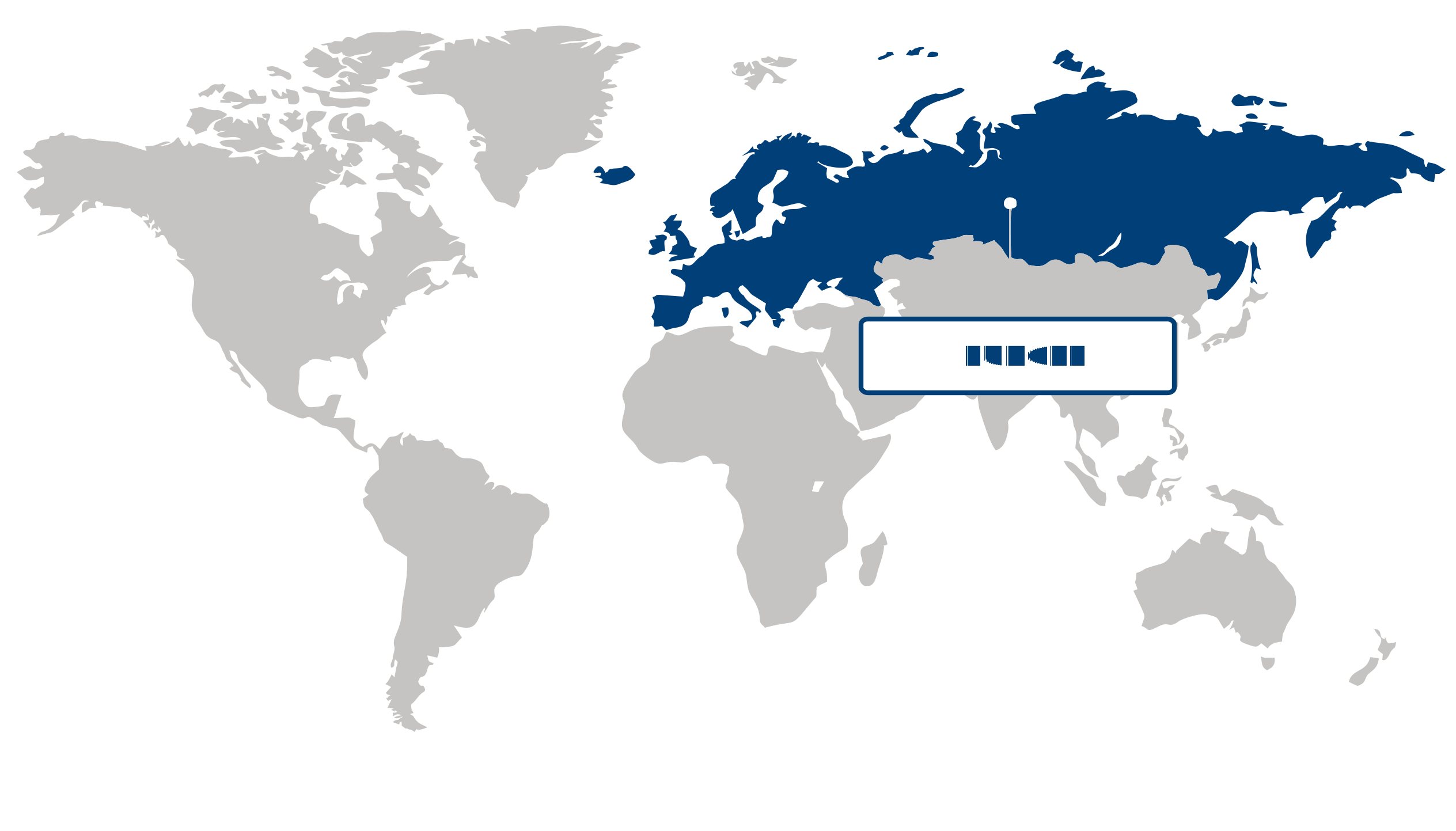
Europe (Largest Region)
Europe led the IVF time-lapse imaging devices market, accounting for a 38.27% share in 2026, supported by the region’s established assisted reproductive care infrastructure and growing adoption of advanced embryology technologies. Fertility clinics and specialized reproductive centers are increasingly integrating continuous embryo monitoring to improve laboratory workflows, support more informed embryo selection, and enhance treatment decision-making. Strong clinical expertise, investment in reproductive medicine, and increasing demand for technologically advanced fertility services further reinforce Europe’s market position. At the same time, emphasis on treatment quality, laboratory standardization, and patient-centered fertility care is encouraging broader adoption of imaging-based technologies.
Asia Pacific (Fastest-Growing Region)
Asia Pacific is emerging as the fastest-growing region, driven by expanding access to assisted reproductive services, rising awareness of fertility treatments, and increasing investment in modern healthcare infrastructure. Growing demand for IVF among couples facing fertility challenges is encouraging clinics to upgrade embryology laboratories with technologies that can provide continuous, non-invasive observation of embryo development. Improvements in healthcare capacity, increasing adoption of advanced fertility procedures, and greater availability of specialized reproductive centers are creating favorable conditions for market expansion. The region’s evolving healthcare ecosystem and rising interest in improving IVF outcomes are expected to support continued demand for time-lapse imaging solutions.
| Parameter | North America | Asia Pacific | Europe | Latin America | MEA |
|---|---|---|---|---|---|
| Innovation Hub i Scale Nascent Developing Advanced | |||||
| Cost-Sensitive Region i Scale Low Medium High | |||||
| Regulatory Environment i Scale Restrictive Neutral Supportive | |||||
| Demand Drivers i Scale Weak Moderate Strong | |||||
| Development Stage i Scale Emerging Developing Developed | |||||
| Adoption Rate i Scale Low Medium High | |||||
| New Entrants / Startups i Scale Sparse Moderate Dense | |||||
| Macro Indicators i Scale Weak Stable Strong |
Key Country Insights
Germany 🇩🇪
Clinical Quality EnhancementGermany promotes IVF time-lapse imaging devices within fertility centers seeking consistent embryo monitoring and evidence-based treatment approaches. Clinics in Germany prioritize imaging systems that improve laboratory efficiency while supporting informed embryology decisions.
France 🇫🇷
Advanced Embryo AssessmentFrance continues adopting IVF time-lapse imaging devices to strengthen embryo evaluation within specialized fertility clinics. Healthcare providers in France emphasize technologies that support standardized embryology practices while improving laboratory productivity.
Italy 🇮🇹
Assisted Reproduction ModernizationItaly expands investment in IVF laboratory modernization, encouraging adoption of time-lapse imaging devices for continuous embryo monitoring. Fertility centers in Italy seek systems that improve workflow efficiency and support consistent embryo assessment throughout treatment cycles.
Japan 🇯🇵
Precision Embryology SupportJapan advances the use of IVF time-lapse imaging devices to enhance embryo observation without disrupting incubation conditions. Fertility clinics in Japan increasingly invest in technologies that improve laboratory consistency and optimize assisted reproduction workflows.
South Korea 🇰🇷
Digital Fertility SolutionsSouth Korea strengthens fertility treatment capabilities through adoption of digitally enabled IVF time-lapse imaging systems. Fertility centers in South Korea focus on advanced embryo monitoring technologies that enhance operational efficiency and clinical decision support.
United States 🇺🇸
Fertility Technology AdoptionThe U.S. continues integrating IVF time-lapse imaging devices into fertility clinics to improve embryo assessment and workflow efficiency. Clinics across the U.S. increasingly adopt advanced imaging platforms that support data-driven embryo selection and standardized laboratory practices.
Segment Leadership and Growth Trends
IVF Time-lapse Imaging Devices Market Share (%), by End Use, 2026
Go beyond the chart, access full insights & data tables
Request Free Sample ReportEnd Use Segment Analysis: Hospitals & Other Settings (Largest Segment) vs Fertility Clinics (Fastest-Growing Segment)
Hospitals & other settings accounted for the largest share of the IVF time-lapse imaging devices market, representing 73.92% in 2026, supported by their established reproductive medicine infrastructure and access to multidisciplinary clinical and laboratory resources. These settings can integrate time-lapse imaging into broader assisted reproductive workflows, enabling continuous embryo observation without repeated removal from controlled incubation environments. Growing emphasis on embryo monitoring, laboratory efficiency, and technology-supported fertility care continues to sustain demand across hospital-based and other established healthcare settings.
Fertility clinics are emerging as a key growth area as specialized reproductive care providers increasingly invest in technologies that can enhance embryo assessment and support more controlled IVF laboratory workflows. Time-lapse imaging enables continuous visualization of embryo development while minimizing disruption to incubation conditions, making it attractive for clinics seeking advanced laboratory capabilities. Rising patient interest in technology-enabled fertility treatment and the expansion of specialized reproductive healthcare services are supporting broader adoption within fertility clinics.
| Segment | Sub-Segment | Largest Segment | Fastest Growing |
|---|---|---|---|
| End Use | Fertility Clinics, Hospitals & Other Settings | Hospitals & Other Settings | Fertility Clinics |
Competitive Landscape and Market Positioning
Top players in the IVF time-lapse imaging devices market:
1. Vitrolife AB (Sweden)
2. Esco Medical Technologies UAB (Lithuania)
3. Genea Biomedx Pty Ltd. (Australia)
4. ASTEC Co. Ltd. (Japan)
5. Merck KGaA (Germany)
6. FUJIFILM Irvine Scientific Inc. (United States)
7. CooperSurgical Inc. (United States)
8. Hamilton Thorne Ltd. (Canada)
In the IVF time-lapse imaging devices market, advanced imaging technologies are improving embryo monitoring precision and developmental assessment. Continuous product innovation is enhancing visualization capabilities for reproductive procedures. Integrated clinical ecosystems are supporting more informed decision-making in assisted reproduction workflows.
| Company | Market Share | Company Revenue | Revenue CAGR (%) | Product Portfolio | Geographic Presence | Innovation / R&D Focus | Strategic Developments |
|---|---|---|---|---|---|---|---|
| Vitrolife AB (Sweden) | |||||||
| Esco Medical Technologies UAB (Lithuania) | |||||||
| Genea Biomedx Pty Ltd. (Australia) | |||||||
| ASTEC Co. Ltd. (Japan) | |||||||
| Merck KGaA (Germany) | |||||||
| FUJIFILM Irvine Scientific Inc. (United States) | |||||||
| CooperSurgical Inc. (United States) | |||||||
| Hamilton Thorne Ltd. (Canada). |
Industry Development/News
| Company Name | Date | Key Development |
|---|---|---|
| Vitrolife | May-24 | Vitrolife acquired eFertility, a company specializing in IVF clinic management software systems. The acquisition expands Vitrolife’s presence into digital clinic workflow solutions, integrating reproductive technologies with software-driven operational management tools and strengthening its position across the assisted reproduction ecosystem beyond time-lapse imaging devices. |
| Gameto | May-24 | Gameto published research outlining cellular engineering and manufacturing methods behind its Fertilo solution, a vitrification-based in vitro maturation approach using engineered ovarian support cells. The development highlights a biologically engineered workflow designed to enable egg maturation outside the body, supporting both clinical and commercial scaling pathways in assisted reproduction technologies. |
Customize Your Report
Explore examples of how this report can be tailored to different research needs, including custom segments, additional topics or chapters, and related reports. Click a section of the wheel or its numbered marker to explore the available options.
IVF Time-lapse Imaging Devices Market — Custom Segments
| Segment | Sub-Segment |
|---|---|
| Imaging Technology | Brightfield Imaging, Darkfield Imaging, Multispectral Imaging, Other Advanced Imaging Technologies |
| Purchase Model | Direct Purchase, Leasing, Equipment-as-a-Service, Reagent or Consumables-Linked Models |
| Fertility Treatment Type | Conventional IVF, Intracytoplasmic Sperm Injection (ICSI), Preimplantation Genetic Testing (PGT)-Supported IVF, Other Assisted Reproductive Treatments |
IVF Time-lapse Imaging Devices Market — Custom TOC
| Custom Chapter | Custom Details |
|---|---|
| Embryology Laboratory Automation Roadmap |
|
| Assisted Reproduction Outcome Optimization Strategies |
|
| Fertility Center Investment and Expansion Assessment |
|
Need a different cut of the data?
Request Custom ResearchHow big is the IVF time-lapse imaging devices market?
How is the IVF time-lapse imaging devices industry expected to grow over the next 10 years?
How is AI-driven embryo selection influencing adoption of time-lapse imaging systems in IVF clinics?
How are fertility preservation and delayed parenthood trends expanding demand for IVF time-lapse imaging devices?
Why do hospitals and other settings dominate the IVF time-lapse imaging devices market?
Which end-use segment is expanding the fastest in the IVF time-lapse imaging devices market?
What factors make Europe the leading market for IVF time-lapse imaging devices?
Why is Asia Pacific experiencing the fastest growth in the IVF time-lapse imaging devices market?
Who are the major participants shaping the IVF time-lapse imaging devices landscape?
Our Clients
"The team took the time to understand our specific business needs and delivered a report that was well aligned with our objectives. Their expertise and understanding of the industry were clearly reflected in the quality and relevance of the insights provided."
Siemens Healthcare
"Our experience in acquiring the research report has been excellent. The depth of analysis, and actionable insights provided have been extremely valuable in supporting our ongoing R&D efforts."
GC Biopharma
"The report offered a comprehensive view of the market trends. The in-depth segmentation and analysis of emerging opportunities gave us a better understanding of the market."
Medtronic
Our Research Team & Methodology
Every Fundamental Business Insights report is built by a dedicated vertical research team, validated through a structured primary-and-secondary methodology, and reviewed for accuracy before it reaches you.
Research Team Overview
Prepared by the Healthcare & Medical Devices Research Team
Delivery
Published
Demand
Available
Support
Trust & Compliance
Research Domains
10 coverage areasResearch Intelligence
| Source | Reference |
|---|---|
| World Health Organization (WHO) | www.who.int |
| U.S. Food & Drug Administration (FDA) | www.fda.gov |
| European Medicines Agency (EMA) | www.ema.europa.eu |
| Centers for Disease Control and Prevention (CDC) | www.cdc.gov |
| National Institutes of Health (NIH) | www.nih.gov |
| National Center for Biotechnology Information (NCBI) | www.ncbi.nlm.nih.gov |
| PubMed | pubmed.ncbi.nlm.nih.gov |
| ClinicalTrials.gov | clinicaltrials.gov |
| International Organization for Standardization (ISO) | www.iso.org |
| ASTM International | www.astm.org |
| Advanced Medical Technology Association (AdvaMed) | www.advamed.org |
| Medical Device Innovation Consortium (MDIC) | mdic.org |
| Biotechnology Innovation Organization (BIO) | www.bio.org |
| International Federation of Pharmaceutical Manufacturers & Associations (IFPMA) | www.ifpma.org |
| U.S. Pharmacopeia (USP) | www.usp.org |
| European Directorate for the Quality of Medicines & HealthCare (EDQM) | www.edqm.eu |
| World Organisation for Animal Health (WOAH) | www.woah.org |
| American Hospital Association (AHA) | www.aha.org |
| OECD Health | www.oecd.org/health |
| World Bank Data | data.worldbank.org |
Research Workflow & Quality Assurance
Data Collection
Verified information gathered through primary and secondary research.
Data Triangulation
Cross-validation using multiple independent data sources.
Forecast Modelling
Market estimates developed using historical trends and analytical models.
Analyst Validation
Findings reviewed by domain experts for accuracy and consistency.
Editorial & Quality Review
Final editorial, quality, and compliance checks before publication.
Final Publication
Released after successful completion of the internal review process.
Report Coverage
📊 Market Assessment
- Market Size & Forecast
- Market Segmentation
- Regional Analysis
- Growth Drivers & Challenges
- Market Dynamics
🏢 Competitive Intelligence
- Competitive Landscape
- Company Profiles
- Competitive Benchmarking
- Mergers & Acquisitions
- Market Share Analysis or Key Company Strategies
🔍 Strategic Analysis
- Value Chain Analysis
- Porter's Five Forces
- PESTLE Analysis
- Pricing Trends
- Supply-Demand Analysis
🚀 Future Outlook
- Technology Landscape
- Regulatory Landscape
- Investment & Funding Landscape
- Emerging Opportunities
- Future Market Outlook
Have a question about this report or need a custom scope?
Request Customization