Industrial Rhamnolipid Market Size & Growth Forecast 2027–2036, By Segments (Form, Type, End Use Industry), Regional Demand Trends (North America, Asia Pacific, Europe), Key Country Insights (U.S., Japan, South Korea, Germany, France, Italy), and Competitive Landscape
Market Size and Growth Outlook
Industrial Rhamnolipid Market size was around USD 485.1 Million in 2026 and is slated to grow at 8.9% CAGR from 2027 to 2036, attaining USD 1.14 Billion by 2036. The industry revenue for 2027 is assessed at USD 521.77 Million.
Get more details on this report
Request Free Sample ReportIndustrial Rhamnolipid Market Intelligence Snapshot
Regional Market Dynamics
- Asia Pacific held 32.4% in 2026, supported by expanding industrial activity, bio-based chemical adoption, and demand for sustainable alternatives across multiple manufacturing sectors.
- North America is expected to grow fastest through investment in sustainable chemistry, biotechnology innovation, fermentation technologies, and scalable biomanufacturing.
Segment Momentum
- The oil & gas segment led the market in 2026 due to strong use of rhamnolipids in enhanced oil recovery, drilling fluids, and environmental remediation, where biodegradable surfactants support environmentally responsible operations.
- Di-rhamnolipids are the fastest-growing type as demand rises for biosurfactants with improved foaming, emulsification, and biodegradability, supported by ongoing product innovation and expanding commercial applications.
Market Expansion Drivers
- Rising demand for biodegradable surfactants accelerating industrial rhamnolipid adoption across sectors
- Expanding use in enhanced oil recovery improving efficiency of oilfield chemical operations
- Increasing cosmetic formulation shift toward bio-based ingredients supporting surfactant substitution trends
Leading Market Participants
- Key companies in the industrial rhamnolipid market include Evonik Industries AG (Germany), Stepan Company (United States), Holiferm Ltd (United Kingdom), Jeneil Biotech Inc. (United States), Biotensidon GmbH (Germany), AGAE Technologies LLC (United States), GlycoSurf Inc. (United States), TensioGreen (United States), Zhejiang Silver Elephant Bio-engineering Co., Ltd. (China), Shaanxi Deguan Biotechnology Co., Ltd. (China)
Global Market Forecast Snapshot
Market Outlook
- 2026 Market Size: USD 485.1 Million
- 2027 Estimated Market Size: USD 521.77 Million
- Projected Market Size: USD 1.14 Billion by 2036
- Growth Forecast: 8.9% CAGR (2027-2036)
Regional and Segment Outlook
- Leading Regional Market: Asia Pacific
- High-Growth Regional Hub: North America
- Core Revenue Segment: Liquid (Form) | Mono-rhamnolipids (Type) | Oil & Gas (End Use Industry)
- Emerging Opportunity Segment: Liquid (Form) | Di-rhamnolipids (Type) | Cosmetics & Personal Care (End Use Industry)
Market Growth Drivers and Industry Trends
Rising demand for biodegradable surfactants accelerating industrial rhamnolipid adoption across sectors
Increasing environmental awareness and stronger preference for sustainable industrial inputs are encouraging manufacturers to replace conventional surfactants with biodegradable alternatives across multiple applications. The industrial rhamnolipid market will benefit from this transition because rhamnolipids offer effective surface-active performance while supporting environmentally responsible production practices. Industries seeking lower ecological impact are incorporating these bio-based surfactants into cleaning formulations, industrial processing, agriculture, and specialty chemical applications where biodegradability and reduced environmental persistence are becoming important product selection criteria.
Expanding use in enhanced oil recovery improving efficiency of oilfield chemical operations
Oilfield operators are increasingly evaluating bio-based chemical solutions that improve extraction processes while supporting more sustainable operational practices. Within this evolving landscape, the industrial rhamnolipid market is gaining momentum as rhamnolipids enhance oil displacement through their surface-active properties, helping improve fluid mobility and reservoir interaction during enhanced oil recovery operations. Their compatibility with challenging operating environments and ability to support efficient chemical performance make them suitable for applications where operational effectiveness and environmental considerations must be balanced.
Increasing cosmetic formulation shift toward bio-based ingredients supporting surfactant substitution trends
Consumer preference for naturally derived and environmentally conscious personal care products is encouraging cosmetic manufacturers to reformulate products using renewable ingredients. This transition will drive the industrial rhamnolipid market growth as formulators substitute conventional surfactants with bio-based alternatives that deliver cleansing, foaming, and emulsification functions while aligning with evolving sustainability objectives. Product developers are also incorporating renewable surfactants into a wider range of skincare, haircare, and personal hygiene formulations to satisfy demand for ingredient transparency and environmentally responsible cosmetic solutions.
| Growth Driver | Impact on CAGR | Regulatory Influence | Geographic Relevance | Adoption Rate | Impact Timeline |
|---|---|---|---|---|---|
| Rising demand for biodegradable surfactants accelerating industrial rhamnolipid adoption across sectors | 2.6% | High | Europe, North America | Medium | Mid Term |
| Expanding use in enhanced oil recovery improving efficiency of oilfield chemical operations | 2.3% | Moderate | Middle East, North America | High | Near Term |
| Increasing cosmetic formulation shift toward bio-based ingredients supporting surfactant substitution trends | 2% | Moderate | Europe, Asia Pacific | High | Near Term |
Explore Growth Opportunities
Request Free Sample ReportRegional Demand Dynamics
Asia Pacific (Largest Region)
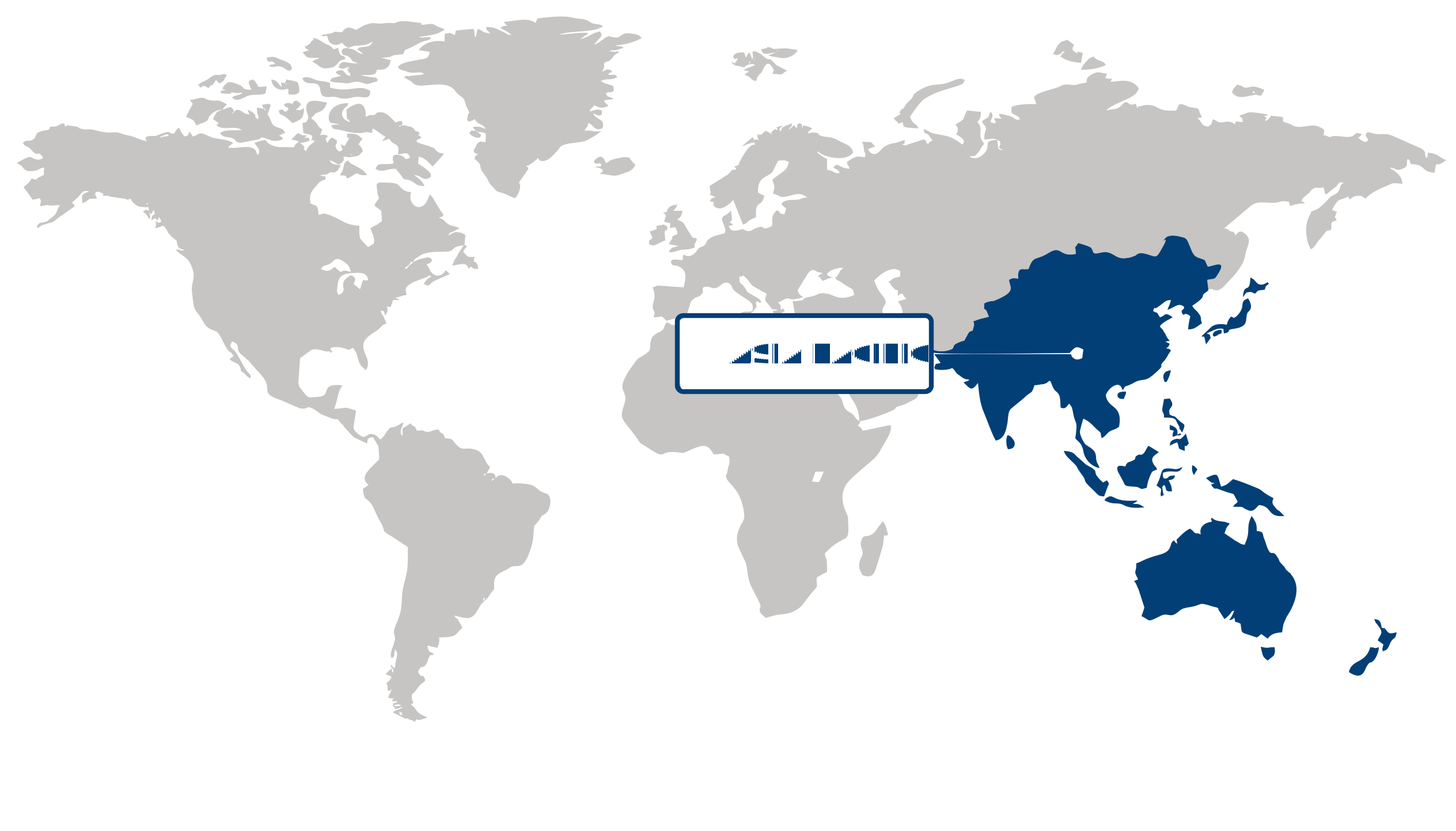
The industrial rhamnolipid market was led by Asia Pacific, which accounted for the largest share of 32.4% in 2026, supported by expanding industrial activity, growing interest in bio-based chemicals, and increasing efforts to adopt sustainable alternatives to conventional surfactants. The region's strong manufacturing base across sectors such as personal care, agriculture, food processing, and industrial cleaning creates broad application potential for rhamnolipids. Rising environmental awareness and tighter attention to biodegradable and lower-impact ingredients are also encouraging manufacturers to explore microbial-derived surfactants for industrial formulations.
North America (Fastest-Growing Region)
North America is expected to witness the fastest growth, driven by increasing investment in sustainable chemistry, biotechnology innovation, and the development of bio-based industrial ingredients. Growing demand for environmentally responsible cleaning and formulation solutions is creating opportunities for rhamnolipids across multiple end-use industries. In addition, advances in fermentation technologies and greater emphasis on scalable biomanufacturing are helping improve the commercial potential of microbial surfactants, while sustainability-focused product development continues to strengthen regional demand.
| Parameter | North America | Asia Pacific | Europe | Latin America | MEA |
|---|---|---|---|---|---|
| Innovation Hub i Scale Nascent Developing Advanced | |||||
| Cost-Sensitive Region i Scale Low Medium High | |||||
| Regulatory Environment i Scale Restrictive Neutral Supportive | |||||
| Demand Drivers i Scale Weak Moderate Strong | |||||
| Development Stage i Scale Emerging Developing Developed | |||||
| Adoption Rate i Scale Low Medium High | |||||
| New Entrants / Startups i Scale Sparse Moderate Dense | |||||
| Macro Indicators i Scale Weak Stable Strong |
Key Country Insights
United States 🇺🇸
Sustainable BiosurfactantsThe U.S. industrial rhamnolipid market is expanding as manufacturers seek bio-based surfactants for cleaning products, agriculture, and industrial formulations. Buyers prioritize scalable production, regulatory compliance, and consistent performance compared with conventional surfactants.
Germany 🇩🇪
Green Chemistry AdoptionGermany supports industrial rhamnolipid adoption through growing demand for sustainable chemical ingredients across manufacturing sectors. Companies focus on renewable feedstocks, process efficiency, and biosurfactants that align with environmental performance objectives.
Japan 🇯🇵
Specialty Formulation FocusJapan integrates industrial rhamnolipids into high-value specialty formulations where performance and environmental compatibility are equally important. Japanese manufacturers emphasize product consistency, purity, and application-specific development for industrial and consumer markets.
South Korea 🇰🇷
Bio-Based InnovationSouth Korea is strengthening industrial rhamnolipid development through biotechnology investments and sustainable industrial materials initiatives. Producers focus on improving fermentation efficiency and supplying bio-based surfactants for diverse industrial applications.
France 🇫🇷
Eco-Formulation DemandFrance encourages industrial rhamnolipid adoption in response to increasing demand for environmentally responsible industrial and consumer formulations. Companies prioritize biodegradable surfactants that support product differentiation while meeting sustainability expectations across multiple industries.
Italy 🇮🇹
Industrial Bioprocess DevelopmentItaly is advancing industrial rhamnolipid applications through biotechnology research and specialty chemical production. Italian manufacturers seek cost-effective bioprocesses and reliable commercial supply to expand adoption across cleaning, agriculture, and industrial formulations.
Segment Leadership and Growth Trends
Industrial Rhamnolipid Market Share (%), by Form, 2026
Go beyond the chart, access full insights & data tables
Request Free Sample ReportForm Segment Analysis: Liquid (Largest & Fastest-Growing Segment)
The liquid form segment dominated the industrial rhamnolipid market, accounting for 68.06% in 2026, while also emerging as the fastest-growing form. Liquid rhamnolipids are widely preferred because they can be readily incorporated into industrial formulations, ensuring easier handling, uniform mixing, and efficient processing across multiple applications. Their compatibility with manufacturing operations in sectors such as cleaning products, agriculture, and oilfield chemicals has strengthened market demand. Growing interest in bio-based surfactants and sustainable formulation technologies continues to support the expanding adoption of liquid rhamnolipids across industrial applications.
Type Segment Analysis: Mono-rhamnolipids (Largest Segment) vs Di-rhamnolipids (Fastest-Growing Segment)
The mono-rhamnolipids segment held the largest share in 2026, reflecting its broad commercial availability and extensive use in industrial processes requiring effective surface activity and emulsification. Manufacturers favor mono-rhamnolipids because they offer consistent performance across a wide range of formulations while supporting environmentally friendly product development. Their versatility across multiple industries has reinforced their position as the leading product type.
The industrial rhamnolipid market is experiencing the fastest growth in the di-rhamnolipids segment as demand increases for advanced biosurfactants with enhanced functional properties. Di-rhamnolipids are gaining greater attention in specialized applications where improved foaming, emulsification, and biodegradability are valued. Ongoing research, product innovation, and expanding commercial applications are expected to further accelerate the adoption of this segment.
End Use Industry Segment Analysis: Oil & Gas (Largest Segment) vs Cosmetics & Personal Care (Fastest-Growing Segment)
The oil & gas end use industry segment held the largest share in 2026, driven by the increasing use of rhamnolipids in enhanced oil recovery, drilling fluids, and environmental remediation activities. Their biodegradable nature and effective surface-active characteristics make them an attractive alternative to conventional surfactants in demanding field operations. Rising emphasis on environmentally responsible production methods has further encouraged their adoption across the oil and gas sector.
The cosmetics & personal care end use industry segment is emerging as the fastest-growing category in the industrial rhamnolipid market due to increasing consumer preference for naturally derived and sustainable ingredients. Manufacturers are incorporating biosurfactants into skincare, haircare, and personal hygiene formulations to improve product performance while meeting clean-label and environmentally conscious product trends. The shift toward biodegradable ingredients and sustainable cosmetic formulations is expected to continue supporting the segment’s rapid growth.
| Segment | Sub-Segment | Largest Segment | Fastest Growing |
|---|---|---|---|
| Form | Liquid, Powder | Liquid | Liquid |
| Type | Mono-rhamnolipids, Di-rhamnolipids | Mono-rhamnolipids | Di-rhamnolipids |
| End Use Industry | Oil & Gas, Agriculture, Pharmaceuticals & Healthcare, Cosmetics & Personal Care, Others | Oil & Gas | Cosmetics & Personal Care |
Unlock insights tailored to your business with our bespoke market research solutions.
Click to get your customized report now.
Competitive Landscape and Market Positioning
Top players in the industrial rhamnolipid market:
- Evonik Industries AG (Germany)
- Stepan Company (United States)
- Holiferm Ltd (United Kingdom)
- Jeneil Biotech, Inc. (United States)
- Biotensidon GmbH (Germany)
- AGAE Technologies LLC (United States)
- GlycoSurf, Inc. (United States)
- TensioGreen (United States)
- Zhejiang Silver Elephant Bio-engineering Co., Ltd. (China)
- Shaanxi Deguan Biotechnology Co., Ltd. (China)
Innovation is becoming the principal competitive driver in the industrial rhamnolipid market as producers seek more efficient fermentation processes and scalable manufacturing methods that improve commercial viability across industrial applications. Competitive differentiation increasingly depends on the ability to deliver consistent product quality while addressing formulation requirements for diverse end-use sectors where performance and sustainability expectations continue to evolve. Emerging manufacturers are leveraging specialized production expertise to target niche applications, encouraging established participants to accelerate process optimization, strengthen application development, and expand technical collaboration with downstream industries to maintain market relevance.
| Company | Market Share | Company Revenue | Revenue CAGR (%) | Product Portfolio | Geographic Presence | Innovation / R&D Focus | Strategic Developments |
|---|---|---|---|---|---|---|---|
| Evonik Industries AG (Germany) | |||||||
| Stepan Company (United States) | |||||||
| Holiferm Ltd (United Kingdom) | |||||||
| Jeneil Biotech Inc. (United States) | |||||||
| Biotensidon GmbH (Germany) | |||||||
| AGAE Technologies LLC (United States) | |||||||
| GlycoSurf Inc. (United States) | |||||||
| TensioGreen (United States) | |||||||
| Zhejiang Silver Elephant Bio-engineering Co. Ltd. (China) | |||||||
| Shaanxi Deguan Biotechnology Co. Ltd. (China) |
Industry Development/News
| Company Name | Date | Key Development |
|---|
Customize Your Report
Explore examples of how this report can be tailored to different research needs, including custom segments, additional topics or chapters, and related reports. Click a section of the wheel or its numbered marker to explore the available options.
Industrial Rhamnolipid Market — Custom Segments
| Segment | Sub-Segment |
|---|---|
| Production Method | Microbial Fermentation, Enzymatic Production |
| Feedstock Source | Renewable Feedstocks, Industrial By-Products, Synthetic Feedstocks |
| Purity Grade | Technical Grade, Industrial Grade, High-Purity Grade |
Industrial Rhamnolipid Market — Custom TOC
| Custom Chapter | Custom Details |
|---|---|
| Industrial Adoption Roadmap |
|
| Feedstock and Production Economics |
|
| Customer Procurement and Qualification Criteria |
|
Need a different cut of the data?
Request Custom ResearchHow big is the industrial rhamnolipid market?
How is the industrial rhamnolipid industry projected to perform over the next decade?
What is driving adoption of industrial rhamnolipids across multiple industries?
How are evolving application trends expanding opportunities for industrial rhamnolipids?
Why is the oil & gas industry the largest end-use segment in the industrial rhamnolipid market?
Which product type is growing fastest in the industrial rhamnolipid market?
Why does Asia Pacific lead the industrial rhamnolipid market?
What is driving faster industrial rhamnolipid growth in North America?
Who are the major participants shaping the industrial rhamnolipid landscape?
Our Clients
"The report helped us understand emerging consumer trends in our product category. It clarified where to focus innovation for the next product launch."
LyondellBasell
"The regional forecast section was incredibly useful. We were able to identify two new potential partners in Europe thanks to the vendor mapping you included."
SABIC
"We appreciated how actionable the recommendations were. It guided us to improve supply chain resilience."
Olin Corporation
Our Research Team & Methodology
Every Fundamental Business Insights report is built by a dedicated vertical research team, validated through a structured primary-and-secondary methodology, and reviewed for accuracy before it reaches you.
Research Team Overview
Prepared by the Chemicals & Materials Research Team
Delivery
Published
Demand
Available
Support
Trust & Compliance
Research Intelligence
Research Workflow & Quality Assurance
Data Collection
Verified information gathered through primary and secondary research.
Data Triangulation
Cross-validation using multiple independent data sources.
Forecast Modelling
Market estimates developed using historical trends and analytical models.
Analyst Validation
Findings reviewed by domain experts for accuracy and consistency.
Editorial & Quality Review
Final editorial, quality, and compliance checks before publication.
Final Publication
Released after successful completion of the internal review process.
Report Coverage
📊 Market Assessment
- Market Size & Forecast
- Market Segmentation
- Regional Analysis
- Growth Drivers & Challenges
- Market Dynamics
🏢 Competitive Intelligence
- Competitive Landscape
- Company Profiles
- Competitive Benchmarking
- Mergers & Acquisitions
- Market Share Analysis or Key Company Strategies
🔍 Strategic Analysis
- Value Chain Analysis
- Porter's Five Forces
- PESTLE Analysis
- Pricing Trends
- Supply-Demand Analysis
🚀 Future Outlook
- Technology Landscape
- Regulatory Landscape
- Investment & Funding Landscape
- Emerging Opportunities
- Future Market Outlook
Have a question about this report or need a custom scope?
Request Customization