Industrial Food Processor Market Size & Growth Forecast 2027–2036, By Segments (Mode of Operation, Application, Distribution Channel, Type), Regional Demand Trends (North America, Asia Pacific, Europe), Key Country Insights (U.S., Japan, South Korea, Germany, France, Italy), and Competitive Landscape
Market Size and Growth Outlook
Industrial Food Processor Market size was more than USD 71.74 Billion in 2026 and is set to grow at 4.86% CAGR between 2027 and 2036, attaining USD 115.31 Billion by 2036. The industry revenue for 2027 is assessed at USD 74.65 Billion.
Get more details on this report
Request Free Sample ReportIndustrial Food Processor Market Intelligence Snapshot
Regional Market Dynamics
- Asia Pacific accounted for 38.88% in 2026, driven by expanding food manufacturing capacity, processed food demand, urbanization, and investments in automation and production efficiency.
- North America is expected to grow fastest as processors modernize facilities and adopt automated, high-throughput systems focused on efficiency, food safety, labor optimization, and consistency.
Segment Momentum
- Semi-automatic systems accounted for 58.3% of the market in 2026 by offering an effective balance of production efficiency, operational flexibility, operator control, and lower implementation costs for food processors.
- The automatic segment is expected to grow the fastest as manufacturers invest in automation to improve productivity, reduce labor dependence, ensure consistent product quality, and integrate with modern production lines.
Market Expansion Drivers
- Expansion of global food and beverage manufacturing boosting industrial processing equipment demand
- Advancements in automation improving efficiency and throughput in food processing facilities
- Stringent food safety regulations driving compliance-focused modernization of processing systems
Leading Market Participants
- Top companies in the industrial food processor market include Bühler Group (Switzerland), GEA Group AG (Germany), JBT Corporation (USA), Marel hf. (Iceland), Tetra Pak International S.A. (Sweden), Alfa Laval AB (Sweden), Krones AG (Germany), The Middleby Corporation (USA), SPX FLOW, Inc. (USA), BAADER Group (Germany)
Global Market Forecast Snapshot
Market Outlook
- 2026 Market Size: USD 71.74 Billion
- 2027 Estimated Market Size: USD 74.65 Billion
- Projected Market Size: USD 115.31 Billion by 2036
- Growth Forecast: 4.86% CAGR (2027-2036)
Regional and Segment Outlook
- Leading Regional Market: Asia Pacific
- High-Growth Regional Hub: North America
- Core Revenue Segment: Semi-automatic (Mode of Operation) | Bakery (Application) | Direct Sales (Distribution Channel) | Baking (Type)
- Emerging Opportunity Segment: Automatic (Mode of Operation) | Bakery (Application) | Direct Sales (Distribution Channel) | Mixing (Type)
Market Growth Drivers and Industry Trends
Expansion of global food and beverage manufacturing boosting industrial processing equipment demand
Rising consumption of processed foods and the expansion of food manufacturing capacity are increasing the need for advanced industrial processing solutions. The industrial food processor market growth is driven by manufacturers investing in equipment that improves production efficiency, supports large-scale operations, and meets evolving consumer demand for diverse food products. Growing food processing activities across regional markets are encouraging facilities to modernize production lines with reliable machinery capable of handling higher volumes and varied product requirements.
Advancements in automation improving efficiency and throughput in food processing facilities
The integration of automated technologies is transforming food processing operations by improving productivity, consistency, and operational control. The industrial food processor market is benefiting from automation advancements that enable faster processing cycles, reduced manual intervention, and improved resource utilization across manufacturing facilities. Smart processing equipment with enhanced monitoring and control capabilities is helping producers optimize workflows while maintaining product quality and operational efficiency.
Stringent food safety regulations driving compliance-focused modernization of processing systems
Increasing regulatory focus on hygiene, traceability, and quality standards is encouraging food manufacturers to upgrade processing infrastructure. Stringent safety requirements will boost the industrial food processor market demand as companies adopt modern equipment designed to support cleaner operations, better contamination control, and compliance with industry standards. Processing systems with improved sanitation features and monitoring capabilities are becoming essential for manufacturers seeking to maintain regulatory alignment and protect product quality.
| Growth Driver | Impact on CAGR | Regulatory Influence | Geographic Relevance | Adoption Rate | Impact Timeline |
|---|---|---|---|---|---|
| Expansion of global food and beverage manufacturing boosting industrial processing equipment demand | 2% | High | Asia Pacific, North America | High | Mid Term |
| Advancements in automation improving efficiency and throughput in food processing facilities | 1.6% | Moderate | Europe, Asia Pacific | High | Near Term |
| Stringent food safety regulations driving compliance-focused modernization of processing systems | 1.5% | High | North America, Europe | High | Near Term |
Unlock insights tailored to your business with our bespoke market research solutions.
Click to get your customized report now.
Regional Demand Dynamics
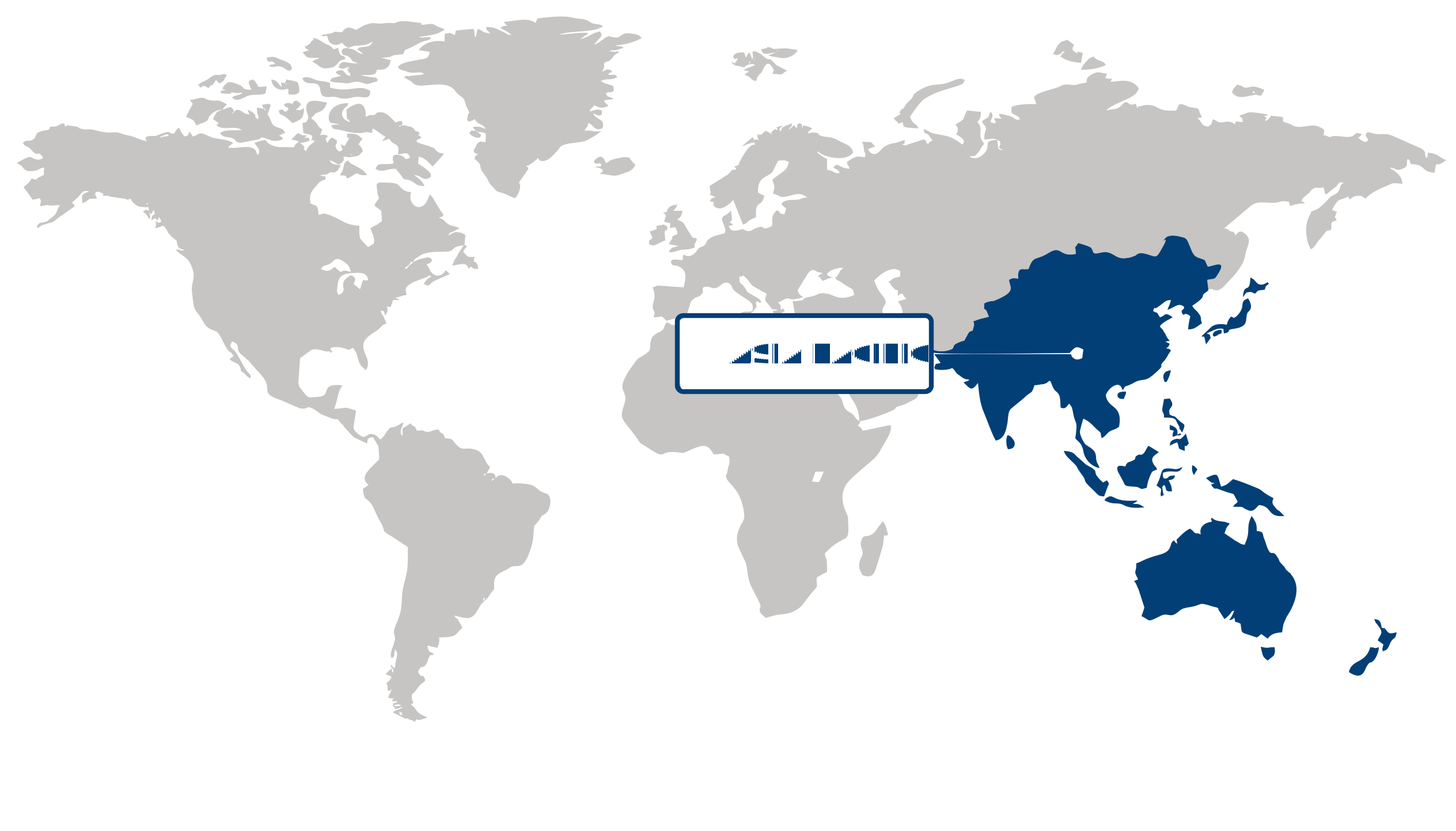
Asia Pacific (Largest Region)
In the industrial food processor market, Asia Pacific accounted for the largest regional share of 38.88% in 2026, supported by expanding food manufacturing capacity, rising processed food consumption, and rapid development of organized food processing industries. Growing urban populations, changing dietary preferences, and increasing demand for convenient and packaged foods are encouraging producers to modernize processing operations, while investments in automation and production efficiency are strengthening demand for industrial food processing equipment across the region.
North America (Fastest-Growing Region)
North America is anticipated to record the fastest growth, driven by increasing adoption of automated food processing technologies, modernization of production facilities, and strong demand for efficient, high-throughput manufacturing systems. The region's mature food processing infrastructure and focus on operational efficiency, food safety, labor optimization, and product consistency are encouraging processors to upgrade equipment and integrate advanced processing solutions.
| Parameter | North America | Asia Pacific | Europe | Latin America | MEA |
|---|---|---|---|---|---|
| Innovation Hub i Scale Nascent Developing Advanced | |||||
| Cost-Sensitive Region i Scale Low Medium High | |||||
| Regulatory Environment i Scale Restrictive Neutral Supportive | |||||
| Demand Drivers i Scale Weak Moderate Strong | |||||
| Development Stage i Scale Emerging Developing Developed | |||||
| Adoption Rate i Scale Low Medium High | |||||
| New Entrants / Startups i Scale Sparse Moderate Dense | |||||
| Macro Indicators i Scale Weak Stable Strong |
Key Country Insights
United States 🇺🇸
High-Volume ProcessingThe U.S. food industry continues investing in industrial food processors to improve production efficiency across packaged food categories. Manufacturers prioritize automation, sanitation, and flexible processing systems capable of handling diverse product formulations.
Germany 🇩🇪
Automated Production SystemsGermany emphasizes industrial food processors that support highly automated manufacturing and consistent product quality. Food manufacturers increasingly seek equipment with energy-efficient operation, precise process control, and compliance with demanding hygiene standards.
Japan 🇯🇵
Compact Processing EfficiencyJapan favors industrial food processors that maximize production efficiency within space-constrained manufacturing environments. Food producers prioritize equipment delivering consistent output, simplified cleaning, and flexibility for premium and convenience food applications.
South Korea 🇰🇷
Value-Added Food ProductionSouth Korea is expanding industrial food processing capacity to meet demand for processed and ready-to-eat products. Manufacturers are investing in versatile processing equipment that improves throughput while maintaining product consistency and food safety.
France 🇫🇷
Premium Food ManufacturingFrance continues upgrading industrial food processors to support premium food production and efficient manufacturing operations. Equipment investments emphasize product consistency, hygienic design, and adaptability across bakery, dairy, and prepared food applications.
Italy 🇮🇹
Specialty Food ProcessingItaly utilizes industrial food processors to enhance efficiency across specialty and packaged food manufacturing. Companies prioritize equipment that preserves product quality while supporting flexible production requirements and streamlined processing operations.
Segment Leadership and Growth Trends
Industrial Food Processor Market Share (%), by Mode of Operation, 2026
Go beyond the chart, access full insights & data tables
Request Free Sample ReportMode of Operation Segment Analysis: Semi-automatic (Largest Segment) vs Automatic (Fastest-Growing Segment)
The semi-automatic mode of operation segment dominated the industrial food processor market, accounting for 58.3% in 2026. Its leadership is driven by its ability to provide an effective balance between production efficiency, operational flexibility, and capital investment. Semi-automatic systems are widely adopted by small and medium-sized food processing facilities that require reliable processing capabilities while retaining greater operator control over production activities. Their adaptability across multiple food processing applications and comparatively lower implementation costs have further supported their widespread adoption.
The automatic mode of operation segment is anticipated to record the fastest growth as food manufacturers increasingly invest in advanced automation to improve productivity, reduce labor dependency, and maintain consistent product quality. Automatic systems enable continuous processing, enhanced operational accuracy, and seamless integration with modern production lines. Rising demand for high-volume food manufacturing and smart factory solutions is expected to accelerate the growth of this segment.
Application Segment Analysis: Bakery (Largest & Fastest-Growing Segment)
The bakery application segment led the industrial food processor market, capturing 22.03% in 2026, while also emerging as the fastest-growing application segment. Increasing consumer demand for bread, cakes, pastries, and other baked products has encouraged manufacturers to adopt advanced food processing equipment that improves production efficiency, consistency, and product quality. The growing preference for convenience foods, expanding commercial bakery operations, and continuous innovation in baked product offerings continue to drive investment in industrial food processing technologies for bakery applications.
Distribution Channel Segment Analysis: Direct Sales (Largest & Fastest-Growing Segment)
The direct sales distribution channel dominated the industrial food processor market, holding the largest share in 2026 while also representing the fastest-growing segment. Food processing equipment manufacturers increasingly prefer direct engagement with customers to provide customized solutions, technical consultation, installation support, and comprehensive after-sales services. Direct sales also facilitate better understanding of application-specific processing requirements and enable stronger long-term customer relationships. Growing demand for tailored processing equipment and integrated production solutions is expected to further strengthen this distribution channel.
| Segment | Sub-Segment | Largest Segment | Fastest Growing |
|---|---|---|---|
| Mode of Operation | Automatic, Semi-automatic | Semi-automatic | Automatic |
| Application | Dairy Processing, Meat/Poultry Processing, Beverage Processing, Bakery, Fruit & Vegetable Processing, Others | Bakery | Bakery |
| Distribution Channel | Direct Sales, Indirect Sales | Direct Sales | Direct Sales |
| Type | Cutting & Chopping, Mixing, Chilling & Freezing, Grinding, Baking, Frying, Ovens, Others | Baking | Mixing |
Competitive Landscape and Market Positioning
Top players in the industrial food processor market:
- Bühler Group (Switzerland)
- GEA Group AG (Germany)
- JBT Corporation (USA)
- Marel hf. (Iceland)
- Tetra Pak International S.A. (Sweden)
- Alfa Laval AB (Sweden)
- Krones AG (Germany)
- The Middleby Corporation (USA)
- SPX FLOW, Inc. (USA)
- BAADER Group (Germany)
Manufacturers are increasingly differentiating themselves through integrated processing solutions that improve production efficiency, hygiene, and operational flexibility rather than competing solely on equipment capacity. As food producers seek adaptable manufacturing lines capable of handling changing product portfolios, suppliers are expanding engineering expertise in automation, digital monitoring, and process optimization. Competitive momentum is also shifting toward providers that can deliver customized system configurations, responsive maintenance support, and compliance with evolving food safety requirements, creating stronger long-term customer relationships than standalone equipment offerings.
| Company | Market Share | Company Revenue | Revenue CAGR (%) | Product Portfolio | Geographic Presence | Innovation / R&D Focus | Strategic Developments |
|---|---|---|---|---|---|---|---|
| Bühler Group (Switzerland) | |||||||
| GEA Group AG (Germany) | |||||||
| JBT Corporation (USA) | |||||||
| Marel hf. (Iceland) | |||||||
| Tetra Pak International S.A. (Sweden) | |||||||
| Alfa Laval AB (Sweden) | |||||||
| Krones AG (Germany) | |||||||
| The Middleby Corporation (USA) | |||||||
| SPX FLOW Inc. (USA) | |||||||
| BAADER Group (Germany) |
Industry Development/News
| Company Name | Date | Key Development |
|---|
Customize Your Report
Explore examples of how this report can be tailored to different research needs, including custom segments, additional topics or chapters, and related reports. Click a section of the wheel or its numbered marker to explore the available options.
Industrial Food Processor Market — Custom Segments
| Segment | Sub-Segment |
|---|---|
| Equipment Purchase Lifecycle | New Equipment Installation, Capacity Expansion, Equipment Replacement, Equipment Upgrade/Retrofit |
| Production Facility Type | Food Manufacturing Plants, Contract Manufacturing Facilities, Centralized Commissary Facilities, Specialty Processing Facilities |
| Equipment Ownership Model | Company-Owned Equipment, Leased Equipment, Equipment-as-a-Service |
Industrial Food Processor Market — Custom TOC
| Custom Chapter | Custom Details |
|---|---|
| Food Processing Capacity Expansion Pipeline |
|
| Automation Investment Priorities Across Food Manufacturing |
|
| Contract Food Manufacturing Opportunity Assessment |
|
Need a different cut of the data?
Request Custom ResearchHow much revenue does the industrial food processor market generate?
What is the forecasted size of the industrial food processor industry?
How is automation transforming demand for industrial food processing equipment?
Why are food safety regulations driving modernization of industrial food processing systems?
Why does the semi-automatic segment lead the industrial food processor market?
Which mode of operation is expected to grow the fastest in the industrial food processor market?
Why does Asia Pacific hold the largest share of the industrial food processor market?
What is driving rapid growth in North America's industrial food processor market?
What are the prominent companies operating in the industrial food processor landscape?
Our Clients
"The report provided a thorough look at market trends, technological advancements, and the competitive landscape. The depth of insights was really valuable."
ITC Limited
"We would highly recommend Fundamental Business Insights & Consulting to anyone looking for reliable, detailed, and comprehensive market research in the Food industry."
Tyson Foods
"The clarity and presentation of the information were commendable. The report was delivered timely, which made the overall experience smooth and convenient."
Mondelēz International
Our Research Team & Methodology
Every Fundamental Business Insights report is built by a dedicated vertical research team, validated through a structured primary-and-secondary methodology, and reviewed for accuracy before it reaches you.
Research Team Overview
Prepared by the Food & Beverage Research Team
Delivery
Published
Demand
Available
Support
Trust & Compliance
Research Domains
10 coverage areasResearch Intelligence
| Source | Reference |
|---|---|
| Food and Agriculture Organization (FAO) | www.fao.org |
| World Health Organization (WHO) | www.who.int |
| U.S. Food & Drug Administration (FDA) | www.fda.gov |
| European Food Safety Authority (EFSA) | www.efsa.europa.eu |
| U.S. Department of Agriculture (USDA) | www.usda.gov |
| Codex Alimentarius Commission | www.fao.org/fao-who-codexalimentarius |
| International Organization for Standardization (ISO) | www.iso.org |
| AOAC INTERNATIONAL | www.aoac.org |
| Institute of Food Technologists (IFT) | www.ift.org |
| International Dairy Foods Association (IDFA) | www.idfa.org |
| International Sweeteners Association (ISA) | www.sweeteners.org |
| International Probiotics Association (IPA) | internationalprobiotics.org |
| Good Food Institute (GFI) | gfi.org |
| American Feed Industry Association (AFIA) | www.afia.org |
| International Feed Industry Federation (IFIF) | ifif.org |
| Specialty Food Association (SFA) | www.specialtyfood.com |
| Brewers Association | www.brewersassociation.org |
| International Bottled Water Association (IBWA) | bottledwater.org |
| International Alliance for Dietary/Food Supplement Associations (IADSA) | www.iadsa.org |
| OECD Agriculture & Food | www.oecd.org/agriculture |
Research Workflow & Quality Assurance
Data Collection
Verified information gathered through primary and secondary research.
Data Triangulation
Cross-validation using multiple independent data sources.
Forecast Modelling
Market estimates developed using historical trends and analytical models.
Analyst Validation
Findings reviewed by domain experts for accuracy and consistency.
Editorial & Quality Review
Final editorial, quality, and compliance checks before publication.
Final Publication
Released after successful completion of the internal review process.
Report Coverage
📊 Market Assessment
- Market Size & Forecast
- Market Segmentation
- Regional Analysis
- Growth Drivers & Challenges
- Market Dynamics
🏢 Competitive Intelligence
- Competitive Landscape
- Company Profiles
- Competitive Benchmarking
- Mergers & Acquisitions
- Market Share Analysis or Key Company Strategies
🔍 Strategic Analysis
- Value Chain Analysis
- Porter's Five Forces
- PESTLE Analysis
- Pricing Trends
- Supply-Demand Analysis
🚀 Future Outlook
- Technology Landscape
- Regulatory Landscape
- Investment & Funding Landscape
- Emerging Opportunities
- Future Market Outlook
Have a question about this report or need a custom scope?
Request Customization