Industrial Engine Market Size & Growth Forecast 2027–2036, By Segments (Fuel Type, End Use, Operation, Cooling Type, Distribution Channel, Power Range), Regional Demand Trends (North America, Asia Pacific, Europe), Key Country Insights (U.S., Japan, South Korea, Germany, France, Italy), and Competitive Landscape
Market Size and Growth Outlook
Industrial Engine Market size was over USD 140.01 Billion in 2026 and is likely to grow at 4.86% CAGR between 2027 and 2036, surpassing USD 225.04 Billion by 2036. The industry revenue for 2027 is calculated at USD 145.68 Billion.
Get more details on this report
Request Free Sample ReportIndustrial Engine Market Intelligence Snapshot
Regional Market Dynamics
- Asia Pacific led in 2026, supported by industrialization, manufacturing expansion, infrastructure development, and demand across construction, mining, agriculture, and power generation.
- North America is projected to grow fastest as industrial modernization, infrastructure investment, equipment replacement, and demand for efficient power solutions accelerate.
Segment Momentum
- Diesel engines accounted for 60.1% of the market in 2026 because they deliver high torque, reliable heavy-duty performance, long operating life, and benefit from an extensive service infrastructure across industrial applications.
- The oil & gas segment is expected to grow the fastest as rising investments in exploration, extraction, and energy infrastructure increase demand for efficient, reliable industrial engines in demanding operating environments.
Market Expansion Drivers
- Expanding manufacturing output increasing demand for high-capacity industrial engines
- Rising energy generation needs driving efficient industrial power systems
- Electrification of industrial machinery accelerating hybrid engine adoption
Leading Market Participants
- Major players in the industrial engine market include Cummins Inc. (United States), Caterpillar Inc. (United States), Deere & Company (United States), Kubota Corporation (Japan), Yanmar Holdings Co., Ltd. (Japan), Perkins Engines Company Limited (United Kingdom), Mitsubishi Heavy Industries, Ltd. (Japan), Honda Motor Co., Ltd. (Japan), Kohler Co. (United States), Wärtsilä Corporation (Finland)
Global Market Forecast Snapshot
Market Outlook
- 2026 Market Size: USD 140.01 Billion
- 2027 Estimated Market Size: USD 145.68 Billion
- Projected Market Size: USD 225.04 Billion by 2036
- Growth Forecast: 4.86% CAGR (2027-2036)
Regional and Segment Outlook
- Leading Regional Market: Asia Pacific
- High-Growth Regional Hub: North America
- Core Revenue Segment: Diesel (Fuel Type) | Automotive & Transportation (End Use) | Four-stroke Engine (Operation) | Water Cooled Engine (Cooling Type) | Direct Sales (Distribution Channel) | Above 500 HP (Power Range)
- Emerging Opportunity Segment: Gas (Fuel Type) | Oil & Gas (End Use) | Two-stroke Engine (Operation) | Air Cooled Engine (Cooling Type) | Indirect Sales (Distribution Channel) | Up to 100 HP (Power Range)
Market Growth Drivers and Industry Trends
Expanding manufacturing output increasing demand for high-capacity industrial engines
The expansion of manufacturing activities across sectors such as mining, construction, processing, and heavy industry is increasing the requirement for dependable power solutions capable of supporting continuous operations. The industrial engine market is benefiting from rising demand for high-capacity engines that deliver consistent performance under demanding operating conditions while powering production equipment, material handling systems, and industrial machinery. Manufacturers are prioritizing engines with improved durability, operational reliability, and fuel efficiency to maximize equipment utilization and minimize unplanned downtime across high-output industrial facilities.
Rising energy generation needs driving efficient industrial power systems
Growing electricity demand from industrial facilities, commercial operations, and critical infrastructure is encouraging investment in efficient distributed power generation solutions. This trend will propel the industrial engine market growth as businesses seek reliable engine-based systems that provide stable power for prime and backup applications while supporting uninterrupted industrial processes. Increasing emphasis on operational resilience is also encouraging the adoption of advanced engine technologies that optimize fuel consumption, improve load management, and maintain dependable performance across diverse operating environments.
Electrification of industrial machinery accelerating hybrid engine adoption
The ongoing transition toward electrified industrial equipment is reshaping engine development by encouraging the integration of hybrid propulsion and intelligent power management technologies. The industrial engine market is driven by growing demand for hybrid engine configurations that combine conventional power systems with electric components to improve energy efficiency, reduce emissions, and enhance operational flexibility. These integrated solutions enable equipment operators to optimize performance across variable load conditions while supporting evolving sustainability objectives in industrial operations.
| Growth Driver | Impact on CAGR | Regulatory Influence | Geographic Relevance | Adoption Rate | Impact Timeline |
|---|---|---|---|---|---|
| Expanding manufacturing output increasing demand for high-capacity industrial engines | 2% | Moderate | Asia Pacific, Latin America | High | Near Term |
| Rising energy generation needs driving efficient industrial power systems | 1.7% | High | Europe, Middle East & Africa | High | Mid Term |
| Electrification of industrial machinery accelerating hybrid engine adoption | 1.5% | Moderate | North America, Europe | Medium | Long Term |
Unlock insights tailored to your business with our bespoke market research solutions.
Click to get your customized report now.
Regional Demand Dynamics
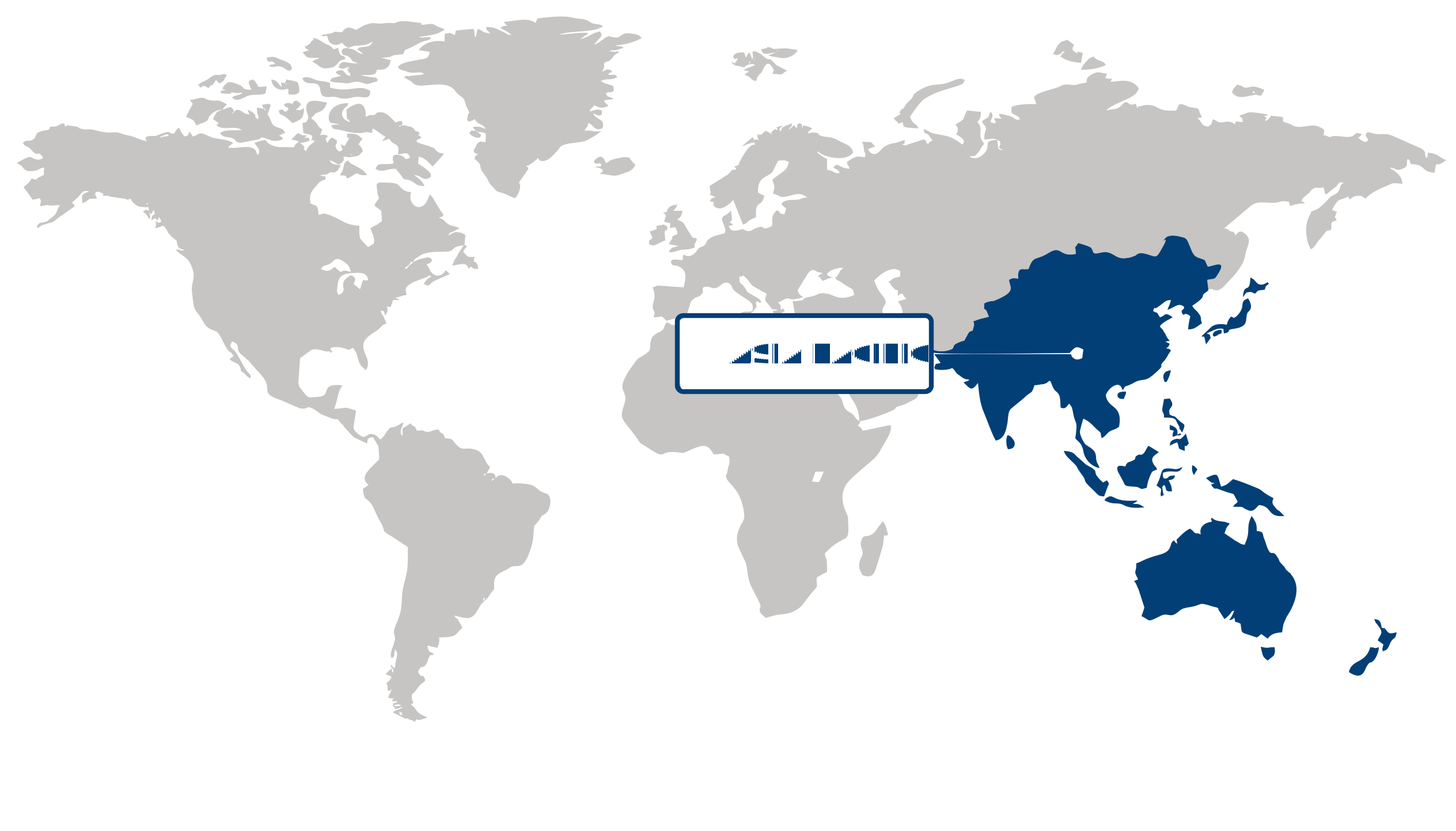
Asia Pacific (Largest Region)
The industrial engine market was led by Asia Pacific in 2026, supported by extensive industrialization, manufacturing expansion, and infrastructure development across major economies in the region. Strong activity in construction, mining, power generation, agriculture, and heavy industries continues to sustain demand for reliable engine systems used across demanding operating environments. The expansion of industrial production and investment in transportation and infrastructure projects is also encouraging the deployment of advanced engines with improved fuel efficiency, durability, and operational performance. Growing mechanization across emerging economies further broadens the application base for industrial engines.
North America (Fastest-Growing Region)
North America is expected to register the fastest growth, supported by industrial modernization, infrastructure investment, and increasing demand for efficient power solutions across construction, agriculture, energy, and other heavy-duty applications. The region's established industrial base is encouraging replacement of aging equipment with more technologically advanced engine systems offering improved operational efficiency and lower environmental impact. Greater emphasis on equipment productivity, emissions management, and reliable power generation is also supporting investment in next-generation industrial engines, creating favorable conditions for continued market expansion.
| Parameter | North America | Asia Pacific | Europe | Latin America | MEA |
|---|---|---|---|---|---|
| Innovation Hub i Scale Nascent Developing Advanced | |||||
| Cost-Sensitive Region i Scale Low Medium High | |||||
| Regulatory Environment i Scale Restrictive Neutral Supportive | |||||
| Demand Drivers i Scale Weak Moderate Strong | |||||
| Development Stage i Scale Emerging Developing Developed | |||||
| Adoption Rate i Scale Low Medium High | |||||
| New Entrants / Startups i Scale Sparse Moderate Dense | |||||
| Macro Indicators i Scale Weak Stable Strong |
Key Country Insights
United States 🇺🇸
Equipment Performance FocusThe U.S. industrial engine market prioritizes reliable engines for construction, agriculture, power generation, and industrial equipment. Buyers increasingly seek fuel-efficient platforms with digital diagnostics that simplify maintenance and improve equipment utilization.
Germany 🇩🇪
Advanced Powertrain EngineeringGermany emphasizes industrial engines engineered for operational efficiency, durability, and emissions compliance. Manufacturers continue refining engine technologies that support demanding industrial applications while aligning with evolving environmental requirements.
Japan 🇯🇵
Efficient Engine IntegrationJapan focuses on compact industrial engines offering dependable performance across construction equipment, generators, and specialized machinery. Companies prioritize fuel efficiency and long service life to support industrial productivity and equipment reliability.
South Korea 🇰🇷
Industrial Equipment ExpansionSouth Korea supports industrial engine demand through continued investment in construction machinery, logistics equipment, and manufacturing assets. Engine suppliers increasingly integrate digital monitoring capabilities to improve operational performance and maintenance planning.
France 🇫🇷
Emissions Compliance StrategyFrance encourages industrial engine adoption that aligns with stringent emissions expectations while maintaining operational reliability. Equipment owners increasingly invest in efficient engine technologies that reduce fuel consumption across industrial applications.
Italy 🇮🇹
Machinery Manufacturing SupportItaly's industrial engine market benefits from demand across agricultural equipment, industrial machinery, and specialized manufacturing applications. Customers prioritize versatile engine solutions that deliver dependable performance while supporting diverse equipment configurations.
Segment Leadership and Growth Trends
Industrial Engine Market Share (%), by Fuel Type, 2026
Go beyond the chart, access full insights & data tables
Request Free Sample ReportFuel Type Segment Analysis: Diesel (Largest Segment) vs Gas (Fastest-Growing Segment)
Holding the largest share of the industrial engine market, the diesel segment accounted for 60.1% in 2026. Diesel engines remain the preferred choice across industrial applications because of their high torque output, operational reliability, and ability to perform efficiently under heavy-duty working conditions. They are extensively used in construction, mining, power generation, and industrial machinery where continuous performance and long operating life are essential. Their proven durability and widespread service infrastructure continue to reinforce the segment's leading position.
The gas segment is expected to witness the fastest growth over the forecast period. Increasing emphasis on cleaner fuel alternatives and improved emission performance is encouraging industries to adopt gas-powered engines. Advancements in engine technology, greater fuel efficiency, and expanding natural gas infrastructure are supporting broader deployment across industrial applications. The growing focus on sustainable industrial operations is expected to further accelerate the adoption of gas engines.
End Use Segment Analysis: Automotive & Transportation (Largest Segment) vs Oil & Gas (Fastest-Growing Segment)
The automotive & transportation segment held the largest share of 28.08% in 2026. Industrial engines are widely utilized in commercial transportation equipment and specialized vehicles that require dependable power and long operating cycles. Ongoing demand for efficient engine performance, durability, and operational reliability across transportation-related industrial activities continues to strengthen this segment. Expanding logistics operations and infrastructure development also contribute to sustained demand.
In the industrial engine market, the oil & gas segment is projected to record the fastest growth over the forecast period. Exploration, drilling, extraction, and processing operations require robust engines capable of operating in demanding environments. Increasing investments in energy projects and the modernization of field equipment are driving the need for advanced industrial engines with improved efficiency and reliability. Continued expansion of energy infrastructure is expected to support the segment's strong growth trajectory.
Operation Segment Analysis: Four-stroke Engine (Largest Segment) vs Two-stroke Engine (Fastest-Growing Segment)
The four-stroke engine segment held the largest share in 2026. Its dominance is attributed to its superior fuel efficiency, reliable long-term performance, and suitability for continuous industrial operations. Four-stroke engines are widely preferred across multiple industries because they provide stable power delivery, reduced maintenance requirements, and dependable operation under demanding workloads. Their broad compatibility with industrial equipment continues to support their leading market position.
The two-stroke engine segment is expected to witness the fastest growth over the forecast period. Increasing demand for compact, lightweight, and high power-to-weight engine solutions in specialized industrial applications is contributing to rising adoption. Technological improvements that enhance performance and operational efficiency are expanding their suitability across selected industrial equipment. As industries seek application-specific engine configurations, demand for two-stroke engines is expected to increase steadily.
| Segment | Sub-Segment | Largest Segment | Fastest Growing |
|---|---|---|---|
| Fuel Type | Diesel, Gas | Diesel | Gas |
| End Use | Oil & Gas, Mining & Metallurgy, Automotive & Transportation, Agriculture, Energy & Power, Industrial Equipment & Machinery, Others | Automotive & Transportation | Oil & Gas |
| Operation | Two-stroke Engine, Four-stroke Engine | Four-stroke Engine | Two-stroke Engine |
| Cooling Type | Water Cooled Engine, Air Cooled Engine | Water Cooled Engine | Air Cooled Engine |
| Distribution Channel | Direct Sales, Indirect Sales | Direct Sales | Indirect Sales |
| Power Range | Up to 100 HP, 100 to 500 HP, Above 500 HP | Above 500 HP | Up to 100 HP |
Competitive Landscape and Market Positioning
Leading companies in the industrial engine market:
- Cummins, Inc. (United States)
- Caterpillar, Inc. (United States)
- Deere & Company (United States)
- Kubota Corporation (Japan)
- Yanmar Holdings Co., Ltd. (Japan)
- Perkins Engines Company Limited (United Kingdom)
- Mitsubishi Heavy Industries Ltd. (Japan)
- Honda Motor Co., Ltd. (Japan)
- Kohler Co. (United States)
- Wärtsilä Corporation (Finland)
Rising expectations for operational efficiency and regulatory compliance are reshaping how manufacturers position industrial engine platforms across diverse end-use applications. Development priorities increasingly revolve around improving fuel flexibility, emissions performance, durability, and digital diagnostics, enabling equipment operators to optimize asset utilization throughout demanding operating cycles. Competitive differentiation is extending into aftermarket support through predictive maintenance capabilities, parts availability, and lifecycle service offerings that reinforce long-term equipment reliability while addressing the varied requirements of industrial, construction, agricultural, and power generation environments.
| Company | Market Share | Company Revenue | Revenue CAGR (%) | Product Portfolio | Geographic Presence | Innovation / R&D Focus | Strategic Developments |
|---|---|---|---|---|---|---|---|
| Cummins Inc. (United States) | |||||||
| Caterpillar Inc. (United States) | |||||||
| Deere & Company (United States) | |||||||
| Kubota Corporation (Japan) | |||||||
| Yanmar Holdings Co. Ltd. (Japan) | |||||||
| Perkins Engines Company Limited (United Kingdom) | |||||||
| Mitsubishi Heavy Industries Ltd. (Japan) | |||||||
| Honda Motor Co. Ltd. (Japan) | |||||||
| Kohler Co. (United States) | |||||||
| Wärtsilä Corporation (Finland) |
Industry Development/News
| Company Name | Date | Key Development |
|---|---|---|
| Scania New Zealand | Dec-25 | Scania New Zealand completed the acquisition of Power Solutions, a strategic move intended to expand its service portfolio and strengthen its regional market offering. This integration enhances the company's technical capabilities and broadens its range of customer support solutions within the industrial engine sector, improving overall service footprint and competitive positioning. |
| Volvo Penta | Dec-25 | Volvo Penta executed a strategic investment in UIG to accelerate the commercialization of its Energy Storage for Resiliency platform. This initiative focuses on enhancing grid integration capabilities for utilities and data centers, positioning the company to capture value in the growing demand for advanced, integrated power and energy storage solutions. |
| Force Motors Limited | Nov-24 | Force Motors Limited reached a production milestone by manufacturing its 200,000th Mercedes-Benz engine at its Chakan facility. This achievement validates the company's sustained manufacturing scale and technical competency in producing high-performance engines, reinforcing the long-term viability and operational stability of its strategic manufacturing partnership within the global industrial engine supply chain. |
| Volvo Penta | Oct-24 | Volvo Penta introduced the D17 industrial engine, a 17-liter diesel power unit equipped with dual-stage turbochargers and heavy-duty steel pistons. This launch signifies a material technological advancement for demanding industrial segments, including power generation, by offering increased displacement and power density necessary for high-load operational environments. |
| Cummins Inc. | Apr-24 | Cummins Inc. launched a new 15L diesel engine specifically engineered for the off-highway market. Debuted at Intermat 2024, this product development represents a material expansion of the company’s heavy-duty industrial powertrain portfolio, designed to meet rigorous performance requirements for off-highway applications while supporting its broader industrial technology strategy. |
Customize Your Report
Explore examples of how this report can be tailored to different research needs, including custom segments, additional topics or chapters, and related reports. Click a section of the wheel or its numbered marker to explore the available options.
Industrial Engine Market — Custom Segments
| Segment | Sub-Segment |
|---|---|
| Aftermarket vs. OEM Demand | OEM Engine Supply, Replacement Engines, Remanufactured/Rebuilt Engines |
| Application Duty Cycle | Intermittent Duty, Prime/Variable Duty, Continuous Duty |
| Emissions Compliance Tier | Non-Tier/Legacy Engines, Current Emission-Compliant Engines, Low-Emission/Advanced Compliance Engines |
Industrial Engine Market — Custom TOC
| Custom Chapter | Custom Details |
|---|---|
| Engine Replacement Economics |
|
| Engine Fuel Transition Pathways |
|
| Industrial Fleet Modernization Strategies |
|
Need a different cut of the data?
Request Custom ResearchHow much revenue does the industrial engine market generate?
What is the projected value of the industrial engine industry by 2036?
Which operational trends are driving demand for advanced industrial engines?
How is industrial electrification influencing engine development strategies?
Why do diesel engines dominate the industrial engine market?
Which end-use industry is expected to experience the fastest growth in the industrial engine market?
What makes Asia Pacific the leading industrial engine market?
Why is North America expected to grow fastest in industrial engines?
What are the prominent companies operating in the industrial engine landscape?
Our Clients
"The information presented in the report was genuinely insightful. The data was clear and easy to understand, which made it much easier to interpret the findings."
Amara Raja Group
"The responsiveness and professionalism exhibited by the team were exemplary. They were readily available to address queries, provide clarifications, and offer additional insights."
ONGC
"The reports offered a comprehensive analysis of various segments within the market. The detailed insights into market trends, and regulatory landscapes were excellent."
TotalEnergies
Our Research Team & Methodology
Every Fundamental Business Insights report is built by a dedicated vertical research team, validated through a structured primary-and-secondary methodology, and reviewed for accuracy before it reaches you.
Research Team Overview
Prepared by the Energy & Power Research Team
Delivery
Published
Demand
Available
Support
Trust & Compliance
Research Domains
10 coverage areasResearch Intelligence
| Source | Reference |
|---|---|
| International Energy Agency (IEA) | www.iea.org |
| U.S. Energy Information Administration (EIA) | www.eia.gov |
| International Renewable Energy Agency (IRENA) | www.irena.org |
| International Electrotechnical Commission (IEC) | www.iec.ch |
| International Organization for Standardization (ISO) | www.iso.org |
| IEEE | www.ieee.org |
| CIGRE (International Council on Large Electric Systems) | www.cigre.org |
| World Energy Council (WEC) | www.worldenergy.org |
| U.S. Department of Energy (DOE) | www.energy.gov |
| International Atomic Energy Agency (IAEA) | www.iaea.org |
| American Petroleum Institute (API) | www.api.org |
| Society of Petroleum Engineers (SPE) | www.spe.org |
| Hydrogen Council | hydrogencouncil.com |
| Battery Council International (BCI) | batterycouncil.org |
| Global Wind Energy Council (GWEC) | gwec.net |
| SolarPower Europe | www.solarpowereurope.org |
| World Bioenergy Association (WBA) | worldbioenergy.org |
| International Hydropower Association (IHA) | www.hydropower.org |
| Edison Electric Institute (EEI) | www.eei.org |
| National Renewable Energy Laboratory (NREL) | www.nrel.gov |
Research Workflow & Quality Assurance
Data Collection
Verified information gathered through primary and secondary research.
Data Triangulation
Cross-validation using multiple independent data sources.
Forecast Modelling
Market estimates developed using historical trends and analytical models.
Analyst Validation
Findings reviewed by domain experts for accuracy and consistency.
Editorial & Quality Review
Final editorial, quality, and compliance checks before publication.
Final Publication
Released after successful completion of the internal review process.
Report Coverage
📊 Market Assessment
- Market Size & Forecast
- Market Segmentation
- Regional Analysis
- Growth Drivers & Challenges
- Market Dynamics
🏢 Competitive Intelligence
- Competitive Landscape
- Company Profiles
- Competitive Benchmarking
- Mergers & Acquisitions
- Market Share Analysis or Key Company Strategies
🔍 Strategic Analysis
- Value Chain Analysis
- Porter's Five Forces
- PESTLE Analysis
- Pricing Trends
- Supply-Demand Analysis
🚀 Future Outlook
- Technology Landscape
- Regulatory Landscape
- Investment & Funding Landscape
- Emerging Opportunities
- Future Market Outlook
Have a question about this report or need a custom scope?
Request Customization