Industrial Blower Market Size & Growth Forecast 2027–2036, By Segments (Distribution Channel, Technology, Product, Pressure, End-Use), Regional Demand Trends (North America, Asia Pacific, Europe), Key Country Insights (U.S., Japan, South Korea, Germany, France, Italy), and Competitive Landscape
Market Size and Growth Outlook
Industrial Blower Market size was estimated at USD 3.98 Billion in 2026 and is projected to grow at 5.4% CAGR from 2027 to 2036, reaching USD 6.73 Billion by 2036. The industry revenue for 2027 is calculated at USD 4.16 Billion.
Get more details on this report
Request Free Sample ReportIndustrial Blower Market Intelligence Snapshot
Regional Market Dynamics
- Strong industrialization across manufacturing, chemicals, food processing, cement, and metals is sustaining demand for reliable blowers used in diverse industrial processes.
- New production capacity and equipment modernization are expanding demand, while greater emphasis on energy efficiency encourages replacement of conventional blower systems.
Segment Momentum
- Centrifugal blowers accounted for 46.28% of the market in 2026 due to their dependable airflow, operational flexibility, and reliable performance across manufacturing, environmental control, and heavy industrial applications.
- The indirect distribution channel is expected to grow the fastest as expanding distributor networks improve product availability, delivery speed, and localized support, particularly for small and medium-sized industrial customers.
Market Expansion Drivers
- Expansion of wastewater treatment infrastructure driving demand for energy-efficient industrial blowers
- Rising manufacturing and industrial activity boosting deployment of ventilation and process blowers
- Adoption of high-efficiency turbo blowers improving energy optimization in aeration systems
Leading Market Participants
- Leading companies in the industrial blower market include Atlas Copco AB (Sweden), Ingersoll Rand Inc. (United States), Siemens AG (Germany), Xylem Inc. (United States), Kaeser Kompressoren SE (Germany), Aerzen Maschinenfabrik GmbH (Germany), Sulzer Ltd. (Switzerland), Ebara Corporation (Japan), Busch SE (Germany), Chart Industries Inc. (United States)
Global Market Forecast Snapshot
Market Outlook
- 2026 Market Size: USD 3.98 Billion
- 2027 Estimated Market Size: USD 4.16 Billion
- Projected Market Size: USD 6.73 Billion by 2036
- Growth Forecast: 5.4% CAGR (2027-2036)
Regional and Segment Outlook
- Leading Regional Market: Asia Pacific
- High-Growth Regional Hub: Asia Pacific
- Core Revenue Segment: Direct (Distribution Channel) | Centrifugal (Technology) | Centrifugal Blowers (Product) | Low (Pressure) | Wastewater Treatment (End-Use)
- Emerging Opportunity Segment: Indirect (Distribution Channel) | Centrifugal (Technology) | High Speed Turbo Blowers (Product) | High (Pressure) | Chemical (End-Use)
Market Growth Drivers and Industry Trends
Expansion of wastewater treatment infrastructure driving demand for energy-efficient industrial blowers
Ongoing investments in municipal and industrial wastewater treatment facilities are creating sustained demand for advanced aeration equipment, which will drive the industrial blower market growth. Aeration remains one of the most energy-intensive processes within wastewater treatment, encouraging operators to adopt blower technologies that deliver consistent airflow while reducing power consumption and operating costs. As treatment plants expand capacity and modernize aging infrastructure to comply with stricter environmental standards, energy-efficient industrial blowers become essential for maintaining process stability, optimizing oxygen transfer, and supporting continuous biological treatment operations across a wide range of treatment applications.
Rising manufacturing and industrial activity boosting deployment of ventilation and process blowers
Expanding industrial production across sectors such as chemicals, food processing, metals, cement, and manufacturing is increasing the need for dependable air movement systems that will propel the industrial blower market growth. Industrial blowers play a critical role in process ventilation, material conveying, combustion air supply, drying operations, and dust control, making them integral to efficient plant operations. As manufacturers pursue higher productivity, improved workplace safety, and greater process reliability, demand continues to rise for blower systems capable of operating under diverse industrial conditions while supporting uninterrupted production workflows.
Adoption of high-efficiency turbo blowers improving energy optimization in aeration systems
The transition toward advanced turbo blower technologies is strengthening operational efficiency across industrial and municipal applications, and the industrial blower market is benefiting from this shift toward energy optimization. High-efficiency turbo blowers provide precise airflow control, reduced maintenance requirements, and lower lifecycle operating costs compared with conventional blower systems. Their integration with automated monitoring and process control platforms allows operators to adjust airflow according to changing process requirements, improving aeration performance while minimizing unnecessary energy consumption in facilities where continuous air delivery is essential.
| Growth Driver | Impact on CAGR | Regulatory Influence | Geographic Relevance | Adoption Rate | Impact Timeline |
|---|---|---|---|---|---|
| Expansion of wastewater treatment infrastructure driving demand for energy-efficient industrial blowers | 2% | High | Asia Pacific, North America | High | Near Term |
| Rising manufacturing and industrial activity boosting deployment of ventilation and process blowers | 1.8% | Moderate | Asia Pacific, Middle East & Africa | High | Near Term |
| Adoption of high-efficiency turbo blowers improving energy optimization in aeration systems | 1.6% | Moderate | Europe, North America | Medium | Mid Term |
Unlock insights tailored to your business with our bespoke market research solutions.
Click to get your customized report now.
Regional Demand Dynamics
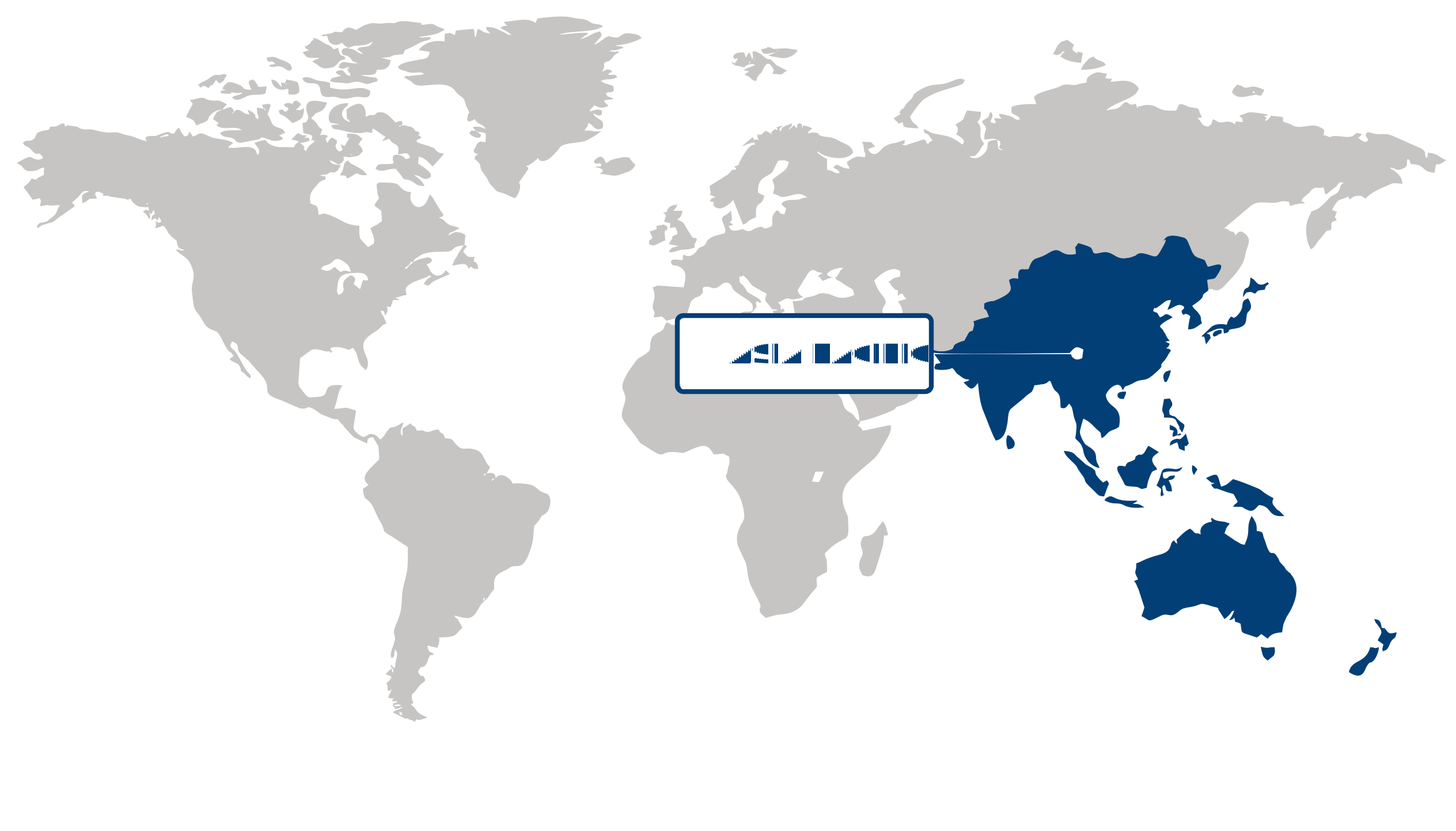
Asia Pacific (Largest & Fastest-Growing Region)
The Asia Pacific region held the largest position in the industrial blower market in 2026 and is also expected to remain the fastest-growing regional market. Strong industrialization and expansion across manufacturing, chemicals, food processing, cement, metals, and other process industries are generating sustained demand for efficient air movement and ventilation equipment. Industrial facilities increasingly require reliable blowers for material handling, combustion support, drying, cooling, and process ventilation, while investments in new production capacity are broadening the addressable market. Growing emphasis on energy efficiency and modernization of industrial equipment is also encouraging the replacement of conventional systems with more efficient blower technologies.
| Parameter | North America | Asia Pacific | Europe | Latin America | MEA |
|---|---|---|---|---|---|
| Innovation Hub i Scale Nascent Developing Advanced | |||||
| Cost-Sensitive Region i Scale Low Medium High | |||||
| Regulatory Environment i Scale Restrictive Neutral Supportive | |||||
| Demand Drivers i Scale Weak Moderate Strong | |||||
| Development Stage i Scale Emerging Developing Developed | |||||
| Adoption Rate i Scale Low Medium High | |||||
| New Entrants / Startups i Scale Sparse Moderate Dense | |||||
| Macro Indicators i Scale Weak Stable Strong |
Key Country Insights
United States 🇺🇸
Process Efficiency FocusU.S. manufacturers are prioritizing industrial blowers that improve energy efficiency, airflow control, and equipment reliability across manufacturing, chemicals, and wastewater operations. Demand is supported by modernization projects that emphasize lower operating costs and predictive maintenance capabilities.
Germany 🇩🇪
Precision Engineering DemandGermany emphasizes high-performance industrial blowers designed for precision manufacturing and advanced production facilities. Industrial users increasingly value efficient systems with digital monitoring features that support stringent operational and environmental performance requirements.
Japan 🇯🇵
Compact System IntegrationJapan focuses on compact, reliable industrial blower solutions suited to automated factories and space-constrained industrial environments. Manufacturers seek equipment offering quiet operation, durability, and seamless integration with smart production systems.
South Korea 🇰🇷
Smart Factory SupportSouth Korea is expanding the use of industrial blowers compatible with digitally connected manufacturing facilities. Buyers prioritize energy-efficient equipment that enhances production consistency while supporting automation and industrial process optimization initiatives.
France 🇫🇷
Sustainable Industrial UpgradesFrance is encouraging industrial blower replacements that reduce energy consumption while meeting environmental compliance requirements. Industrial operators increasingly favor systems that combine operational efficiency with improved lifecycle performance across multiple process industries.
Italy 🇮🇹
Manufacturing ModernizationItaly is investing in industrial blower upgrades for machinery manufacturing, food processing, and industrial production facilities. Businesses prioritize dependable equipment that enhances production efficiency while minimizing maintenance interruptions and operating expenses.
Segment Leadership and Growth Trends
Industrial Blower Market Share (%), by Distribution Channel, 2026
Go beyond the chart, access full insights & data tables
Request Free Sample ReportDistribution Channel Segment Analysis: Direct (Largest Segment) vs Indirect (Fastest-Growing Segment)
In the industrial blower market, the direct distribution channel segment accounted for the largest share of 60.1% in 2026. Direct sales enable manufacturers to provide customized solutions, technical consultation, installation support, and after-sales services for complex industrial applications. Large industrial customers often prefer direct engagement to ensure equipment specifications align with operational requirements, resulting in stronger customer relationships and improved project execution.
The indirect distribution channel segment is expected to witness the fastest growth as distributors and channel partners expand their reach across regional and emerging markets. Indirect sales networks improve product accessibility, shorten delivery timelines, and provide localized customer support, making them increasingly attractive for serving small and medium-sized industrial customers. Growing industrialization across developing regions is expected to further strengthen demand through indirect distribution.
Technology Segment Analysis: Centrifugal (Largest & Fastest-Growing Segment)
The industrial blower market was led by the centrifugal technology segment, which captured 56.39% of the market share in 2026 while also emerging as the fastest-growing technology category. Centrifugal blowers are widely adopted because they deliver high airflow, stable performance, and reliable pressure generation across diverse industrial applications. Their efficiency, durability, and suitability for ventilation, material handling, dust collection, and process air systems make them a preferred choice across manufacturing, power generation, chemical processing, and wastewater treatment facilities. Continued investment in energy-efficient industrial equipment and process optimization is expected to reinforce the segment’s dominant position.
Product Segment Analysis: Centrifugal Blowers (Largest Segment) vs High Speed Turbo Blowers (Fastest-Growing Segment)
The industrial blower market was dominated by the centrifugal blowers product segment, accounting for 46.28% of the market share in 2026. Centrifugal blowers are extensively used because they provide dependable airflow, operational flexibility, and reliable performance across a wide variety of industrial processes. Their ability to operate efficiently under demanding conditions has supported widespread deployment in manufacturing facilities, environmental control systems, and heavy industrial operations.
The high speed turbo blowers segment is projected to experience the fastest growth as industries increasingly seek energy-efficient air movement solutions with lower operating costs and reduced maintenance requirements. High speed turbo blowers offer advanced aerodynamic performance, compact designs, and enhanced operational efficiency, making them well suited for modern industrial facilities focused on improving productivity and sustainability.
| Segment | Sub-Segment | Largest Segment | Fastest Growing |
|---|---|---|---|
| Distribution Channel | Direct, Indirect | Direct | Indirect |
| Technology | Centrifugal, Axial | Centrifugal | Centrifugal |
| Product | Positive Displacement Blowers, Centrifugal Blowers, High Speed Turbo Blowers, Multistage Centrifugal Blowers, Others | Centrifugal Blowers | High Speed Turbo Blowers |
| Pressure | High, Low, Medium | Low | High |
| End-Use | Food & Beverage, Wastewater Treatment, Cement Plant, Steel Plant, Mining, Power Plant, Chemical, Oil and Gas, Aerospace and Defence, Food Processing, Pulp and Paper, Water Treatment Plant, Others | Wastewater Treatment | Chemical |
Competitive Landscape and Market Positioning
Key companies in the industrial blower market:
- Atlas Copco AB (Sweden)
- Ingersoll Rand, Inc. (United States)
- Siemens AG (Germany)
- Xylem, Inc. (United States)
- Kaeser Kompressoren SE (Germany)
- Aerzen Maschinenfabrik GmbH (Germany)
- Sulzer Ltd. (Switzerland)
- Ebara Corporation (Japan)
- Busch SE (Germany)
- Chart Industries, Inc. (United States)
Industrial buyers are placing greater emphasis on operational efficiency and lifecycle performance, prompting competition in the industrial blower market to extend well beyond equipment capacity alone. Manufacturers are refining aerodynamic designs, intelligent control systems, and energy-efficient operation to address increasingly demanding industrial processes while reducing maintenance requirements. The growing integration of digital monitoring, predictive servicing capabilities, and application-specific engineering is creating a more solutions-oriented competitive environment where technical customization and long-term operational value carry greater strategic importance than standardized equipment offerings.
| Company | Market Share | Company Revenue | Revenue CAGR (%) | Product Portfolio | Geographic Presence | Innovation / R&D Focus | Strategic Developments |
|---|---|---|---|---|---|---|---|
| Atlas Copco AB (Sweden) | |||||||
| Ingersoll Rand Inc. (United States) | |||||||
| Siemens AG (Germany) | |||||||
| Xylem Inc. (United States) | |||||||
| Kaeser Kompressoren SE (Germany) | |||||||
| Aerzen Maschinenfabrik GmbH (Germany) | |||||||
| Sulzer Ltd. (Switzerland) | |||||||
| Ebara Corporation (Japan) | |||||||
| Busch SE (Germany) | |||||||
| Chart Industries Inc. (United States) |
Industry Development/News
| Company Name | Date | Key Development |
|---|---|---|
| Piller Group | Nov-25 | Piller Group inaugurated a new manufacturing facility in Satara, Maharashtra, India, through its subsidiary Piller India. Spanning 9,106 square meters, the facility expands regional production capacity and supply chain responsiveness for industrial blower and compressor systems across power and process industries. |
| Pedro Gil | Jun-24 | Pedro Gil launched the RPG lobe blower, engineered for industrial air movement applications requiring high efficiency and operational durability. The product release targets expanding industrial processing and municipal wastewater treatment sectors seeking energy-efficient blowers. |
| Fuji Electric | Jun-24 | Fuji Electric introduced the EXV1000-7W 10 HP direct-drive explosion-proof blower built to safety standards for hazardous environments. The product addresses industrial demand for certified, specialized blower systems operating in high-risk chemical processing and oil and gas facilities. |
| Atlas Copco | Aug-23 | Atlas Copco invested in constructing a sustainable manufacturing facility in Talegaon, Pune, India, powered by 80% solar energy and 75% rainwater harvesting. The facility expands local and export production capacity for industrial air and gas compressor systems. |
| Ingersoll Rand | Dec-22 | Ingersoll Rand acquired Everest Blower Systems Private Limited, an Indian manufacturer specializing in customized blowers and vacuum pumps. The strategic acquisition strengthens Ingersoll Rand's local presence and expands its product portfolio across industrial blower and vacuum application markets in India. |
Customize Your Report
Explore examples of how this report can be tailored to different research needs, including custom segments, additional topics or chapters, and related reports. Click a section of the wheel or its numbered marker to explore the available options.
Industrial Blower Market — Custom Segments
| Segment | Sub-Segment |
|---|---|
| Airflow Capacity | Low-Capacity Blowers, Medium-Capacity Blowers, High-Capacity Blowers |
| Drive Arrangement | Direct Drive, Belt Drive, Coupled Drive |
| Aftermarket vs. New Equipment | New Equipment, Replacement Equipment, Retrofit and Upgrade |
Industrial Blower Market — Custom TOC
| Custom Chapter | Custom Details |
|---|---|
| Energy-Efficient Blower Adoption |
|
| Predictive Maintenance & Service Models |
|
| Blower Fleet Modernization Strategies |
|
Need a different cut of the data?
Request Custom ResearchHow large is the industrial blower market?
What is the anticipated CAGR of the industrial blower industry?
Why are wastewater treatment investments driving demand for advanced industrial blowers?
How are high-efficiency turbo blowers improving industrial operations?
Why are centrifugal blowers the leading product segment in the industrial blower market?
Which distribution channel is expected to grow the fastest in the industrial blower market?
Why does Asia Pacific maintain a leading position in the industrial blower market?
How is Asia Pacific supporting continued industrial blower market growth?
Who holds a significant market share in the industrial blower landscape?
Our Clients
"The team at Fundamental Business Insights & Consulting demonstrated a commitment to excellence, not only in the quality of the report but also in their client-centric approach."
FANUC
"The level of detail in the market segmentation provided were particularly noteworthy. The detailed country-level insights were also very helpful."
B&R Industrial Automation GmbH
"The consultant took the time to understand our specific business objectives, ensuring that the reports were tailored to address our unique challenges and opportunities."
KUKA SE & Co. KGaA
Our Research Team & Methodology
Every Fundamental Business Insights report is built by a dedicated vertical research team, validated through a structured primary-and-secondary methodology, and reviewed for accuracy before it reaches you.
Research Team Overview
Prepared by the Industrial Automation & Equipment Research Team
Delivery
Published
Demand
Available
Support
Trust & Compliance
Research Domains
10 coverage areasResearch Intelligence
| Source | Reference |
|---|---|
| International Society of Automation (ISA) | www.isa.org |
| International Organization for Standardization (ISO) | www.iso.org |
| National Institute of Standards and Technology (NIST) | www.nist.gov |
| IEEE | www.ieee.org |
| VDMA (German Mechanical Engineering Industry Association) | www.vdma.org |
| Association for Advancing Automation (A3) | www.automate.org |
| International Federation of Robotics (IFR) | ifr.org |
| ASME (American Society of Mechanical Engineers) | www.asme.org |
| ASHRAE | www.ashrae.org |
| American Society of Heating, Refrigerating and Air-Conditioning Engineers (ASHRAE) | www.ashrae.org |
| Material Handling Industry (MHI) | www.mhi.org |
| OSHA (Occupational Safety and Health Administration) | www.osha.gov |
| National Fire Protection Association (NFPA) | www.nfpa.org |
| ASTM International | www.astm.org |
| International Electrotechnical Commission (IEC) | www.iec.ch |
| Open Process Automation Forum (The Open Group) | www.opengroup.org/open-process-automation-forum |
| AGMA (American Gear Manufacturers Association) | www.agma.org |
| Association of Equipment Manufacturers (AEM) | www.aem.org |
| Food and Agriculture Organization (FAO) | www.fao.org |
| International Labour Organization (ILO) | www.ilo.org |
Research Workflow & Quality Assurance
Data Collection
Verified information gathered through primary and secondary research.
Data Triangulation
Cross-validation using multiple independent data sources.
Forecast Modelling
Market estimates developed using historical trends and analytical models.
Analyst Validation
Findings reviewed by domain experts for accuracy and consistency.
Editorial & Quality Review
Final editorial, quality, and compliance checks before publication.
Final Publication
Released after successful completion of the internal review process.
Report Coverage
📊 Market Assessment
- Market Size & Forecast
- Market Segmentation
- Regional Analysis
- Growth Drivers & Challenges
- Market Dynamics
🏢 Competitive Intelligence
- Competitive Landscape
- Company Profiles
- Competitive Benchmarking
- Mergers & Acquisitions
- Market Share Analysis or Key Company Strategies
🔍 Strategic Analysis
- Value Chain Analysis
- Porter's Five Forces
- PESTLE Analysis
- Pricing Trends
- Supply-Demand Analysis
🚀 Future Outlook
- Technology Landscape
- Regulatory Landscape
- Investment & Funding Landscape
- Emerging Opportunities
- Future Market Outlook
Have a question about this report or need a custom scope?
Request Customization