Industrial and Commercial LED Lighting Market Size & Growth Forecast 2027–2036, By Segments (Product, Application, End-Use), Regional Demand Trends (North America, Asia Pacific, Europe), Key Country Insights (U.S., Japan, South Korea, Germany, France, Italy), and Competitive Landscape
Market Size and Growth Outlook
Industrial and Commercial LED Lighting Market size was around USD 72.9 billion in 2026 and is slated to grow at a 7.51% CAGR from 2027 to 2036, crossing USD 150.39 billion by 2036. The industry revenue for 2027 is estimated at USD 77.51 billion.
Get more details on this report
Request Free Sample ReportIndustrial and Commercial LED Lighting Market Intelligence Snapshot
Regional Market Dynamics
- Asia Pacific held a 45.47% market share in 2026, supported by extensive construction activity and widespread LED adoption across industrial, commercial, and public infrastructure projects.
- Asia Pacific is expected to expand at an 11.31% CAGR as ongoing replacement of conventional lighting and increasing specification of LED systems in new developments sustain strong regional demand.
Segment Momentum
- Luminaires hold a 60.92% share in 2026 because they integrate complete lighting systems, offering higher reliability, easier installation, and long service life suited to industrial and commercial operational requirements.
- Outdoor applications are the fastest-growing segment as organizations upgrade perimeter, parking, and logistics lighting to improve efficiency, durability, and visibility in extended-hour and harsh environmental conditions.
Market Expansion Drivers
- Energy efficiency mandates and cost reduction pressures accelerating LED replacement of traditional lighting systems.
- IoT-enabled smart lighting integration enabling real-time monitoring and centralized building control systems.
- Corporate decarbonization and ESG initiatives driving smart lighting adoption in commercial infrastructure.
Leading Market Participants
- Prominent players in the industrial and commercial LED lighting market include Signify N.V. (Netherlands), ams-OSRAM AG (Austria), Panasonic Holdings Corporation (Japan), Acuity Brands, Inc. (United States), Zumtobel Group AG (Austria), Eaton Corporation plc (Ireland), Hubbell Incorporated (United States), Current Lighting Solutions, LLC (United States), Cree Lighting USA LLC (United States), NVC Lighting Holding Limited (China).
Global Market Forecast Snapshot
Market Outlook
- 2026 Market Size: USD 72.9 billion
- 2027 Estimated Market Size: USD 77.51 billion.
- Projected Market Size: USD 150.39 billion by 2036
- Growth Forecast: 7.51% CAGR (2027-2036)
Regional and Segment Outlook
- Leading Regional Market: Asia Pacific
- High-Growth Regional Hub: Asia Pacific
- Core Revenue Segment: Luminaires (Product) | Indoor (Application) | Commercial (End-Use)
- Emerging Opportunity Segment: Lamps (Product) | Outdoor (Application) | Industrial (End-Use)
Market Growth Drivers and Industry Trends
Energy efficiency mandates and cost reduction pressures accelerating LED replacement of traditional lighting systems
Rising emphasis on electricity conservation and operating-cost management is encouraging commercial and industrial facilities to replace conventional lighting technologies with more efficient LED systems. The industrial and commercial LED lighting market is supported by energy-efficiency requirements that encourage organizations to reduce lighting-related power consumption while maintaining adequate illumination across workplaces, warehouses, retail facilities, offices, and industrial environments. LED systems also provide longer operating lifetimes and lower maintenance requirements, which can reduce the frequency of lamp replacement and associated labor costs. These combined economic and regulatory considerations make LED upgrades increasingly attractive for facility operators managing large lighting installations and seeking improvements in long-term building operating efficiency.
IoT-enabled smart lighting integration enabling real-time monitoring and centralized building control systems
The integration of connected sensors, communication technologies, and automated controls is transforming lighting from a standalone electrical function into a managed building system. IoT capabilities within the industrial and commercial LED lighting market allow facilities to monitor lighting conditions, adjust illumination according to occupancy or operating schedules, and manage installations from centralized platforms. Real-time information can help facility managers identify equipment issues, optimize lighting usage, and coordinate illumination with other building-management functions. Networked LED infrastructure can also support automated dimming, occupancy-based controls, and remote configuration, making lighting systems more responsive to changing operational requirements across large and distributed facilities.
Corporate decarbonization and ESG initiatives driving smart lighting adoption in commercial infrastructure
Businesses are placing greater emphasis on reducing environmental impacts across their physical infrastructure, with building energy consumption becoming an important area for efficiency improvements. The industrial and commercial LED lighting market is gaining from corporate decarbonization programs because lighting upgrades can contribute to lower electricity use while providing organizations with an identifiable infrastructure improvement aligned with sustainability objectives. Smart lighting systems can further support these initiatives by allowing facilities to optimize illumination based on actual occupancy and usage patterns rather than maintaining fixed operating levels. Commercial property owners and corporate facility managers can incorporate connected LED systems into broader building modernization programs alongside energy management and automation measures.
| Growth Driver | Impact on CAGR | Regulatory Influence | Geographic Relevance | Adoption Rate | Impact Timeline |
|---|---|---|---|---|---|
| Energy efficiency mandates and cost reduction pressures accelerating LED replacement of traditional lighting systems | 2.60% | Moderate | Asia Pacific, Europe, North America | High | Near Term |
| IoT-enabled smart lighting integration enabling real-time monitoring and centralized building control systems | 2.20% | Moderate | North America, Asia Pacific | High | Mid Term |
| Corporate decarbonization and ESG initiatives driving smart lighting adoption in commercial infrastructure | 1.80% | Moderate | Europe, North America | Medium | Mid Term |
Unlock insights tailored to your business with our bespoke market research solutions.
Click to get your customized report now.
Regional Demand Dynamics
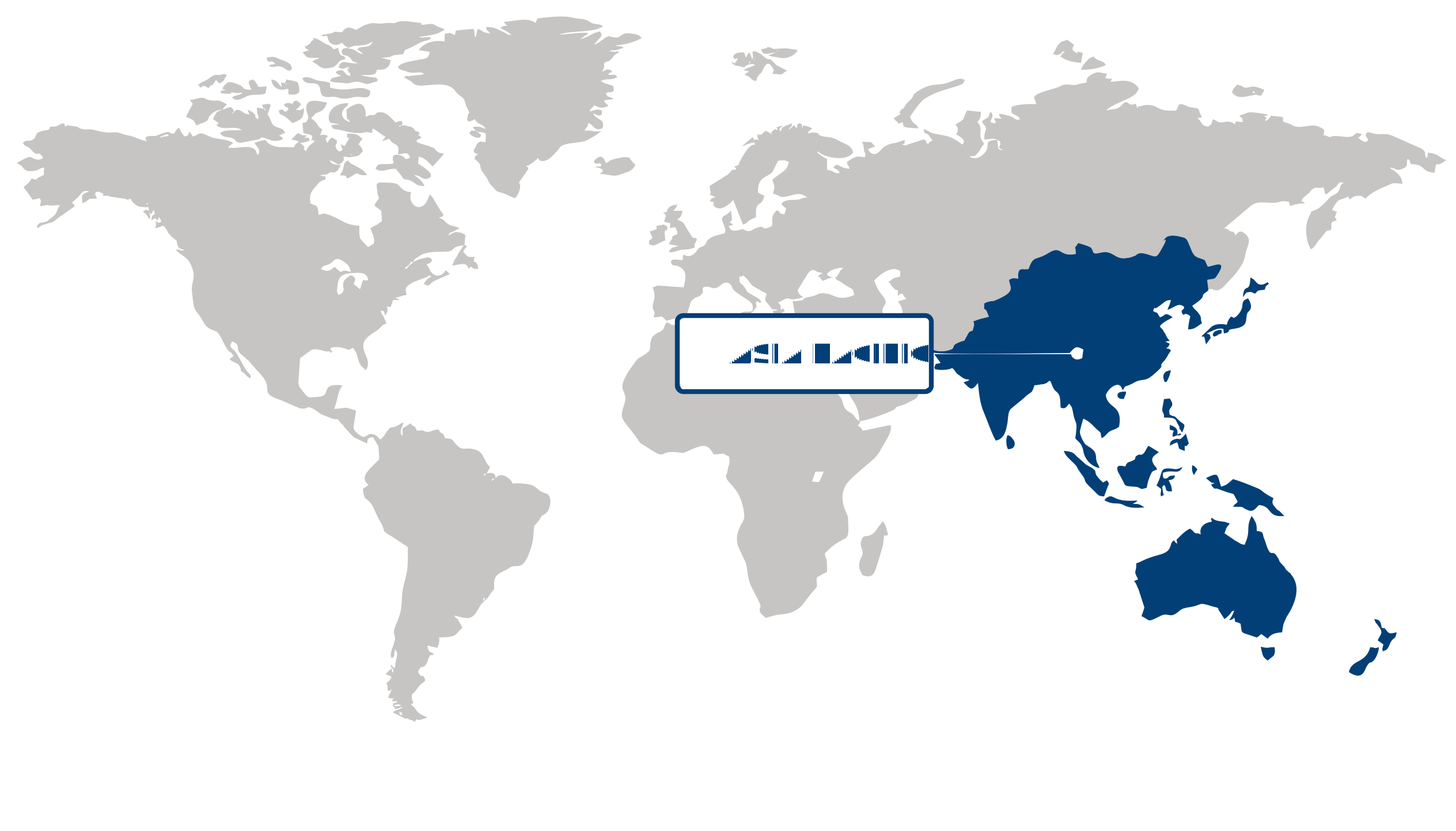
Asia Pacific (Largest & Fastest-Growing Region)
The Asia Pacific industrial and commercial LED lighting market accounted for 45.47% of the global market in 2026, maintaining its leading position through rapid urbanization, industrial expansion, and extensive development of commercial and infrastructure facilities. The region's large manufacturing base and growing demand for energy-efficient lighting are supporting widespread replacement of conventional systems with LED solutions. Government initiatives promoting energy conservation, smart infrastructure development, and modernization of industrial facilities are further encouraging adoption, while advances in connected lighting and automation are creating additional opportunities across warehouses, factories, offices, retail facilities, and public infrastructure.
Asia Pacific is also the fastest-growing region, supported by continued construction activity, expanding industrial capacity, and rising investment in energy-efficient building technologies. Businesses and infrastructure operators are increasingly prioritizing lighting systems that reduce energy consumption while providing improved illumination, controllability, and operational flexibility. The growing integration of sensors, digital controls, and smart building technologies is broadening the role of LED lighting beyond basic illumination, strengthening demand across both new construction and facility modernization projects.
| Parameter | North America | Asia Pacific | Europe | Latin America | MEA |
|---|---|---|---|---|---|
| Innovation Hub i Scale Nascent Developing Advanced | |||||
| Cost-Sensitive Region i Scale Low Medium High | |||||
| Regulatory Environment i Scale Restrictive Neutral Supportive | |||||
| Demand Drivers i Scale Weak Moderate Strong | |||||
| Development Stage i Scale Emerging Developing Developed | |||||
| Adoption Rate i Scale Low Medium High | |||||
| New Entrants / Startups i Scale Sparse Moderate Dense | |||||
| Macro Indicators i Scale Weak Stable Strong |
Key Country Insights
Germany 🇩🇪
Energy Optimization FocusGermany emphasizes high-efficiency LED lighting solutions for industrial production facilities and commercial buildings. Businesses increasingly integrate advanced lighting controls to reduce operational costs while supporting sustainability and workplace productivity objectives.
France 🇫🇷
Sustainable Building UpgradesFrance continues replacing conventional lighting with efficient LED systems across commercial properties and industrial facilities. Buyers increasingly favor solutions that combine energy savings, regulatory compliance, and enhanced lighting quality for modern building operations.
Italy 🇮🇹
Commercial Renovation SupportItaly's industrial and commercial LED lighting market benefits from ongoing renovation of manufacturing facilities and commercial spaces. Businesses increasingly invest in durable lighting systems that improve workplace efficiency while lowering long-term operating expenses.
Japan 🇯🇵
Precision Lighting SystemsJapan prioritizes reliable, long-life LED lighting solutions for manufacturing plants, logistics centers, and commercial infrastructure. Demand centers on compact, high-performance products that improve illumination quality while minimizing maintenance requirements.
South Korea 🇰🇷
Intelligent Facility IntegrationSouth Korea incorporates LED lighting into smart factories and digitally connected commercial facilities. Businesses increasingly adopt networked lighting platforms that support automation, energy monitoring, and adaptive lighting control across diverse operating environments.
United States 🇺🇸
Smart Retrofit DemandThe U.S. industrial and commercial LED lighting market is driven by facility modernization and intelligent building upgrades. Organizations increasingly prioritize connected lighting systems with energy management, occupancy sensing, and maintenance optimization capabilities.
Segment Leadership and Growth Trends
Industrial and Commercial LED Lighting Market Share (%), by Product, 2026
Go beyond the chart, access full insights & data tables
Request Free Sample ReportProduct Segment Analysis: Luminaires (Largest Segment) vs Lamps (Fastest-Growing Segment)
Luminaires represented the largest share of the industrial and commercial LED lighting market at 60.92% in 2026, driven by their ability to deliver integrated, energy-efficient illumination for offices, warehouses, manufacturing facilities, retail spaces, and other commercial environments. Modern luminaires offer improved light distribution, controllability, and compatibility with smart building systems, supporting replacement of conventional lighting infrastructure. Increasing emphasis on energy efficiency and facility modernization continues to sustain demand for integrated LED lighting solutions.
Lamps are experiencing the fastest growth as businesses and facility operators increasingly seek flexible and straightforward alternatives for upgrading existing lighting systems. LED lamps can provide an efficient replacement for conventional light sources without requiring complete fixture replacement, making them attractive for retrofit projects. Growing attention to operating costs, energy conservation, and incremental lighting upgrades is expanding their use across commercial and industrial settings.
Application Segment Analysis: Indoor (Largest Segment) vs Outdoor (Fastest-Growing Segment)
Indoor applications held the largest position in the industrial and commercial LED lighting market in 2026, reflecting extensive deployment across workplaces, production facilities, retail environments, warehouses, institutional buildings, and commercial properties. LED technology provides efficient illumination, long operating life, and flexible control options that support diverse indoor lighting requirements. Increasing modernization of building infrastructure and adoption of energy-efficient lighting systems continue to underpin demand.
Outdoor applications are advancing at the fastest pace as municipalities, commercial property owners, and industrial operators increasingly prioritize efficient illumination for streets, parking areas, campuses, pathways, and exterior facilities. LED lighting offers strong durability and controllability for outdoor environments while supporting efforts to reduce energy consumption and maintenance requirements. Integration with connected lighting controls and broader smart infrastructure initiatives is further expanding opportunities for outdoor LED systems.
| Segment | Sub-Segment | Largest Segment | Fastest Growing |
|---|---|---|---|
| Product | Lamps, Luminaires | Luminaires | Lamps |
| Application | Indoor, Outdoor | Indoor | Outdoor |
| End-Use | Industrial, Commercial | Commercial | Industrial |
Competitive Landscape and Market Positioning
Leading companies in the industrial and commercial LED lighting market:
1. Signify N.V. (Netherlands)
2. ams-OSRAM AG (Austria)
3. Panasonic Holdings Corporation (Japan)
4. Acuity Brands Inc. (United States)
5. Zumtobel Group AG (Austria)
6. Eaton Corporation plc (Ireland)
7. Hubbell Incorporated (United States)
8. Current Lighting Solutions LLC (United States)
9. Cree Lighting USA LLC (United States)
10. NVC Lighting Holding Limited (China)
Energy-efficient lighting systems are reshaping the industrial and commercial LED lighting market through improved performance and reduced power consumption. Smart lighting integration is enhancing operational control and automation capabilities. The market is evolving through innovation focused on sustainability, efficiency, and intelligent lighting management.
| Company | Market Share | Company Revenue | Revenue CAGR (%) | Product Portfolio | Geographic Presence | Innovation / R&D Focus | Strategic Developments |
|---|---|---|---|---|---|---|---|
| Signify N.V. (Netherlands) | |||||||
| ams-OSRAM AG (Austria) | |||||||
| Panasonic Holdings Corporation (Japan) | |||||||
| Acuity Brands Inc. (United States) | |||||||
| Zumtobel Group AG (Austria) | |||||||
| Eaton Corporation plc (Ireland) | |||||||
| Hubbell Incorporated (United States) | |||||||
| Current Lighting Solutions LLC (United States) | |||||||
| Cree Lighting USA LLC (United States) | |||||||
| NVC Lighting Holding Limited (China). |
Industry Development/News
| Company Name | Date | Key Development |
|---|---|---|
| Panasonic Corporation | Jul-25 | Panasonic Corporation acquired Focus Lighting and Fixtures, a B2B lighting products provider in India. The acquisition represents a strategic effort to strengthen Panasonic’s position in the Indian commercial lighting market, expanding its distribution and product capabilities in the fast-growing B2B electrical and lighting segment and reinforcing its long-term regional growth strategy. |
| Zumtobel Group AG | May-25 | Zumtobel Group AG launched TECTON II, the second generation of its continuous-row lighting system. The upgraded platform integrates enhanced efficiency, design improvements, and simplified installation architecture, positioning the system as a next-generation industrial and commercial lighting solution with improved scalability and sustainability performance for large-scale infrastructure deployments. |
| Signify Holding | Mar-25 | Signify Holding entered a 50:50 joint venture with Dixon Technologies to manufacture lighting products and accessories in India. The partnership combines Signify’s lighting technology capabilities with Dixon’s manufacturing scale, aimed at strengthening local production capacity, improving cost competitiveness, and supporting domestic supply chain development under India’s manufacturing-led initiatives. |
Customize Your Report
Explore examples of how this report can be tailored to different research needs, including custom segments, additional topics or chapters, and related reports. Click a section of the wheel or its numbered marker to explore the available options.
Industrial and Commercial LED Lighting Market — Custom Segments
| Segment | Sub-Segment |
|---|---|
| Control System Integration | Standalone Lighting Controls, Centralized Building Management Systems, Wireless/IoT-Enabled Controls |
| Distribution Channel | Direct Sales, Electrical Distributors, Lighting Specialists, Online Channels |
| Procurement Model | Direct Facility Procurement, Contractor/EPC Procurement, Lighting-as-a-Service |
Industrial and Commercial LED Lighting Market — Custom TOC
| Custom Chapter | Custom Details |
|---|---|
| Smart Lighting Transformation Roadmap |
|
| Retrofit Market Opportunity Analysis |
|
| Building Automation Integration Assessment |
|
Need a different cut of the data?
Request Custom ResearchHow much revenue does the industrial and commercial LED lighting market generate?
What is the projected value of the industrial and commercial LED lighting industry by 2036?
How are energy efficiency mandates driving LED retrofit adoption in the industrial and commercial LED lighting market?
How are IoT integration and ESG priorities reshaping lighting procurement strategies?
Why do luminaires dominate the industrial and commercial LED lighting market?
Which application segment is driving the fastest growth beyond indoor lighting demand?
Why does Asia Pacific dominate the industrial and commercial LED lighting market?
What is supporting Asia Pacific's continued growth in industrial and commercial LED lighting?
What are the prominent companies operating in the industrial and commercial LED lighting landscape?
Our Clients
"The information presented in the report was genuinely insightful. The data was clear and easy to understand, which made it much easier to interpret the findings."
Amara Raja Group
"The responsiveness and professionalism exhibited by the team were exemplary. They were readily available to address queries, provide clarifications, and offer additional insights."
ONGC
"The reports offered a comprehensive analysis of various segments within the market. The detailed insights into market trends, and regulatory landscapes were excellent."
TotalEnergies
Our Research Team & Methodology
Every Fundamental Business Insights report is built by a dedicated vertical research team, validated through a structured primary-and-secondary methodology, and reviewed for accuracy before it reaches you.
Research Team Overview
Prepared by the Energy & Power Research Team
Delivery
Published
Demand
Available
Support
Trust & Compliance
Research Domains
10 coverage areasResearch Intelligence
| Source | Reference |
|---|---|
| International Energy Agency (IEA) | www.iea.org |
| U.S. Energy Information Administration (EIA) | www.eia.gov |
| International Renewable Energy Agency (IRENA) | www.irena.org |
| International Electrotechnical Commission (IEC) | www.iec.ch |
| International Organization for Standardization (ISO) | www.iso.org |
| IEEE | www.ieee.org |
| CIGRE (International Council on Large Electric Systems) | www.cigre.org |
| World Energy Council (WEC) | www.worldenergy.org |
| U.S. Department of Energy (DOE) | www.energy.gov |
| International Atomic Energy Agency (IAEA) | www.iaea.org |
| American Petroleum Institute (API) | www.api.org |
| Society of Petroleum Engineers (SPE) | www.spe.org |
| Hydrogen Council | hydrogencouncil.com |
| Battery Council International (BCI) | batterycouncil.org |
| Global Wind Energy Council (GWEC) | gwec.net |
| SolarPower Europe | www.solarpowereurope.org |
| World Bioenergy Association (WBA) | worldbioenergy.org |
| International Hydropower Association (IHA) | www.hydropower.org |
| Edison Electric Institute (EEI) | www.eei.org |
| National Renewable Energy Laboratory (NREL) | www.nrel.gov |
Research Workflow & Quality Assurance
Data Collection
Verified information gathered through primary and secondary research.
Data Triangulation
Cross-validation using multiple independent data sources.
Forecast Modelling
Market estimates developed using historical trends and analytical models.
Analyst Validation
Findings reviewed by domain experts for accuracy and consistency.
Editorial & Quality Review
Final editorial, quality, and compliance checks before publication.
Final Publication
Released after successful completion of the internal review process.
Report Coverage
📊 Market Assessment
- Market Size & Forecast
- Market Segmentation
- Regional Analysis
- Growth Drivers & Challenges
- Market Dynamics
🏢 Competitive Intelligence
- Competitive Landscape
- Company Profiles
- Competitive Benchmarking
- Mergers & Acquisitions
- Market Share Analysis or Key Company Strategies
🔍 Strategic Analysis
- Value Chain Analysis
- Porter's Five Forces
- PESTLE Analysis
- Pricing Trends
- Supply-Demand Analysis
🚀 Future Outlook
- Technology Landscape
- Regulatory Landscape
- Investment & Funding Landscape
- Emerging Opportunities
- Future Market Outlook
Have a question about this report or need a custom scope?
Request Customization